Practical home setup
Entryway Storage Ideas for a Calmer Arrival
The entry is often a small space with an outsized daily job. Shoes gather where the door opens, bags land on the nearest chair, keys disappear into pockets, and wet umbrellas lean wherever gravity allows.
Useful entryway storage ideas do not start with buying a larger cabinet. They start with the first minute after someone comes home. What needs to happen there? Shoes off, keys down, coat hung, bag parked, path clear.
A calmer arrival, in this context, means a more orderly first step into the home. It is not a promise about mood or health. It is a practical setup: fewer objects underfoot, fewer decisions at the door, and a threshold that works on ordinary days.
broader context
Broader context
Use the broader page when you need more context before this narrower page.
Start With the Route, Not the Storage Piece
Before choosing a bench, cabinet, rack, or basket, walk the route from the outside door into the home. Storage should not make people step around the entry.
Public accessibility standards are not a private-home decorating rulebook, but they are a useful reminder that doorways, turns, and routes need clear movement. In a home entry, check:
- whether the door can open without hitting a rack, basket, bench, or cabinet door;
- whether two people can pass or pause without one person backing into furniture;
- whether someone can stand to remove shoes without blocking the whole entrance;
- whether bags, boots, or open cabinet fronts spill into the walking line;
- whether a guest, child, or older visitor can understand where to step.
A calm-looking entry can still function poorly if it narrows the first few steps. A plain tray and one hook may serve a tight doorway better than a handsome hall tree that blocks the door swing.
Try a quick route check before adding anything new. Enter with a coat, a bag, and something in one hand. Where do you naturally pause? Where does the bag want to land? Where do shoes end up if you are not thinking about it? Those instinctive landing points show where storage is needed. The path shows how large that storage can be.
Build an Entryway Drop Zone Without Adding Visual Clutter
An entryway drop zone is not a dumping area. It is a small sequence of predictable places for the objects that arrive with you.
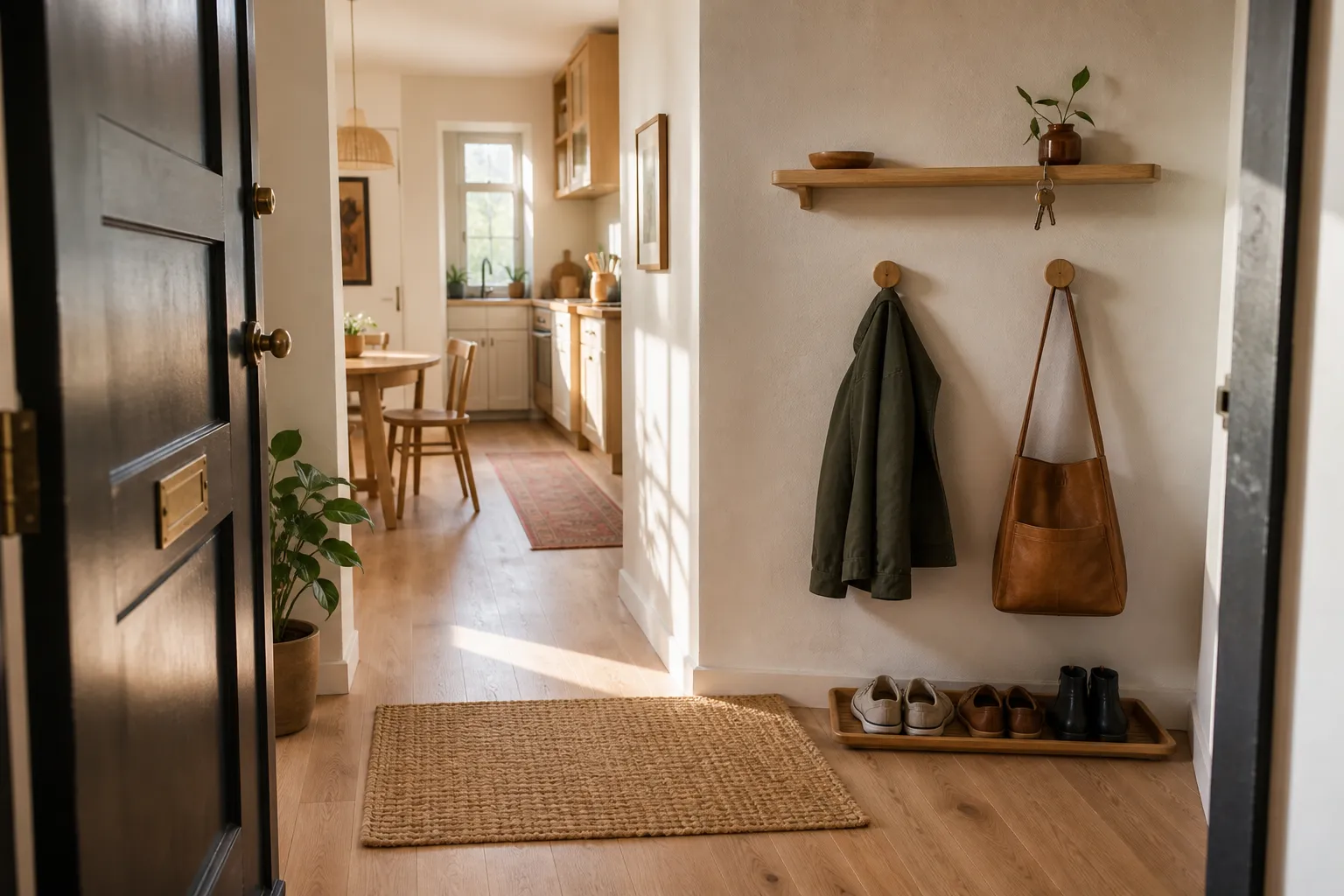
The clearer the first action, the less storage you may need. A wall hook beside a shallow shelf can be better than a large unit if the household only needs a place for one bag, one coat, and keys. In a family home, the same idea may need lower hooks or separate baskets so each person knows where things belong.
Visual clutter often comes from mixing too many categories in one spot. Shoes, mail, keys, bags, dog leashes, sports gear, and seasonal accessories all compete for attention. If the entry still looks busy after organizing it, reduce the visible categories. Keep daily objects at the threshold and move occasional items elsewhere.
A useful rule: if an item is used less than once or twice a week, it probably does not need prime entryway space.
Genkan Entryway Design as a Threshold Cue, Not a Theme
Many readers search for genkan entryway design because they like the clarity of a defined threshold: a place where outdoor shoes stop, indoor movement begins, and the transition is visible. Used modestly, that idea can help homes without a built-in recessed entry.
The available source set for this page does not support detailed claims about Japanese architectural history or etiquette, so it is better to treat genkan as spatial inspiration rather than a set of imported rules. The practical lesson is simple: define where shoes come off and where they wait.
For a home without a built-in step or sunken area, you can suggest the threshold with ordinary choices:
- a washable mat just inside the door;
- a shoe tray aligned with the wall rather than floating in the path;
- a low bench placed beside, not in front of, the main route;
- a narrow shelf or hooks for the first items in hand;
- a change in surface, such as a natural-fiber mat beside wood or tile;
- one basket or shoe space per person.
This works best when the shoe-removal zone is obvious at a glance. Guests should not have to guess whether shoes stay on or come off. A tray with a little empty room, slippers below a bench, or a clear row of shoes near the threshold can communicate the habit without turning the entry into a display.
The mistake is making the threshold too decorative to use. A beautiful mat that cannot handle wet shoes, a fragile basket placed where boots scrape it, or a bench covered with cushions and objects weakens the function. The threshold should look cared for, but it still has to receive daily weather, dust, bags, and hurry.
Shoe Storage Ideas for Narrow and Small Entries
Shoe storage near the threshold is one of the most common entryway problems because shoes multiply quickly and occupy the floor. In a narrow entry, the best choice depends less on style and more on how many pairs must stay by the door.
Open shoe rack
An open rack works when the household needs quick access and can tolerate seeing shoes. It is usually easier to use with frequently worn footwear because nothing needs to be opened. It also makes the shoe limit visible: if the rack is full, extra pairs need to move.
The tradeoff is visual busyness. Open storage looks orderly only when the number of shoes is controlled. It can also collect dust and may look crowded in a narrow hall.
Use open storage when:
- shoes are changed often during the day;
- the entry has enough wall length for a low rack;
- household members are more likely to put shoes away when the action is immediate;
- you can limit visible pairs.
Closed shoe cabinet
A closed cabinet reduces visual clutter and can make a small foyer feel simpler. It is useful when the entry opens directly into a living room or when you want the first view into the home to feel less busy.
The tradeoff is clearance. Cabinet doors or tilt-out fronts need room to open. A slim cabinet may save floor space but still interfere with the route if placed badly. Tall or narrow cabinets also deserve a stability check, especially when freestanding.
Use closed storage when:
- the entry needs fewer visible objects;
- shoes can be stored dry before being closed away;
- the door or drawer action does not block the route;
- the cabinet can be installed according to the maker’s instructions.
Shoe bench
A bench combines sitting and storage, which can help when people need a place to put on shoes. It is especially useful for households with boots, children’s shoes, or guests who remove footwear.
Bench storage is not automatically better. A bench that is too deep can crowd a narrow hall. A bench placed directly opposite the door may force people to squeeze around it. Open cubbies under a bench can also become another clutter line if every pair is left there.
Use a bench when:
- there is enough clearance to sit without blocking the entrance;
- the bench is low and stable;
- the under-seat storage has a clear limit;
- people actually sit to change shoes.
If no one sits, a bench often becomes a shelf for bags and mail. In that case, hooks, a tray, and a low shoe rack may work better.
How Many Shoes Should Stay in the Entryway?
A useful entry does not need every shoe near the door. It needs the right shoes near the door.
Start with current, repeated-use footwear: daily shoes, weather shoes, slippers if used, and perhaps one guest-ready option. Formal shoes, off-season sandals, spare trainers, and rarely used boots can move to a closet, bedroom storage, or seasonal bin.
Think in pairs per person rather than total storage capacity. Many homes stay more usable when each person has a small allowance: one daily pair, one weather pair, and one flexible pair if space allows. Larger households may need a rotation system rather than a bigger rack.
Seasonal overflow is where entries often fail. In winter, boots are bulkier. In rainy periods, trays fill. In summer, sandals scatter because they are small and easy to kick off. Instead of letting the main entry expand without limit, create a secondary overflow zone:
- a lidded bin in a closet for off-season shoes;
- a boot tray used only during wet months;
- an upper shelf for occasional footwear;
- a mudroom or laundry basket for sports shoes;
- a weekly reset where extra pairs leave the threshold.
The entry should hold what supports the next departure, not the whole shoe collection.
Coats, Bags, and Umbrellas in One Small Area
Entryway storage for coats and bags is harder than shoe storage because weight and height matter. A few hooks can look minimal when empty, then become crowded by evening.
Wall hooks or peg rails are often efficient because they use vertical space. Research on microapartments is not entryway-specific, but it does point to a useful small-space principle: when floor area is limited, vertical and built-in storage can help reduce crowding. In an entry, that idea only works if the hooks, shelves, or cabinets do not narrow the route.
For a compact entry, divide vertical storage into levels:
- higher hooks for adult coats used daily;
- lower hooks for children’s coats, tote bags, or dog leashes;
- a shallow shelf above hooks for hats or small baskets;
- a low basket for soft bags that do not hang well;
- a separate umbrella stand or tray if wet items are common.
Coat trees and hall trees can be useful in entries without wall mounting, but they need more scrutiny than a simple hook rail. Freestanding pieces can wobble if loaded unevenly. Tall, narrow furniture can become top-heavy when heavy bags or coats hang high.
Consumer product safety guidance from the CPSC emphasizes awareness around furniture tip-over and anchoring. For entryway furniture, translate that into ordinary purchase and installation checks:
- Is the base wide and steady?
- Does the item rock when loaded?
- Are heavy items stored low rather than high?
- Does the maker provide anchoring instructions?
- Could a child pull, climb, or swing from it?
- Does the piece remain stable when only one side is loaded?
This is not a reason to avoid all tall storage. It is a reason to treat tall shoe cabinets, narrow cabinets, coat trees, and hall trees differently from low benches and trays.
Wet Shoes, Mats, and Seasonal Overflow
Wet weather changes the entry. A layout that works on dry days can fail when boots, umbrellas, coats, and damp bags all arrive together.
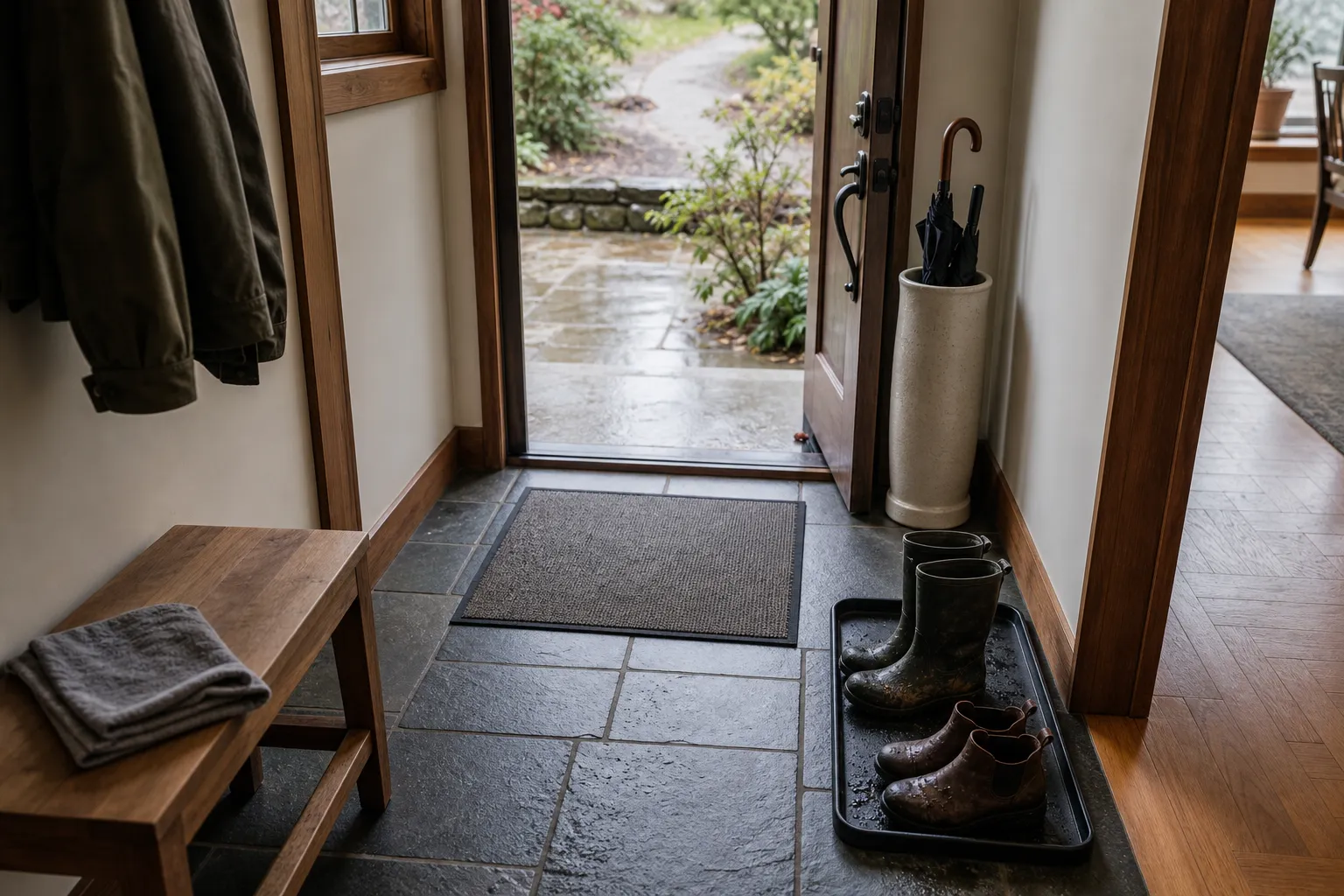
A practical wet-weather setup keeps moisture-prone items near the threshold without putting them in the walking path. Often, that means a mat for the first step, a tray for shoes, and a place for umbrellas that does not require someone to cross the floor while dripping.
A simple sequence can work well:
- Outdoor mat before the door, if the home allows it.
- Indoor mat where the first step lands.
- Shoe tray beside the route, not in the middle of it.
- Hook or stand for umbrellas and wet outerwear.
- Secondary storage for dry shoes and coats.
Be cautious with closed cabinets for wet footwear. Without stronger material-care sources, it is not useful to make broad claims about drying, odor, or long-term shoe care. The practical point is narrower: wet shoes need a place to sit where they are not underfoot. If a cabinet is used, follow the product’s care instructions and avoid storing items in a way that damages the cabinet or the shoes.
Natural materials can look beautiful in an entry, but they should match the job. Wood, bamboo, rattan, seagrass, ceramic, metal, and washable textiles each bring a different feel. Since this source set does not include material durability testing for entryway use, choose by observable conditions: expected moisture, cleaning needs, weight, and contact with grit from shoes.
A woven basket may be fine for scarves but less suitable for muddy boots. A ceramic tray may be easy to wipe but can chip if heavy shoes are dropped into it. A wooden bench should be used and cared for within its intended limits.
The entry is a working threshold. Materials should be pleasant to touch and see, but they also need to accept repetition.
Renter-Friendly Entryway Storage Without Drilling
Renters often need storage without wall damage, built-ins, or permanent changes. The same route and stability principles still apply.
Renter-friendly options include:
- a low shoe rack that fits along one wall;
- a narrow console with a tray for keys;
- a freestanding bench with under-seat baskets;
- over-door hooks where the door and frame allow them;
- adhesive hooks for very light items, used within their stated limits;
- a basket for bags under an existing table;
- a slim umbrella stand on a washable mat.
The temptation in rentals is to solve every problem with freestanding furniture. That can work, but too many loose pieces can crowd a small entry. A low rack, one tray, and one coat solution may be better than a bench, cabinet, basket tower, and decorative ladder all competing for the same few feet.
If a tall freestanding piece is the only option because drilling is not allowed, check whether it can be used as intended in that home. If the product requires anchoring and anchoring is not possible, choose a lower or broader alternative.
A Practical Decision Frame for Entryway Furniture
When comparing entryway storage ideas, sort the choice by the problem you are actually solving.
If the problem is shoes in the path
Start with a defined shoe zone. Use a low rack, tray, or bench cubby. Reduce the number of pairs before buying a larger cabinet.
If the problem is visual clutter
Closed shoe storage, matching baskets, and fewer visible categories help more than adding decorative objects. Keep only daily-use items at the threshold.
If the problem is bags landing on chairs
Add one clear bag place near the door: a sturdy hook, low basket, cubby, or bench end. A small key tray will not solve bag storage.
If the problem is coats piling up
Check whether the coat solution is too small, too high, or too unstable. Wall hooks may be better than a freestanding tree in narrow entries, while a closet may need clearer daily zones.
If the problem is a narrow hallway
Favor shallow, wall-aligned storage. Avoid furniture with doors that open into the route. Use vertical space carefully, especially with tall, narrow pieces.
If the problem is guests
Make the shoe-removal cue visible. Leave a little empty space on the rack or tray. Provide a place to sit only if the entry can hold a bench without blocking movement.
Common Mix-Ups That Make Entries Harder to Use
One common mistake is treating storage capacity as the same thing as order. A larger cabinet may hide more items, but if the door blocks the hallway or the top becomes a dumping surface, the entry has not improved.
Another mix-up is assuming small-space furniture is always small-space friendly. Tall narrow cabinets, slim hall trees, and compact benches can be useful, but only when their movement, stability, and loading needs fit the home.
A third mistake is designing for the photograph instead of the arrival. The entry has to work when someone is holding groceries, when children come in with school bags, when boots are wet, or when guests do not know the house rules. The best setup is often quieter than the most stylish one: a clear mat, a contained shoe zone, hooks that can take daily use, and one place for keys.
Finally, a genkan-inspired entry should not become a decorative theme without function. Its most useful lesson for many homes is spatial clarity: outdoor items stop here, indoor movement begins there, and the path remains open.
Final Check Before You Change the Entry
Walk through the entry and ask five plain questions:
- Can the door open freely?
- Can someone stand and remove shoes without blocking the route?
- Are daily shoes contained but easy to reach?
- Do keys, bags, coats, and umbrellas each have a predictable place?
- Are tall or freestanding pieces stable, sensibly loaded, and installed as intended?
If the answer is yes, the entry does not need to be elaborate. A calmer arrival often comes from fewer decisions at the door: where shoes go, where the bag lands, where the coat hangs, and where the path stays clear.