Entryway Mat and Shoe Tray Layout for Wet Weather
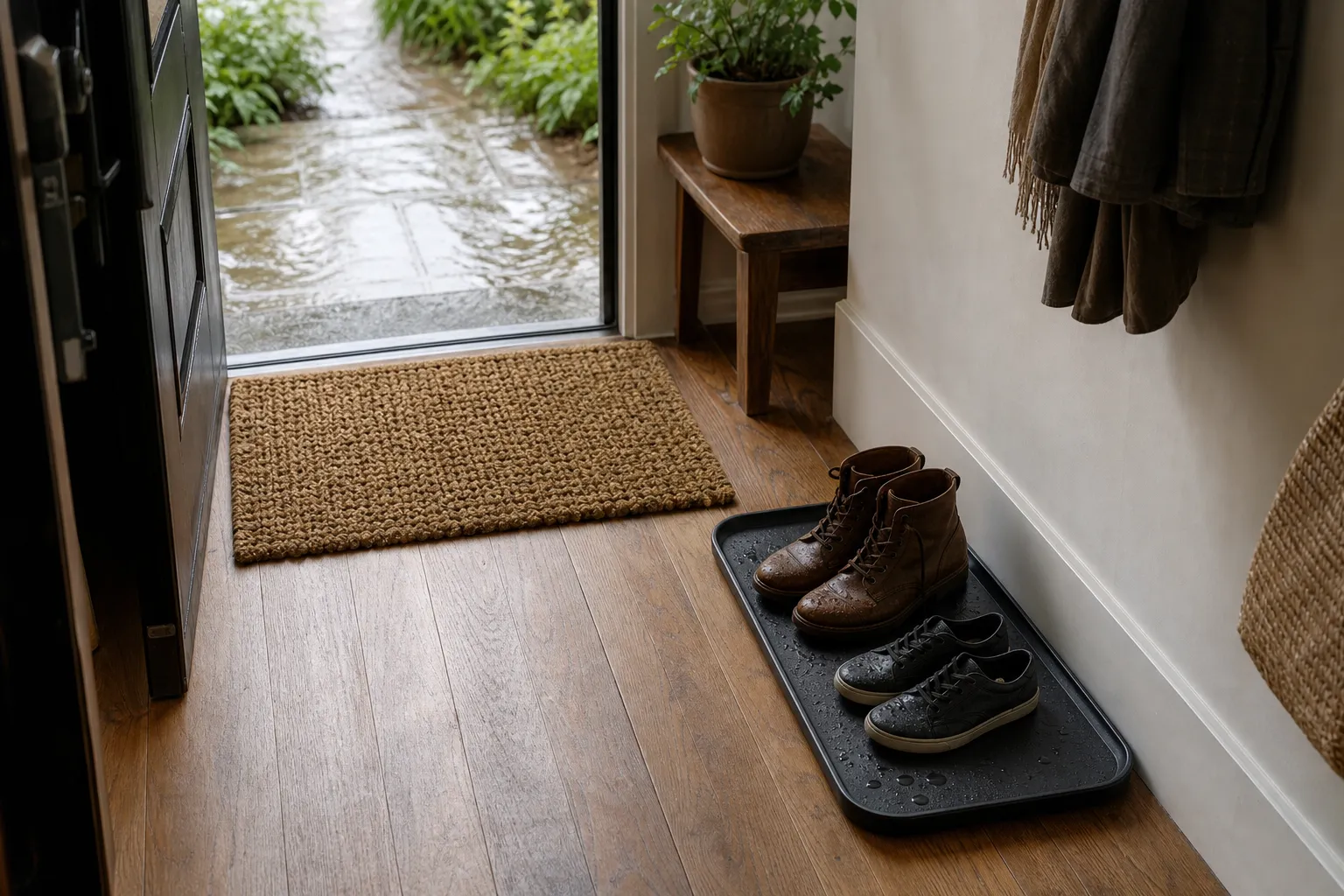
For a wet-weather doorway, the simplest entryway shoe tray layout is a two-step landing zone: put a scraping or textured mat where the first wet step lands, then place a shallow, wipeable shoe tray just outside the main walking line. The tray should be close enough that shoes come off before water, mud, or grit reaches the finished floor, but not so close that it blocks the door swing or makes people step over an edge.
The aim is modest: give rain, snow, mud, and grit a clear stopping point. Soles meet the mat. Shoes rest in the tray. The walkway stays open.
broader context
Parent topic
Use the broader page when you need more context before this narrower page.
Mat first, tray beside the path
Treat the entry as a short sequence, not a pile of objects by the door.
The first surface should handle what arrives on the soles. In many homes, that means a textured mat near the threshold. If there is already a sturdy outdoor mat, the indoor mat can be softer and more absorbent. If the outside landing is exposed to rain or snow, the indoor mat may need to do more of the scraping work.
The shoe tray belongs just beyond that first step, but not in the center of the route. Good locations include:
- along the hinge-side wall, if the door swing stays clear;
- under or beside a bench;
- next to a narrow shoe table;
- against a side wall where people naturally pause.
Landing
The first wet step lands on a mat.
Removal
The person can stand or sit without blocking the door.
Containment
Wet shoes rest on a tray while drips and mud stay off the finished floor.
In a very small entry, the removal and containment zones may overlap. Stand on the mat, take off the shoes, then place them into a tray to the side. What matters is that wet shoes by the door have a defined destination instead of spreading into the walkway.
Follow the drip path
Before buying a new tray or rearranging furniture, look at where water actually goes.
Wet footwear does not only drip from the sole. Boots may shed water from the upper, snow may melt from the sides, and mud often falls when shoes are turned, nudged, or kicked off. The tray should sit where shoes can be placed without carrying them over bare floor.
If people usually remove shoes while facing into the room, the tray should be reachable from that stance. If they sit on a bench, the tray should be close to the seated position, not behind the legs or across the doorway.
A tray with a raised edge is useful for shoe tray water containment, but deeper is not always better. A taller edge may hold more meltwater, yet it can also become a small obstacle if it sits where people walk. There is no strong public source that gives a universal household rule for tray lip height or exact tray size, so use a room test instead: water should stay inside during normal use, and no one should need to step over the tray to enter the home.
For snow season, leave space between pairs rather than stacking wet shoes tightly. Crowded footwear is harder to clean around and has less drying airflow. The tray is mainly a containment surface, not a drying device by itself. Drying still depends on air exposure, room conditions, shoe material, and how wet the footwear is.
Choose the mat for the mess you actually have
A common mistake in entryway mat ideas is treating every rug as if it does the same job.
In wet weather, ask what the mat needs to do first:
A scraping mat helps loosen grit before shoes move farther inside. An absorbent mat is more useful after the heaviest debris has already been knocked off.
The available technical sources support broad caution rather than product rankings. Research on shoe-floor interaction shows that footwear, water, sole pattern, and floor surface all affect traction. Wet floor studies also describe slip resistance as a combination of surface and use conditions, not a single feature. For a home entry, that means it is better to avoid relying on one mat as the whole solution.
Choose a mat that lies flat, does not curl at the corners, can be cleaned according to its care instructions, and matches the kind of wet mess your doorway receives.
For finished floors, also check what happens underneath. If water soaks through the mat and sits against the floor, the area may stay damp even when the top looks tidy. Because flooring finishes and mat backings vary, follow the care guidance for your floor and mat rather than assuming all materials are compatible.
Keep the walkway calm and clear
A wet weather entry setup fails when it makes the doorway harder to use.
Walk through the door as you normally do. Notice where your foot lands, where the door swings, where bags brush the wall, and where a second person might wait. The mat should support that movement, not interrupt it. The shoe tray should sit outside the main line of travel.
If the entry is narrow, use a smaller tray for the current wet pair and move dry shoes elsewhere. Trying to store the whole household at the threshold often turns wet shoe storage into clutter.
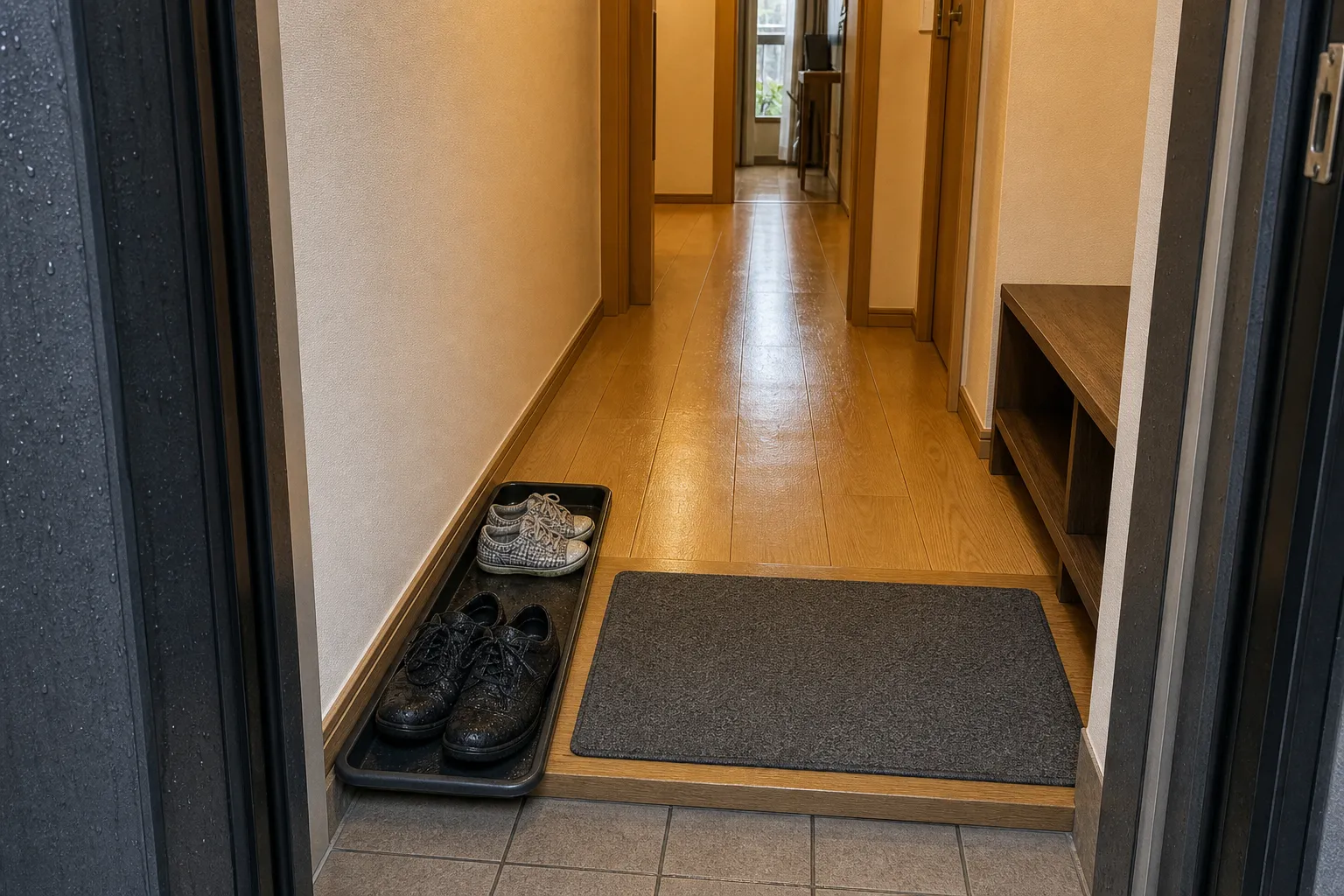
In a hallway entry, the tray usually works better lengthwise along the wall than across the hall. Boots can point inward or sideways depending on the tray shape, but the open walking line should remain obvious.
A low bench can help if people sit to remove shoes. Just avoid letting the bench, tray, and mat form a crowded triangle. Often the best shoe tray placement idea is simple: a side-wall tray, a washable mat, and a small household habit that only wet footwear stays there.
Adjust the layout by doorway type
The same mat and tray can work well in one entry and poorly in another. Use the doorway, not the product photo, as the guide.
Apartment door opening into a small hall
Place a flat mat directly inside the door and a compact tray along the wall. Keep the tray out of the door edge and away from visitors’ first steps. If space is tight, treat the tray as temporary wet weather shoe storage, not general storage.
Mudroom or side door
This doorway usually needs more grit control. Put the scraping mat where the mess first lands, then place the tray near the bench, hooks, or utility sink if one exists. Make sure the tray can be lifted, rinsed, or wiped without dismantling the whole area.
Front entry with a decorative rug
A decorative rug can still set the tone of the room, but it should not carry the entire wet-weather job. Put the functional mat at the threshold and keep the decorative rug farther inside, or choose a mat that looks calm while still handling moisture and grit.
Door with no protected exterior landing
If rain blows directly against the door, assume the indoor landing will receive more water. The mat needs to cover the first step, and the tray should be close enough that wet shoes are not carried across the floor. After a storm, check the actual pooling pattern; it may differ from what the layout suggests on a dry day.
The maintenance check that keeps it working
A mat and tray are only useful if they can be cleaned without turning the entry into a chore.
Before settling on the layout, ask:
- Can the mat be shaken, vacuumed, washed, or cleaned as its care label allows?
- Can the tray be lifted or wiped without moving half the entryway?
- Does water collect under the mat or behind the tray?
- Do wet pairs have enough space around them instead of sitting in a tight pile?
- Are dry shoes stored somewhere else if the entry is narrow?
During rainy weeks, the tray may stay out. During dry months, it can be stored or reserved for garden shoes. In snow season, a second tray or more deliberate boot area may help, but only if the doorway can hold it without blocking movement.
The best test is still the room itself. After a wet day, look for water outside the tray, mud beyond the mat, curled edges, blocked movement, and shoes that stay damp because they are packed too tightly.
Quick layout check before the next storm
- The first wet step lands on a mat, not bare finished floor.
- The shoe tray is reachable before wet shoes cross the room.
- The tray edge is not in the main walking path.
- The door opens fully without pushing the mat or tray.
- Wet pairs have some space around them.
- The mat lies flat and does not bunch at the corners.
- The tray can be wiped or emptied without a complicated reset.
- Dry shoes are stored elsewhere if the entry is small.
A good entryway mat and shoe tray arrangement is not about adding more storage. It is about giving wet weather a clear stopping point: soles on the mat, shoes in the tray, walkway open, floor visible, and the doorway easy to use when people come home in rain, snow, or mud.