Shoe Storage Ideas for a Narrow Entryway
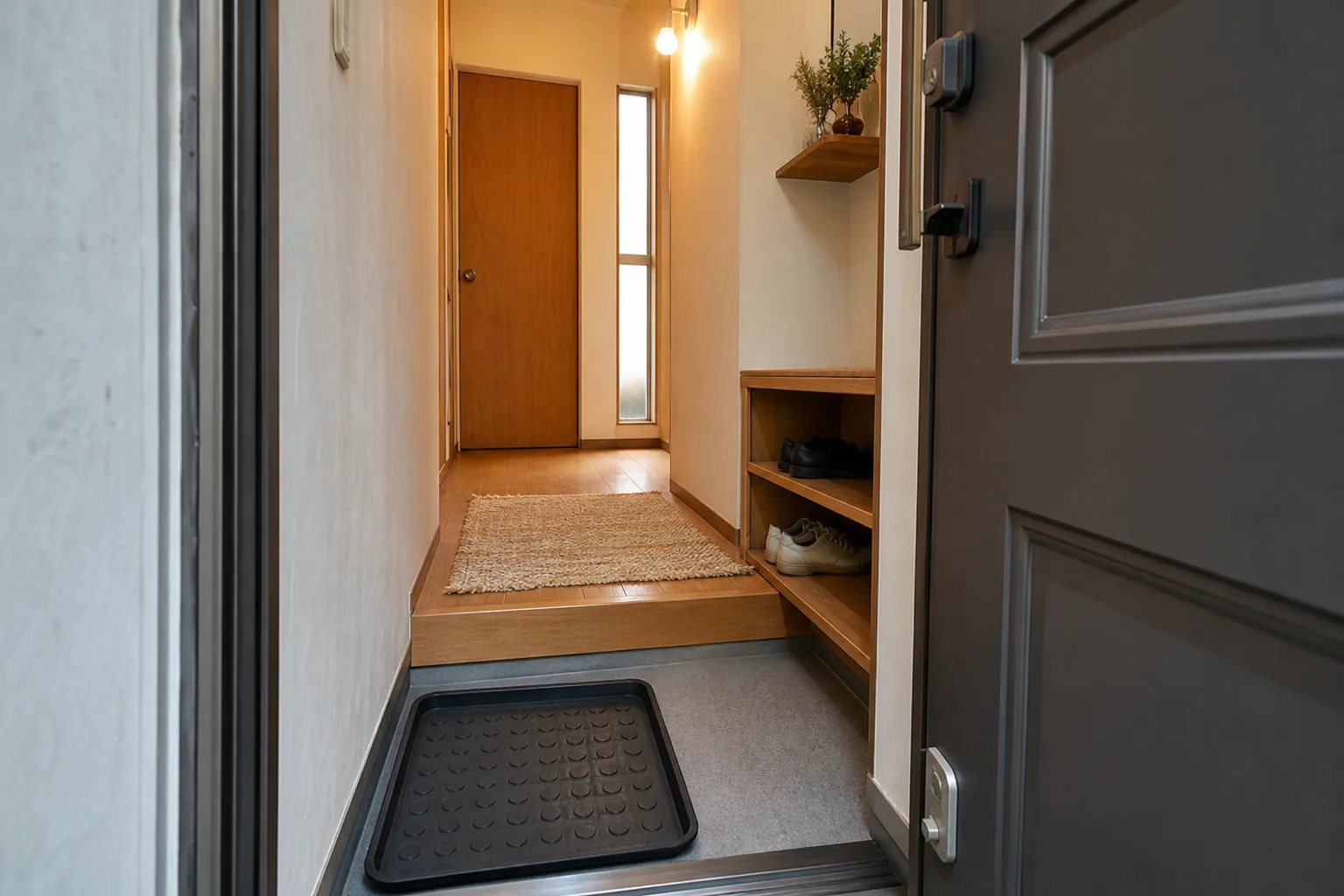
The most useful shoe storage ideas for narrow entryway spaces are shallow, divided, and realistic about daily habits. Keep only the shoes used most often near the door, give wet or dirty pairs a washable landing spot, and move overflow shoes somewhere else. A slim shoe cabinet, open low rack, wall-mounted shelf, narrow bench, tray, or over-the-door organizer can all work—but only if the door still opens cleanly and the walking path does not become a squeeze.
The point is not to hide every pair. It is to make the first few steps into the home clear, calm, and easy to use.
broader context
Parent topic
Use the broader page when you need more context before this narrower page.
Start with the space you actually have
Before buying storage, stand in the entryway and watch how the area works on an ordinary day. A narrow threshold usually has four competing needs:
- the front door needs room to open;
- people need to pass through without turning sideways;
- daily shoes need to be easy enough to put away;
- wet, muddy, snowy, or sandy shoes need a place that can be wiped clean.
This is why measuring entryway depth matters more than choosing a beautiful cabinet first. Measure from the wall to the point where the door swing, coat hems, stairs, radiator, or hallway traffic begins to interfere. Then check the space again as if someone were standing there to remove shoes. A cabinet that looks slim online can still feel too deep if it makes the body twist at the threshold.
Research on movement through openings is not about shoe racks, but it does support a familiar home observation: people change their route and posture when a passage feels tight. Door-opening studies also show that the act of opening a door affects movement near a threshold. For a narrow residential entry, the practical takeaway is simple: check the door swing first, then keep shoe storage outside that movement whenever possible.
A useful first edit is to divide shoes into jobs
Daily shoes
One pair per person, or two if they are truly worn often.
Weather shoes
Boots, rain shoes, garden shoes, or muddy pairs on a tray or washable mat.
Occasional shoes
Stored in a closet, bedroom box, under-bed container, or another overflow area.
Guest space
One small empty spot, not a full guest-shoe system unless you host often.
A narrow entryway should not become the home’s entire shoe archive.
Shoe storage ideas that usually work in a narrow entryway
Different forms solve different problems. The best narrow entryway shoe storage depends on depth, moisture, visibility, door swing, and whether you can install anything on the wall.
Slim shoe cabinet
Best for visually quiet storage for dry daily shoes.
Check door clearance, internal shoe size, ventilation, and anchoring if tall.
Open low shoe rack
Best for fast access and everyday use.
Check whether it will look crowded if overfilled.
Shoe tray or entryway mat
Best for wet weather, boots, and muddy soles.
Check cleaning needs; it is not a full storage system.
Wall-mounted rack or shallow shelf
Best for saving floor space.
Check wall type, hardware, load limits, and rental rules.
Narrow entryway bench
Best for sitting while changing shoes.
Check room for knees, standing, and passing.
Over-the-door shoe organizer
Best for renters or hidden overflow.
Check whether it interferes with closing or looks busy on the main door.
Baskets or bins
Best for children’s shoes, slippers, and soft sandals.
Check whether pairs get buried because the bin is too full.
Slim shoe cabinet
A slim shoe cabinet is often the first thing people search for when planning a narrow entry. It can work well when the entry needs a quieter surface and the shoes going inside are mostly dry. Tilt-out cabinets are popular because they keep a shallow front against the wall.
The limitation is that “slim” does not mean it fits every shoe. Bulky trainers, boots, high-tops, and larger sizes may need more internal depth or height than the cabinet allows. A closed cabinet also should not be the first stop for shoes that are still wet. Let damp pairs sit on a tray or mat first, then move them once they are dry enough for storage.
For tall cabinets or wall-mounted pieces, follow the manufacturer’s installation instructions. A shallow cabinet is not automatically stable.
Open low shoe rack
An open low shoe rack is less visually quiet than a cabinet, but it is often more forgiving. It keeps everyday pairs visible, reachable, and able to air out after ordinary use. In a household where people will not open a cabinet every time, an open rack may be the more honest solution.
The key is restraint. A low rack should hold current shoes, not every pair owned. If shoes are stacked, spilling forward, or blocking the path, the rack has stopped helping. In wet climates, choose a surface that can be wiped or place a tray beneath it.
Shoe trays and entryway mats
Shoe trays for entryway use are practical in wet, snowy, sandy, or muddy places. They create a clear landing area for messy footwear. A tray with a raised edge can help contain water or grit, but it still needs to be emptied and cleaned. Do not place it where someone steps directly into pooled water when entering.
An entryway shoe mat works best with a limit. For example: one washable mat for the active pair, one tray for wet shoes, and overflow moved away. Without that limit, the mat becomes an invitation for every shoe in the home to gather at the door.
Wall-mounted rack or shallow shelf
When the floor is scarce, the wall can help. Small-space housing research often points to vertical storage and underused areas as useful strategies in compact homes. In a narrow entry, that might mean wall-mounted rails, shallow shelves, peg-style storage, or a vertical cabinet.
Keep this modest. Wall-mounted shoe storage must suit the wall material, hardware, and expected weight. Renters should check lease limits before drilling. If drilling is not possible, consider a freestanding narrow rack, a closet-door organizer, or a light basket system placed away from the door swing.
Narrow entryway bench
A bench can make changing shoes easier, but it is not always right for a narrow entry. It needs space for the bench itself, a person’s knees, and the movement of sitting down and standing up. In a very slim hallway, a bench may take the exact space needed for passing.
If you use one, choose a narrow bench with open space below for one row of shoes. Avoid bulky storage chests near the door unless the entry has enough depth. A bench should feel like a pause point, not a blockage.
Over-the-door shoe organizer
An over-the-door shoe organizer can be useful for renter-friendly shoe storage, especially on a closet door near the entry rather than on the main front door. It works best for lightweight shoes, slippers, children’s pairs, or seasonal overflow.
Check that the door still closes cleanly and that the organizer does not hit trim, hooks, wall edges, or the floor. On the main entry door, it can look busy and may interfere with daily movement. It is usually better as secondary storage than as the main visual feature.
A simple layout for daily shoes, wet shoes, and overflow
A narrow entryway works better when each shoe category has its own place. One cabinet rarely solves everything. It often leads to damp shoes being hidden too soon, boots crammed sideways, and extra pairs returning to the floor.
Try this small system:
-
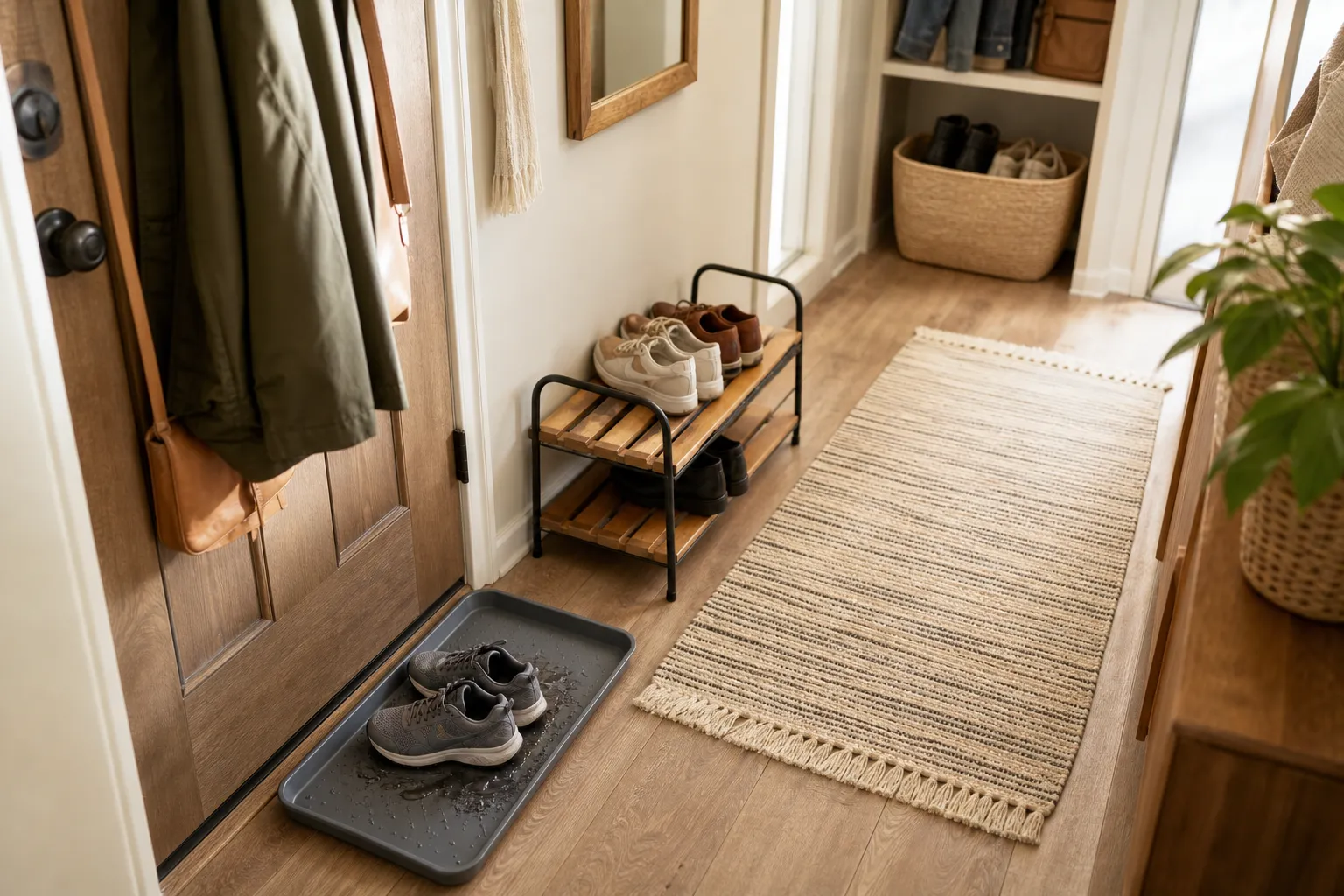
Put a washable mat or tray closest to the door.
Use it for shoes that arrive wet, sandy, snowy, or muddy. It should be easy to see and easy to clean.
-
Place daily shoe storage just beyond the door swing.
This may be a low rack, slim cabinet, or shallow shelf. Keep it within natural reach, but not where the door hits it.
-
Use vertical storage only where it stays stable and reachable.
Higher shelves are better for light overflow than for shoes used several times a day.
-
Move overflow away from the entry.
Dress shoes, off-season boots, duplicates, and rarely worn pairs belong in a closet, bedroom storage box, or another defined area.
-
Leave one empty landing space.
A narrow entry feels calmer when not every surface is already full. One open spot gives a guest a place for shoes, lets wet footwear pause, or creates room for a bag while you unlock the door.
For a small household, this might mean a two-tier open rack plus one boot tray. For a family, it may be a slim cabinet for dry daily shoes, a separate tray for wet pairs, and labeled overflow bins elsewhere. For a renter, it may be a no-drill rack, a closet-door organizer, and a washable mat instead of installed shelves.
What changes the best answer
The right choice depends on ordinary conditions in the room.
Door swing
If the door opens into the entry, avoid storage where the door edge, handle, or person entering will collide with it. Test the footprint with painter’s tape or a cardboard box before buying.
Shoe size and type
Boots, high-tops, and bulky trainers often need more height and depth than sandals or slippers. Check internal dimensions, not just the outside width of a cabinet.
Weather
In rainy, snowy, or muddy places, open landing space matters. Closed storage can still be useful, but wet shoes need a practical pause before being put away.
Household habits
If people naturally kick off shoes quickly, a beautiful closed cabinet may fail unless it is very easy to use. If the entry needs to look quieter, combine a closed cabinet for dry pairs with one small open tray for real life.
Rental limits
Renter-friendly shoe storage usually means freestanding racks, over-the-door organizers, lightweight baskets, or pieces that do not require permanent hardware. For anything attached to a wall, follow both the product instructions and the rules of the home.
Cleaning needs
Entry storage should tolerate grit, water, and repeated handling. Smooth metal, sealed wood, plastic trays, and washable mats are often easier to maintain than absorbent fabric near the door. Natural materials such as wood or rattan can look warm, but they need more care around moisture and dirt.
Common mistakes in narrow entryway shoe storage
One common mistake is assuming the thinnest cabinet is always the best answer. Sometimes it is. But in many homes, a low open rack works better because daily shoes stay reachable and damp pairs are not shut away too soon.
Another mistake is treating all shoes the same. Daily shoe storage and overflow shoe storage are different tasks. The entryway should handle the shoes used today and the shoes arriving from weather. It does not need to hold every pair owned.
A third mistake is using vertical storage without thinking about weight, reach, and installation. Vertical space is valuable in small homes, but a tall or wall-mounted unit should not wobble, lean, or rely on improvised hardware. Product instructions matter because load limits and anchoring needs vary.
Finally, visual calm does not require empty minimalism. In many homes, a small visible row of shoes is more useful than a cabinet no one opens. A calm entryway is one where the next action is obvious: wet shoes go on the tray, daily shoes go on the rack or in the cabinet, and everything else has another home.
Quick buying and placement check
Before choosing a shoe rack, cabinet, bench, tray, or organizer, ask:
- Does the front door open fully without hitting it?
- Can someone enter while another person is putting on shoes?
- Is there a washable place for wet or dirty footwear?
- Are daily shoes reachable without moving other pairs first?
- Are overflow shoes stored somewhere other than the narrow threshold?
- If the unit is closed, is there a place for damp shoes to pause before going inside?
- If it is tall or wall-mounted, can it be installed according to the manufacturer’s instructions?
- If the home is rented, does the solution avoid damage or fit the lease rules?
- Can the material be wiped, swept under, or lifted for cleaning?
- Does the piece make the entry simpler, or does it add another obstacle?
If the answer is unclear, mark the footprint on the floor with painter’s tape and live with the outline for a day. Open the door, carry a bag through, put on shoes, and notice where your body naturally moves. In a narrow entryway, that small test is often more useful than another product search.
The quietest solution is usually a small system
For most narrow entryways, the best answer is not one impressive piece of furniture. It is a small system: a mat or tray for wet shoes, one shallow rack or slim cabinet for daily pairs, and a separate overflow place away from the door. Add a bench only if there is enough depth for sitting and passing. Use wall storage only when it can be installed properly and reached comfortably.
Good shoe storage should respect the lived-in moment at the threshold. People arrive tired, carrying things, wearing wet shoes, or leaving in a hurry. The right setup keeps shoes close without turning the doorway into a squeeze point.