How to Plan an Entryway Drop Zone Without Adding Visual Clutter
A good entryway drop zone starts by holding fewer things, not by adding more storage. Map what lands in the first 30 seconds after you open the door—keys, shoes, bag, coat, mail, umbrella, leash, packages, or tomorrow’s outgoing item—then give only those objects a clear place.
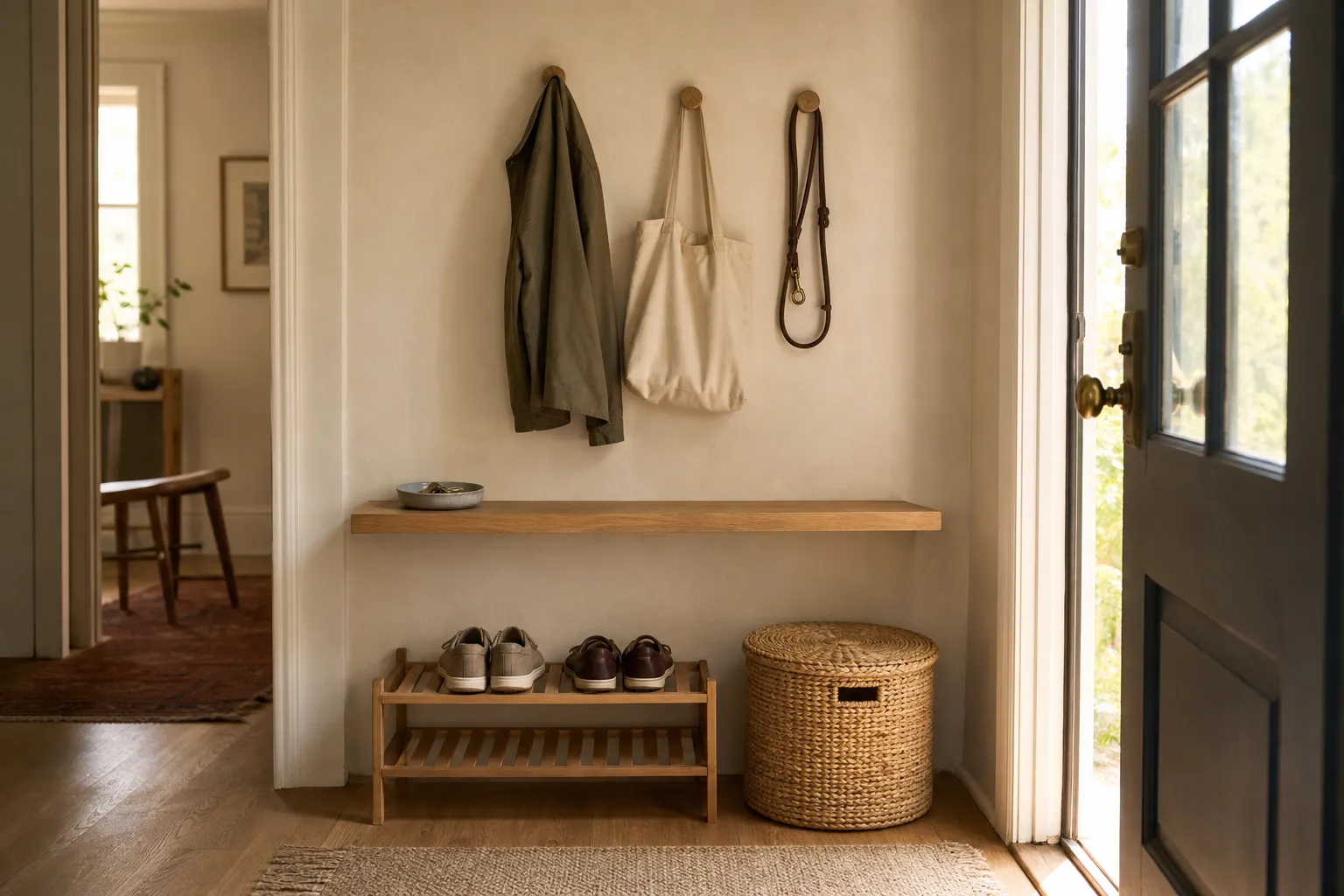
The most useful entryway drop zone ideas usually combine four quiet parts: a small landing surface, a vertical place for coats or bags, a shoe solution sized for daily pairs, and one closed or semi-closed container for loose items. If the setup blocks the door swing, narrows the walking path, or relies on a wobbly tall piece, it is adding clutter even if it looks minimal.
broader context
Parent topic
Use the broader page when you need more context before this narrower page.
Start with the arrival sequence
Before choosing a bench, console, cabinet, or basket, test the routine at the door.
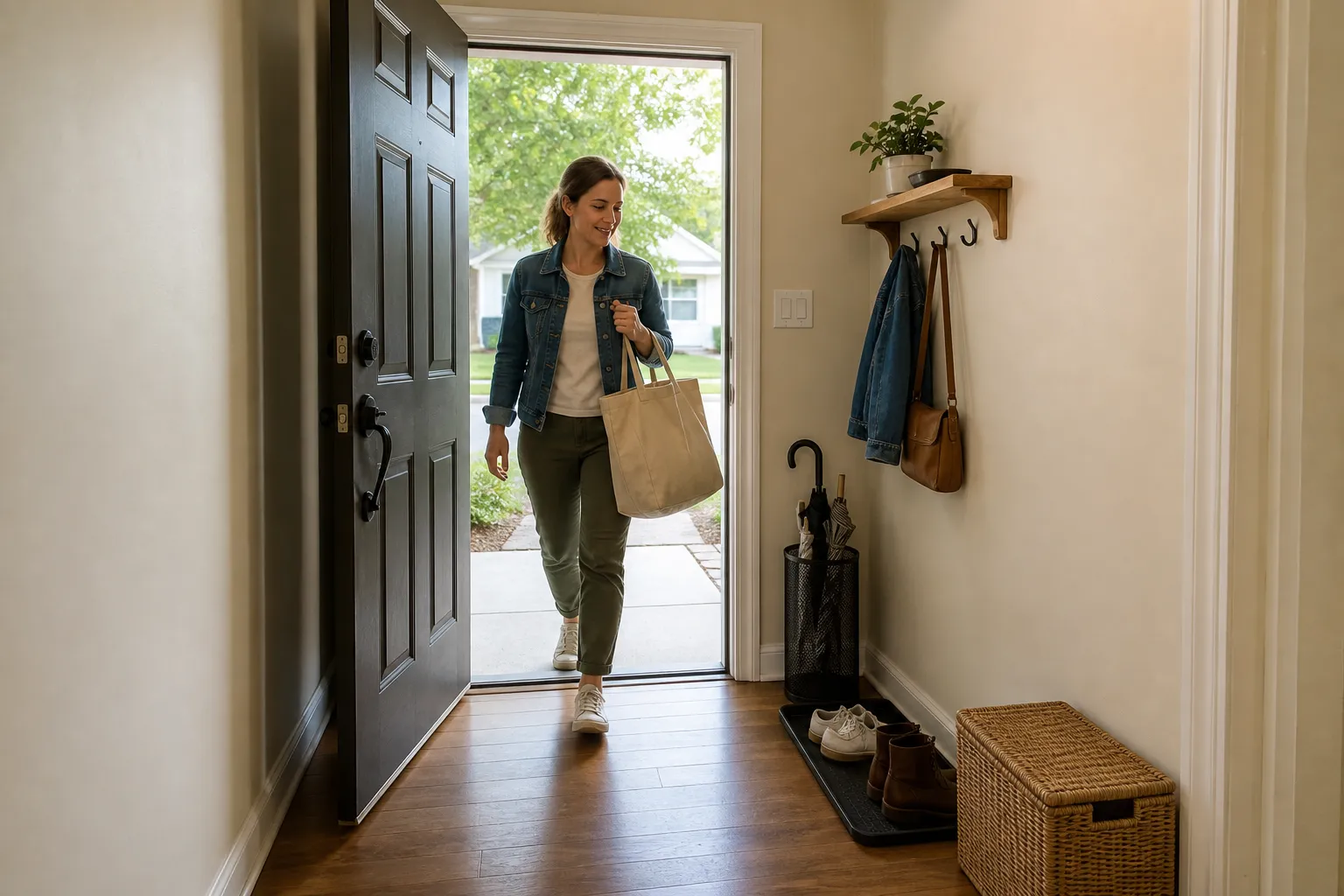
Stand outside with what you normally carry. Open the door fully. Step in. Put down your bag. Remove shoes if that is part of your household habit. Drop mail. Hang a coat. Reach for the dog leash. Pick up the item that needs to leave tomorrow.
That short test tells you more than a styled product photo. An entryway drop zone in a house, apartment, hallway, or small foyer has to support a sequence of actions. If the first usable surface is too far from the door, keys will land somewhere else. If the shoe storage is awkward, shoes stay on the floor. If mail has no next step, it becomes a pile.
Must land here
Keys, daily shoes, everyday bag, coat, leash, umbrella, transit card, wallet, or outgoing item.
Can live elsewhere
Extra coats, archived mail, sports gear, shopping bags, seasonal shoes, rarely used umbrellas.
Seasonal only
Wet-weather trays, winter scarves, summer hats, school-year bags, guest slippers.
Visual noise
Loose receipts, duplicate bags, packaging, decorative objects that crowd the landing surface, unassigned baskets.
A useful small entryway organization plan is often stricter than expected. The drop zone is not a home for everything that passes through the door. It is a pause point for daily arrival storage.
Use four quiet parts, not random add-ons
Most clutter-free entryway storage can be planned with four zones. You may not need all of them in a narrow hall, but the logic helps keep the entry from becoming a collection of separate fixes.
1. A small landing surface
An entryway landing surface should be useful enough to catch daily objects, but small enough to discourage piling. It might be a shallow wall shelf, a slim console, the top of a shoe cabinet, a tray on a bench, or a small bowl on a recessed ledge.
Use it for objects that need one-handed placement: keys, wallet, sunglasses, transit pass, or one piece of mail. A tray helps because it creates an edge. Without an edge, a surface becomes open territory.
Keep the surface focused
- a low tray for keys and wallet;
- a small upright sorter for today’s mail;
- a lidded box for spare keys or dog-walk items;
- a single dish for things that leave with you every morning.
Avoid making this surface decorative first and useful second. A vase, candle, framed object, and stack of books may look composed, but if there is nowhere to put wet keys or a folded letter, daily objects will spread around them.
2. A vertical place for coats, bags, and leashes
Hooks, pegs, a rail, or a narrow coat rack can reduce floor clutter when the hanging area matches what people actually carry. One hook for each daily user is often clearer than a crowded row of decorative hooks.
Separate heavy bags from light coats when possible. A work bag, backpack, or tote can pull at a hook, swing into the walking path, or make a narrow entry feel crowded. In a small hallway, a lower hook or open cubby for one bag may work better than hanging everything at shoulder height.
For entryway bag storage, ask
- Does the bag project into the path when full?
- Can someone pass while it is hanging?
If not, place the bag under a bench, in a low cubby, or on a designated floor mat beside—not in—the main route. A bag that catches your leg every time you enter is still clutter.
3. Shoe storage sized for daily pairs
Entryway shoe storage works best when it is sized for daily shoes, not the whole household collection. A two-person home may only need two to four pairs near the door. A family may need a stricter rotation: current daily shoes at the entry, extras elsewhere.
Choose the least visually busy option that still gets used
- Low open rack: easy for daily shoes, but visible and quick to look crowded.
- Bench with lower shelf: helpful when shoes come off at the door, but it needs clear floor space.
- Tilt-front or closed shoe cabinet: visually quiet, but easy to overfill if treated as long-term storage.
- Tray for wet shoes: practical in rainy or snowy seasons, but should not become a permanent pile.
- Basket for slippers or children’s shoes: softens the view, but only if the category is specific.
Closed storage can reduce visual clutter, but it does not automatically solve clutter. If shoes are hard to retrieve, people leave them outside the cabinet. If the cabinet is too deep, it narrows the path. If it is tall, narrow, freestanding, or heavily loaded, check its stability before using it for bags, shoes, and daily pulling.
The U.S. Consumer Product Safety Commission’s furniture tip-over guidance is a useful reminder for entry storage: tall or unstable furniture can be a problem when pulled, climbed on, or loaded unevenly. Choose sturdy pieces, keep heavier items low, and follow the manufacturer’s anchoring instructions where appropriate.
4. One closed or semi-closed container
A visually quiet entry usually needs one place for small, irregular objects: a lidded basket, drawer, fabric bin, cabinet compartment, or woven box under a bench.
The key word is one. Too many baskets look organized for a week, then become hidden overflow. Give each container a named job:
- dog-walk items;
- winter gloves;
- reusable shopping bags;
- outgoing returns;
- guest slippers;
- umbrellas;
- children’s school accessories.
If the category cannot be named, the container will likely become a catchall. A basket filled with receipts, loose chargers, old mail, and single gloves is only quiet from a distance.
Check the path before you call it finished
An entryway is a threshold, but it is also a working passage. Door swing, walking clearance, and turning space matter more than symmetry.
Public accessibility standards, such as the 2010 ADA Standards for Accessible Design, are not a rulebook for every private home. Local rules, rental limits, housing type, and personal mobility needs vary. Still, those standards are a useful reminder that clear movement should be considered early, not after the storage is installed.
In the room itself, check
- Door swing: Open the door fully. No basket, bench, shoe rack, or package zone should stop it.
- First step inside: Leave a clear place to stand before removing shoes or putting down a bag.
- Two-person use: If one person is hanging a coat, can another still enter?
- Carried items: Test the path with a backpack, grocery bag, suitcase, stroller, or mobility aid if those are part of your household.
- Pinch points: Watch where a console, bag hook, shoe rack, and door trim create a squeeze.
- Low light: Make sure the landing surface and shoe area are easy to read at night without adding objects to the floor.
A narrow drop zone may work better on the wall than on the floor: hooks, a shallow shelf, a slim mirror with a ledge, or a wall-mounted mail slot. But wall storage still has depth. A hanging tote, coat sleeve, or umbrella can narrow the route as much as a piece of furniture.
If the entry opens directly into a living room, use a small visual boundary rather than a heavy divider. A low bench, narrow cabinet, rug, or aligned hook rail can mark the entrance without blocking movement.
Keep the threshold quiet without over-styling it
In many Eastern-influenced interiors, the entrance is treated as a transition, not just a storage problem. The practical idea is simple: the first few steps inside decide how the home receives shoes, weather, bags, and outside objects. Architectural writing on residential approach spaces often discusses entry as a sequence of movement, boundary, light, and enclosure. In an ordinary home, that does not need to become symbolic or elaborate. It means the next action should be obvious.
A quiet threshold can come from restraint
- one visible material family, such as wood, woven fiber, ceramic, or matte metal;
- closed storage below eye level and lighter objects above;
- one tray instead of several small dishes;
- hooks aligned in a simple row;
- shoes kept low and contained;
- mail given a forward path, not a permanent pile.
Hidden entryway storage can help: a drawer for keys, a cabinet for shoes, or a lidded basket for gloves reduces visual activity. But hiding everything can also make the entry harder to use. Keep the most repeated action visible enough to be easy. If you use the same key every day, its place should not require opening three compartments.
The goal is not an empty entry. It is a readable one.
Give mail, packages, and tomorrow’s items their own rules
Mail and packages often break an otherwise tidy entry because they are temporary but irregular. They do not belong permanently near the door, yet they need somewhere to land.
For entryway mail flow, use a small “today only” holder: a wall pocket, tray, or upright file. Then decide when mail moves inward—after dinner, before bed, or when you sit at a desk. If the holder stores weeks of paper, it has become an archive in the wrong room.
Packages need a different plan. A small outgoing-return zone can be useful near the door, but it should not block the door swing or become a second floor pile. If returns are frequent, use one labeled bin or low shelf. If they are occasional, a temporary spot beside the drop zone is enough.
Tomorrow’s items need visibility but limited volume. A library book, lunch bag, umbrella, or parcel to return can sit in one “leaving soon” tray or on one hook. That keeps the entry useful without turning it into general storage.
What changes in a very small entry
Small entryway organization is mostly editing. In a tight hall, you may have to choose between a bench and shoe storage, or between a console and bag hooks. Pick the function that solves the most daily friction.
If shoes are the main problem, skip the console and use a slim shoe cabinet with a small tray on top. If bags are the problem, use low storage or hooks outside the walking line. If mail is the problem, install a wall pocket and keep the floor empty. If coats are seasonal clutter, move most of them to a closet and leave only the current daily layer near the door.
For a tight hallway, a simple formula is
- one shallow wall shelf or tray;
- two to four hooks;
- one low shoe tray or slim cabinet;
- no extra decorative floor objects;
- a weekly reset for overflow.
If even that feels crowded, remove the landing surface and use a wall-mounted key rail with a tiny ledge. The smallest successful drop zone may be only a short section of wall, as long as it matches the household’s real routine.
Common misunderstanding: minimal does not always mean functional
A minimal cabinet can still be too deep. A beautiful bench can still block the door. A row of matching baskets can still hide unsorted clutter. A large storage tower can still feel visually heavy and need a stability check.
The appearance of order is not the same as a working arrival system.
A better test is this: after a normal day, can the entry return to order in two minutes without moving objects to random places? If yes, the drop zone is probably sized well. If not, there are too many categories at the threshold, or the storage is in the wrong place.
The available public sources support the practical boundaries more than the styling details: keep movement clear, avoid awkward obstructions, and pay attention to unstable freestanding storage. Specific products, finishes, and organizing habits still need to be adjusted to the room and the people using it.
Quick planning checklist
Use this before buying anything:
- What lands in the first 30 seconds after arrival?
- Which of those items truly need to stay at the entry?
- Can the door open fully with the storage in place?
- Can one person enter while another uses the drop zone?
- Are shoes contained without taking over the floor?
- Does every basket, drawer, or tray have one named job?
- Are heavy items stored low?
- Is tall or narrow freestanding furniture stable and installed according to its instructions?
- Is there a next step for today’s mail?
- Is seasonal gear limited to the current season?
A good entryway drop zone should feel almost modest. It receives the day, holds only what belongs there, and lets the rest of the home begin without a pile at the door.