Entryway storage decision
Open Shoe Rack or Closed Shoe Cabinet for an Entryway
Choose an open shoe rack if your entryway often handles wet shoes, muddy soles, children’s daily pairs, guests, or fast in-and-out routines. Choose a closed shoe cabinet if shoes are usually dry before storage and your main problem is visual clutter, a narrow-looking doorway, or too many visible pairs.
In the open shoe rack vs closed shoe cabinet decision, the better choice is not the more polished-looking one. It is the one that matches moisture, access, cleaning habits, hallway clearance, and furniture stability in your actual entryway.
A useful rule: daily damp shoes need air first; stored shoes can be hidden later.
broader context
Parent topic
Use the broader page when you need more context before this narrower page.
Quick decision: what your entryway needs most
Look at the shoes that sit near the door on an ordinary weekday, not the entryway you imagine after a perfect reset.
| Entryway condition | Better starting choice | Why it usually fits |
|---|---|---|
| Rain, snow, mud, humid weather, or wet shoes most days | Open shoe rack | More air movement and easier drying before storage |
| Shoes are mostly dry, but the doorway looks busy | Closed shoe cabinet | Hides pairs and gives the entry a calmer surface |
| Children, guests, or people who forget to put shoes away | Open shoe storage | Easier to see, grab, and return pairs |
| Very narrow hallway | Depends on depth | A shallow cabinet may look cleaner; a low rack may block less movement |
| Dress shoes or structured leather shoes | Either, with care | Dry first, avoid crushing, and leave enough shelf height |
| Tall storage piece near children or pets | Closed cabinet needs extra checks | Stability, loading, and anchoring matter more with taller furniture |
| Household dislikes visible shoes | Closed cabinet | Visual calm may be worth the extra drying and cleaning routine |
| Household dislikes opening doors for daily shoes | Open rack | Lower friction for daily access |
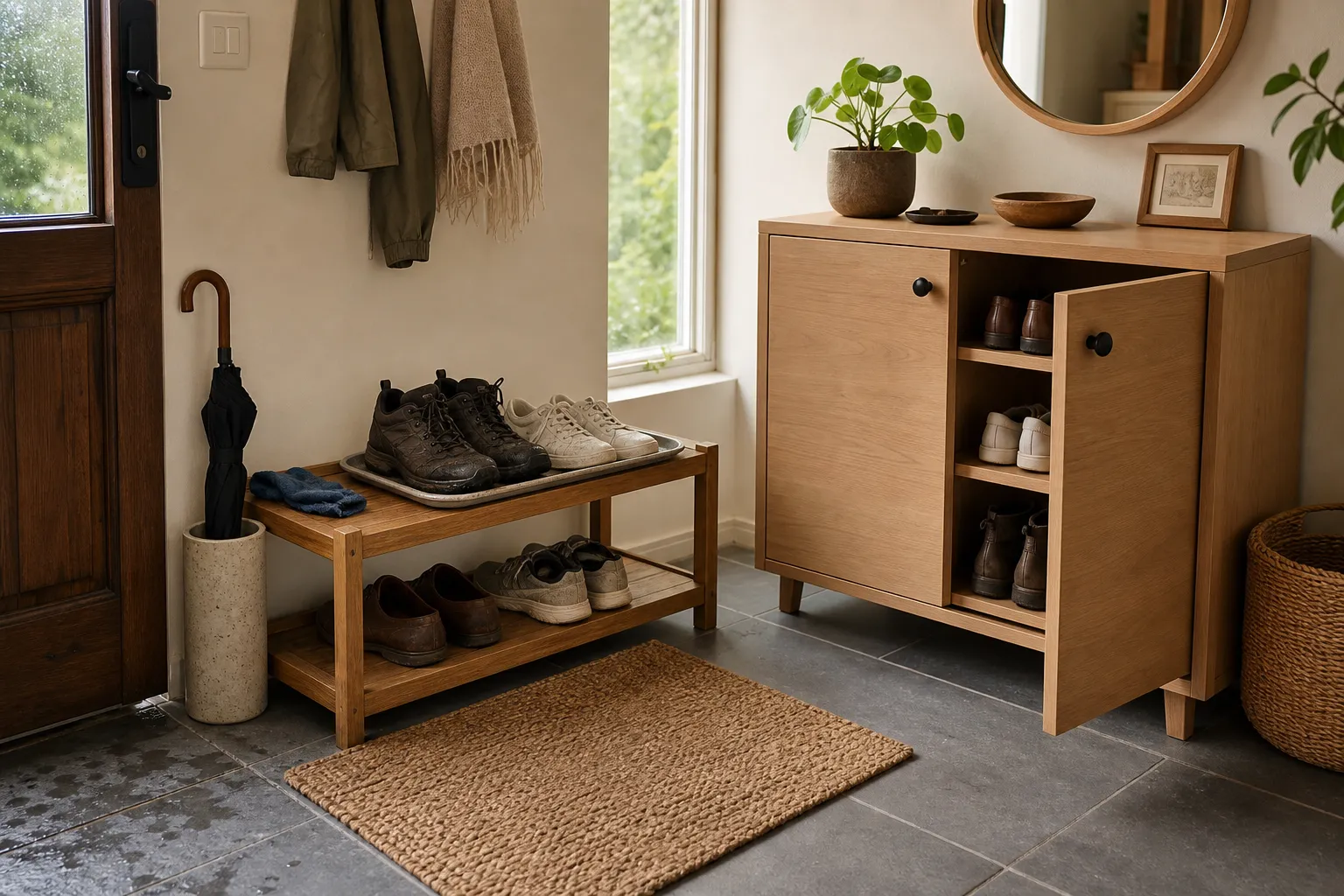
Many entryways work best with both: a small open landing zone for wet or current shoes, plus a closed cabinet for dry, less-used pairs. That is often more realistic than expecting one piece of furniture to handle moisture, storage, display, and family behavior all at once.
When an open shoe rack works better
An open rack is most useful when shoes arrive with moisture. Rain boots, school shoes, winter footwear, gardening clogs, and everyday sneakers often need time before they belong inside a cabinet.
Home moisture guidance supports the basic idea that damp items do better when air can move around them than when they sit in enclosed, low-airflow spaces. That does not mean an open rack dries every shoe quickly or solves every odor issue. The public sources do not give us direct household trials comparing ordinary shoe racks and cabinets. Still, for daily use, the design logic is practical: an open rack lets you see what is wet, separate muddy pairs, wipe the floor beneath, and avoid hiding dampness behind a door.
Open storage also suits homes where shoes move constantly. If two or three pairs are used every day, a cabinet door can become one more step people skip. A low rack near the threshold makes the desired habit obvious: take shoes off, place them here, keep the walking path clear. Guests understand it without much instruction.
The tradeoff is visual exposure. Open shoe storage asks for editing. If every shelf is packed, odd pairs lean outward, or muddy soles face the room, the rack becomes visual noise. In a calm entryway, an open rack works best as a working surface, not as a full collection display.
A few checks help
- Keep only daily or wet-weather pairs on the open rack.
- Use a washable tray below the lowest shelf if rain, snow, or grit is common.
- Leave a little space between pairs instead of stacking shoes tightly.
- Wipe the rack and floor beneath it often enough that dirt does not become part of the room.
- Avoid placing the rack where shoes project into the walking line.
An open rack is not automatically messy. It becomes messy when it is asked to store too many pairs, too close together, in a place no one cleans.
When a closed shoe cabinet works better
A closed shoe cabinet makes sense when the entryway’s main problem is visual clutter. Doors turn mismatched soles, laces, sandals, boots, and children’s shoes into one simple furniture face. In a small apartment entry, that calmer front can make the doorway feel less crowded, even if the number of shoes has not changed.
Closed storage is also useful when the front door opens into another living area: a sitting room, dining space, tea corner, or quiet hallway. Visible footwear may feel too busy there. A cabinet gives the space a more settled edge.
The condition is that closed storage needs better habits. A door hides shoes, but it does not remove moisture, grit, or smell. If wet shoes go straight inside, the cabinet can become a hidden damp zone. For an entryway shoe cabinet, the plain routine is: dry first, close later.
Look for these features if you choose a closed cabinet
- Vents, slatted doors, an open back, or small gaps for some air movement.
- Shelves that can be wiped clean.
- Enough internal height so shoes are not crushed.
- A depth that fits your largest daily shoes without forcing the door.
- A top surface that does not invite heavy piles on a narrow cabinet.
- Hardware and doors that can handle frequent use.
A closed cabinet is better for dry storage than first-stage drying. In wet weather, a better sequence is: knock off mud or snow, leave shoes on a tray or open rack until they are dry to the touch, then move them into the cabinet if you want the entry to look quiet again.
This matters for structured leather shoes and dress shoes. This is not a full leather-care guide, and brand-led shoe-care language should not be treated as neutral evidence. But as a storage matter, shaped footwear should not be crushed, sealed while damp, or treated like rubber sandals. Give structured pairs drying time, keep them away from pressure points, and store them where the upper is not bent by a tight shelf.
The variables people often notice too late
Airflow and visual calm are the obvious difference. Depth, cleaning, daily access, and stability often decide whether the piece still works after the first week.
Hallway clearance
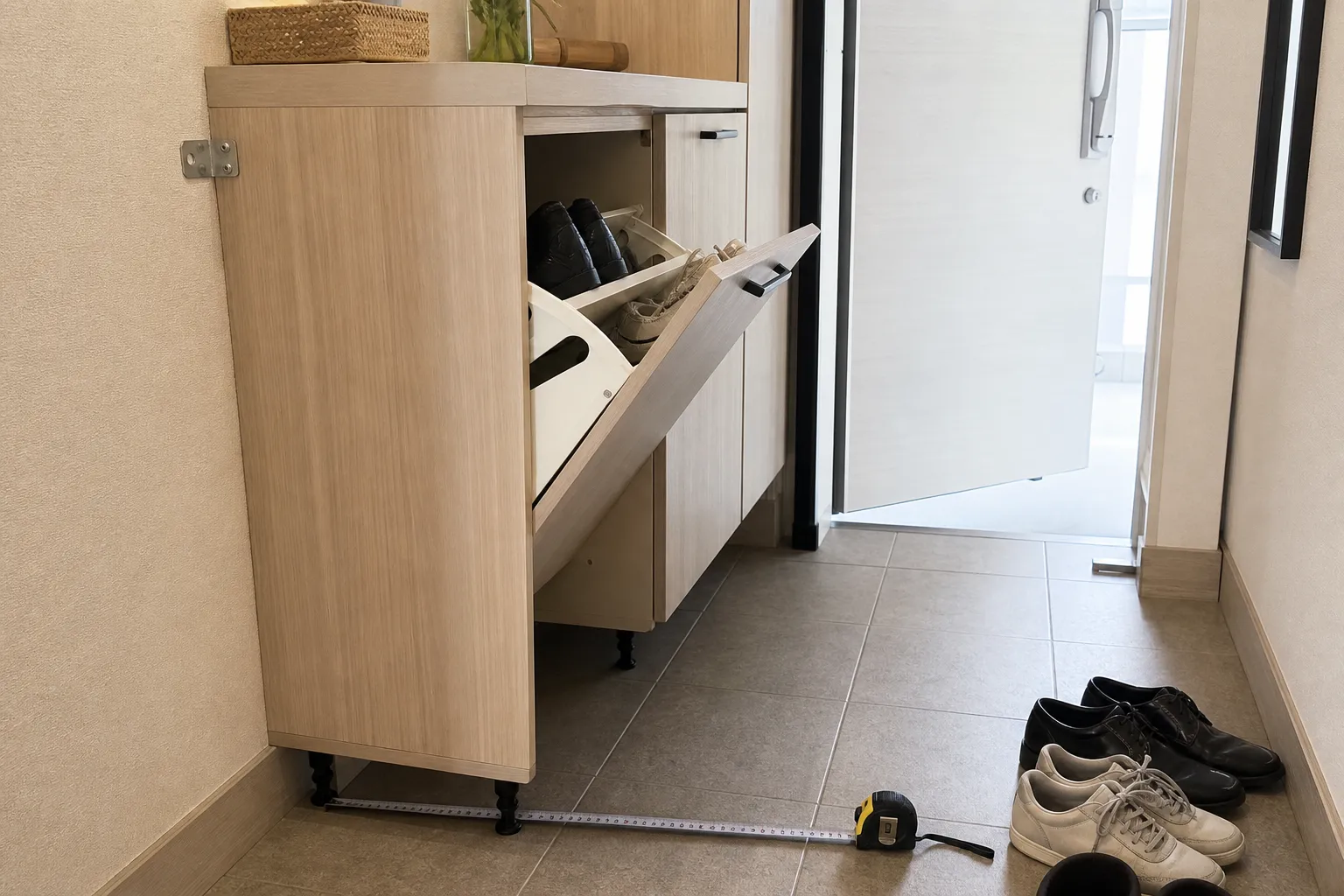
Measure the walking path with the furniture depth included, not just the wall where it will sit. A narrow cabinet may look neater than an open rack, but a swinging door can still irritate the path. A low rack may seem smaller, yet shoes can spill forward and steal more floor space than expected.
For a tight entryway, check:
- Can two people pass, or does one person have to step around the storage?
- Do shoes or cabinet doors interfere with the main door?
- Can you bend, open, and put shoes away without blocking the whole entry?
If the answer is no, the problem may be size rather than open versus closed storage.
Cleaning habits
Open racks show dirt sooner. That can be annoying, but it is also useful: grit is visible, and the floor beneath can be cleaned before it spreads. Closed cabinets hide dirt until you open the door or notice odor. They need periodic wiping inside, especially on lower shelves where wet soles and dust collect.
If your household tends to clean what it can see, an open rack may stay more honest. If your household is disciplined about weekly resets, a cabinet can remain tidy without becoming a hidden dumping place.
Number of daily shoes
A cabinet is often chosen because there are “too many shoes,” but daily access matters more than total ownership. If six pairs are used every day, hiding all six behind doors may slow the routine. If only two pairs are daily and the rest are occasional, a closed cabinet works more naturally.
Sort shoes by frequency:
- Current daily pair: near the door, easy to reach.
- Wet or muddy pair: open air or tray until dry.
- Occasional pair: cabinet shelf.
- Seasonal pair: stored elsewhere if the entry is small.
Furniture stability
A low open rack usually raises more clutter and tripping concerns than tip-over concerns. A tall closed shoe cabinet is different. It is furniture, and it should be treated like furniture.
Consumer product safety guidance on furniture tip-over is often aimed at dressers, bookcases, and similar pieces, but the practical lesson applies to tall, narrow, freestanding shoe cabinets too. Check the manufacturer’s instructions, use provided anchoring hardware where appropriate, avoid overloading upper shelves, and be especially careful if children may climb, pull, or open multiple compartments.
A cabinet that is shallow, tall, heavily loaded, or placed on an uneven floor deserves extra attention. Visual calm is not worth a wobbly piece at the doorway.
Common misunderstandings
A closed cabinet is not automatically better shoe care. It can be better for visual order, dust reduction, and keeping pairs together. But if damp shoes are shut inside, the cabinet may work against drying. Doors are not a care routine.
An open rack is not automatically casual or untidy. An open rack with five well-spaced daily pairs can look calmer than a cabinet overflowing behind a door. Openness becomes a problem when the rack holds every shoe the household owns.
Ventilation does not have to mean a complicated feature. For ordinary entryway use, it can be simple: slats, gaps, an open back, occasional door opening, and the habit of not storing wet shoes immediately. Available research on moisture, enclosed conditions, and footwear microclimates supports the general mechanism that moisture and low air movement matter, but it does not identify one ordinary cabinet style as the universal winner.
Also, do not let smart-cabinet marketing distract from the basic decision. Powered drying or deodorizing features may appear in product language, but most homes should start with simpler questions: Are the shoes wet? Do you need fast access? Can the hallway handle the depth? Will the cabinet be aired and cleaned? Is the furniture stable?
A simple test before buying
Before ordering an entryway shoe cabinet or open rack, do a three-day count.
For three normal days, note:
- How many pairs sit by the door at the busiest time?
- How many are damp, muddy, snowy, or sweaty after use?
- How many pairs are grabbed more than once a day?
- How much clear walking space remains?
- Does visible footwear bother the household enough to change behavior?
- Would people actually open and close cabinet doors every time?
- Would a tall cabinet need anchoring or a more stable location?
Then choose from the pattern
- If shoes are often wet and used constantly, start with an open rack or open drying zone.
- If shoes are mostly dry but visually distracting, choose a ventilated closed cabinet.
- If both are true, use a small open rack for active shoes and a cabinet for dry stored pairs.
- If the hallway is very tight, choose the shallowest option that keeps shoes out of the walking path.
- If children interact with the furniture, treat stability as part of the purchase, not an afterthought.
The most reliable entryway setup is usually not the one that hides the most shoes. It is the one that makes the right action easy on a tired weekday: wet shoes get air, daily shoes are reachable, stored shoes stay out of sight, and the floor remains passable.
Bottom line
For wet climates, muddy routines, busy households, and frequent daily access, an open shoe rack is usually the more forgiving first choice. For dry shoes, visual calm, and a more finished entryway, a closed shoe cabinet can work well if it has some ventilation, is cleaned periodically, is not overloaded, and stands securely.
If you are unsure, do not choose the largest cabinet first. Create a small open landing area for shoes that truly need air and access, then add closed storage for pairs that are dry enough to be hidden.