No-drill rental entry setup
Renter-Friendly Entryway Storage Without Drilling Into Walls
Yes: you can create useful renter friendly entryway storage without drilling into walls. The most reliable setup is usually not a wall full of “damage-free” products. It is a small mix of low, movable storage and a few carefully chosen removable pieces.
Start with what touches the floor: a narrow shoe bench, slim rack, tray, basket, or small freestanding cabinet. Add hooks, over-door storage, or tension pieces only after checking door swing, wall finish, weight, and your lease.
The simplest rule: keep heavy things low, keep the walking path clear, and treat every removable attachment as lower-commitment rather than guaranteed mark-free.
broader context
Parent topic
Use the broader page when you need more context before this narrower page.
Start With the Entryway You Actually Have
Many rentals do not have a true foyer. The “entryway” may be a strip of wall beside the door, the back of the door, a corner near the kitchen, or a narrow hallway shared with shoes, bags, umbrellas, parcels, and coats.
Before buying anything, check four ordinary details:
Door swing
Open the door fully. Include the thickness of coats, bags, or an over-door rack, not just the bare door.
Walking path
Enter as you normally do, with groceries, a backpack, or a tote. If storage makes you turn sideways every day, it is too deep.
Floor interruptions
Look for thresholds, mats, vents, uneven tile, baseboards, heaters, or radiators. These can make slim furniture wobble or block airflow.
Wall and trim condition
Painted drywall, old plaster, textured paint, wallpaper, veneer doors, and glossy trim may react differently to removable products.
For a small apartment entryway, the answer is rarely “add storage everywhere.” It is usually “make one clear landing place for what is used every day.” That might mean two pairs of shoes, a tray for keys, one hook for the current coat, and a basket for scarves or dog-walk items. Seasonal overflow belongs somewhere else if the entrance is already tight.
Many apartment entryway ideas look better in photos than in use because the space is empty. A real entry has wet shoes, a return package, a leash, outgoing mail, and someone trying not to trip while unlocking the door. Plan for that moment.
The Best No-Drill Setup Usually Starts on the Floor
If you are worried about wall marks, floor-based storage is the first place to look. It avoids relying on paint, adhesive, or a landlord’s tolerance for wall changes. It still needs to fit the room, but it is usually easier to move and adjust.
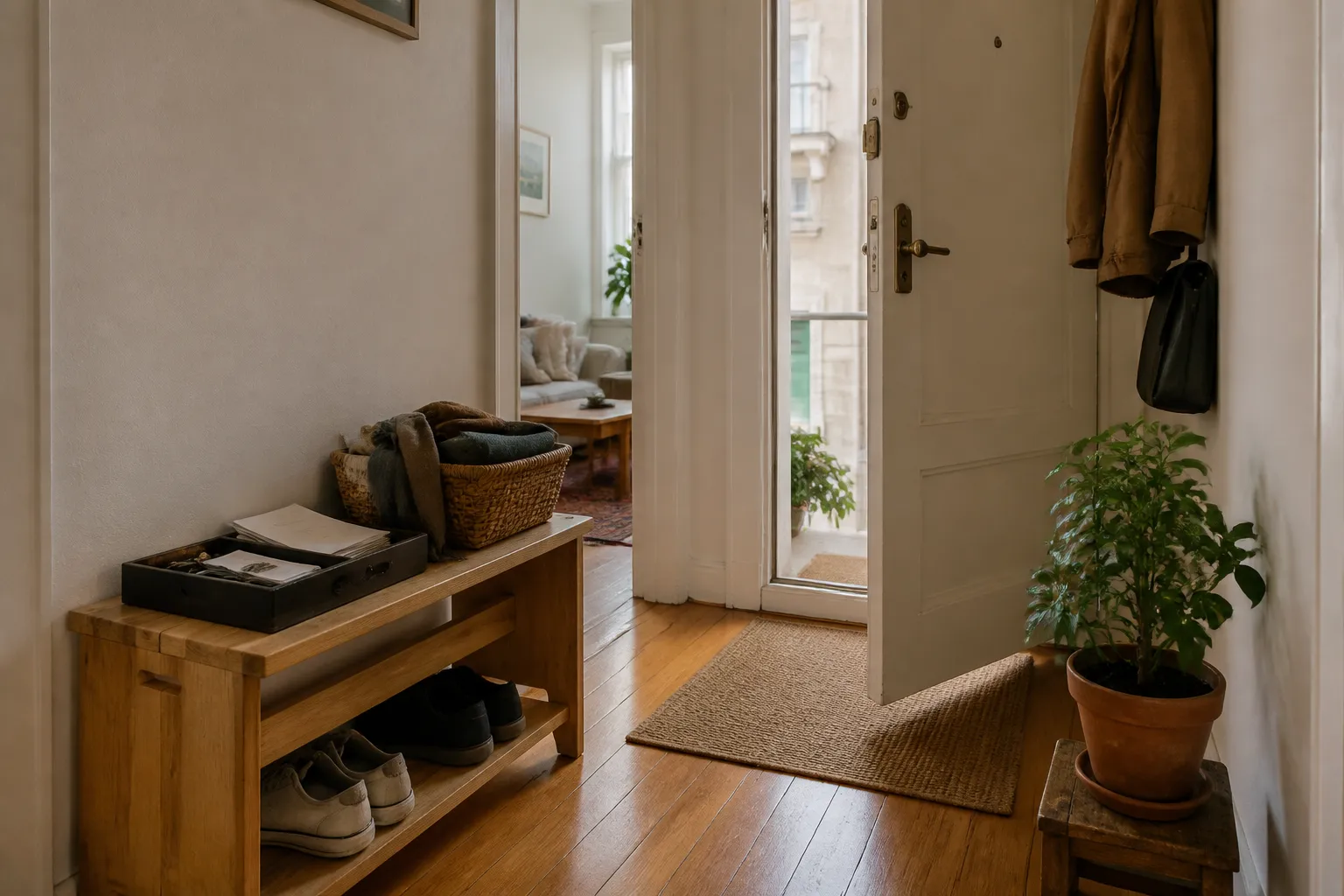
Narrow shoe bench
A low bench with shoe space underneath can work when you need a place to sit, tie shoes, or set down a bag. Choose one shallow enough that the door can still open and people can pass.
Works well for
- daily shoes
- a bag landing spot
- a small key tray
- households that need a sitting perch near the door
Works less well for
- long coats
- many pairs of shoes
- very narrow hallways
- uneven floors where the bench rocks
Avoid letting a light bench become a tower of bags and parcels. Once items spill outward, it stops solving the entryway problem.
Slim shoe rack or open shelf
A slim open rack is one of the most direct forms of entryway storage without drilling. It is easy to move at the end of a lease and easy to clean around.
The tradeoff is visual clutter. Open racks show every shoe. If your entry is part of the living room, a closed or semi-closed piece may feel calmer, but it will usually need more depth.
Use an open rack when the main problem is shoe scatter. Be cautious with tall, narrow versions near a frequently used door; they can look efficient online but feel unstable or awkward in a tight hallway.
Basket, tray, or low crate
For temporary entryway organization, a basket or tray may be enough. A shallow shoe tray can protect the floor from daily mess better than a complicated storage system no one uses. A woven basket, wood crate, or fabric bin can hold slippers, umbrellas, or reusable bags without becoming a permanent fixture.
This fits a quiet, pared-back entry especially well: one container for one category.
The limit is capacity. A basket that receives everything quickly becomes a soft pile of forgotten items.
Freestanding coat stand or hall tree
Freestanding entryway storage can help when there is no suitable wall surface. The main caution is stability. Coats, backpacks, and tote bags can pull unevenly, especially if everyone hangs items on the same side.
Use a freestanding piece only where it has enough breathing room. Keep heavier items low if the design allows, distribute weight evenly, and avoid placing a tall coat tree where the door or passersby will bump it.
This option is better in a true corner or short wall run. It is weaker in a narrow corridor where people brush past it several times a day.
Use Doors and Walls Carefully
No drill entryway storage often moves upward: removable hooks, over-door racks, adhesive rails, hanging pockets, or tension pieces. These can be useful, but they need more checking than floor pieces because they depend on surfaces, clearances, and repeated daily handling.
Removable entryway hooks
Removable hooks are tempting because they are small, inexpensive, and easy to place. Use them for light, frequently used items rather than heavy or sentimental ones: keys, a cap, a dog leash, a cloth tote, or one lightweight jacket if the product instructions allow that use.
Before relying on them:
- read the manufacturer’s surface and removal instructions
- avoid peeling, damp, dusty, weak, or recently painted surfaces
- test discreetly only where that makes sense for the finish
- leave space around the hook so items do not rub the wall
- remove slowly according to the instructions, not by pulling harder
The important boundary: “removable” does not mean “paint-safe in every rental.” Adhesives can behave differently on old paint, matte finishes, textured walls, humid entryways, wallpaper, and patched surfaces.
If you do not know the wall finish, avoid trusting adhesive storage with anything heavy.
Over-door entryway storage
Over door entryway storage can be useful when the door is the only available vertical surface. It can hold light coats, hats, scarves, umbrellas, or bags, depending on the design.
The main issue is clearance. Before keeping it in place:
- Close the door slowly and listen for scraping.
- Check the top gap between the door and frame.
- Make sure the rack does not hit trim, weatherstripping, a closer, or a security device.
- Confirm that hanging items do not block the handle, lock, peephole, or door chain.
- Step back and check whether the door still opens wide enough for daily use.
Over-door racks may leave pressure marks or rub points on paint, veneer, or trim. Felt pads may reduce rubbing in some situations, but they do not make every door suitable.
If the door already sticks, has a very tight frame, or is part of a shared building requirement, skip this option or ask before using it.
Tension poles and pressure-fit pieces
Tension-style storage avoids holes, but it still applies pressure to the floor, ceiling, or wall. That matters in rentals with delicate trim, soft ceiling finishes, uneven floors, or suspended ceilings.
Follow the product instructions closely. A pressure-fit item should not wobble, lean, block the door, or rely on a fragile surface. If you are constantly tightening it, adjusting it, or walking around it carefully, it is not a good entryway solution.
A Simple Layout That Works in Many Rentals
A practical renter entry can be built in layers without turning the doorway into a storage wall.
-
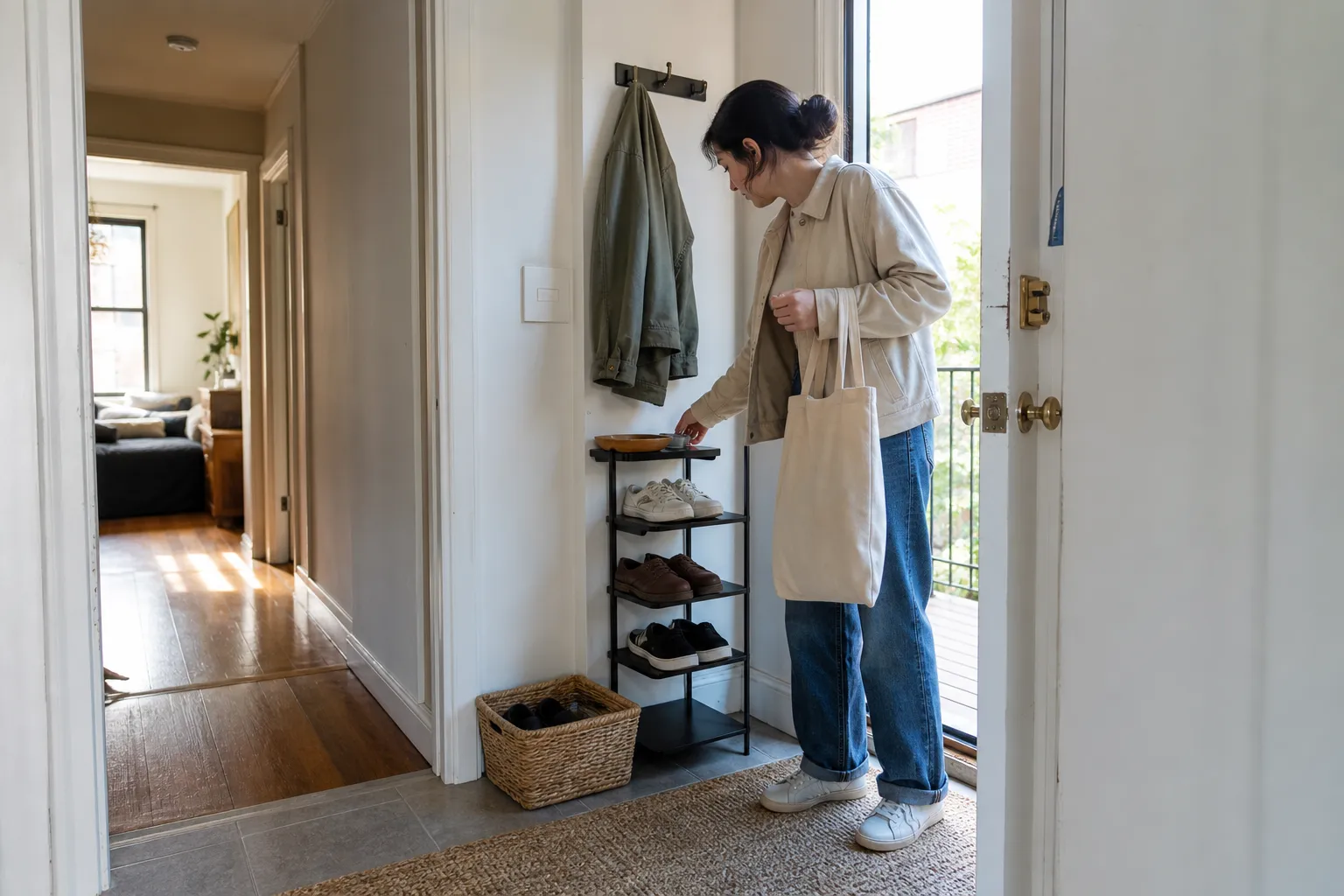
Layer 1: the floor zone
Place a narrow tray, shoe rack, or bench where shoes already land. Do not fight the natural drop point unless it blocks the door. If everyone enters and kicks shoes to the left, storage on the right may stay unused.
-
Layer 2: the hand zone
Add one small tray, bowl, or shelf-like surface for keys, wallet, transit card, sunglasses, or outgoing mail. A ceramic dish, wooden tray, or woven basket can give small objects a visible home without adding visual noise.
-
Layer 3: the light hanging zone
Use a removable hook, over-door hook, or freestanding stand only for items that truly need to hang near the door. One current jacket is easier to manage than a season’s worth of outerwear.
-
Layer 4: the exit check
Walk through the setup with full hands. Open the door, take off shoes, hang a bag, pick up keys, and leave again. If the sequence feels cramped, remove something.
This works because each piece has one job. The tray handles shoes. The bowl handles small objects. The hook handles one active item. The bench or rack stays low and steady. Nothing has to carry the whole household.
What Changes the Right Choice
The best removable entryway storage options depend on the rental, not just the product type.
Lease and building rules
Some leases limit wall attachments, door attachments, adhesive products, hallway storage, or changes visible from common areas. This article cannot tell you what your lease allows. If the rule is unclear, check your lease or ask the landlord or property manager before adding anything that touches walls, doors, trim, ceilings, or shared corridors.
“Lease friendly organization” means you are trying to reduce permanence and repair burden. It does not guarantee approval.
Surface condition
A smooth, sound surface is very different from flaking paint, wallpaper, old plaster, textured coating, or a recently patched wall. If the surface already looks fragile, avoid adhesive storage there. Use a floor piece, basket, or freestanding option instead.
Storage weight
Storage weight limits are not universal. They depend on the product, installation method, surface, item shape, humidity, pulling direction, and daily handling.
A hook that seems fine with a scarf may not behave the same with a loaded backpack. Keep heavy items on the floor whenever possible: shoes, full bags, tools, pet supplies, and bulky seasonal items.
Door clearance
Door clearance checks are essential with over-door storage. Even a thin bracket can change how the door closes. A rack that rubs each time may mark paint or trim over time, and a bulky hanging organizer can interfere with locks or movement.
Floor space
If your entry is only a narrow slice of hallway, choose storage that is shallow, low, and visually simple. A large bench may look calm in a photo but feel like furniture in the way. In very tight spaces, a tray plus one hook may be better than a full storage unit.
Common Misunderstanding: Renter-Friendly Is Not Risk-Free
The most common misunderstanding is that “renter-friendly” means an item cannot cause marks, residue, dents, wobble, or lease problems.
A more honest meaning is lower-commitment: easier to remove, less permanent than drilling, and often more adaptable at move-out.
Shoe tray or low basket
Good use: Shoes, slippers, umbrellas.
Main caution: Can become clutter if the category is too loose.
Narrow bench
Good use: Shoes plus sitting or bag drop.
Main caution: Needs enough depth and stable footing.
Slim open rack
Good use: Daily footwear.
Main caution: Shows clutter and may wobble if tall.
Freestanding coat stand
Good use: Coats and bags without wall contact.
Main caution: Can lean or tip if loaded unevenly.
Removable hooks
Good use: Light daily items.
Main caution: Surface compatibility and removal marks vary.
Over-door rack
Good use: Extra vertical storage where wall use is limited.
Main caution: Door clearance, rubbing, and hardware interference.
Tension piece
Good use: Vertical use without screws.
Main caution: Pressure points and stability depend on the room.
If the entryway is especially delicate—fresh paint, old plaster, wallpaper, a narrow door gap, or a strict lease—choose movable floor storage first. If you still need vertical storage, add the lightest reversible option and watch how it behaves during a normal week.
Think About Move-Out Before You Install Anything
A good temporary entryway organization plan is easy to undo.
Keep packaging or instructions for removable products. Photograph the condition of a questionable surface before adding anything. Avoid stacking several adhesive pieces in one visible area if you are unsure how the wall will respond.
At move-out, rushing removal can cause more trouble than the storage itself. Follow the product instructions, work slowly, and do not pry at paint or trim. If something feels stuck, stop and reassess instead of pulling harder.
Also think about cleaning. A shoe rack that traps grit behind it, a basket that scratches the floor when dragged, or a bench that blocks a vent can create daily maintenance problems. Add felt glides, a washable mat, or a tray only where appropriate for your floor surface, and make sure nothing traps moisture against wood or laminate.
A Calm No-Drill Entryway Formula
For most renters, the most useful formula is modest:
- One low shoe solution near the natural drop point.
- One small landing tray for keys and daily pocket items.
- One light hanging point for the current coat, tote, leash, or umbrella.
- One clear path from door to room, tested with the door fully open.
- One lease and surface check before using adhesives, over-door hardware, or pressure-fit storage.
That is enough for many apartments. If the entry still feels messy, the issue may not be the storage system. It may be that too many categories are being asked to live at the doorway. Move backup shoes, extra coats, parcels, and seasonal items away from the entrance.
No-drill storage works best when it respects the room’s limits. Keep heavy things grounded, daily objects visible, the walking line open, and wall commitments light. That is the difference between an entryway that looks organized for a day and one that stays useful through ordinary rental life.