Entryway decision guide
Entryway Bench Storage: When It Helps and When It Gets in the Way
Entryway bench storage helps when it supports something that already happens at the door: sitting to remove shoes, keeping a small daily shoe rotation nearby, or giving a bag a brief landing place without narrowing the route into the home. It gets in the way when it steals door-swing space, crowds a hallway, hides damp shoes, makes cleaning harder, or becomes the first flat surface where everything gets dropped.
The better question is not “Is a storage bench a good idea?” It is: does this bench earn the floor space it takes from your entryway? Open the door, walk the normal path, count the shoes that truly need to live there, and notice whether anyone actually sits down. In most homes, the answer is visible before you buy.
broader context
Parent topic
Use the broader page when you need more context before this narrower page.
When entryway bench storage genuinely helps
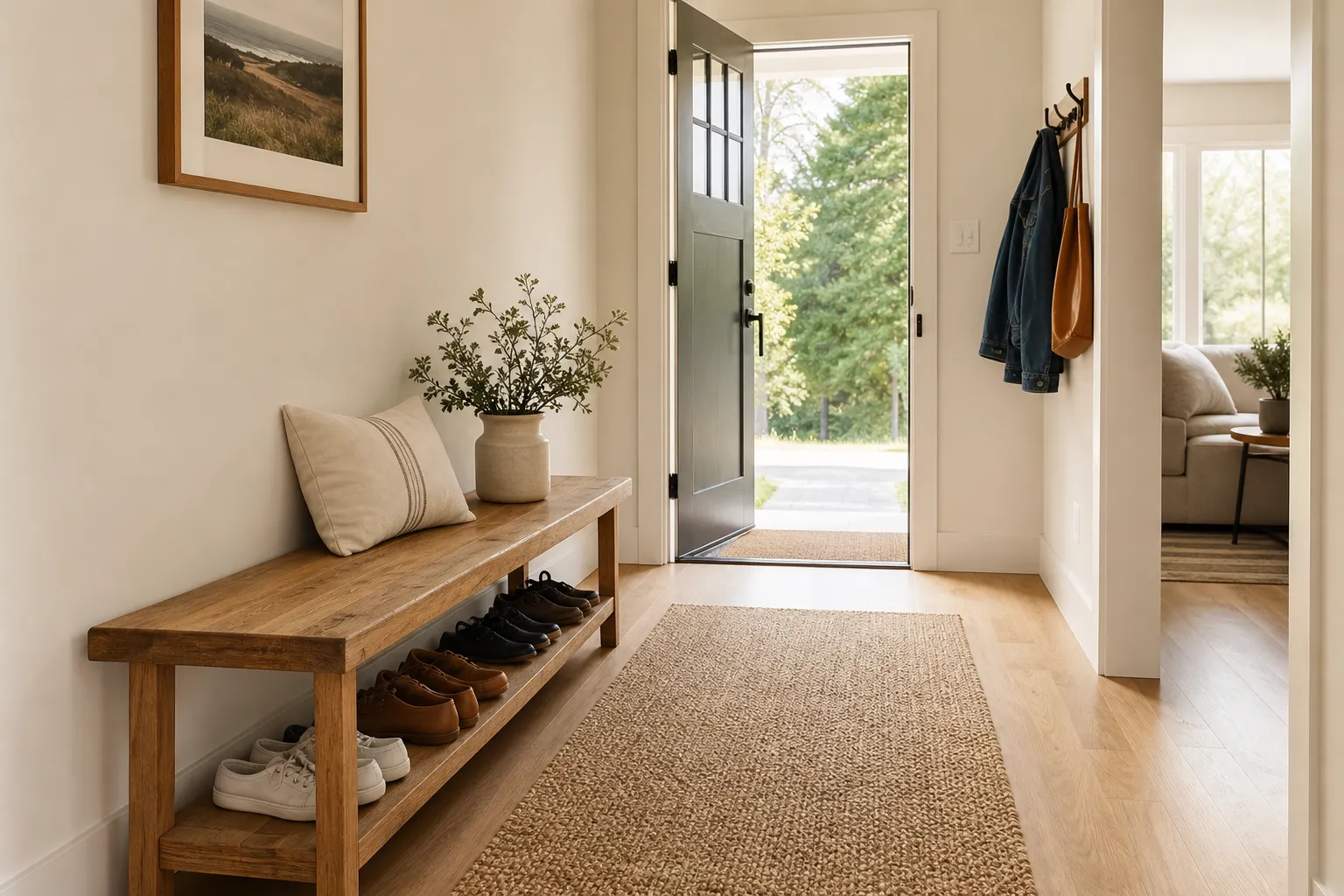
A bench with shoe storage works best when the entry has one repeated routine. Someone comes in, sits briefly, removes outdoor shoes, places them in the same low compartment, and moves on. The bench is doing a simple job well: the seat has a purpose, the shoes have a home, and the threshold feels less improvised.
It is especially useful when the entry is wide enough for both movement and sitting. A bench should not require everyone else to turn sideways while one person changes shoes. In a wider front hall, a small mudroom, or an apartment entry with a recessed wall, the bench can sit at the edge of the path rather than in it.
A shoe bench for entryway use also works better when the household owns fewer “door shoes” than the bench can hold. If the bench fits six pairs and the household regularly leaves fifteen pairs near the door, the furniture will not create order by itself. It will hold the favorites and leave the rest as overflow.
The best cases are modest
- One or two people regularly sit to tie shoes or remove boots.
- Only current-season footwear stays by the door.
- The bench can sit along a wall without blocking a closet, radiator, vent, outlet, or door swing.
- Wet shoes have somewhere to dry before being tucked away.
- The seat is cleared daily instead of becoming a permanent unloading shelf.
In those rooms, entryway bench storage is not about adding more furniture. It removes one small decision: shoes go there, the seat is for changing shoes, and the path stays open.
When a bench becomes an obstruction
The first warning sign is that the doorway starts to feel negotiated. If the front door, closet door, interior door, or stair route has to work around the bench, the bench is asking too much of the space.
Doors are active parts of a room. They swing, pull, push, pause, and gather people at awkward moments. Research on door-opening movement and indoor obstacles is not a furniture-buying manual, but it does support a plain design lesson: objects near movement points change how people pass through. In an entryway, that matters because people often arrive carrying bags, packages, umbrellas, groceries, children’s items, or wet outerwear.
Test the door area in its most demanding state
- 1Open the front door fully.
- 2Open the coat closet or nearby cabinet.
- 3Stand where someone would sit.
- 4Walk past with a bag in one hand.
- 5Imagine two people entering at the same time.
- 6Check the path in low evening light, not only in bright daytime.
If the bench makes any of these movements clumsy, a smaller solution may serve the entry better: wall hooks, a shallow shoe tray, a narrow stool, or a closed cabinet placed away from the door.
A narrow apartment hall bench needs extra caution. In a slim corridor, even a beautiful wood bench can turn a clean line into a daily squeeze. The issue is not only bench depth. It is the combination of bench, shoes sticking out, basket handles, open cabinet doors, hanging coats, and the person standing there to use it.
A bench can also be a poor fit if it blocks cleaning access. Entryways collect grit, leaves, dust, rain marks, and winter residue. If the bench is too heavy to move, too low to clean under, or too full of baskets to maintain, the area may look calm from above while collecting mess underneath. A bench that helps with shoe changing but makes sweeping awkward may not be a net improvement.
Storage is not the same as shoe care
Many people search for entryway bench storage because the visible problem is footwear: crowded floors, separated pairs, and a doorway that never feels settled. A bench can gather shoes, but ordinary bench storage should not be expected to dry footwear, remove odor, improve air conditions, or preserve materials in any guaranteed way.
That distinction matters. A simple bench with open shelves, baskets, cubbies, or cabinet doors is not the same as a specialized drying cabinet. It may keep shoes off the floor. It may make pairs easier to find. It may reduce visual scatter. But damp shoes still need air and time before they are enclosed.
Open shelves
Open shelves make it easier to see what is there and may be easier to air out.
Baskets
Baskets soften the look but can hide dampness and encourage overfilling.
Closed cabinets
Closed cabinets reduce visual clutter but can keep wet or dirty shoes out of sight.
Upholstered benches
Upholstered benches near wet footwear usually need more care than wipeable surfaces.
Rattan, cane, and woven details
Rattan, cane, and woven details can look light, but grit may settle into the texture.
These are practical checks, not universal material rules. Manufacturer care instructions still matter, especially for wood finishes, fabric upholstery, metal frames, woven panels, and composite materials. If the entry gets damp, sandy, or muddy, choose a bench you will realistically clean, not only one that photographs well.
Sometimes a small tray beside or beneath the bench is more useful than extra cubbies. If shoes need to dry before being stored, the bench should support that routine rather than hide it.
The clutter drop zone problem
A bench is a seat, but it is also a flat surface. In a busy entryway, flat surfaces attract mail, gloves, tote bags, returns, pet leashes, school items, and things that are “just for now.” This is where entryway bench storage can quietly become the opposite of calm.
The bench becomes a clutter drop zone when its purpose is vague. If the seat is sometimes for sitting, sometimes for parcels, sometimes for laundry, sometimes for bags, and sometimes for shoes, no one knows what counts as “put away.” The bench still looks like storage, but it functions like a waiting room for undecided objects.
A useful bench has a narrow job
- The seat stays clear enough for one person to sit.
- The lower shelf holds only current daily shoes.
- Hooks above hold active coats or bags, not deep storage.
- Baskets are assigned by person or purpose, not treated as mystery bins.
- Anything that does not belong at the door is moved during the daily reset.
An entryway bench with hooks or a coat rack can help in a small home, but it can also concentrate too much life at the threshold. Coats hang over the seat, bags cover the bench, shoes fill the base, and the first view into the home becomes a dense vertical stack. If the household already struggles to clear the doorway, adding more storage above the bench may increase the load rather than solve it.
The calmer choice is sometimes less storage. A narrow bench without lower compartments, paired with a shoe shelf inside a closet, may work better. Or a low shoe cabinet without seating may be enough if no one actually sits down.
A quick room check before buying or keeping one
Use this check in the actual entryway, not from a product photo.
1. Watch the routine for two days.
Who enters most often? Do they sit, stand, lean, or walk straight through? A bench for a household that never sits becomes display furniture with storage attached.
2. Count only the shoes that need to live at the door.
Do not count the entire shoe collection. Count the pairs used this week. If that number is already larger than the bench can hold, decide where overflow will go before buying.
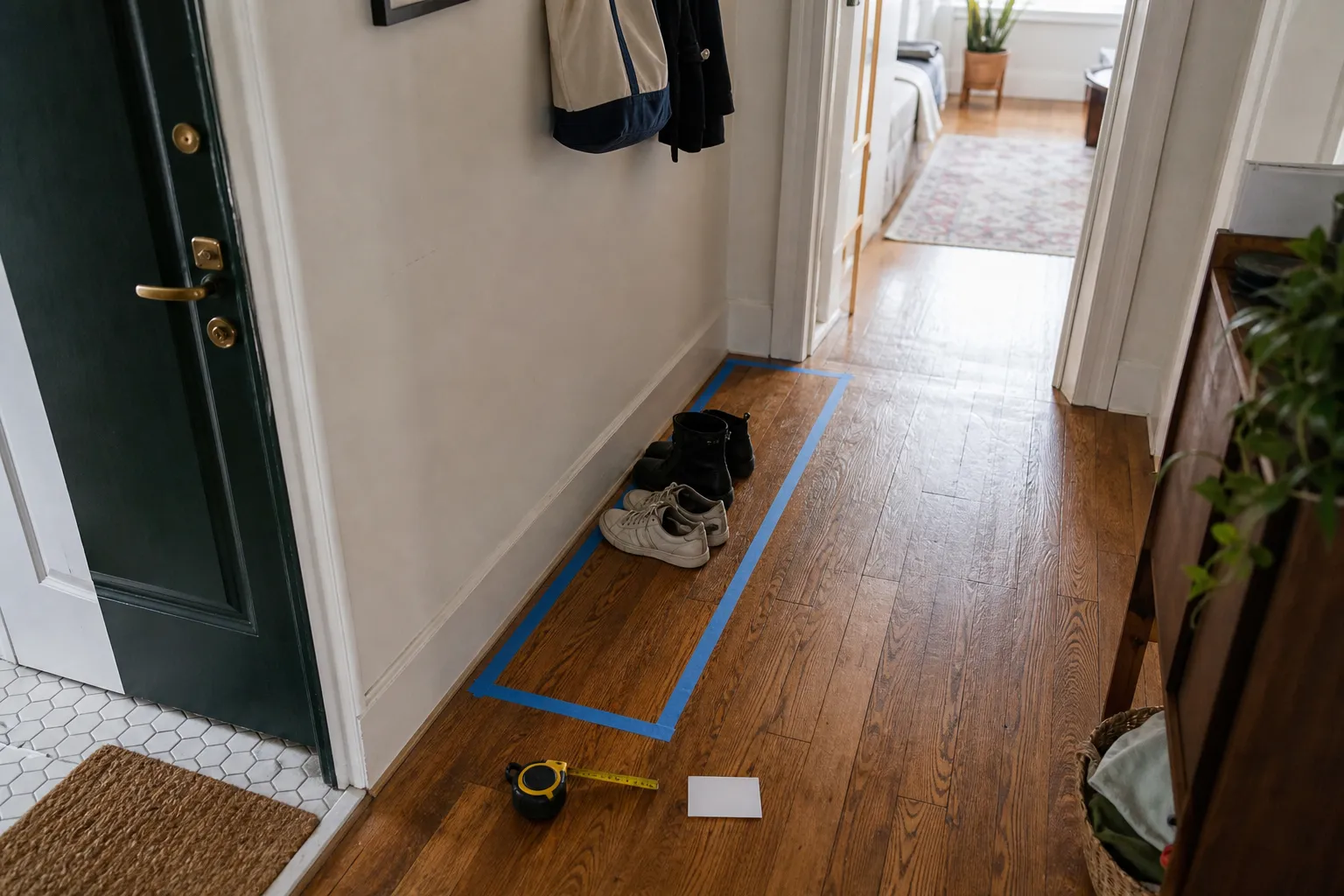
3. Test door swing and bench placement.
Mark the proposed footprint with painter’s tape, boxes, or a folded blanket. Open every nearby door. If the marked area feels annoying during the test, the real bench will not feel smaller.
4. Leave room for standing, turning, and carrying.
Entryways are not still-life arrangements. People arrive with objects in hand. If the bench makes the normal path bend sharply, it may be better placed elsewhere or skipped.
5. Check cleaning access.
Can you sweep or vacuum around it without removing half the contents? Can grit be seen and reached? If not, the bench may make the entry look more finished while making maintenance less likely.
6. Think about damp seasons.
Rain, snow, garden soil, beach sand, and humid weather change how shoe storage behaves. Open storage, trays, and easy-to-wipe surfaces may matter more than extra compartments.
7. Decide what the seat is not for.
If the seat must remain usable, make that part of the household routine. Without a clear limit, the bench may quickly become the easiest place to drop anything.
Better fits and poor fits by entry type
A storage bench is usually a better fit in a wider entry, a mudroom, a covered porch transition, or a front hall with a clear wall that is not needed for door movement. In these spaces, small entryway seating can make removing shoes feel settled without making the route feel crowded.
It can also work in a rental if the bench is freestanding, light enough to move for cleaning, and does not require wall mounting. For renters, the simplest version is often best: a low bench, an open shelf, and a removable tray or baskets.
It is a weaker fit in a narrow hallway where the front door opens directly into the walking path. It is also a weak fit where the entry already has competing functions: stroller parking, pet supplies, laundry overflow, package storage, or a door that opens into a tight corner. In those cases, a bench may become one more object in an already compressed zone.
A modern entryway bench storage unit, a wood bench with baskets, or a narrow cabinet-style bench can all work if the room supports them. The category matters less than the behavior around it. A well-made bench in the wrong path is still in the way. A simple stool and a shoe tray in the right spot may serve the entry better.
What an entryway bench cannot promise
A bench can organize a limited number of objects. It cannot make people own fewer shoes, dry footwear properly, stop dropping bags, or keep the seat clear. It also cannot solve a doorway that is too narrow for the furniture being added.
The available research around indoor movement, door operation, compact living, and entry transitions supports only modest conclusions for this topic: furniture placement affects how people move, doors need working room, and small homes require tradeoffs between storage and circulation. It does not provide universal rules for ideal entryway bench clearance, shoe capacity, moisture handling, odor control, material durability, or every household condition.
So the most reliable decision is local and observable. If the bench gives you a real place to sit, holds the shoes that truly belong there, leaves the door and walkway comfortable, and can be cleaned around without resentment, it helps. If it narrows the first steps into the home, hides damp clutter, or becomes a permanent pile, it gets in the way.