Natural Material Choices for Entryway Shoe Storage
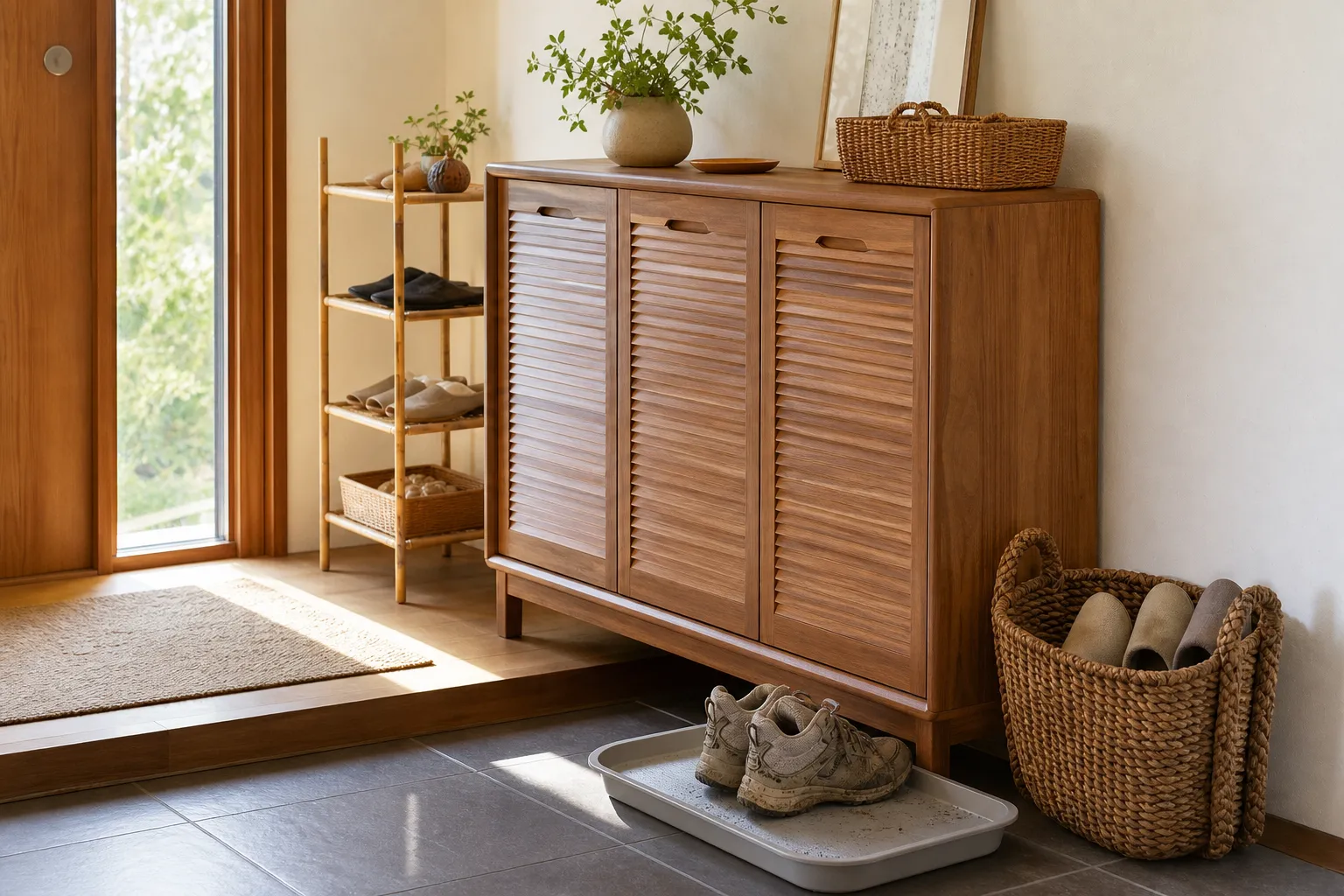
For most entryways, the best natural shoe storage materials are finished wood, bamboo, and rattan used in the right place. Finished wood works well when you want a quiet, cabinet-like piece. Bamboo suits a lighter open rack. Rattan and other woven natural fibers are best for dry storage, baskets, or airy door panels.
The choice should start with the room, not the label. If shoes often come in wet, muddy, or snowy, choose open storage with a removable tray before choosing the prettiest natural cabinet. If the entry stays mostly dry and you want the first view of the home to feel settled, a well-finished wood shoe cabinet can be the better fit.
broader context
Parent topic
Use the broader page when you need more context before this narrower page.
The quick material match for a real entryway
A natural entryway piece has to hold shoes, survive grit, and still soften the first view of the home. Wood, bamboo, and rattan can all do that, but they do not handle damp soles and daily rubbing in the same way.
Finished wood shoe cabinet
Works best when: You want closed storage, visual calm, and a furniture-like entry.
Watch closely for: Damp shoes trapped inside, finish wear, lower shelves that are hard to wipe.
Bamboo shoe rack
Works best when: You want a light, open rack with a warm natural look.
Watch closely for: Construction type, finish quality, side-to-side wobble.
Rattan entryway storage
Works best when: You want airy texture, baskets, or woven panels.
Watch closely for: Moisture exposure, snagging, dust in the weave, weak support under heavy shoes.
Seagrass, water hyacinth, or other woven baskets
Works best when: You need flexible sorting for slippers, sandals, or accessories.
Watch closely for: Wet footwear, crushed fibers, cleaning difficulty.
Mixed material storage with a wood or bamboo frame and removable tray
Works best when: You want natural warmth but easier cleaning under soles.
Watch closely for: Whether the natural parts are protected from standing water.
A useful rule: let natural materials provide the frame, door, basket, or visible surface; let a tray, washable mat, or wipeable insert handle the wettest part of the shoe routine.
Wood shoe cabinets: calm appearance, with moisture kept outside
A wood shoe cabinet is usually the most visually settled choice. It hides everyday clutter, reads like furniture, and can hold a bowl, keys, a lamp, or a small seasonal object without making the entry look busy.
Its weakness is often the same thing that makes it appealing: closed storage. Wet shoes shut inside a solid cabinet may dry slowly, leave marks, and make the lower shelves harder to clean. Because the source set here is stronger on bamboo and rattan than on finished household wood furniture, the wood guidance should stay practical and modest: look for a protective finish, keep standing water off shelves, and follow the maker’s cleaning and load instructions.
Choose a wood cabinet when
- Your entry is mostly dry before shoes are stored.
- Very wet footwear can sit first on a mat or boot tray.
- The cabinet has vents, slats, gaps, or another path for air movement.
- The lowest shelf can be wiped without dismantling the unit.
- The piece feels stable for its height, depth, and likely use.
Be more cautious when
- Rain, snow, or garden mud regularly comes inside.
- The cabinet is deep, tightly packed, and unventilated.
- The lower shelves are unfinished or rough.
- The unit is tall, narrow, or top-heavy.
- Children may pull on doors or climb shelves.
Wood is not a poor entryway material. It simply works best when the wettest part of the day happens outside the cabinet.
Bamboo shoe racks: light and open, but not automatically water-ready
A bamboo shoe rack often suits a small entry because it looks lighter than a solid cabinet and lets more air move around shoes. Bamboo’s appeal is easy to understand: it has a clean linear grain, a familiar place in many Asian material traditions, and a lighter visual presence than many dark woods.
The important limit is that “bamboo” is not one uniform product. Its performance depends on species, processing, treatment, construction, adhesive, and finish. Research on bamboo materials repeatedly notes that treatment and moisture exposure affect stability and durability. That does not mean every consumer bamboo rack is built for wet shoes.
Check the construction rather than the label alone
- Solid round bamboo: often used for rails or legs; look closely at joints and splitting points.
- Laminated bamboo: made from strips or layers; can be stable when well made, but edge sealing and finish still matter.
- Bamboo veneer over another board: may show bamboo on the surface while the core behaves differently.
- Bamboo composite or engineered board: may be more uniform, but care depends on the specific product.
A bamboo rack is a good fit for everyday shoes that are not dripping wet, slippers, indoor shoes, or a small rotation of frequently worn pairs. It is less suitable as the only landing place for soaked boots unless you add a tray beneath it or choose a design where water cannot sit against bamboo parts.
Look for raised feet, sealed surfaces, smooth edges, and cross-bracing. In a narrow hallway, even a small wobble becomes noticeable because people brush past the rack often.
Rattan and woven storage: texture for dry use
Rattan entryway storage gives a different kind of softness. Instead of the solid quiet of a cabinet, it brings shadow, texture, and visual lightness. A rattan-front cabinet, a woven bench basket, or open baskets under a console can make shoe storage feel less hard-edged.
The tradeoff is moisture and load. Rattan and similar natural fibers should not be treated as waterproof or as equal to a rigid shelf. Research on rattan cane describes variation by species, diameter, and cane position, along with moisture-related limits common to natural lignocellulosic materials. For entryway use, the practical takeaway is simple: keep woven natural fiber construction away from standing water and heavy damp use unless the product is specifically designed and finished for that condition.
Use rattan or woven storage for
- Dry shoes, slippers, scarves, bags, or small accessories.
- Cabinet door fronts where the frame carries the load.
- Baskets that can be lifted out and shaken or vacuumed.
- Entries where visual lightness matters more than maximum durability.
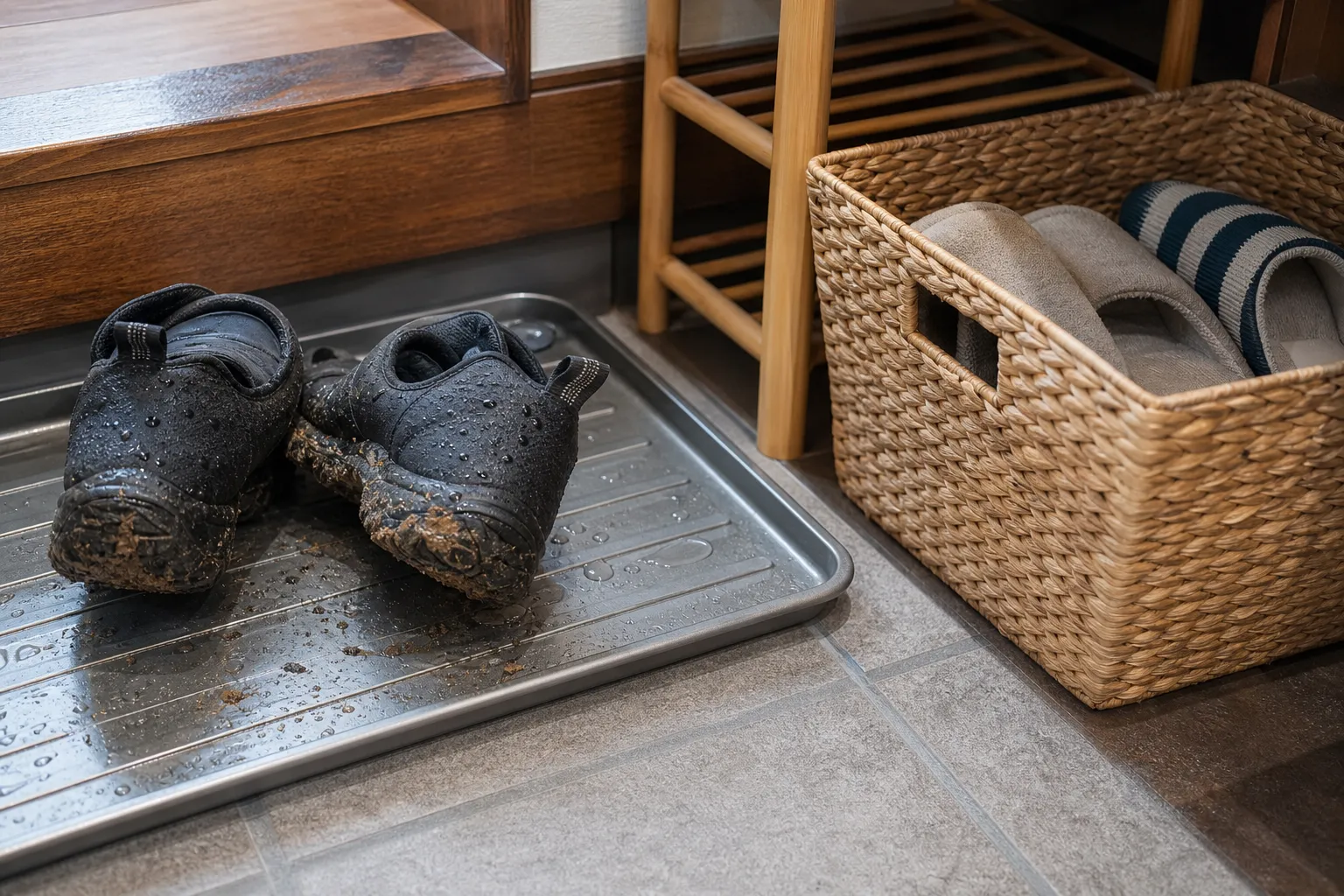
Avoid using delicate woven baskets as the main container for muddy boots. Mud can lodge in the weave, wet soles can press moisture into fibers, and cleaning access is poor. If you like woven entryway storage but live with rain or snow, pair it with a practical wet zone: a boot tray near the door and woven baskets for dry pairs or household slippers.
What changes the answer
The best material changes once you picture the entryway as a daily route rather than a product photo.
Damp shoes come first
If shoes often arrive wet, prioritize open shelves, a boot tray, or a washable insert. Repeated wet contact can mark surfaces, darken fibers, loosen joints, or make cleaning harder.
Airflow changes how closed storage performs
Open racks expose shoes to more air than closed cabinets. Closed cabinets can still work if they have vents, slats, open backs, raised bases, or enough internal space.
Cleaning access decides whether the piece stays pleasant
A rack with narrow gaps may trap grit. A fixed lower shelf may be awkward to wipe. Woven baskets collect dust in the weave. Before buying, imagine cleaning mud from the lowest level on a weekday evening.
Weight and stability matter in narrow entries
Check product documentation for load limits, assembly guidance, and anchoring instructions where relevant. A tall narrow cabinet needs more care than a low bench or rack. Heavy shoes stored high can make a light unit feel less settled.
Footprint is not just wall width
Leave room for opening doors, pulling baskets, standing while changing shoes, and passing through the entry with a bag or coat.
A practical buying check before choosing “natural”
Natural material language can be vague. Two products may both be sold as bamboo or rattan while using very different construction. Before choosing, inspect the parts that will take the most wear.
Use this quick check
- Where do wet soles touch? Prefer a tray, washable mat, sealed shelf, or raised rack surface.
- Can air move around shoes? Look for open shelves, slats, vents, or spacing.
- Can the lowest level be cleaned easily? If not, grit and moisture will be harder to manage.
- Is the surface finished or raw? A protective finish usually matters near entry dirt and moisture.
- How is the material built? Solid wood, veneer, laminated bamboo, and woven fiber do not wear the same way.
- Does it wobble? Check frame shape, bracing, feet, and height.
- Will the material age in a way you accept? Wood may show scuffs, bamboo may darken or mark depending on finish, and woven fibers may loosen or collect dust.
- Does the footprint fit real movement? Measure the path where people turn, bend, and pass each other.
For a household with many wet shoes, a mixed solution is often more practical than a fully natural one: a wood or bamboo frame for warmth, paired with a removable metal, rubber, or washable tray at the bottom.
Common confusion about natural shoe storage materials
One common mistake is treating “natural” as if it means low-maintenance. Natural materials can be tactile and visually warm, but moisture, grit, sunlight, and repeated rubbing still change them over time.
Another mistake is assuming bamboo is always the strongest choice. Bamboo can be light and strong, but bamboo products vary widely. Treatment, construction, joints, finish, and indoor conditions all affect performance.
A third mistake is using rattan baskets for every kind of shoe. Rattan and woven natural fibers are better for dry, lighter storage than for soaked boots. They often work best as texture, door panels, dry baskets, or accessory storage rather than the wettest landing zone.
The most balanced choice
For a dry entry where visual calm is the priority, choose a finished wood shoe cabinet with ventilation and easy-clean lower shelves. For a small or moderately damp entry, choose an open bamboo shoe rack with sealed surfaces and a removable tray. For texture and lightness, use rattan or woven entryway storage for dry shoes, slippers, or baskets, while keeping wet footwear on a separate tray.
The best natural shoe storage is not the most “natural” object in the room. It is the piece that fits the daily path from door to floor: wet shoes first, airflow next, cleaning access always, and material beauty where it can age without being asked to do the wrong job.