How to Make a Quiet Nook in a Small Living Room
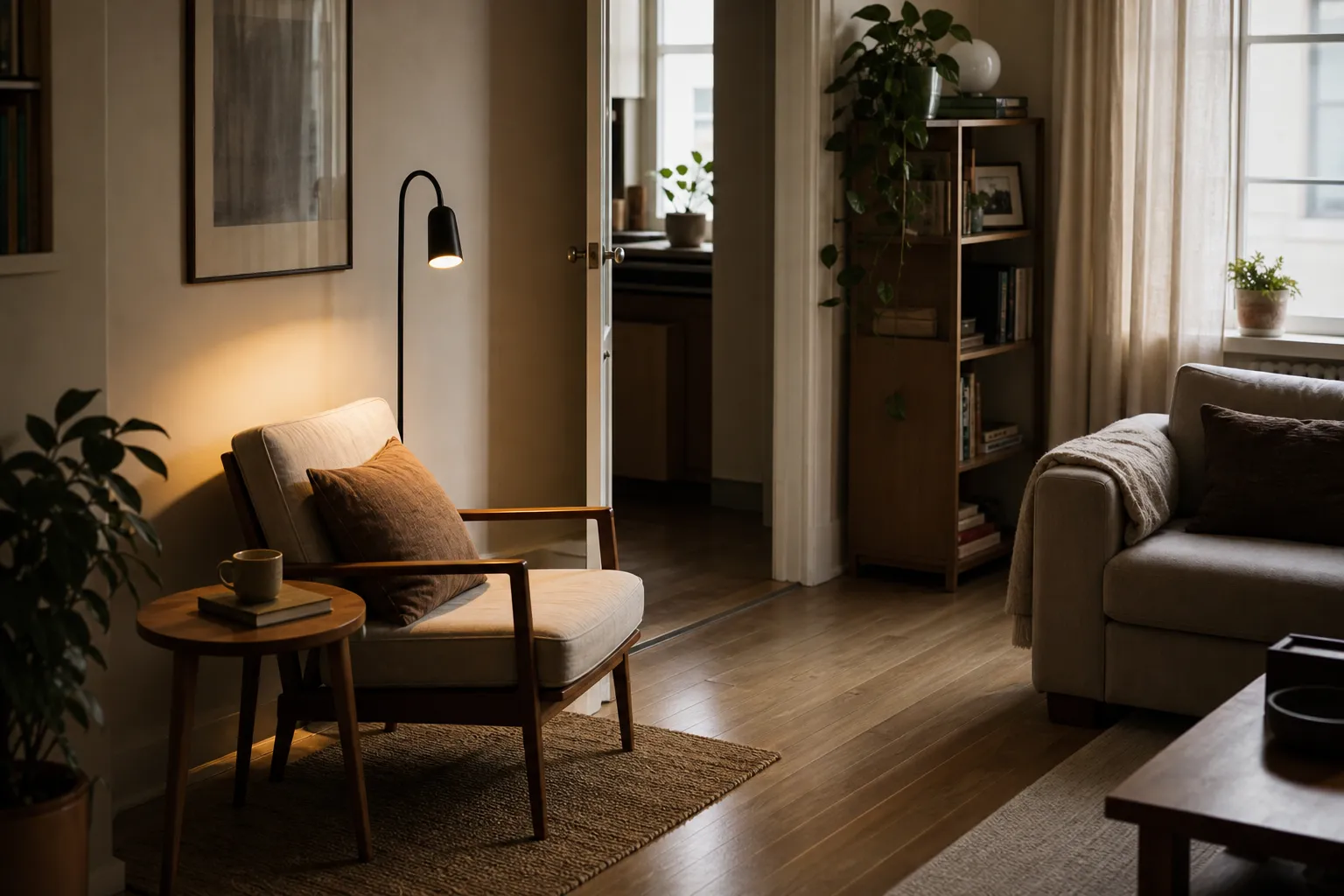
To make a quiet nook in a small living room, choose one underused corner, add one compact seat, give it a small surface and its own directed light, then mark it gently with a rug, shelf, plant, textile, or material change. Keep the main walking route open before you add anything decorative.
The aim is not to create a silent room inside a room. It is to make one small sitting corner feel visually settled, easy to use, and separate enough from the busier sofa, TV, or entry area.
A good nook usually needs less than people expect:
- one comfortable, well-scaled seat
- one place to set a cup, book, or glasses
- one focused light source
- one soft zoning cue
- enough empty floor to sit down without squeezing past furniture
broader context
Parent topic
Use the broader page when you need more context before this narrower page.
Start with the least disruptive corner
In a small living room, the best nook is not always the prettiest corner. It is the corner that interrupts movement the least.
Look for a place that meets most of these conditions:
- It is not on the direct path between the entry, sofa, TV, balcony door, storage, or kitchen.
- It has a nearby wall for a shelf, lamp, or small artwork.
- It can hold a chair without forcing people to turn sideways as they pass.
- It does not block window access, radiator access, curtains, or a cabinet door.
- It can borrow daylight or use a plug-in lamp without a cord crossing the walking route.
A small living room quiet corner often works beside a window, at the end of a sofa, near a bookcase, or in a shallow recess. If the room is narrow, the nook may need to sit along a wall rather than diagonally across the corner. Angled chairs can look inviting in photos, but in a tight room they often take up more usable floor space than a straight placement.
Before moving heavy furniture, test the area. Use painter’s tape, a folded blanket, or a few stacked books to mark the rough footprint of the chair, side table, and lamp base. Then walk through the room the way you actually use it: from the door to the sofa, from the sofa to the window, from the kitchen with a drink in hand, and around any cabinet or storage you open often.
If your hip, bag, knee, or laundry basket keeps catching the marked area, the nook is too large or in the wrong place.
This route test matters more than styling. Living-room design research often connects furniture arrangement, lighting, and open space with how efficient or comfortable a room feels. In a small home, the practical version is simple: the nook should borrow unused space, not steal the room’s main path.
Choose one compact seat, not a full lounge setup
The seat decides whether the nook works. A compact chair for nook use has to fit both the body and the room. If it is comfortable but too deep, too wide, or too high-backed for the corner, the living room will feel more crowded.
Good candidates include:
- a small upholstered armchair with slim arms
- a low-back chair near a window to keep sightlines open
- a compact armless chair if arms would make the seat too wide
- a small chaise only if the room has enough length and the chaise does not cut across the path
- a storage bench under a window if the nook is for tea, reading, or short sitting rather than long lounging
Avoid starting with a large recliner, oversized accent chair, or broad chaise unless the room already has generous circulation. More seating is not always better in a small living room. One well-scaled chair can make a small sitting corner feel intentional; two chairs and an ottoman can make the same corner feel like overflow storage.
Pay attention to the chair back. A high back can give the nook more enclosure, but it may also block daylight, views, and the visual line across the room. Low-back seating near windows often keeps the room feeling lighter. That is a tradeoff, not a rule: if the view is poor or the chair sits against a blank wall, a slightly taller back may be fine.
Also match the seat to the actual use. If the nook is for reading, the chair needs enough upright support and a reliable light. If it is for a morning cup of tea, a cushioned bench and narrow shelf may be enough. If it is for occasional guests, choose a chair that can turn slightly toward the sofa without blocking the room.
The useful test is: can you sit there without moving three other things? If not, reduce the setup.
Add a small surface and a lamp that solve real use
A quiet-feeling nook fails quickly when there is nowhere to put a book, cup, glasses, or phone. The surface does not need to be large. It can be a narrow round table, a C-shaped table, a nesting table, a wall shelf, or the top of a storage ottoman.
Choose the surface by obstacle, not by style:
The surface should be reachable from the chair without projecting into the walking line. Round or oval tables can be forgiving in tight routes because they have no sharp corners, though they still need enough floor room.
Lighting is the next practical layer. A task lamp for reading nook use should aim light where the activity happens instead of brightening the whole living room. This can be a small table lamp, a wall-mounted plug-in lamp, or a floor lamp for a quiet corner. The right choice depends on where the cord, switch, shade, and base will sit.
A floor lamp works when there is no table large enough for a lamp. Choose one with a stable base and a shade or arm that directs light toward the chair. A table lamp works if the side table is steady and not overloaded. A wall lamp can save surface space; renters may prefer plug-in versions that do not require permanent wiring.
Cord placement is part of the design. Do not run lamp cords across the main path, under a loose rug edge, or where feet will catch them. If the nearest outlet forces a cord through the walking route, choose another corner, a different lamp type, or a battery light only if it gives enough usable light for the task.
Lighting research suggests that fixture arrangement and lighting style can affect how people read a living room. For this small task, the takeaway is modest: give the nook its own focused light so it reads as a distinct place, especially in the evening.

Use soft zoning instead of building a divider
A quiet nook in a small living room does not need a screen, partition, or renovation. In many small rooms, a hard divider makes the space feel smaller and blocks light. Soft zoning is usually enough.
Soft zoning means giving the nook a few visual cues that say, “this is a separate sitting spot,” while keeping the room open. Useful cues include:
- a small rug under the nook chair
- a wall shelf above or beside the chair
- a floor lamp that creates a pool of light
- a cushion or throw in a quieter texture than the main sofa
- one plant that marks the edge without forming a wall
- a low bookcase or the end of a sofa acting as a gentle boundary
- a slightly different wall tone, artwork, or natural material texture
A rug under the nook chair can work well if the living room already has one larger rug near the sofa. The nook rug should be small enough not to compete with the main seating area, but large enough that the chair does not look stranded. If a second rug makes the room visually busy, skip it and use light, a shelf, or a textile instead.
The same restraint applies to plants and objects. One plant can soften the edge of the nook. Five pots, a basket, a stack of books, a lantern, and a floor cushion may turn the corner into clutter. Plants only help if they fit the light conditions and leave the floor clear.
This is where an Eastern-inspired approach can stay practical rather than decorative. Let the nook hold fewer, better-chosen objects: a chair with a natural fabric, a ceramic cup on a small table, a woven basket for one blanket, a warm lamp, a plain shelf with the books currently in use. The atmosphere comes from spacing and care, not from filling the corner with themed items.
Reduce clutter before buying more furniture
A small sitting corner often appears through removal, not addition. Before shopping, clear the candidate corner completely. Remove old magazines, unused baskets, extra stools, cable tangles, plant stands, and objects that no longer serve the room. Then add back only what the nook needs.
A useful sequence:
- Empty the corner.
- Place the chair.
- Check the walking route.
- Add the lamp.
- Check the cord and switch access.
- Add one surface.
- Add one soft item, such as a cushion, throw, or rug.
- Stop and live with it for a few days before adding more.
Vertical storage can help if the nook attracts books, blankets, chargers, or tea things. A wall shelf for nook storage keeps small items off the floor. A narrow vertical bookcase can work if it does not crowd the chair or block light. A basket is useful only when it has a specific job. Storage that becomes a mixed pile will make the corner feel busier.
Microapartment design research often emphasizes matching furniture and storage choices to actual user needs. That idea is useful here. Do not add space saving nook furniture just because it has hidden compartments. Add it only when it solves a real problem: nowhere for the current book, no place for a blanket, no landing spot for a cup, or no way to keep the floor clear.
If the living room already has visual noise, edit the surrounding area too. Clear the nearby windowsill. Reduce the number of objects on the adjacent media unit. Keep only one or two items on the side table. A nook cannot feel settled if it sits inside a crowded ring of unrelated things.
What can change the answer
The best setup depends on the room’s shape and daily use.
If the living room is also a passage to another room, circulation comes first. The nook may need to be a wall shelf, stool, and lamp rather than a full armchair.
If children, pets, or frequent guests use the room, avoid unstable lamp placements and pieces that are easy to knock.
If the room is long and narrow, place the chair parallel to the long wall and use a rug or lamp to define the zone instead of turning the chair outward.
If the only available corner is beside a window, low-back seating may keep the room feeling more open.
Sound expectations also need care. A quiet nook is not soundproof. It may feel less busy because it is visually defined and away from the main traffic line, but it will not block neighbor noise, street noise, television sound, or household activity. Home soundscape research shows that people have different sound preferences depending on the activity. For a small living room, treat the nook as a preferred sitting spot, not an acoustic fix.
Common confusion about small living room nooks
Do I need a divider?
Usually, no. A divider can help in some rooms, but it can also block light and make a small living room feel chopped up. Try a rug, lamp, shelf, plant, or chair angle first.
Should the nook match the sofa area?
It should relate to the room, but it does not have to match exactly. Repeating one material, color, or texture is enough. For example, a wooden side table in the nook can connect with a wooden media unit across the room.
Can I make a nook without buying a new chair?
Yes, if you already have a chair that fits. Move it into the least disruptive corner, add a focused light, and remove nearby clutter. If the chair blocks the route or overwhelms the corner, the problem is scale, not styling.
Is a corner always best?
Not always. A corner is often practical, but a window bay, the end of a sofa, or a short wall between two openings may work better. The right place is the one that gives you a usable seat while keeping clear paths in the small living room.
The strongest version is still simple: one compact seat, one small surface, one directed light, one soft zoning cue, and enough open floor to move through the room without negotiation.