Room setup guide
Small Quiet Corner Ideas for Real Rooms
A small quiet corner usually begins with an ordinary room problem: one unused corner, one awkward window, one chair that almost fits, or one shared space where every “cozy” idea starts blocking the walkway. Good small quiet corner ideas are not about copying a styled photo or pretending you have a spare room. They are about choosing a spot that can actually be used, adding a seat that fits both the body and the floor plan, softening light and noise where possible, and leaving enough empty space for daily life to continue around it.
Think of the corner as a small sitting place with a clear job: reading, tea, looking out the window, writing, handwork, or sitting apart from the main activity of the room for a few minutes. Once that job is clear, the choices become much easier.
broader context
Parent topic
Use the broader page when you need more context before this narrower page.
Start With the Corner That Works, Not the Corner That Looks Best
The prettiest corner is not always the most usable one. A window may have beautiful morning light but harsh afternoon glare. A corner beside a bookshelf may look intimate but leave no space for knees, a cup, or a lamp. A corner far from the sofa may seem quiet until the refrigerator, stairwell, street, or television becomes the louder presence.
Before buying anything, test three things:
Sound at different times of day
Sit in each possible corner in the morning, evening, and one busy household moment. If one side of the home faces traffic or a shared hallway, another corner may be noticeably easier to use.
Movement through the room
Walk the normal route from door to sofa, bed, desk, kitchen, or balcony. A quiet nook should not make everyone turn sideways.
Light and temperature
Sit there for ten minutes when the sun is strongest. Window-side corners often need glare control, seasonal heat control, or a warmer evening light source before they feel usable.
Research on quieter sides of dwellings near road traffic supports a simple home-design lesson: orientation matters. The side of a home facing away from stronger road noise can feel very different from the exposed side. For a small sitting corner, this does not need to become a technical measuring project. Compare real corners by what you actually hear and feel, not by appearance alone.
A quiet nook in a small living room might be the corner near a side window, but it could also be the inside wall beside a low cabinet if that spot avoids the television path. In a bedroom, it may be the space near a dresser rather than the space beside the bed. In a studio apartment, it may be nothing more than a chair angled toward a window with a small table pulled close only when needed.
Small Quiet Corner Measurements That Keep the Room Usable
A small sitting corner fails when it steals too much from the room around it. The goal is not to fill the corner; it is to create a usable pause point while keeping circulation clear.
Use these rough checks before committing to furniture:
Small-space housing studies often point to a practical principle: function and spatial flexibility matter more than decorative accumulation. In plain room terms, the corner should earn its floor area. A chair, cushion, stool, tray, basket, shelf, or built-in ledge should each solve a real use problem.
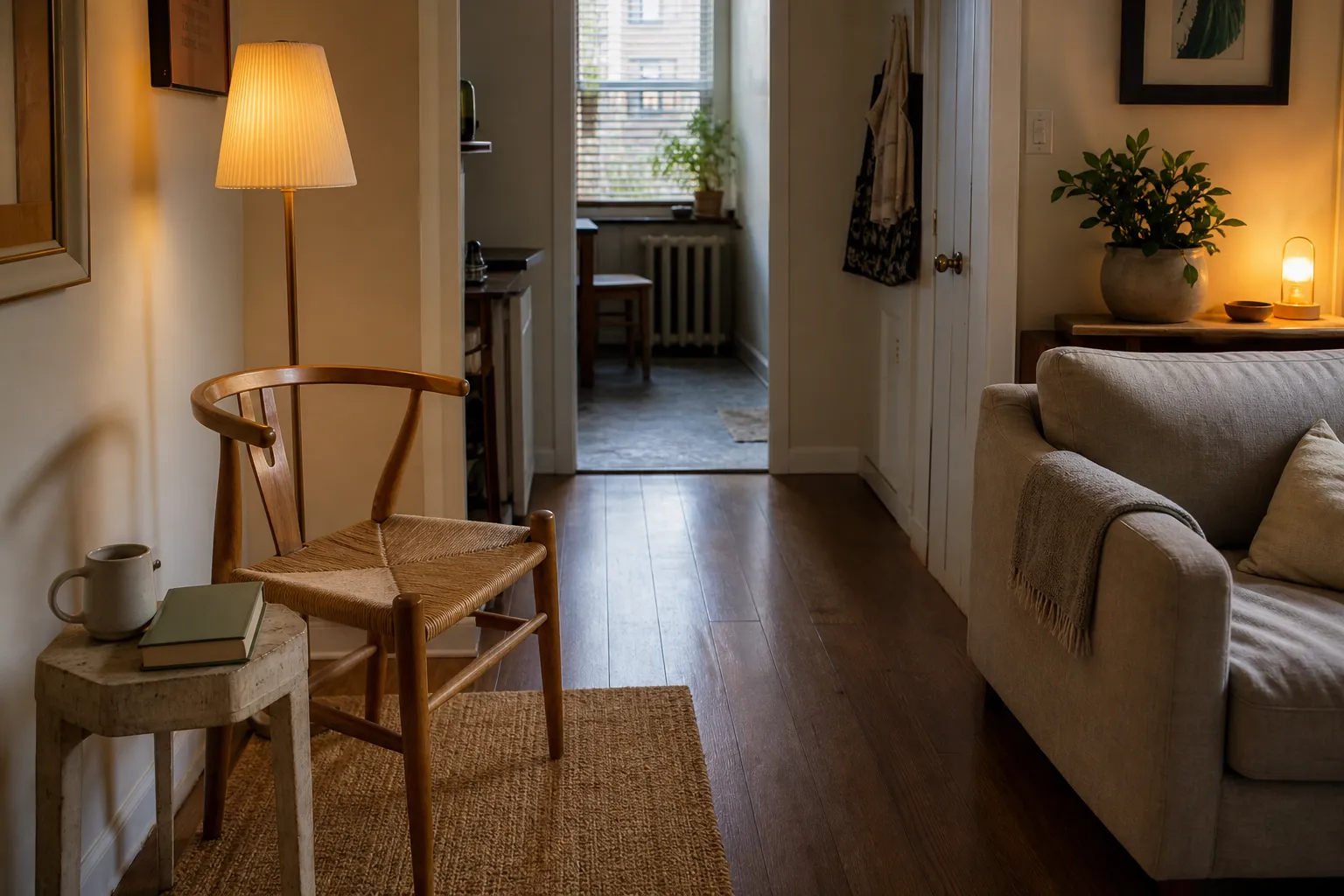
A one chair and side table arrangement is often the most durable small quiet corner idea. It gives you a seat, a surface, and a visual boundary without adding a screen or extra storage. If the room is narrow, choose a chair with visible legs or a lighter frame so the floor still reads as open. If the corner is near a bed, angle the chair away from the bed path so it does not become a second laundry pile.
Seating Choices: Chair, Floor Cushion, Bench, or Low Stool
The seat sets the character of the nook more than any decorative object. It also decides who will actually use it.
One chair and a side table
This is the easiest setup for many adults because it works with ordinary sitting habits. A compact upholstered chair, wooden armchair with a cushion, or armless reading chair can all work. The key is not softness alone; it is proportion.
Choose this option when:
- the user wants back support;
- the corner is used for reading, tea, phone calls, or handwork;
- the floor is cold, hard, or uncomfortable for sitting;
- guests may use the seat occasionally.
Pair it with a small side table, low stool, or ceramic garden seat used as a surface. The surface should sit close enough that a cup does not require twisting or reaching across the room.
Floor cushion quiet corner
A floor cushion quiet corner can be beautiful and space-efficient, especially in rooms with tatami-style inspiration, low tables, woven mats, or simple tea objects. It works best when the household already likes floor sitting.
It is less successful when:
- low sitting is uncomfortable for the person using it;
- the floor is drafty or cold;
- pets treat the cushion as a bed;
- the cushion has to be moved every time someone crosses the room;
- there is no stable place for a cup.
If you use floor seating, give it structure. A flat woven mat, one firm cushion, and a low tray are usually better than a pile of soft pillows. Too many pillows create visual clutter and make the area harder to clean.
Bench or built-in ledge
A bench works well under a window, beside a low bookcase, or along a short wall. It can create a window quiet corner without adding another chair shape. If the bench has storage, keep the contents specific: one blanket, a reading item, tea cloths, or seasonal covers. Hidden storage becomes less useful when it turns into a box for unrelated objects.
Low stool or movable seat
For renters and shared rooms, a small stool may be enough. It can hold a book or cup when no one is sitting, then become a seat when needed. This is a good renter friendly quiet corner choice because it does not require drilling, repainting, or permanent changes.
How to Define a Quiet Corner Without Adding a Room Divider
A divider is not always needed. In a small room, it can make the space feel tighter. A quiet corner can be defined by direction, texture, light, and edges rather than walls.
Try these softer boundaries:
Angle the chair
Turn the seat slightly away from the main room activity, toward a window, plant, shelf, or low table.
Use a small rug or mat
A woven mat, flat rug, or natural-fiber runner can mark the sitting area without blocking sightlines.
Create a light pool
A warm table lamp or shaded floor lamp can define the corner at night more effectively than a screen.
Use one vertical object
A tall plant, narrow shelf, fabric hanging, or bamboo shade can give the eye an edge without closing the area.
Lower the object count
A defined corner does not need many things. It needs enough consistency that the eye understands its purpose.
Screens can be lovely, especially in rooms influenced by Japanese, Chinese, or Korean spatial traditions where partial separation and framed views have long histories. In a modern apartment, though, a screen still has to pass ordinary room tests. If it blocks air movement, steals light, wobbles near a walkway, or becomes a rack for clothes, it is not helping the nook.
For a quiet corner without room divider panels, the simplest formula is: one seat, one surface, one light source, one textile, and one personal object. That is enough to read as intentional.
Window Quiet Corner Ideas: Glare, Heat, and the View
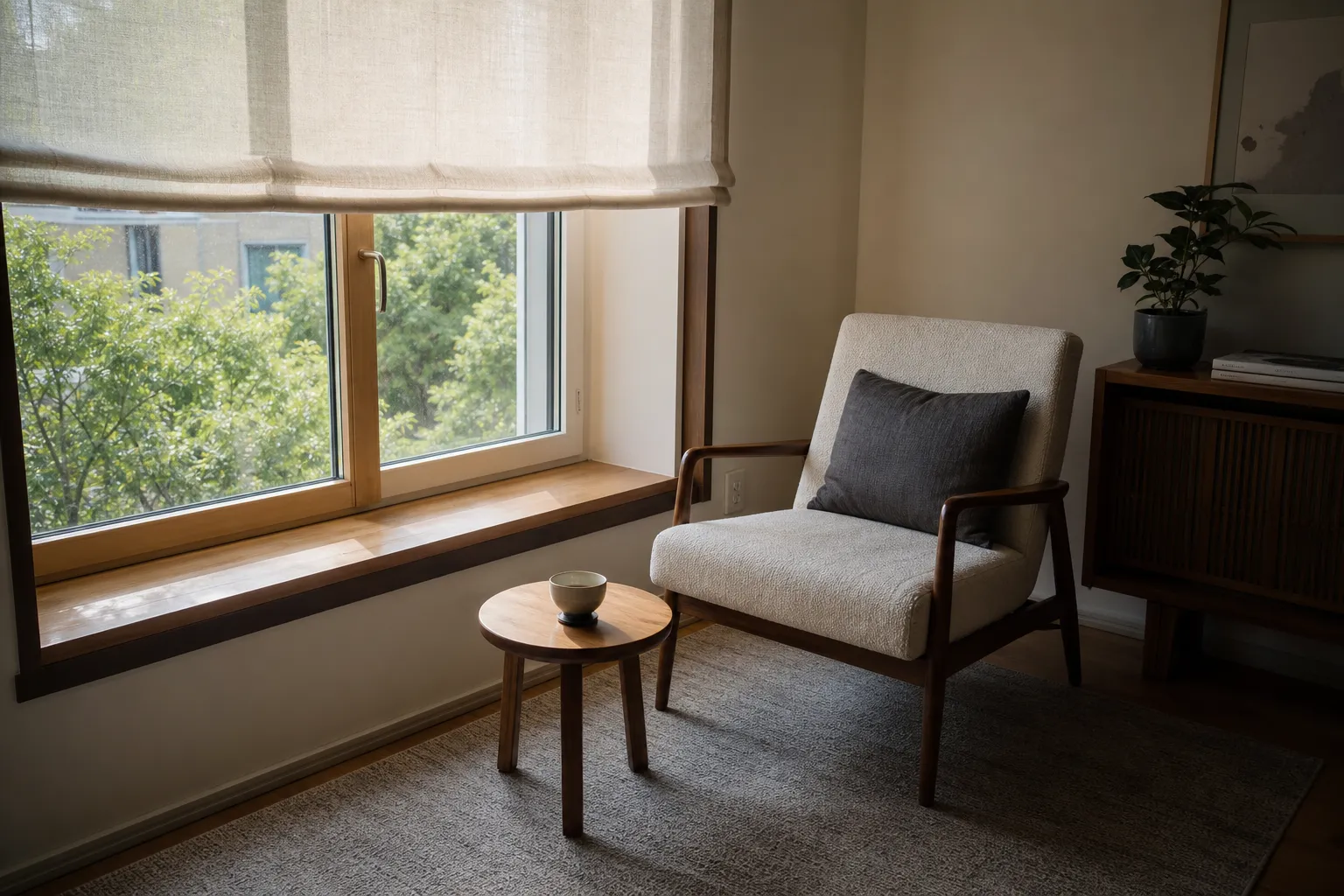
A window is a natural place for a small sitting corner because it offers light and a visual direction. Window seats, deep window recesses, and small tables near windows have long served as “room within a room” spaces for reading, sewing, writing, conversation, or looking outside. In today’s apartments, the window can still do that work, but only if the conditions are comfortable enough for use.
Window treatments are not just decoration here. U.S. Department of Energy guidance notes that curtains, shades, blinds, and similar attachments can affect daylight, glare, solar heat gain, heat loss, and comfort around windows. For a quiet corner near a window, the covering is part of the furniture plan.
Consider the window problem first:
Harsh glare
Use adjustable blinds, lined curtains, woven shades, or a sheer layer paired with a heavier layer.
Hot afternoon sun
Choose a seat that can be moved back from the glass, or use a shade that reduces direct sun during the strongest hours.
Cold window in winter
Keep the seat slightly away from the glass and use a textile that can be cleaned easily.
Busy view
Angle the chair so the window is present but not directly in front of your eyes.
No view
Create a near view with a plant, ceramic bowl, branch arrangement, or small textile on the sill.
A window quiet corner should also respect the window’s practical jobs. Do not block windows that must open for air, access, emergency use, or cleaning. If curtains pool on the floor beside a candle, heater, or lamp cord, restyle the arrangement before using the corner.
Quiet Corner Storage Ideas That Do Not Turn Into Clutter
Quiet corner storage should be small, specific, and easy to reset. The corner is not a second closet.
Good storage choices include:
- a basket for one folded blanket;
- a narrow shelf for two or three current books;
- a lidded box for tea cloths, notebooks, or chargers;
- a tray that gathers a cup, coaster, and small object;
- a wall shelf if drilling is allowed and the wall can support it;
- a low cabinet already in the room, with the top kept clear enough for use.
For renters who cannot drill, use freestanding pieces: a small stool, a slim rolling cart, a lightly used leaning ladder shelf, or a basket under the chair. Adhesive products may work for very light items, but choose them with wall finish and removal in mind.
If the corner needs more than one container to stay orderly, the plan may be too object-heavy. A quiet nook with six books, three blankets, a candle, incense, a plant, a lamp, headphones, chargers, journals, and extra pillows may photograph well for a moment, but it becomes harder to dust, use, and reset.
Eastern-inspired rooms often make strong use of negative space. That does not mean the room must be bare. It means the few objects present have breathing room. A tea cup on a tray, a small ceramic vase, a bamboo basket, or a folded textile can carry more presence when the surrounding surface is not crowded.
Shared Room Quiet Corners: Noise, Movement, and Agreements
A shared room changes the design problem. You are not only designing a corner; you are working around movement, sound, light, and other people’s habits.
In a living room, place the nook outside the main television sightline if possible. If that is not possible, angle the chair so the sitter is not facing the screen directly. Use a lamp with a shade that lights the book or cup area without shining into other people’s eyes.
In a bedroom, the corner should not crowd the bed. Bedroom quiet corner ideas work best when the chair does not block drawers, closet doors, bedside access, or the route to the door. A small chair beside a dresser may work better than a plush chair near the bed. If the bedroom is mainly for sleeping and dressing, keep the corner visually light: one chair, one textile, one surface. Avoid turning it into a second work zone unless the room already supports that use.
In a studio or multipurpose room, use time as part of the design. A stool and tray may become a tea corner in the evening and return to the wall during the day. A floor cushion may live in a basket until needed. Movable furniture is not a compromise when the room itself has many jobs.
For households with children, pets, or frequent guests, visibility and stability matter. A corner that is too hidden may invite dropped items, tipped drinks, or rough use. A corner that is too exposed may not feel different from the rest of the room. Aim for partial definition, not isolation.
What to Put in a Quiet Corner and What to Leave Out
A useful quiet corner usually needs fewer items than people expect.
Start with
- A seat that fits the user and the room.
- A stable surface for a cup, book, glasses, or phone.
- A light source suited to the activity.
- One textile for warmth, texture, or floor definition.
- One or two chosen objects that give the corner character.
Those objects might be a handmade cup, a small ceramic dish, a seasonal branch, flowers, a smooth stone, a bamboo basket, a tea tray, a framed print, or a simple incense holder that is kept unlit unless conditions are suitable. The object does not need to carry a grand meaning. It only needs to belong to the way the corner is used.
Leave out anything that makes the corner harder to maintain:
- unstable stacks of books;
- trailing cords;
- loose fabric near heat or flame;
- too many pillows for the available floor space;
- strong scents in a room with poor airflow;
- fragile ceramics on narrow ledges;
- plants that shed onto cushions or block the window;
- objects added only because they seem “nook-like.”
Flame, smoke, and small surfaces
Candles and incense deserve special caution in small sitting corners because these spaces often combine textiles, paper, plants, and narrow surfaces. NFPA candle guidance emphasizes keeping candles away from things that can burn and not leaving them unattended. EPA indoor air material also treats smoke-producing or combustion-based objects as indoor sources to consider, especially in rooms with limited ventilation.
That does not mean a quiet corner must avoid atmosphere. It means flame and smoke are optional, not essential. A shaded lamp, an unburned decorative candle, a ceramic incense holder used as an object, fresh flowers, a warm-toned bulb, or a textured textile can provide presence without adding smoke or open flame.
Renter Friendly Quiet Corner Ideas
Renters often have the most realistic constraints: no drilling, no repainting, limited storage, awkward outlets, and furniture that must move again later. A renter friendly quiet corner should rely on reversible choices.
Useful renter moves include:
- a freestanding lamp instead of wall wiring;
- a side table or stool instead of a mounted shelf;
- curtains on an existing rod where allowed;
- a rug or mat to define the area;
- a folding screen only if it is stable and does not block the room;
- a basket for storage rather than built-ins;
- a chair that can serve elsewhere after moving.
If the walls are plain, let texture do the work: linen, cotton, wool, bamboo, wood, paper, clay, or woven grass. These materials can make the corner feel considered without requiring permanent changes. Keep heavy objects low and avoid leaning fragile pieces where they can slide.
A renter’s quiet nook does not need to look temporary. It only needs to be assembled from pieces that can leave without damage.
Bedroom Layout Checks for a Small Quiet Corner
In a bedroom, a quiet corner should support the room’s main function rather than compete with it. Keep the layout simple and avoid adding bright task lights, crowded surfaces, or work clutter beside the bed.
Check the room this way:
- Can you reach the bed without walking around the chair?
- Can drawers, closet doors, and windows still open?
- Is the lamp aimed at the corner rather than across the pillow area?
- Is the surface small enough that it will not become a desk?
- Are cups, cords, books, and textiles easy to clear?
- Does the corner look settled when not in use?
If the answer is no, reduce the corner. Use a smaller chair, a stool instead of a table, a folded cushion instead of a permanent floor setup, or a wall-side basket instead of open shelving.
A good bedroom quiet corner is often modest. It gives you somewhere to sit that is not the bed, but it does not ask the bedroom to become a second living room.
A Simple Decision Frame for Small Quiet Corner Ideas
When choosing between quiet nook ideas, use this order:
- Choose the quietest usable location. Test sound, light, heat, and movement before choosing the prettiest corner.
- Pick the smallest comfortable seat. Chair, cushion, bench, or stool should match the user’s body and the room’s routes.
- Add one stable surface. A cup, book, or lamp needs a reliable place.
- Control the window if needed. Glare, heat, cold, and privacy often decide whether the corner is used.
- Define the edge lightly. Rug, lamp, angle, plant, or shelf can be enough.
- Keep objects few. Choose pieces that help use, care, or atmosphere without crowding the space.
- Review flame, smoke, cord, and trip issues. Small corners concentrate fabric, paper, light, and movement.
A real-room quiet corner is successful when it remains easy to enter, easy to use, and easy to reset. It does not need a spare room, a dramatic divider, or a full set of matching objects. It needs a clear purpose, a fitting seat, controlled light, a little surface, and enough empty space around it to let the room keep breathing.