Warm Light Bulb Buying Checks for Lamps, Pendants, and Ceiling Fixtures
A paper shade may glow softly under a warm bulb, while the same bulb can look exposed and bright in a clear pendant. Before choosing by color, inspect the fixture itself.
broader context
Broader context
Use the broader page when you need more context before this narrower page.
The essential buying checks
- 1.Match the base to the socket.
- 2.Confirm that the bulb’s full shape fits the shade, globe, or opening.
- 3.Follow the fixture label’s wattage and lamp restrictions.
- 4.Compare brightness in lumens.
- 5.Choose the color appearance by Kelvin value, commonly 2700–3000 K for warm household light.
- 6.Check whether the bulb is approved for the fixture’s enclosure and operating position.
- 7.Verify compatibility with any dimmer, timer, sensor, or other control.
A bulb is not compatible simply because it screws into the socket. Physical fit, documented limits, enclosure restrictions, and controls are separate checks.
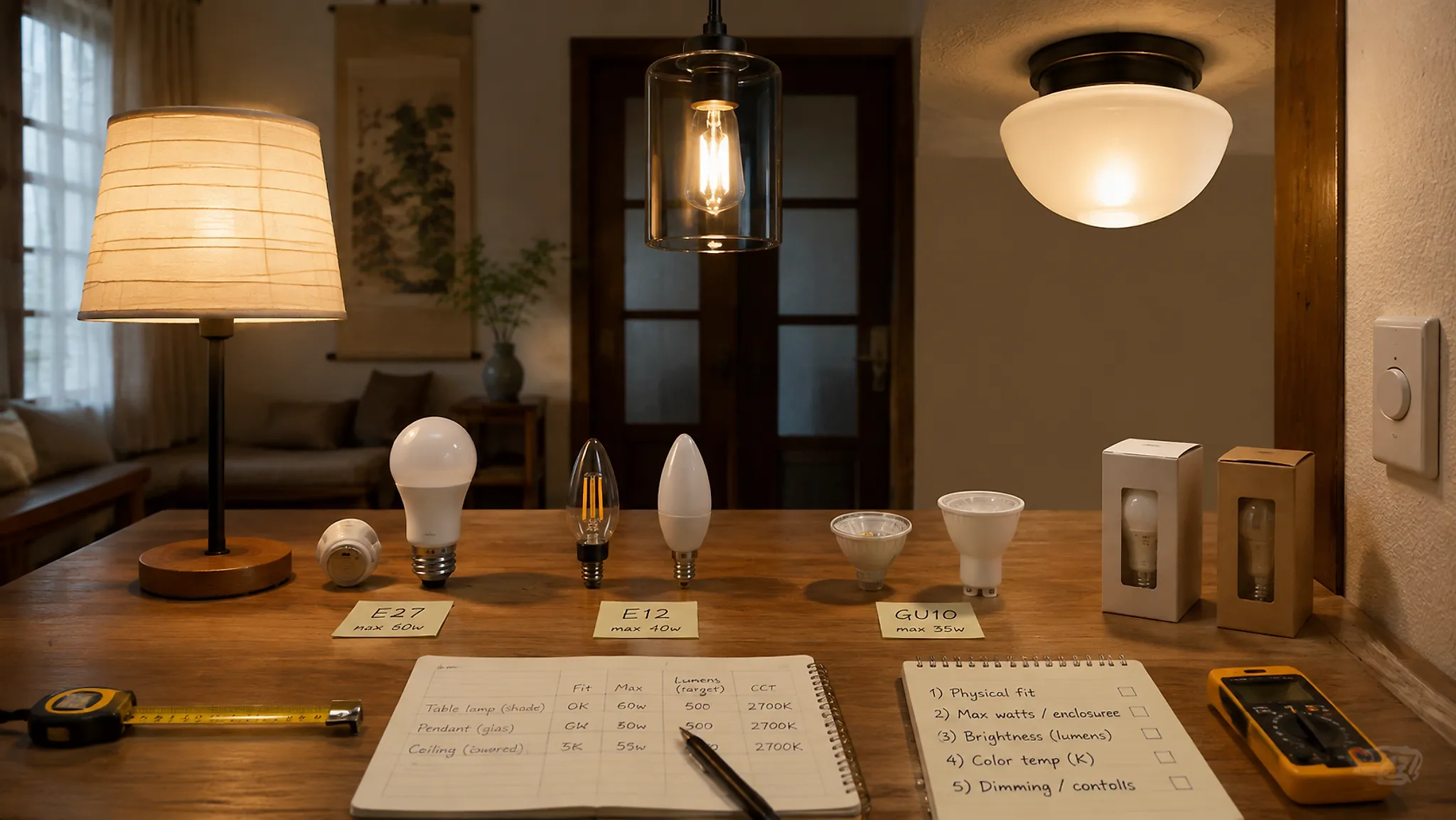
The Pre-Purchase Check at a Glance
Photograph the fixture label and existing bulb before shopping. If the light uses a dimmer, record its model number when that information is visible without removing electrical equipment.
| Check | What to inspect | What must match |
|---|---|---|
| Base | Existing bulb, socket, fixture label | Base type and size |
| Bulb shape | Shade, globe, retaining ring, socket depth | Width, length, neck, and opening clearance |
| Fixture limits | Label or manufacturer documentation | Maximum wattage and permitted lamp type |
| Brightness | Bulb package or product data | Lumens suitable for the room and task |
| Warm appearance | Kelvin value | Often 2700–3000 K |
| Enclosure and position | Fixture design and bulb restrictions | Documented approval for that use |
| Controls | Dimmer, timer, sensor, or other control | Bulb-control compatibility |
Passing one check does not cancel a problem elsewhere. A bulb can have the right color and base yet remain unsuitable for a closed globe or installed dimmer.
Match the Base and the Whole Bulb
Switch off the light and allow the existing bulb to cool. Remove it only as directed by the fixture instructions, then compare its markings and dimensions with the proposed replacement.
Check the base size
The replacement base must match the socket. Household fixtures use several base types and sizes, and bulbs with similar outer shapes may connect differently.
Use the code printed on the existing bulb, fixture label, or manufacturer documentation when available. An online photograph alone is unreliable because decorative bulbs can look nearly identical without sharing the same base.
Do not treat an unverified adapter as a routine solution. This buying check does not cover socket modification, voltage conversion, or rewiring.
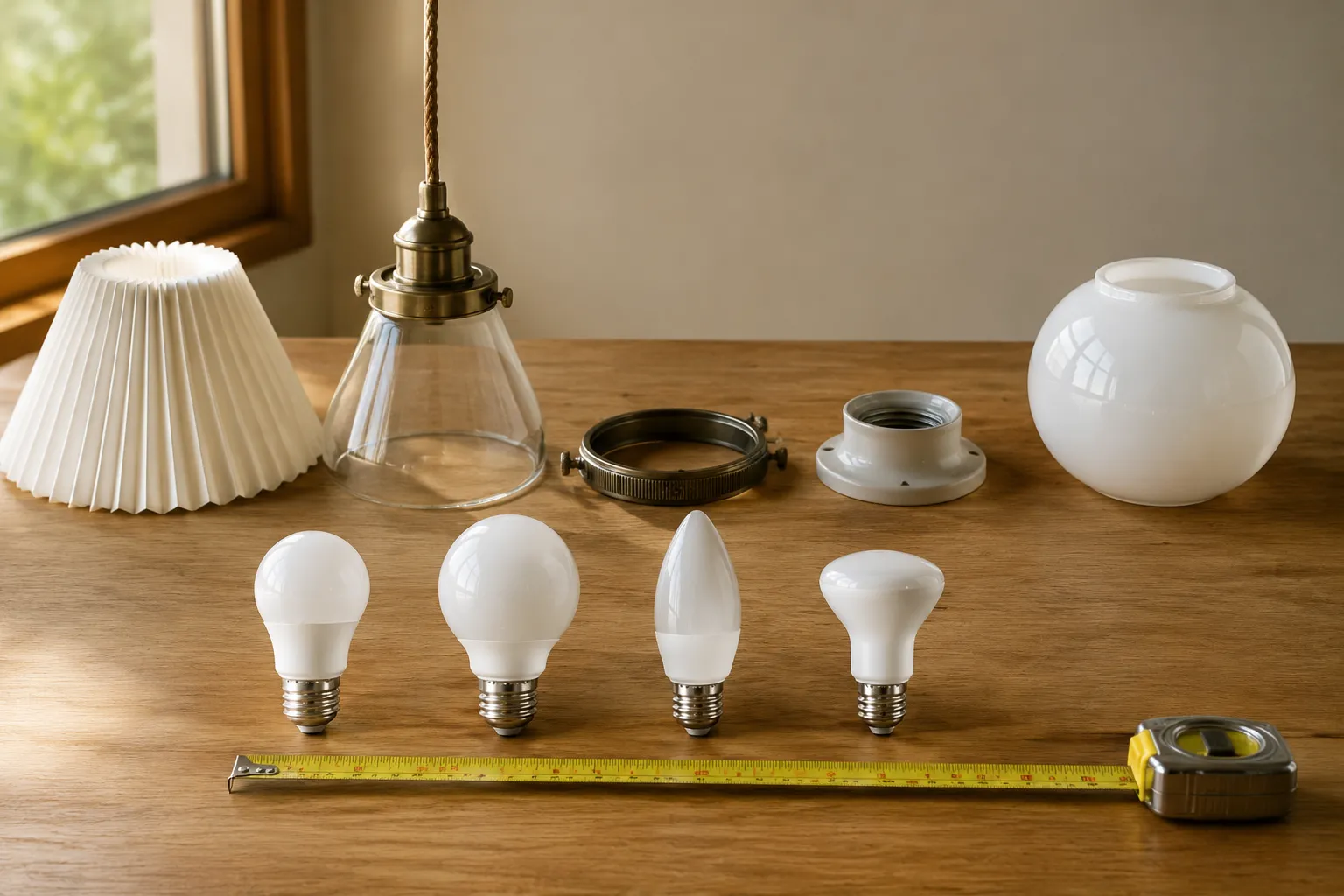
Measure the bulb envelope
A matching base establishes a connection point, not complete physical fit. Check:
- The widest part of the bulb
- Overall bulb length
- Clearance inside the shade or globe
- Space around clips and retaining rings
- The size of the fixture opening
- Clearance between the bulb neck and shade holder
- How far the bulb will extend from an open pendant
Standard, globe, candle, and reflector bulbs occupy different amounts of space. A narrow lamp opening may admit the bulb’s base but not its widest section. In a clear pendant, the shape is also visible, but appearance comes after fit.
The bulb should seat normally without forcing the shade, socket, or retaining hardware.
Read the Fixture Label and Bulb Package Separately
The fixture label describes limits for the fixture. The bulb package describes the bulb. Read both.
A fixture label may state a maximum wattage, permitted lamp type, or another application restriction. Follow that documented limit using the bulb’s actual wattage, even when the package also displays a familiar replacement value.
Fixture maximum wattage
The fixture’s documented limit.
Bulb actual watts
The power used by the bulb.
Bulb lumens
The amount of visible light produced.
Watt-equivalent wording
A comparison with a familiar older brightness category.
For example, “60 W equivalent” does not necessarily mean that the bulb uses 60 watts. It also does not establish physical fit or compatibility with the fixture.
If the fixture label is missing or unreadable, consult its documentation or manufacturer rather than estimating its electrical limits.
Check enclosure and position restrictions
A sealed globe or closely covered ceiling light creates different operating conditions from an open table lamp. Bulb packaging may restrict use in enclosed fixtures or specify an operating position.
Look for wording about:
- Enclosed or recessed fixtures
- Base-up, base-down, or horizontal operation
- Damp or wet locations
- Temperature or ventilation restrictions
- Use with specific fixture types
A low actual wattage does not override these instructions. If the package does not address the kind of enclosure you have, check the bulb manufacturer’s technical documentation.
Choose Brightness and Warmth by Number
Once fit and fixture limits are settled, choose how the light should look on the room’s surfaces.
Compare lumens for brightness
Lumens describe visible light output. A higher lumen number means more light from the bulb.
U.S. Department of Energy consumer guidance uses roughly 800 lumens as a familiar reference for the brightness category associated with a traditional 60-watt incandescent bulb. Treat that as a comparison point, not a target for every room.
A shaded bedside lamp may call for less output than a ceiling fixture lighting a room path. A pendant over a table needs enough light on the surface without creating an uncomfortable bright point through clear glass. Dark shades and opaque diffusers also reduce or redirect the light that reaches the room.
For fixtures with several bulbs, consider their combined lumen output while still applying the fixture’s documented limits to each socket.
Compare Kelvin values for color appearance
Terms such as “warm white” and “soft white” vary between product lines. The Kelvin value offers a clearer comparison.
Warm household bulbs are commonly labeled within the 2700–3000 K range:
- 2700 K usually has a warmer, more amber appearance.
- 3000 K remains warm but often looks a little cleaner or less golden.
The surrounding materials will change the result. Cream paper, timber, colored glass, and woven textiles can deepen the apparent warmth, while a clear globe leaves the bulb directly visible.
Kelvin does not describe brightness. A 2700 K bulb can produce either low or high light output depending on its lumen rating. Color appearance also says nothing about base size, enclosure approval, or control compatibility.
Check Dimmers and Other Controls
For a fixture connected to a dimmer, choose a bulb marked dimmable, then check the documentation for the specific bulb and control.
“Dimmable” describes a general capability; it does not promise that every bulb will work properly with every dimmer. Laboratory testing of individual LED systems has found that performance can vary between particular lamp, dimmer, and system combinations. These tests do not predict every current product, but they support a simple buying rule: verify the pairing.
Before checkout
- 1.Record the bulb’s exact model number.
- 2.Identify the dimmer or control model when it is visible without opening electrical equipment.
- 3.Look for the bulb maker’s compatibility list or technical notes.
- 4.Check the dimmer and fixture documentation.
- 5.Note any listed conditions involving control type, bulb count, or operating range.
Apply the same check to timers, occupancy sensors, photocontrols, lamp dimmers, and other electronic controls.
Some specialty low-voltage fixtures include additional components, such as a transformer. Government testing of MR16 systems shows why the lamp, transformer, and dimmer may need to be considered together. If you cannot identify the parts of such a system, keep the decision at the documentation stage rather than attempting a general replacement or modification.
Common Packaging Misunderstandings
“Warm white” means the bulb will fit.
It describes color appearance. Base, dimensions, fixture limits, enclosure restrictions, and controls still need separate checks.
“60 W equivalent” means the bulb uses 60 watts.
Equivalency is a brightness comparison category. Read the bulb’s actual wattage and lumens separately.
“Dimmable” means it will work with the existing wall control.
The bulb may be capable of dimming without being documented for that particular control.
A matching base means the bulb is compatible.
The bulb may still be too wide, too long, restricted from enclosed use, or unsuitable for the installed control.
A low-watt LED can be used in any fixture.
Lower power use does not cancel the fixture label or the bulb maker’s application restrictions.
When the Check Should Stop
A bulb purchase should not turn into an investigation of wiring or a socket modification. Stop and consult the fixture documentation, manufacturer support, or a qualified electrician if you find:
- A missing or unreadable fixture label
- A cracked, loose, darkened, or distorted socket or fixture part
- Visible damage to the fixture or cord
- Uncertain wiring or voltage
- Unusual heat
- Persistent fault-like flicker or repeated shutoff
- A bulb that will not seat normally
- Conflicting instructions from the bulb, fixture, and control makers
The available sources support label reading, lumen and Kelvin comparisons, basic fit checks, fixture wattage limits, and the need to check control compatibility. They do not provide one universal rule for every socket, enclosure, dimmer, or specialty system; current product documentation remains the deciding reference.
Before buying, return to the real object in the room: confirm the base and dimensions, compare lumens and Kelvin, and read the fixture and bulb restrictions together. The smallest useful step is often a clear photograph of the label.