Japandi Kitchen Storage Ideas for Clear Counters and Warm Materials
The most useful japandi kitchen storage ideas are not about hiding every object. They are about deciding which objects deserve to stay visible: one wood tray for daily tea or coffee pieces, a kettle you use constantly, a salt cellar near prep, or one upright cutting board after it has dried. Packaging, duplicate tools, cords, extra mugs, towels, appliance parts, and occasional gadgets usually work better behind doors or in drawers.
Wood can bring the warmth people want from a Japandi kitchen, but it needs sensible placement. Keep it away from ongoing dampness, give food-prep boards clean dry storage, and do not crowd burnable objects around an active cooking area. The result is a kitchen that reads calm because the working zones stay usable, not because the room is empty.
Here, Japandi is treated as a practical interiors language: quiet forms, reduced visual clutter, useful objects, and natural material. The material notes below are used only for kitchen placement limits, not as proof of a fixed design rulebook.
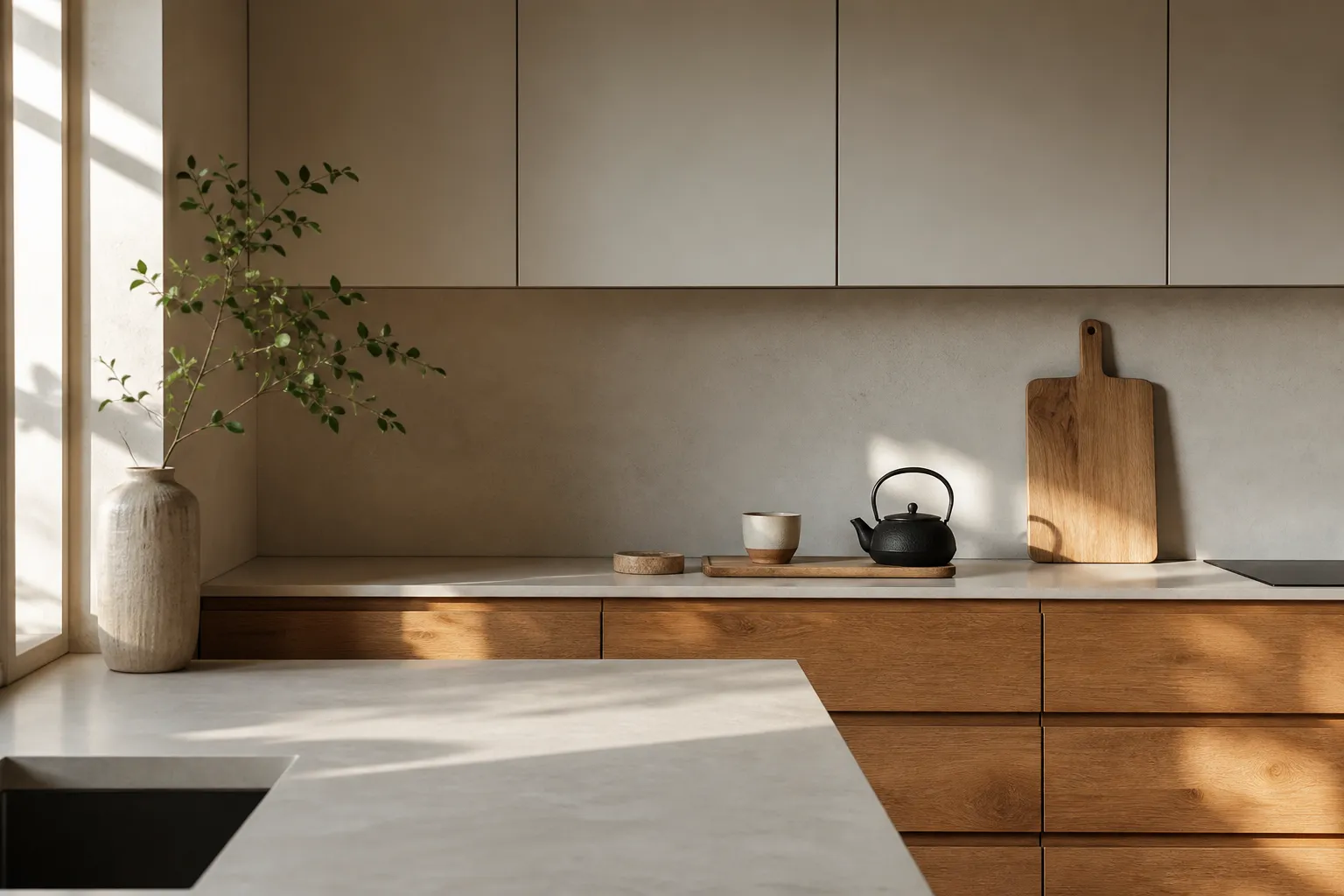
broader context
Parent topic
Use the broader page when you need more context before this narrower page.
The counter test: does this object earn visible space?
A clear counter does not have to be bare. It should show a small number of things that help the kitchen work every day.
Sort counter objects into three groups:
- Useful enough to stay visible: a kettle, a small tea or coffee tray, a frequently used salt cellar, or one clean dry cutting board.
- Useful but better closed away: utensils, measuring spoons, packets, appliance attachments, extra mugs, towels, lids, and food containers.
- Occasional pieces that should leave the counter: serving boards, backup oils, decorative baskets, seasonal dishes, and small appliances used only now and then.
This is where calm kitchen organization becomes practical. The counter is not the main storage area; it is the work surface. If a tray, board, or jar makes the work easier and looks settled, it can stay. If it is only there because it has no assigned home, give it one.
Use visible storage for warmth, closed storage for noise
Japandi hidden kitchen storage does not need to feel cold. Warmth can come from wood drawer dividers, cabinet interiors, vertical board slots, a small shelf, or a single tray rather than from filling every surface with wood objects.
Use visible storage for pieces that are both useful and visually quiet. Use closed storage for mixed packaging, labels, cords, spares, and duplicates.
| Storage choice | Works well for | Keep in mind |
|---|---|---|
| Low wood tray | Tea, coffee, or a small daily grouping | Keep it out of splash-heavy and high-heat areas; lift it to wipe underneath. |
| Vertical board slot | Cutting boards, trays, slim serving pieces | Boards should be clean and dry before going into a tight slot. |
| Wood or bamboo drawer dividers | Utensils, tea tools, measuring pieces | Adds warmth inside storage without adding counter clutter. |
| Closed pantry bins | Packets, snacks, spare tea, dry goods | Reduces mixed packaging without making everything visible. |
| One small open shelf | Bowls, cups, or repeated daily-use pieces | Works best when it stays sparse and easy to dust. |
| Lower cabinet pull-out | Toaster, blender, mixer, grinder | Useful when the appliance needs near-counter access but not constant display. |
Often, the strongest Japandi wood kitchen storage is the kind you notice only when you use it. A drawer that opens to a warm divider can support the same feeling as an exposed rack, with less visual clutter.
Place wood by kitchen zone
The main kitchen storage placement limits are simple: wood should not be kept damp, food-prep boards need clean handling, and items that can burn should not sit close to active cooking.
Near the sink, avoid treating wood like a permanent drip tray. The USDA Forest Products Laboratory’s Wood Handbook describes wood as a material that takes on and releases moisture with surrounding conditions. In everyday kitchen terms, wood trays, racks, baskets, and boards need air and drying room.
For the sink zone:
- Keep a wooden tray beside the sink only if it stays mostly dry.
- Do not slide a damp cutting board straight into a tight cabinet slot.
- Avoid storing wood flat against a wet backsplash.
- Let boards stand with air around them before closing them behind a door.
- Be cautious with baskets or wood bins on damp under-sink floors.
Cutting board display storage needs one extra distinction. A board that touches food is not just decor. USDA FSIS guidance on cutting boards emphasizes clean handling and drying, so an upright board can be part of a warm Japandi kitchen only if it is stored as a working kitchen surface: clean, dry, and not trapped where moisture lingers.
The prep zone needs the most open counter space. Keep cutting, mixing, and seasoning tools close, but not necessarily visible. A shallow drawer below the prep area often does more for daily use kitchen storage than a row of jars across the counter.
The stove zone needs the clearest edge. U.S. Fire Administration cooking guidance advises keeping items that can burn away from the stovetop. In design terms, that means no paper notes, towels, wood trays, baskets, or decorative boards crowded beside active burners. Use nearby drawers, cabinets, or wall storage set away from the cooking surface instead.
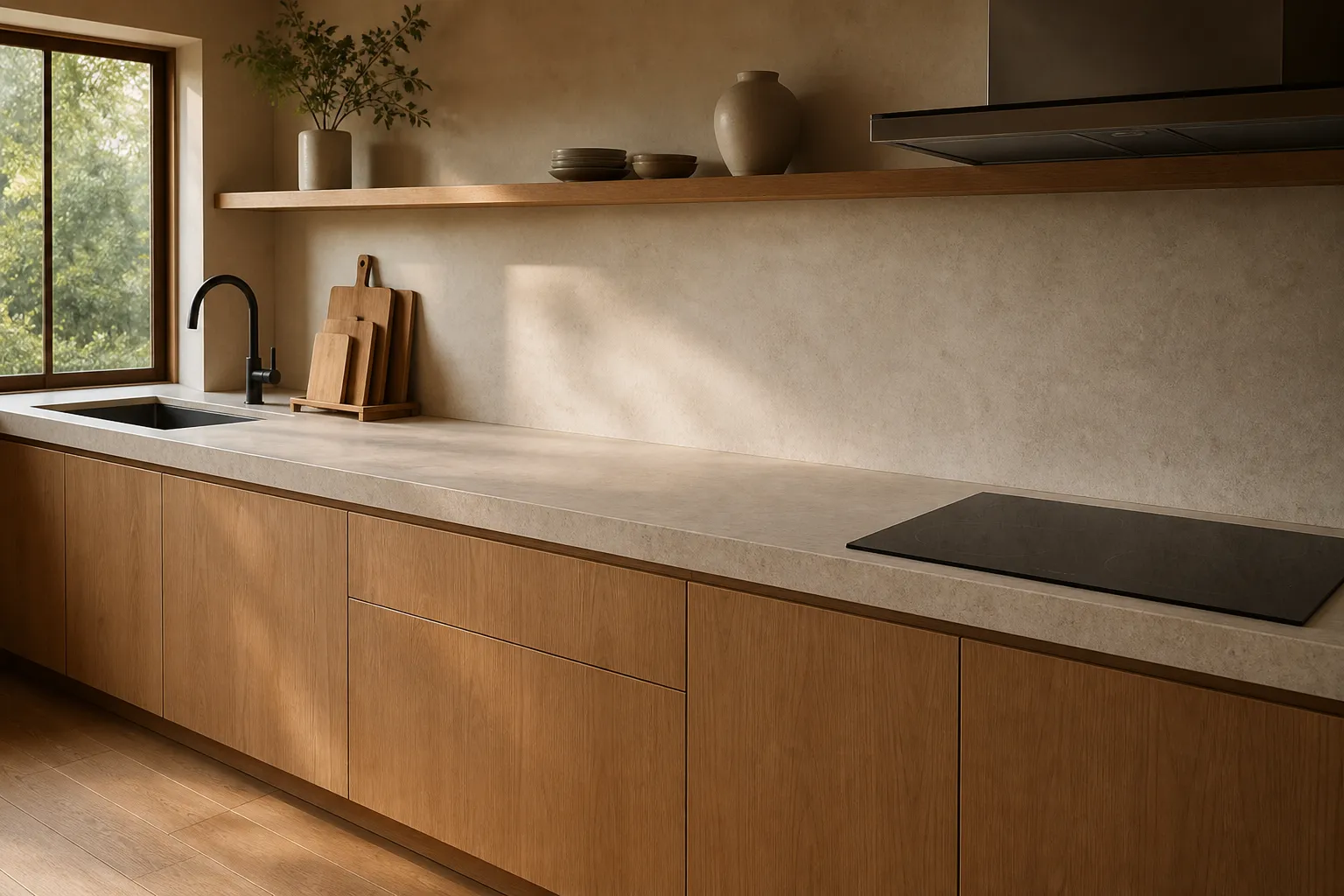
Warm wood accents that do not turn into piles
Wood is often what keeps a minimal kitchen from feeling flat. The key is to use it as an accent with a job.
Good warm wood storage accents include:
- One counter tray for tea, coffee, or breakfast pieces used every day.
- Wood drawer dividers for utensils and small tools.
- A vertical board holder inside a cabinet, used after boards have dried.
- A small open shelf for bowls or cups that are actually in rotation.
- A wood-lidded box for tea packets, napkins, or small loose items.
- A pull-out lower cabinet for heavier appliances that should not live on the counter.
Wood tray kitchen storage works especially well when it gathers one small routine. A tray with a teapot, two cups, and a small container can look intentional. A tray with receipts, chargers, keys, wrappers, and loose packets becomes another clutter zone.
Wood does not need to solve every storage problem. Near the sink, washable quick-drying materials may be easier. Near the stove, closed surfaces and empty space are usually more practical. In a deep pantry, plain bins may matter more than beautiful visible wood.
Common mix-ups
“Clear counters mean empty counters.”
Not quite. A bare counter can still work badly if the tools you use every day are buried. The better question is what needs to be visible for this kitchen to function well today.
“Hidden storage is always better.”
Closed storage is best for dry, clean, visually busy items. It is not ideal for damp boards, towels, or sponges that need drying space.
“More wood means more warmth.”
Usually, a few well-placed wood elements read warmer than many small pieces scattered across the room.
“A displayed cutting board is only decoration.”
If it is used for food prep, treat it like a working surface. Display it only after it has been cleaned and dried.
A practical Japandi kitchen is not a showroom arrangement. It is a daily room with water, steam, crumbs, heat, and repeated hand movements. Storage should make those movements easier while keeping the eye from catching on too many unrelated objects.
A five-minute storage edit
Before buying another organizer, walk through the kitchen once and ask:
- What do I touch every morning or every time I cook?
- Which counter objects are only there because they have no assigned home?
- Can the sink area dry properly, especially wood pieces and cutting boards?
- Is anything made of wood, paper, cloth, or basket material too close to the cooktop?
- Would one drawer, vertical slot, or lower cabinet solve more than another display piece?
- Does the visible storage look like one calm group, or several unrelated piles?
If the answer is unclear, start small: make one warm wood tray for daily items, move duplicates into closed storage, and keep the sink and stove edges open. In many kitchens, that single edit does more for Japandi clear-counter storage than adding another shelf.
Quick answers
Can a Japandi kitchen have things on the counter?
Yes. Keep only the pieces that are used daily or make one simple visual group. The counter should still have open working space.
Where should cutting boards go?
After drying, they can stand upright on the counter, in a vertical slot, or inside a cabinet with room around them. Do not store damp boards tightly closed away.
What should move off the counter first?
Mixed packaging, duplicates, loose cords, spare mugs, rarely used appliances, and anything sitting near the sink or stove only because it has no better place.