Kitchen organization
Spice Storage Ideas That Do Not Take Over the Counter
The best spice storage ideas move jars into a drawer, cabinet, door, wall, pantry edge, or pull-out space without making cooking slower. Put daily seasonings where your hand naturally goes, keep occasional blends farther away, and store refills outside the main cooking zone. Before buying an organizer, measure the space, check the viewing angle for labels, and make sure the new spot does not block prep, wiping, cabinet doors, handles, or normal movement.
A clear counter is only an improvement if the spices are still easy to see, reach, and put back.
broader context
Broader context
Use the broader page when you need more context before this narrower page.
Start with the storage zone, not the rack
A spice rack is the second decision. The first is where the spices should live.
In a small kitchen, the answer may be a shallow drawer beside the prep area. In a galley kitchen, it may be the inside of a cabinet door. In a rental, it may be a removable bin or drawer insert rather than anything drilled into a wall. If two people cook differently, a split system often works better: daily spices in one easy zone, baking spices and refills elsewhere.
Use this quick check before choosing a product:
Shallow drawer near prep or stove
Storage idea that may fit: Angled spice insert or upright jars with lid labels.
Check first: Inside drawer height, jar diameter, label angle.
Deep upper cabinet
Storage idea that may fit: Tiered shelf, turntable, or pull-out insert.
Check first: Cabinet depth, reach, whether back-row jars disappear.
Narrow wall or cabinet side
Storage idea that may fit: Wall rail, magnetic rack, slim mounted shelf.
Check first: Door swing, splash exposure, mounting rules, wiping access.
Rental kitchen
Storage idea that may fit: Drawer bins, loose cabinet caddy, removable shelf.
Check first: Whether it removes cleanly and does not leave awkward residue.
Pantry or tall cupboard
Storage idea that may fit: Labeled bins for refills and less-used blends.
Check first: Whether daily spices become too far from cooking.
Very little cabinet space
Storage idea that may fit: Behind-door rack, under-shelf holder, narrow pull-out gap.
Check first: Whether it blocks nearby storage or becomes hard to clean.
The quietest solution is often not the most decorative one. A drawer of labeled lids may look plain, but it keeps the counter open and shows every jar at once. A wall display can work too, but only if it stays out of the splash zone, does not crowd a narrow path, and does not require reaching over a hot or wet area.
Drawer, cabinet, wall, or pantry: what changes the answer
Drawers work when visibility matters more than display
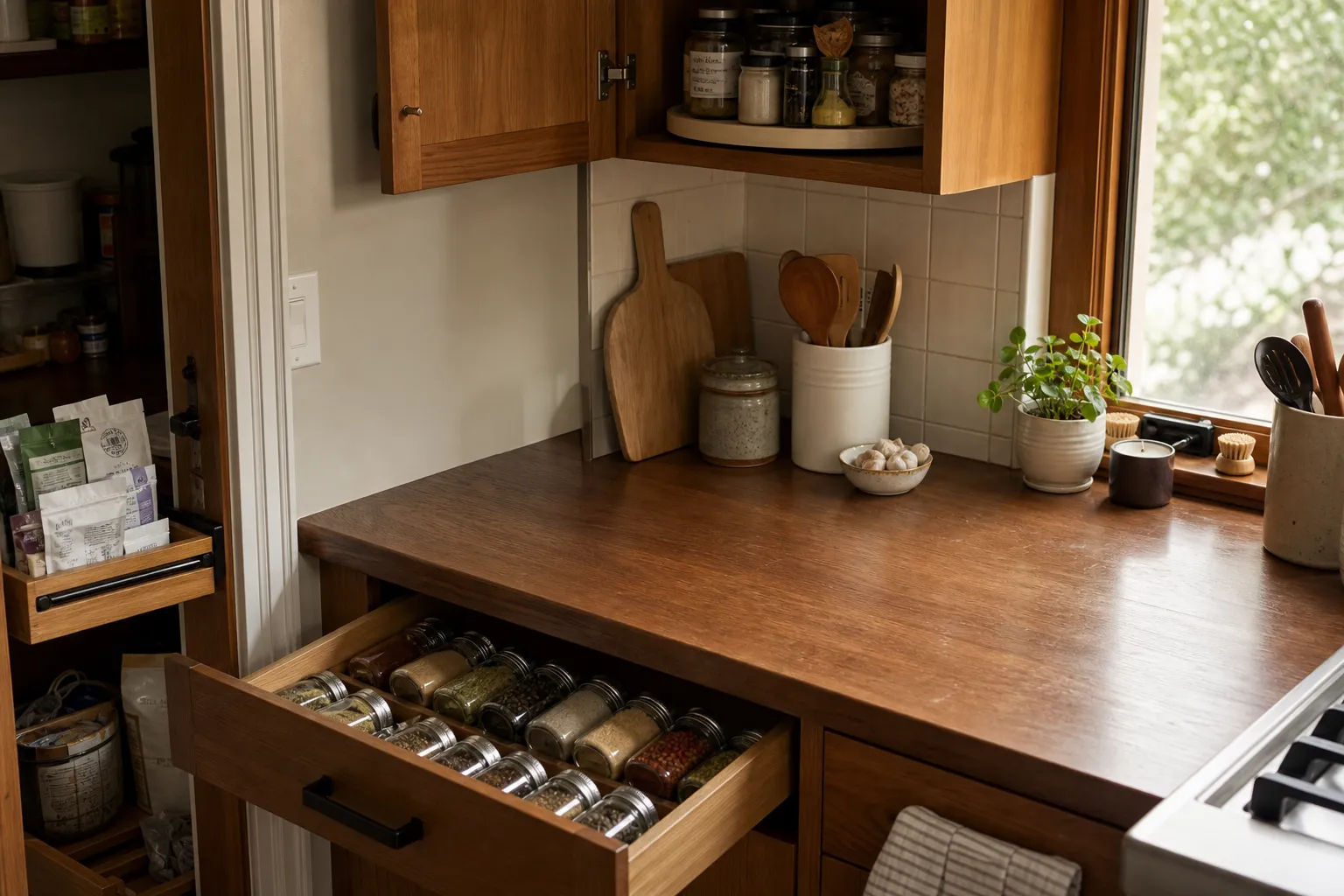
A drawer is one of the clearest answers for spice storage without counter space. It hides jars when closed and makes them visible when opened. It also avoids the common cabinet problem: the jar you need sitting behind three others.
Measure three things before choosing a drawer system:
- the inside drawer height, not the outside drawer front;
- the usable width after drawer sides and runners;
- the jar height or diameter, depending on whether jars will stand upright or lie down.
Spice drawer organization usually works in two ways. Jars lie on a sloped insert with front-facing labels, or they stand upright with labels on the lids. Sloped inserts are easy to scan but use more horizontal space. Upright jars fit more tightly, but only if the top labels are large enough to read quickly.
A drawer can be awkward if it is too low, too shallow, or placed where you have to step away from the pan every time. It also gets messy when refill bags are mixed with daily-use jars. Keep the drawer for active jars; place refills in a separate bin if you have the space.
Cabinet storage works when depth is controlled
Cupboard spice storage often fails because the cabinet is treated like an empty box. Depth matters. If jars sit in two or three deep rows, the back row tends to disappear unless the shelf pulls out, rotates, or rises in tiers.
For an upper cabinet, consider:
- a narrow tiered shelf so labels are not hidden;
- a small turntable for a deeper shelf;
- a pull-out organizer if the cabinet has enough width and clearance;
- a cabinet-door rack if the door closes cleanly with jars attached.
For a lower cabinet, a pull-out tray may help if you already have deep storage and do not want to crouch and search. Check cabinet depth, hinge clearance, and nearby tall bottles before assuming it will work.
Cabinet-door racks need a simple door test. Hold a few jars in place or tape a paper outline where the rack would sit. Close the door slowly. Check whether the jars hit inner shelves, whether the added depth blocks other items, and whether the door still opens comfortably.
Wall storage works only when the wall is truly spare
A magnetic spice rack, wall rail, or slim mounted shelf can look clean because it moves jars off the counter and keeps labels visible. It is also easy to place badly. A wall that looks empty may still be part of the cooking path, splash zone, or cabinet swing.
Before using wall storage, ask:
- Will steam, oil, or water regularly reach this spot?
- Can I wipe behind and under the rack?
- Will jars interfere with a door, drawer, appliance, or elbow movement?
- Am I allowed to drill here, or do I need a renter friendly spice storage option?
- Are the containers secure enough for this location?
This article does not verify magnetic strength, adhesive performance, or wall-mounting reliability. Treat wall systems as a “check carefully” category, not an automatic fix. In a calm kitchen, open display works best when the number of jars is small, the labels are consistent, and the rack is easy to clean around.
Pantry storage works for refills and occasional spices
A pantry shelf is often better for spice refill organization than for daily cooking jars. Backup jars, refill bags, large containers, and rarely used blends do not need to sit beside the stove. Put them in one labeled bin so they do not drift into several cupboards.
This helps if your cooking includes many regional seasonings, whole spices, dried herbs, tea spices, or baking blends. Keep the active set small and close. Keep the extended collection grouped and out of the way. That balance clears the counter without pretending every jar deserves prime reach.
Make labels readable from the angle you actually use
Spice label visibility is not just a neatness detail. It decides whether the system survives daily cooking.
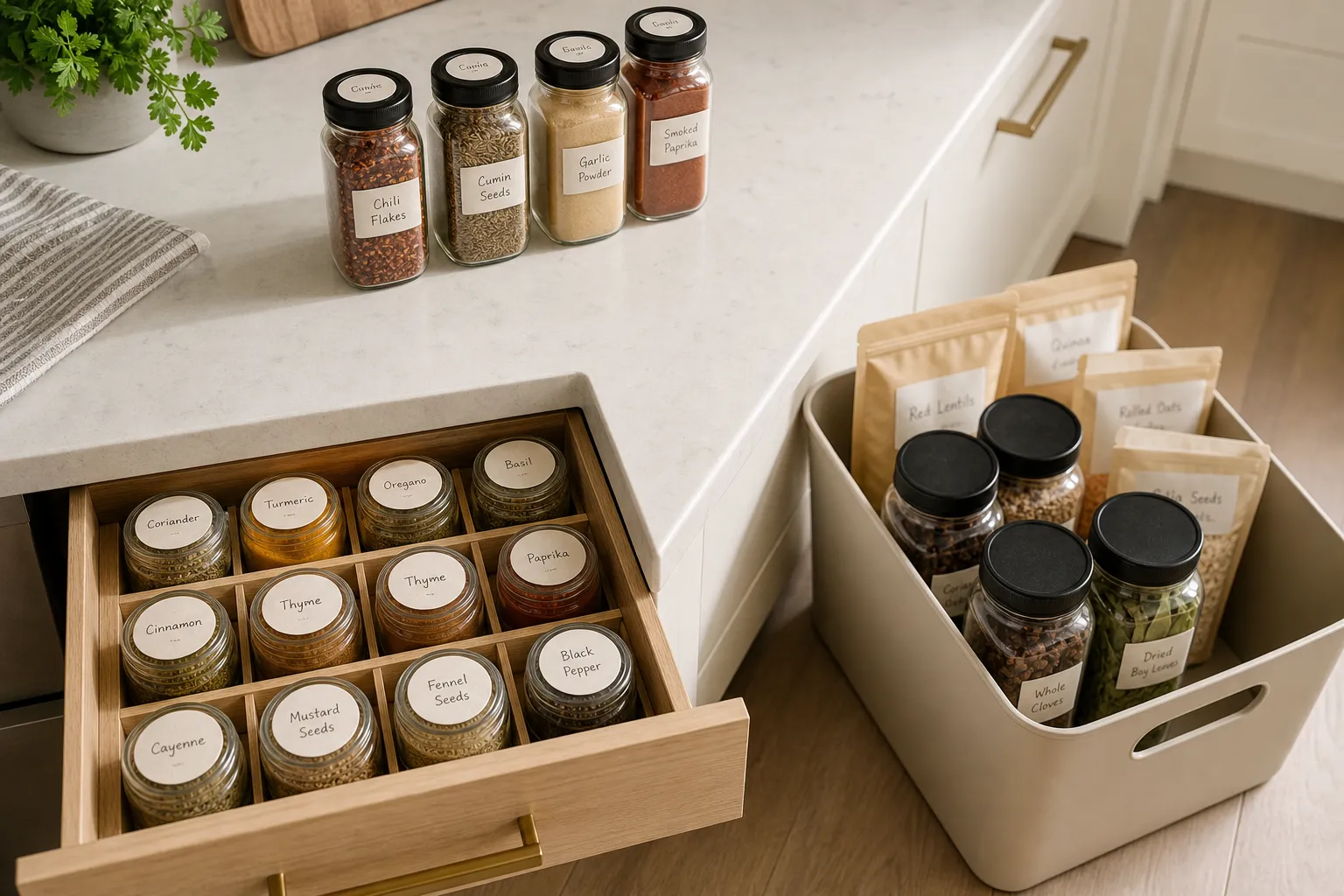
A side label works on a tiered cabinet shelf, but not in a drawer where you see only the lid. A lid label is excellent in a shallow drawer, but not helpful on a high shelf. A front label works on a pull-out rack if the rack opens far enough to show the row.
Match the label to the view:
- Upright jars in a drawer: label the lids.
- Angled jars in a drawer: label the visible upper side.
- Tiered cabinet shelf: label the front face.
- Door rack: label the cap or front, depending on how the rack presents the jar.
- Pantry refill bin: label the bin and keep original package names visible where possible.
If you decant spices into matching containers, keep the names plain. “Cumin,” “ground cumin,” and “cumin seeds” should not blur together when you are cooking. Matching jars can make a kitchen feel calmer, but identical containers make clear labels more important.
Container shape matters too. Round jars work well on turntables and are easy to grip, but they waste a little space in tight rows. Square jars line up neatly, but lid sizes and corners vary. Flat tins can suit a magnetic board, but they need readable labels and a placement that does not invite drops or spills. The best spice container shape is the one your chosen zone can hold without crowding.
Keep the counter clear without making cleaning harder
Countertop-free spice storage should reduce daily friction, not hide it somewhere else.
Avoid placing spices where flour dust, oil film, sink spray, or crumbs collect. If a rack sits too close to a messy prep edge, every jar becomes another surface to wipe. If a door organizer blocks a shelf, cleaning turns into a small negotiation. If a drawer insert traps powder in narrow grooves, it may look tidy while becoming annoying to maintain.
For easy clean spice storage, leave a little room:
- a small gap so shelves can be wiped;
- removable bins instead of tightly packed loose packets;
- jars that lift out without unloading the whole row;
- no storage directly in the path of chopping boards, wet dishes, or hot pans;
- a refill area that does not spill into the daily-use zone.
Empty space is not wasted space here. A little clearance can make a shelf easier to wipe. One fewer jar in the main drawer can make the whole drawer easier to use. A quieter kitchen often comes from fewer small collisions.
A ten-minute way to choose
If you are unsure which idea fits, do not start with shopping. Stand in the kitchen with the spices you use most.
- Pick the 8 to 15 seasonings you reach for weekly.
- Place them temporarily in the nearest drawer, then in the nearest cabinet, then near the wall or pantry spot you are considering.
- Open the stove-side drawer, cabinet door, dishwasher, and main prep drawer while the spices are in that trial spot.
- Check whether labels are readable without lifting every jar.
- Check whether the area can still be wiped.
- Put less-used jars and refills in a separate group.
- Only then choose an insert, rack, bin, or container set.
This small rehearsal prevents the common mismatch: buying a beautiful organizer for a place that is too deep, too high, too crowded, or too irritating to reach.
For many kitchens, the final setup is simple: daily seasonings in a drawer or shallow cabinet zone, occasional spices in a labeled bin, refills in the pantry, and no loose jars on the counter. For a rental, try removable bins and drawer inserts first. For an owned kitchen, a pull-out cabinet insert or fixed door rack may be worth considering after measuring. For a small kitchen, keep one compact active set instead of displaying the whole collection.
What this answer does and does not cover
This guidance is about room use, reach, visibility, cleaning access, and storage fit. It does not rank brands or treat marketplace descriptions as proof. It also does not make product-performance claims about magnetic strength, adhesive life, drawer load limits, wall-mounting reliability, glass durability, or exact spice freshness timelines.
If your plan involves drilling, heavy glass jars, adhesive strips, unusual cabinet hardware, or children who can easily reach the storage area, check the specific product instructions and the conditions of your kitchen before installing. For ordinary organizing, the most reliable starting point remains simple: measure the space, keep daily jars easy to see, and choose the storage zone that clears the counter without interrupting how you cook.
FAQ
What is the best spice storage idea for a small kitchen?
For many small kitchens, a shallow drawer or narrow cabinet zone works better than a counter rack. Keep only the weekly-use spices there, and move refills or occasional blends to a pantry bin or upper shelf.
Are magnetic spice racks a good idea?
They can be useful on a truly spare wall or metal surface, but they need careful placement. Check splash exposure, cleaning access, container security, and whether the rack interferes with doors, drawers, appliances, or normal cooking movement.
Should spices go in matching jars?
Matching jars can make storage calmer and easier to arrange, but they are not required. If you decant, use clear, specific labels and choose a jar shape that fits your drawer, shelf, or rack without crowding.
How do I store spices without using counter space in a rental?
Start with non-permanent options: drawer inserts, loose cabinet bins, a removable caddy, or a labeled pantry box for refills. Avoid drilled or adhesive systems unless they fit your lease rules and can be removed cleanly.