Kitchen Storage Ideas for Clear Counters and Daily Cooking
A crowded counter usually points to one of two problems: too many things are living in the open, or the storage behind the counter is too awkward to use. The most useful kitchen storage ideas do not hide everything. They protect a few clear working areas, keep daily tools close to the task, and move each object according to how often it is used.
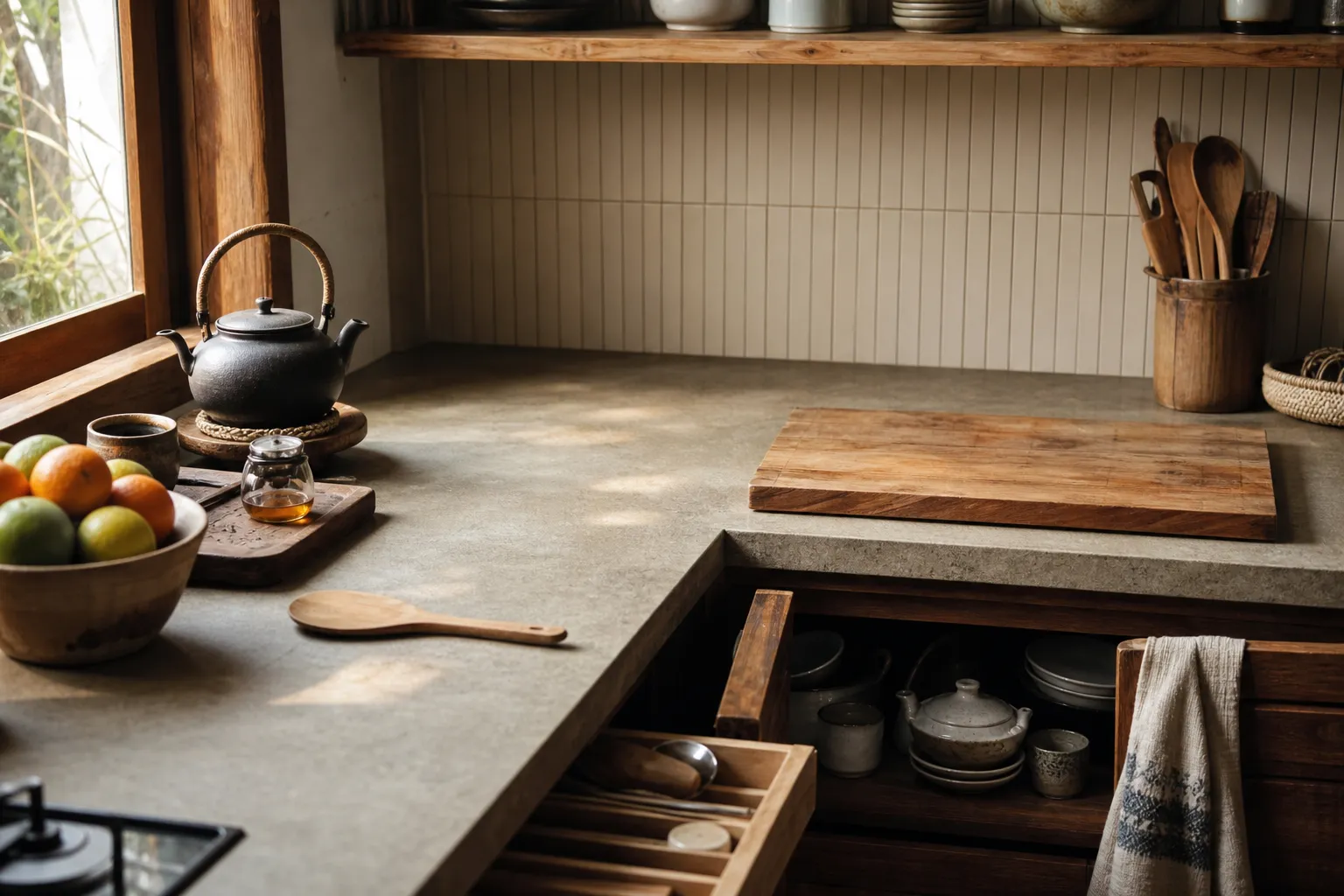
A calm kitchen can still show a kettle, rice cooker, tea tray, small oil tray, fruit bowl, or favorite wooden spoon if those things genuinely serve the day. The better question is not, “How empty can the counter look?” It is, “What needs to be visible, reachable, and easy to care for?”
broader context
Parent topic
Use the broader page when you need more context before this narrower page.
Start With the Counter Jobs, Not the Containers
Before buying pantry bins, drawer dividers, pull-outs, or an appliance garage, look at what your counter is already doing. Most lived-in kitchens need several different work areas:
- a landing place near the refrigerator or pantry
- a washing and drying area near the sink
- a preparation surface for chopping, mixing, and plating
- a cooking-side landing zone near the stove or oven
- a temporary area for tea, coffee, rice, toast, or breakfast items
When all of these jobs collapse into one crowded strip, even a large kitchen can feel difficult to use. When each job has a small protected area, even a compact kitchen may feel more workable.
This is where clear kitchen counters and hidden kitchen storage often get confused. Hidden storage helps only when it does not bury the things you actually use. If every breakfast begins by lifting a toaster from a low cabinet, carrying it across the kitchen, finding an outlet, and waiting for it to cool before putting it away, the counter may look quieter while the routine becomes more awkward.
In many homes, the better answer is semi-hidden storage: a low shelf, a nearby cabinet, a rolling cart, a tray, or a dedicated appliance zone outside the main prep path.
Store by Cooking Zone: Washing, Preparation, Cooking, Serving
Kitchen layout research often discusses workflow, reach, and the relationship between washing, preparation, and cooking areas. At home, you do not need a perfect triangle or a designer plan. You need storage that follows the task.
Near the sink: washing, drying, cleaning, and water-based prep
The sink area needs breathing room. If every inch beside it is filled with bottles, brushes, jars, cutting boards, and drying racks, the kitchen feels crowded before cooking begins.
Useful storage ideas near the sink include:
- a narrow tray for soap, brush, and sponge rather than loose bottles
- an under-sink caddy for backup supplies, not every product you own
- one hook or rail for a frequently used towel
- a vertical slot for cutting boards or trays if there is cabinet space nearby
- a drawer or bin for wraps, foil, parchment, and food bags if you use them near prep
Under-sink kitchen storage is worth keeping simple. The space is hidden, but it often has plumbing, irregular shapes, and limited visibility. A few removable bins usually work better than a tight stack of unrelated bottles. Keep the most-used items in front, and avoid filling the area so fully that you cannot see the back of the cabinet, remove a bin, or reach what the household may need to access.
Near the prep surface: knives, boards, bowls, spices, and daily utensils
The prep zone is where over-organizing can backfire. If knives, boards, bowls, salt, oil, and basic utensils are scattered across the room, the counter may look empty while cooking becomes fragmented.
For kitchen knife storage without a countertop knife block, think about access and handling first:
- In-drawer knife trays can keep blades off the counter if the drawer is close to prep.
- A wall-mounted magnetic strip can work where mounting is appropriate and household conditions allow it.
- A slim knife insert inside a drawer or cabinet may suit kitchens where visible metal strips feel too busy.
The right choice depends on access, household members, and the care needs of the knives. The point is to avoid moving knives so far away that they end up loose on the counter.
For cooking utensils, a countertop crock is convenient but visually dominant. If you do not want one, try:
- a top drawer with dividers for the five or six utensils used most often
- a shallow tray inside a drawer for chopsticks, spatulas, tongs, and tasting spoons
- a rail near the stove for a small edited set, not the whole utensil collection
- a narrow pull-out if your cabinet layout already supports it
Drawer dividers are not only about neatness. They stop small tools from becoming a tangled layer, which is often why duplicates migrate back to the counter.
Near the stove: pans, lids, oils, and heat-adjacent tools
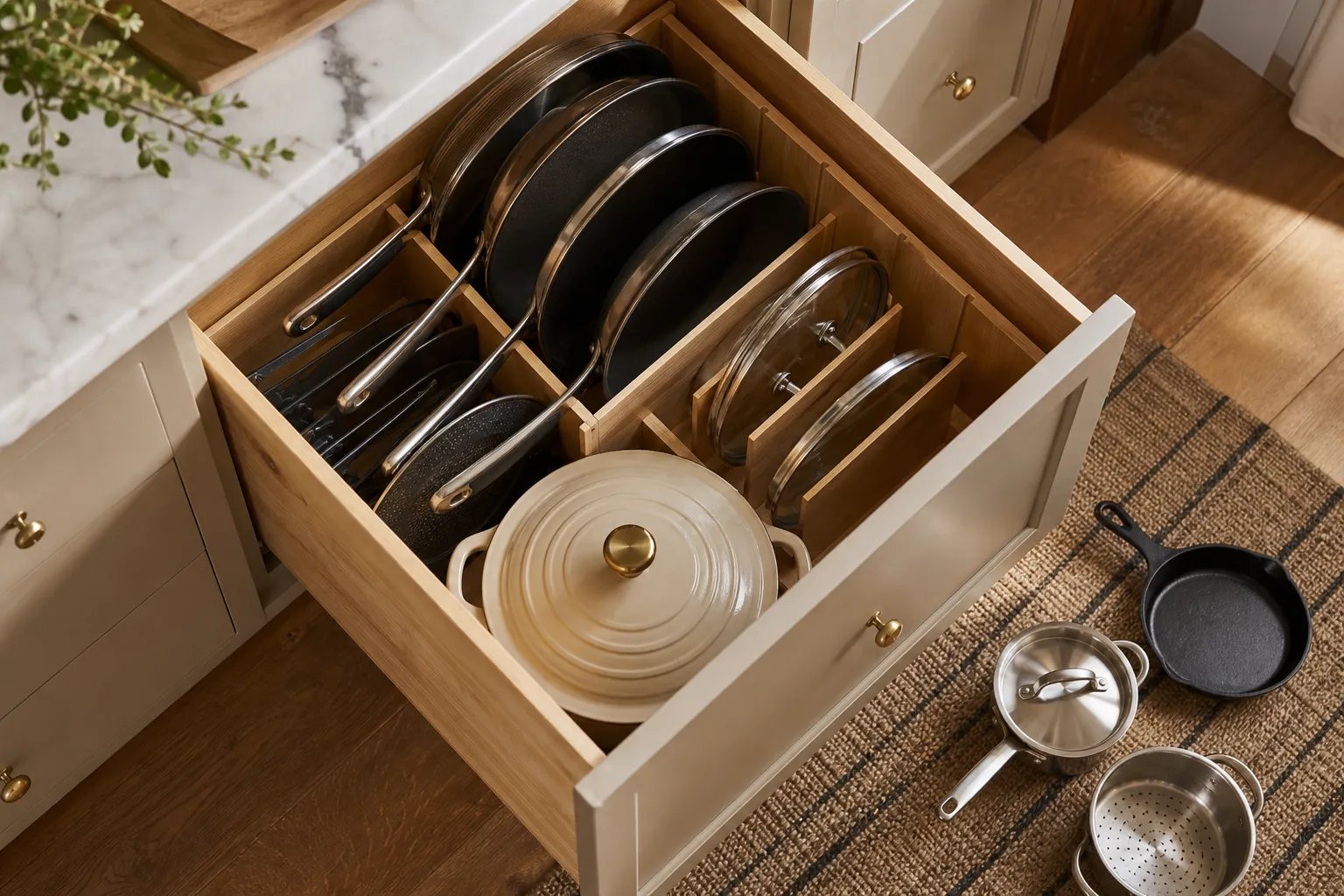
Cooking storage should reduce searching, not crowd the stove. Deep drawer kitchen storage can be especially useful for pots, pans, and lids because the contents are visible from above and easier to separate than in a dark lower cabinet.
If you have deep drawers, assign them by shape and weight:
- one layer for everyday pans
- a lid divider or vertical file for lids
- heavier pots lower down
- less-used specialty cookware away from the prime drawer
If you have lower cabinets instead of drawers, vertical racks, shelf risers, and pan protectors can help, but only if the cabinet is not overstuffed. A pan rack that requires removing three pans to reach one has not solved the real problem.
Oils, salt, pepper, and daily spices often deserve a visible or near-visible place. A small tray beside the stove can look intentional and make wiping easier. Keep the set edited: daily oil, salt, and perhaps two or three seasonings. Store the rest in a drawer, cabinet, or narrow pantry area.
Near serving or breakfast: cups, tea, kettle, toaster, rice cooker
Daily cooking storage includes repeated small rituals: boiling water, making toast, reheating rice, packing lunch, pouring tea. These are not automatically clutter. They are part of how the kitchen works.
Small kitchen appliance storage for toasters, kettles, and rice cookers should follow use:
- Is it used daily or only on weekends?
- Is it heavy or awkward to lift?
- Does it need time to cool before being moved?
- Is there a nearby outlet if it stays in use?
- Does the manufacturer give specific instructions for use, clearance, storage, or cleaning?
Without product-specific guidance, avoid exact claims about appliance clearance or storage. As a room-planning rule, it is usually unhelpful to force heavy or frequently used appliances into high cabinets or deep corners. A low cabinet, open shelf, rolling cart, or appliance garage may be more realistic than a perfectly empty counter.
An appliance garage can help when the appliance already lives where it is used. It helps less when it becomes a dark box for neglected gadgets. If the door or cover makes the tool annoying to access, it may not support daily cooking.
Open Shelves or Closed Cabinets for a Calm Kitchen
Open shelves are often presented as the warm answer: ceramics in view, glass jars lined up, wooden bowls within reach. Closed cabinets are often presented as the clean answer: everything hidden, all surfaces quiet. Real kitchens are less simple.
Open shelving can help when:
- you use the items often enough that dust is less likely to settle for long
- the shelf holds a small edited group, such as bowls, mugs, tea cups, or daily plates
- the objects are easy to lift down and put back
- the shelf is not placed where grease and steam make upkeep frustrating
- the visible materials are pleasing enough that you want to see them every day
Closed cabinets can help when:
- you own many mismatched packages, backup goods, or bulky tools
- you cook with oils and spices that would make open shelves harder to maintain
- visual clutter bothers you more than cabinet searching
- fragile, sharp, or household-specific items need a less exposed place
- your kitchen already has enough texture through wood, stone, textiles, or ceramics
The most workable calm kitchen organization is often mixed: open storage for a few visible daily tools and closed storage for visual noise. One open shelf of tea cups may feel warm. Five open shelves of packages, spare jars, and random mugs may feel busier than cabinets.
If you like Japandi kitchen storage ideas, focus less on the label and more on the underlying choices: restrained quantities, warm materials, simple shapes, and a clear place for each object. Bamboo, oak, ash, linen, stoneware, matte metal, and paper labels can support a quieter look, but material alone does not organize a kitchen. The edit matters more than the aesthetic.
Small Kitchen Storage Without Making Cabinets Worse
Small kitchens usually do not fail because there is no storage at all. They fail because prime storage is filled with things that do not earn it.
Prime storage is the space between easy bending and easy reaching: the drawers and shelves you can access without effort, the cabinet nearest the prep surface, the wall space that does not interrupt cooking, and the counter edges that can briefly hold groceries, washed vegetables, or finished dishes. Protect that space for frequent tasks.
Pantry storage for small kitchens without a walk-in pantry
A pantry does not have to be a separate room. It can be:
- one tall cabinet
- two shelves near the cooking zone
- a rolling cart
- a wall rack for dry goods
- a drawer for breakfast and tea supplies
- a few labeled bins in a lower cabinet
Pantry bins for kitchens are useful when they solve a real problem: loose packets, duplicate bags, awkward snack boxes, or deep shelves where food disappears. They are less useful when every item is decanted into containers that require more maintenance than the household wants to do.
For small spaces, group by cooking behavior rather than perfect categories:
- breakfast: oats, tea, coffee, honey, toaster items
- fast dinner: noodles, rice, sauces, canned goods
- baking: flour, sugar, leavening, chocolate, measuring tools
- lunch packing: wraps, containers, bags, napkins
- seasonings: spices, oils, vinegars, salts
This lets you pull one bin or tray for a task instead of searching through an entire cabinet.
Spice storage ideas that do not take over the counter
Spices are small, but they create visual noise quickly. A rotating rack on the counter can work for a very edited set. For larger collections, try:
- a shallow drawer near the prep or cooking area
- a narrow pull-out if already built into the cabinet plan
- a door-mounted rack where weight and clearance are suitable
- tiered shelves inside a cabinet
- uniform labels only if they help you find things, not just for appearance
Store the daily spices closest to where they are used. Put occasional blends higher, deeper, or in a secondary bin. If you cook across several cuisines, avoid forcing everything into one decorative rack that hides the range of what you actually use.
Plastic containers, wraps, and lids
Plastic containers, foil, wrap, parchment, and lids often cause cabinet swelling. They are also categories where people keep too many partial sets.
A practical reset:
- Match containers with lids.
- Remove warped, missing, or duplicate pieces you no longer use.
- Store lids vertically in a divider or bin.
- Nest containers by shape.
- Keep wraps and bags near the prep or lunch-packing zone.
This is not about perfection. It is about stopping one messy category from pushing daily cookware onto the counter.
Vertical kitchen storage when there are few cabinets
Kitchen storage ideas without cabinets often rely on vertical space, but walls should be used carefully. Too much wall storage can make a small kitchen feel busier.
Consider:
- a narrow rail for utensils used every day
- a pegboard for tools in a rental or workshop-like kitchen, if mounted appropriately
- freestanding shelves for bowls, pantry bins, or appliances
- a magnetic strip or wall rack only where the household can use it responsibly
- over-door storage for light, non-fragile items where doors still close well
For renter-friendly kitchen storage ideas without drilling, look first at freestanding and removable options: carts, tension shelves where suitable, cabinet shelf risers, drawer inserts, under-shelf baskets, removable hooks, and bins. Adhesive products vary by surface and weight, so check product instructions and test carefully rather than assuming every wall or cabinet finish will tolerate them.
Pull-Outs, Appliance Garages, and Other Hidden Kitchen Storage
Hidden kitchen storage is appealing because it promises a quiet surface. But hidden does not always mean better. The best hidden storage makes an item easier to retrieve than it was before.
Pull-out cabinet storage helps when:
- the cabinet is deep and items disappear at the back
- you need to see bottles, pans, or pantry goods from above or the side
- the pull-out does not steal too much usable width
- the hardware can carry the intended weight
- the cabinet door and surrounding layout allow smooth movement
It may not help when:
- the cabinet is already narrow
- the pull-out creates tiny slots that do not fit your real items
- the mechanism makes cleaning harder
- the cabinet is used for heavy appliances that are awkward to lift
- you are renting and cannot alter the cabinet
A pull-out is not automatically more organized than a shelf. It is only better if it matches the contents.
Appliance garages also have a narrow use case. They work best for one or two regularly used appliances that can remain near their outlet and daily task zone. They work poorly as a general hiding place for every small appliance. If a toaster, kettle, blender, rice cooker, coffee grinder, and mixer all compete for one hidden corner, the garage becomes another overstuffed cabinet.
For countertop appliance storage, choose a hierarchy:
- Daily and heavy: keep out, or store at an easy height very close to use.
- Daily but visually noisy: consider a tray, appliance garage, or open shelf.
- Weekly and light: store in a nearby cabinet or pantry zone.
- Occasional and bulky: move to secondary storage if retrieval is still reasonable.
This keeps the counter from becoming a showroom while respecting how cooking actually happens.
A Clear-Counter Reset That Still Supports Daily Cooking
A useful reset can be done without buying anything first.
Step 1: Empty one counter zone
Choose the area that bothers you most: beside the sink, beside the stove, or the main prep surface. Remove everything from that zone and clean the surface.
Step 2: Return only what serves that zone
For a prep zone, that might be a cutting board, salt, oil, and knife access. For a tea zone, it might be a kettle, tea canister, cups, and a small tray. For a sink zone, it might be soap, brush, and a towel.
Step 3: Create a nearby first drawer or cabinet
The counter will not stay clear if the closest drawer is full of unrelated objects. Give the nearest drawer or cabinet to the daily tools that support that surface.
Examples:
- prep drawer: knives, peeler, measuring spoons, tasting spoon
- stove drawer: tongs, spatula, ladle, thermometer if used regularly
- tea drawer: tea, filters, scoop, cloth, small sweets
- lunch drawer: wraps, bags, small containers, labels
Step 4: Move occasional items out of prime storage
Waffle makers, holiday platters, extra mugs, oversized stockpots, party trays, duplicate water bottles, and backup pantry goods should not occupy the easiest reach if they are rarely used. Move them higher, lower, farther, or to a secondary shelf if household access allows.
Step 5: Leave intentional empty space
A clear counter is not just the absence of objects. It is available working surface. Leave a landing zone near the refrigerator or pantry, a prep surface near the sink if possible, and a place to set down finished food according to your kitchen’s layout and surfaces.
Common Misreads About Calm Kitchen Organization
“If it is visible, it is clutter.”
Not always. A bowl of fruit, a kettle, a rice cooker, a tea tray, or a small set of utensils can be part of the working kitchen. Visible storage becomes a problem when it grows beyond use, blocks cleaning, or competes with prep space.
“If it is hidden, the kitchen is organized.”
Hidden storage can simply hide disorder. Overstuffed kitchen cabinets often push items back onto the counter because putting things away is too difficult. A calm kitchen needs accessible storage, not just closed doors.
“Small kitchens need more organizers.”
Sometimes they need fewer objects in prime zones. Organizers help when they separate items, improve visibility, or make retrieval easier. They do not help if they add more layers to a cabinet that already holds too much.
“Open shelves are always easier.”
Open shelves improve visibility, but they also require editing and cleaning. They are best for frequently used, easy-to-maintain items. Closed cabinets are often better for backups, packages, and visually busy categories.
“A clear counter means no daily tools.”
Daily cooking needs tools. The better goal is a counter with room to work, a few useful objects in view, and nearby storage that makes cleanup feel natural.
A Practical Decision Frame for Your Kitchen
Use this test for each item currently on the counter:
-
Do I use it daily?
If yes, keep it visible or one easy reach away.
-
Where do I use it?
Store it in that zone, not wherever there is random space.
-
Is it heavy, sharp, fragile, hot after use, or awkward to lift?
Avoid storage that makes handling more difficult. Check relevant product guidance where needed.
-
Does hiding it make the routine better or worse?
If worse, use semi-visible storage: tray, shelf, nearby drawer, or cabinet.
-
Is the cabinet it would go into already overfull?
Edit the cabinet before moving more into it.
-
Does the counter still have a landing zone?
Do not clear the counter by removing all usable work surface.
The most durable kitchen storage ideas are usually modest: one better drawer, one edited shelf, one tray that gathers daily tools, one deep drawer reorganized for pans and lids, one pantry bin for a repeated meal, one appliance moved to a place that matches its use.
A kitchen does not need to look empty to feel orderly. It needs objects placed with restraint, tools near the work they support, and storage that respects the way you cook on an ordinary day.