Soft White vs Warm White Light: Are They the Same at Home
A lamp beside a woven shade can make one bulb look honey-colored, while the same bulb in an exposed ceiling fixture can look cleaner and whiter. That is why soft white vs warm white light has a practical answer: the terms often overlap on bulb packaging, but they are not reliable enough to use alone.
For home buying, treat “soft white” and “warm white” as clues. Check Kelvin for color appearance, check lumens for brightness, and make sure the bulb fits the fixture. Around 2700K is commonly the softer, more incandescent-like choice. Around 3000K can still be warm, but often reads a little clearer and less yellow.

broader context
Parent topic
Use the broader page when you need more context before this narrower page.
The Short Answer
Soft white light and warm white light usually sit in the warmer part of household lighting. In many stores, both labels point toward a yellowish or amber light close to the old incandescent look. That is why shoppers often use the phrases as if they mean the same thing.
The catch is that these are consumer-facing package words, not fixed technical categories. One brand may call 2700K “soft white.” Another may call 3000K “warm white.” Some product lines let the terms overlap across a similar warm range. The wording on the front of the box cannot tell you exactly how the bulb will look in your room.
Kelvin is the steadier number. Lower Kelvin values generally look warmer and more amber. Higher values move toward cleaner white, then cooler appearances. For this question, the useful home comparison is often 2700K versus 3000K, with the caution that the package label may name them differently.
If you want an old lamp-like glow for a quiet corner, dining table, or evening side lamp, start near 2700K. If you want warmth without as much yellow, look near 3000K. Then test one bulb before replacing a whole room.
Kelvin Tells Color; Lumens Tell Brightness
The most common mistake is reading “warm” as “brighter” or “soft” as “dim.” Those words describe appearance, not brightness. Brightness is measured in lumens. Watts describe energy use, which is useful when comparing LEDs with older incandescent habits, but watts are not the cleanest brightness comparison.
The FTC’s consumer guidance separates brightness, energy cost, life, light appearance, and energy use on bulb labels. ENERGY STAR guidance also points shoppers toward lumens for brightness and color appearance for the kind of light a bulb gives. That separation matters in real rooms.
Two bulbs can both be 800 lumens while one is 2700K and the other is 3000K. They may be similarly bright, but the 2700K bulb will usually look more yellow or amber. The 3000K bulb may look cleaner on white walls, pale stone, or glossy tile. A cream fabric shade can change the impression again, making the same lumen level feel visually softer.
For a fair comparison, match lumens first, then compare Kelvin. If your current lamp is bright enough but too yellow, keep a similar lumen number and move from 2700K toward 3000K. If the color feels right but the room is too dim, keep a similar Kelvin and increase lumens within the fixture’s limits.
The box name starts the search. The numbers finish it.
Why the Same Bulb Can Look Different at Home
A bulb does not live on a package label. It sits inside glass, fabric, paper, ceramic, metal, or an open socket, then throws light onto walls, floors, tabletops, and objects. Those surfaces change how soft white and warm white are perceived.
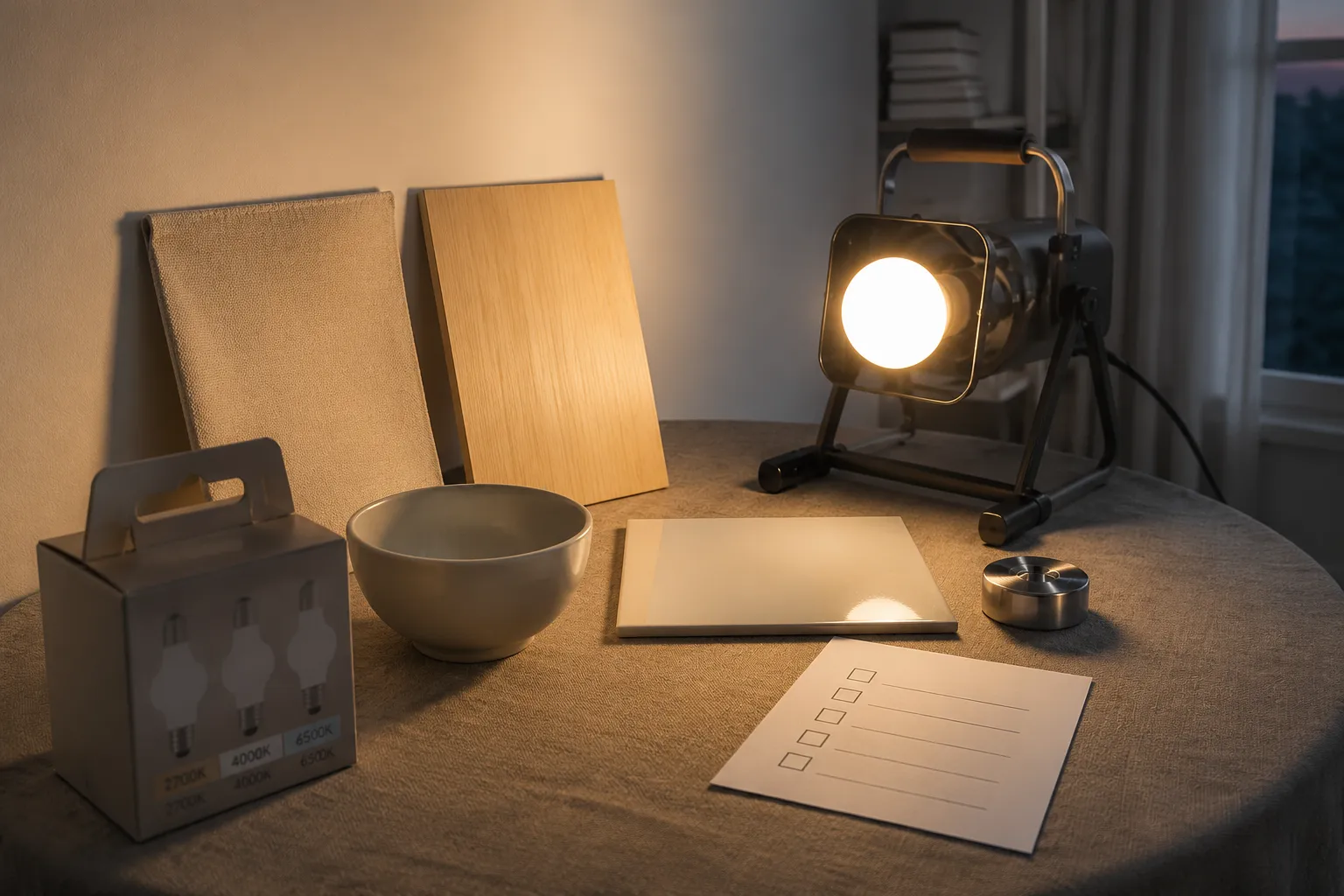
A cream fabric shade, amber glass shade, warm wood cabinet, tatami-toned mat, or clay tea bowl can make a bulb feel warmer and lower in contrast. A white shade, pale wall, glossy counter, chrome fixture, or exposed downlight can make the same Kelvin value appear clearer or sharper. The measured Kelvin and lumens do not change, but the room impression does.
That is why 2700K can be pleasant in a shaded table lamp but too yellow in a small bathroom with beige tile. A 3000K bulb may feel balanced over a kitchen counter, while the same number in a bare bedroom ceiling fixture may feel a little sharper than expected. The room surface is part of the decision.
The fixture matters too. A covered globe diffuses light. A narrow shade directs it downward. A recessed ceiling light spreads or concentrates light depending on trim and beam. A dimmable lamp changes brightness, but not every LED bulb works well with every dimmer. Package notes about dimmer compatibility, enclosed-fixture use, base size, and damp-location suitability are practical checks.
When the room matters, buy one bulb first. Put it in the actual fixture, look at it in the evening and during daylight, and view it against the surfaces it will illuminate.
Choosing Between 2700K and 3000K
For living rooms, bedrooms, dining spaces, tea corners, and low evening lamps, many people prefer the softer side of warm light. In package terms, that often means soft white light around 2700K, though the exact label can vary. It tends to sit well with linen shades, wood, clay, paper, and other natural materials because it is less stark on textured surfaces.
For kitchens, vanities, closets, laundry areas, and desks, a slightly cleaner warm white light around 3000K can be useful when you want warmth but still need to see edges, colors, and small details. This is not a rule for every task space. It is a starting point when 2700K feels too yellow or when pale surfaces can handle a clearer light.
The dining table is a good place to notice the difference. A 2700K bulb above food, ceramics, and wood may read more amber. A 3000K bulb may keep the table warm while making white plates and pale stoneware look less yellow. Neither is automatically better. The right choice depends on the table surface, shade material, ceiling height, and how much brightness the room needs.
For a reading chair, do not choose by color name alone. If the bulb is too dim, moving from soft white to warm white may not solve the problem. You may need more lumens, a better lamp position, or a shade that sends light onto the page. If the bulb is bright enough but visually harsh, Kelvin and glare matter more than wattage-equivalent language.
Color-selectable bulbs can help you compare 2700K and 3000K in the same room. Use that feature as a sample board for light, not as a reason to turn one bulb decision into a larger device project.
Common Package Confusion
The labels are not universal
Commercial and retail language varies: one brand may split 2700K and 3000K into separate names, while another may use broader overlapping ranges. That is why Kelvin is the better comparison.
Watts are not the cleanest brightness check
With older bulbs, many shoppers learned to think in 40W, 60W, or 100W habits. With LEDs, wattage-equivalent language can help you orient yourself, but lumens are the cleaner brightness check. If two bulbs use different watts but produce similar lumens, they may look similarly bright while using different energy.
Warm, soft, bright, and gentle can cross over
A 3000K bulb with low lumens may look less bright than a 2700K bulb with high lumens. A 2700K bulb in an exposed fixture may feel more glaring than a 3000K bulb behind a good shade. Color appearance, brightness, fixture, and surface all work together.
One package word cannot solve every room
A warm ceiling light, a shaded table lamp, and a focused reading lamp do different jobs. Matching every bulb in a room can make the space feel orderly, but careful mixing can also work: warmer shaded lamps for evening atmosphere, slightly cleaner warm bulbs where hands need detail.
The Practical Buying Move
If you are standing in the lighting aisle, use this order:
- Choose the correct bulb shape and base for the fixture.
- Check fixture notes, including dimmer compatibility, enclosed-fixture use, damp-location suitability when relevant, and package instructions.
- Match lumens to the brightness you want.
- Check Kelvin for color appearance.
- Treat “soft white” and “warm white” as secondary wording.
- Buy one bulb first when the room surface or shade may change the look.
For a warmer, more traditional lamp appearance, begin near 2700K. For a still-warm but cleaner household light, begin near 3000K. If two boxes both say warm or soft, the Kelvin number will usually tell you more than the phrase on the front.
The available sources are strong for label reading, lumens, watts, Kelvin color appearance, and general bulb-selection checks. They are more limited for universal soft white versus warm white ranges, because the market does not use those words consistently. That limit is the main lesson: the package name can guide your hand, but the room test makes the decision.
FAQ
Is soft white warmer than warm white?
Sometimes, but not always. In many household bulbs, soft white is around 2700K and warm white is around 3000K, so soft white may look more yellow. Since package language varies, Kelvin is the better check.
Is 2700K or 3000K better for a bedroom?
Many bedrooms feel softer near 2700K, especially with fabric shades, wood, and low evening lamps. If the room feels too yellow or you need clearer visibility near a closet or vanity, 3000K may work better.
Can two bulbs have the same brightness but different color?
Yes. Two bulbs can have the same lumen number and different Kelvin values. They may be similarly bright, while one looks more amber and the other looks cleaner.
Should every bulb in a room match?
Not always. Matching Kelvin can make a room feel orderly, especially with several ceiling lights. A room can also use warmer shaded lamps and a slightly clearer task light, as long as the difference looks intentional rather than accidental.
Bottom Line
Soft white and warm white are not guaranteed to mean different things, and they are not guaranteed to mean the same thing. At home, they usually describe nearby parts of the warm-light range, with 2700K often reading softer and more yellow, and 3000K often reading warm but a little cleaner.
Choose by Kelvin for color, lumens for brightness, and the actual fixture for fit. Then look at the bulb against your wall, shade, table, and objects before buying a full set. One careful test bulb is the smallest useful adjustment.