Warm Lighting for Bedrooms Without Making the Room Too Dark
Yes — you can use warm lighting for bedroom spaces without losing usable brightness. The trick is to keep the light warm in feel, not simply low in output. A bedroom usually works best when the room has enough general light to move around, plus softer light near the bed for evening use.
If the room feels cozy but you still cannot read comfortably, find clothes easily, or see across the room, the problem is usually not “warmth.” It is under-lighting.
broader context
Parent topic
Use the broader page when you need more context before this narrower page.
What warm light should do in a bedroom
Warm light should soften glare, make the room feel calmer at night, and take the edge off hard surfaces. It should not turn the bedroom into a dark corner.
A good bedroom usually has:
- One main light for basic visibility
- One or two bedside lamps for close-up use
- Some way to adjust brightness as the room shifts from daytime to evening
That balance matters because many cozy-looking rooms are simply too dim. Warm light and low light are not the same thing.
The setup that usually works best
For most rooms, layered lighting is the most practical choice. A single fixture trying to do everything usually creates shadows or leaves one part of the room too dark.
A useful setup often looks like this:
- A ceiling light for overall brightness
- Bedside lamps for reading and winding down
- Optional extra light for a closet, dresser, or dark corner
This approach keeps the room soft without making it hard to use. The overhead light gives the room structure, while the bedside lamps carry the warmer, more relaxed feeling.
In smaller bedrooms, one overhead light and a lamp on each side of the bed may be enough. In larger rooms, or rooms with dark walls, dark floors, or heavy curtains, you may need more than one small lamp to keep the space from feeling closed in.
What to check before you buy a lamp
Lamp brightness matters as much as color. A lamp can look gentle and still give enough light if it is placed well. It can also look warm and still be too weak for everyday use.
Before choosing a bedside lamp, ask:
- Is it meant for reading or only for mood light?
- Does the shade block too much light?
- Does the bulb face down, up, or out into the room?
- Will one lamp need to cover more than just the bedside area?
A dim bedside lamp is fine if it is only for atmosphere. If it is the only light near the bed, it may not be enough.
The useful distinction is simple: one part of the setup controls the feeling, and another part controls visibility. You need both.
Placement changes the result
Where the light sits matters as much as the fixture itself.
A few placement choices usually help:
- Put bedside lamps close enough to use comfortably, but not so close that the bulb shines straight into your eyes
- Use shades that soften glare
- Add a second light source instead of forcing one lamp to do all the work
- Keep some overhead light available instead of relying on a single small source
This becomes even more important in rooms with low ceilings, dark finishes, or deep corners. In those spaces, a warm bulb alone will not solve the problem if the light is badly placed.
If the bedroom also doubles as a dressing area, reading nook, or work corner, different parts of the room may need different light levels. That is normal. A bedside lamp can feel comfortable without being enough for the closet or mirror.
A common misunderstanding
Warm lighting does not have to mean yellow, dull, or heavily dimmed.
A better way to think about it:
- Warmth affects mood
- Brightness affects usefulness
- Placement affects balance
If one of those is off, the room can feel wrong even if the others are fine.
Another mistake is assuming a bedroom should be uniformly dim to feel restful. In practice, a room often feels better when the light changes by zone: a gentler overhead source, a brighter bedside area, and softer corners. That variation usually feels more natural than a room that is equally dark everywhere.
A simple home check
If you are not sure whether your room is warm enough without being too dark, test it in the way you actually use it.
Look for these signs:
- You can see across the room without turning on another light
- The bed area feels comfortable for reading or winding down
- Dark corners do not make the room feel heavy
- The light does not shine directly into your eyes from bed
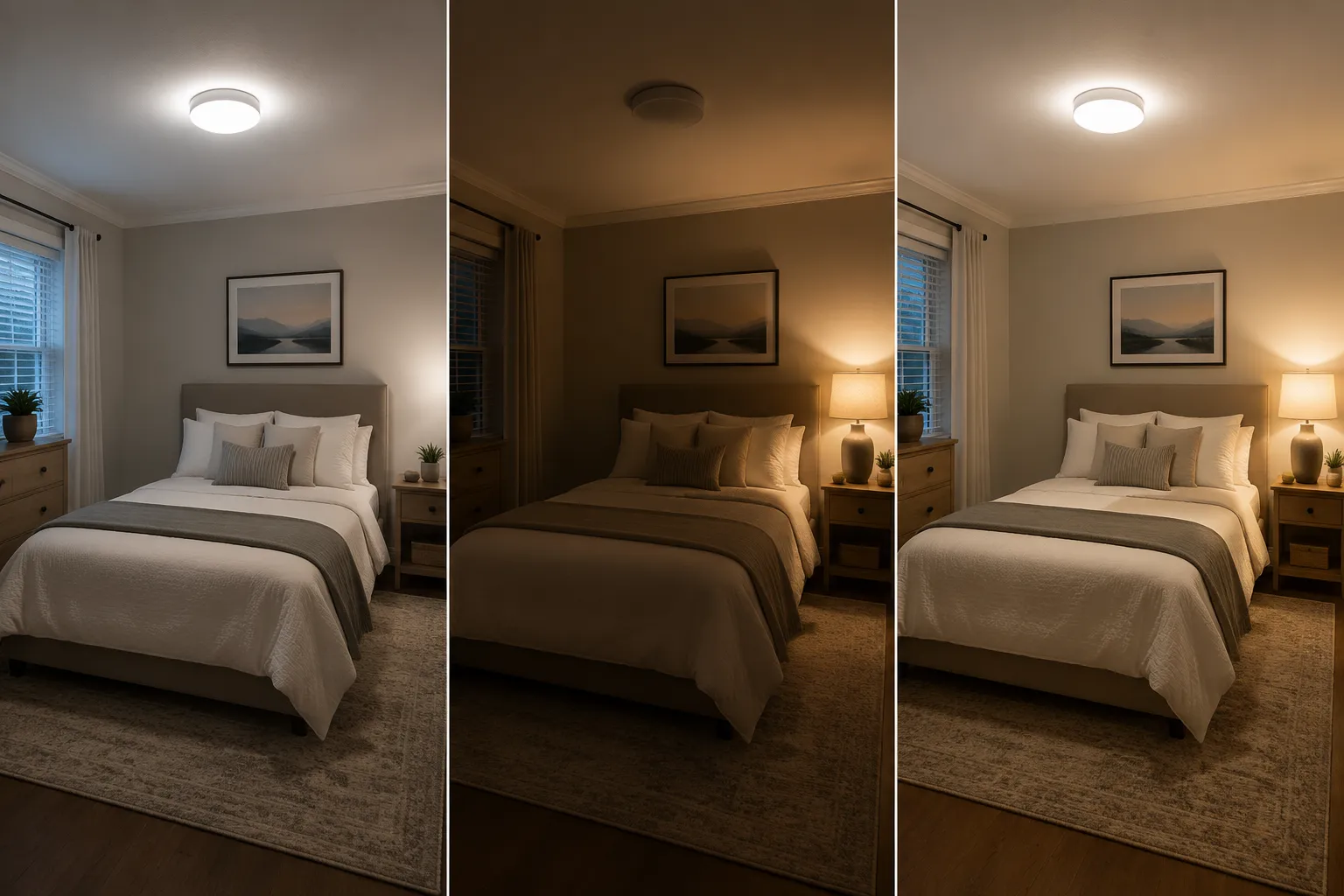
Try the room in three states: overhead light only, bedside lamp only, and both together. That tells you more than judging the room in daylight or looking at a store display.
If the room only feels good when every light is on, the setup may be too weak. If it only feels good with one small lamp, it may be too dark for normal use. The best result is usually somewhere between those two.
Where the limit is
There is no single lighting setup that works for every bedroom. Room size, wall color, ceiling height, furniture layout, and daily use all change the answer.
A small room with light walls may need less output than a larger room with dark finishes. A bedroom used only for sleeping can be softer than one that also works as a reading or dressing space.
The main rule is straightforward: use warmth in tone, not darkness as a substitute for warmth. If the room feels soft but hard to use, add light. If it feels bright but harsh, soften the source. If it feels both harsh and dim, the issue is usually placement as much as brightness.
Warm lighting works in bedrooms when it stays warm in tone and strong enough to use. The goal is not the dimmest room possible. It is a room that feels calm, looks gentle, and still works in everyday life.