Warm Kitchen Lighting That Still Works for Cooking and Cleaning
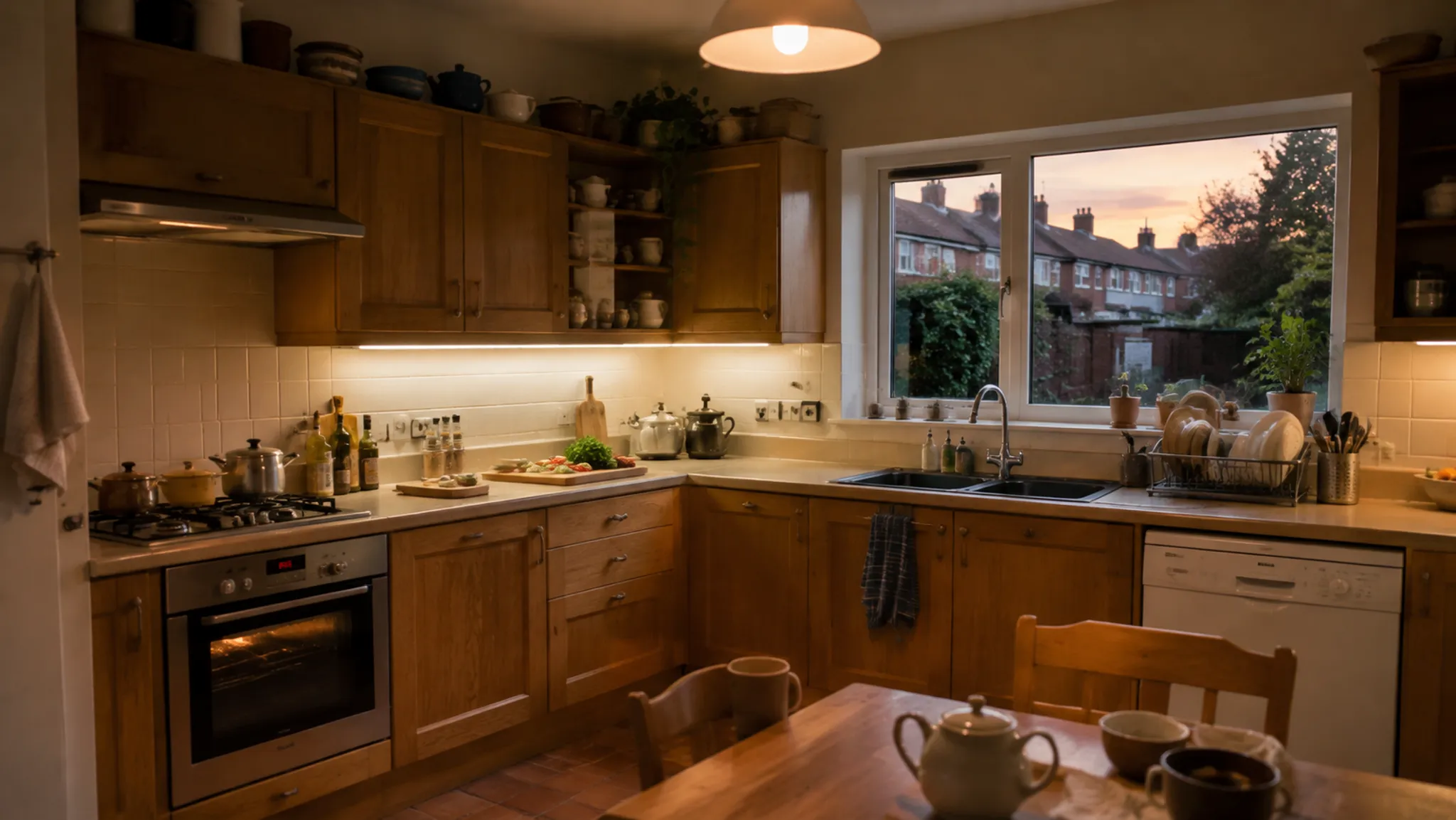
Warm kitchen lighting can work for cooking and cleaning when the room's atmosphere and its work surfaces are lit as separate layers. Keep the general light warm if it suits the wood, plaster, ceramics, and other materials in the room; add focused, evenly distributed task light where you chop, wash, stir, and wipe.
Do not judge the result by color temperature alone. Stand in your usual working position and check the counter, sink, cooktop, and cleaning surfaces. If your body or the upper cabinets cast a shadow, or a bright reflection hides the surface beneath it, adjust the local task lighting before making the whole kitchen cooler or brighter.
broader context
Broader context
Use the broader page when you need more context before this narrower page.
Keep the Warm Background, Then Light the Work
A ceiling fixture is often expected to light the entire kitchen, but its path to the counter may be blocked as soon as someone stands at the worktop. A warm pendant or recessed light can give the room a settled appearance while leaving the chopping board in shadow.
General lighting and kitchen task lighting therefore need separate checks. Virginia Tech kitchen guidance distinguishes between lighting for particular work surfaces and lighting for the wider room. The publication is dated and should not be used to determine current installation requirements, but the planning distinction remains useful.
Begin with the places where work actually happens:
- The main preparation counter
- The sink and draining area
- The cooktop or range
- A counter used for appliances or serving
- Corners beneath deep upper cabinets
- The place where dishes, knives, or tea ceramics are inspected after washing
Test these areas after daylight has faded. Put a cutting board on the counter, stand where you normally work, and move your hands across it. A deep shadow beneath your hands usually points to fixture placement or light distribution, not simply to a lamp being too warm.
Lighting under cabinets can bring light closer to the work surface, but position still matters. A strip mounted too far back may illuminate the backsplash more strongly than the front of the counter. Exposed points of light may also appear as sharp reflections in polished stone, glass, or metal.
Judge the whole working surface, not the brightness directly beneath the fixture. The room can remain warm; the worktop needs its own clear light.
Check Shadows, Color, and Cleaning Surfaces
Warm white kitchen light is not automatically dim. Color temperature describes the broad warm or cool appearance of white light, while usable task visibility also depends on output, placement, distribution, surrounding surfaces, and glare.
Research into scene brightness in illuminated interiors found that source spectrum and surface reflectance can influence how bright a room appears. A warm-lit kitchen may therefore require closer attention to local coverage rather than an immediate switch to cooler lamps.
Three small checks reveal more than the room's overall impression.
Look at the preparation surface
Place a few ordinary objects on the counter: a pale onion, leafy herbs, a tomato, a wooden spoon, and a stainless-steel utensil. Check whether their edges, surface changes, and colors remain distinguishable where preparation occurs.
Correlated color temperature, commonly shown in kelvin, helps describe whether a white light appears warmer or cooler. Color-rendering measures such as CRI offer another comparison point, but they do not fully predict tint, whiteness, preference, or how every material and food will appear. Research on white lighting in residential settings discusses these limits.
Compare a lamp against your own counters, cabinets, cookware, and food. The numbers on the package narrow the choice; the room test completes it.
Look at the sink and cleanup area
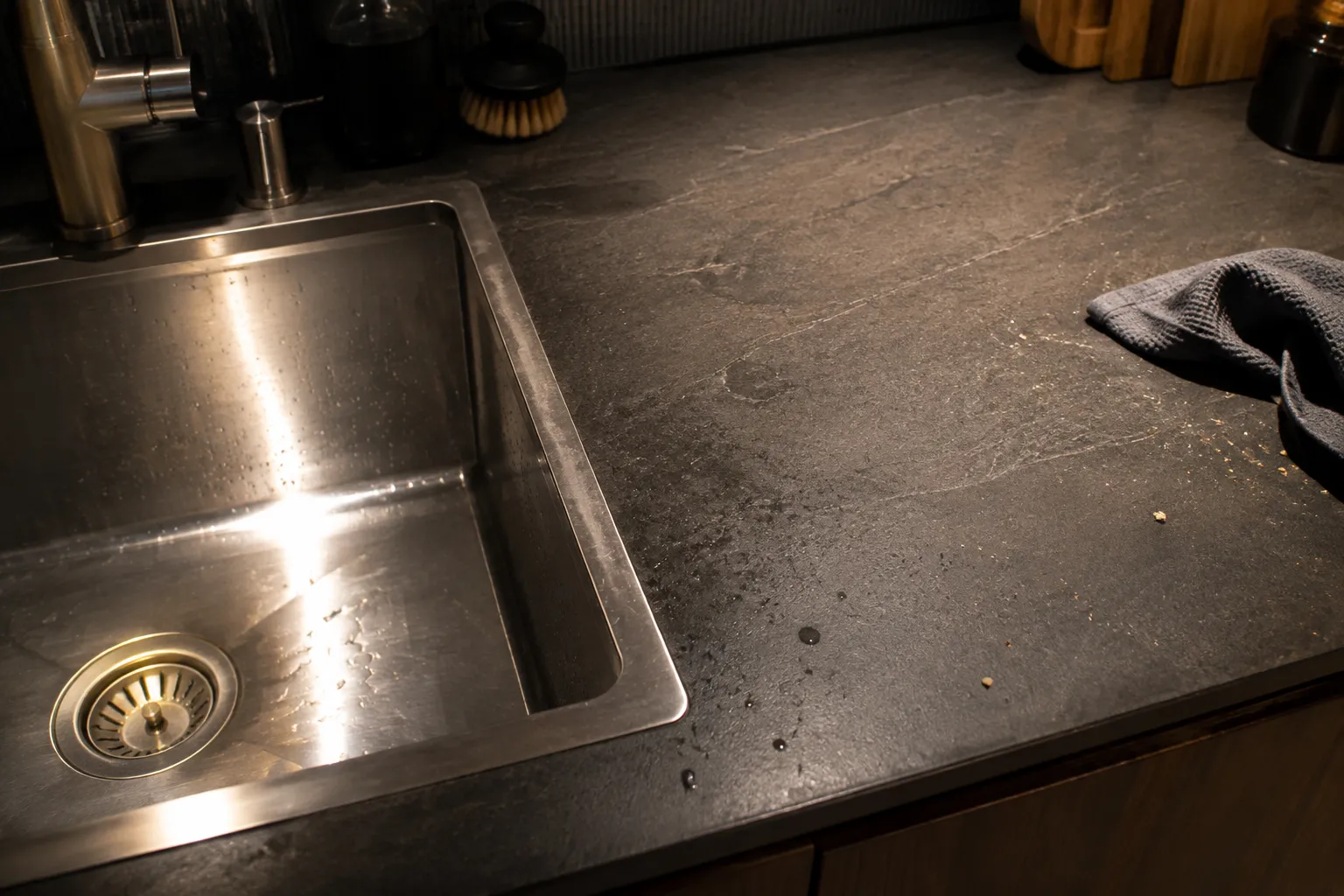
After washing or wiping, inspect the sink, draining area, backsplash, and nearby counter from your normal cleaning position. Then shift your viewing angle slightly.
Marks may become easier to notice when light reaches the surface from a different direction. Too much directional contrast, however, can leave hard shadows behind taps, containers, or appliances.
The available research does not establish one universal lighting specification for finding grease, crumbs, streaks, or water marks in a residential kitchen. Treat this as an observation in your own room. If marks repeatedly disappear, reposition or redirect the task light and check the surface again.
Repeat the test with the kitchen occupied
An empty counter may look adequately lit because nothing interrupts the ceiling light. Stand close to the worktop, open an upper cabinet, and return the appliances that normally sit there.
Counter shadows often come from geometry. A stronger ceiling lamp may make the whole room more intense without reaching the area beneath the cabinets. Bring light closer to the task before increasing brightness everywhere.
Adjust for Glossy, Metallic, and Dark Surfaces
The same fixture can behave differently over pale matte stone, black polished counters, glossy tile, glass, or brushed metal. Surface finish affects how light returns to the eye, while fixture position determines whether that reflection is useful or distracting.
On glossy finishes, look for sharp images of the lamp reflected in the counter or backsplash. Move your head through the positions used for chopping and cleaning. If the reflection remains in your line of sight, dimming may soften it, but shielding, diffusion, or a change in fixture position may address the cause more directly.
A stainless-steel sink or appliance can produce a bright streak even when the surrounding counter is poorly lit. Do not mistake that reflection for useful coverage. Look beside and beneath it to see whether edges, water, and surface marks remain visible.
Dark counters and deep corners can appear subdued because they return less light toward the viewer than pale surfaces. These areas may benefit from a closer, more evenly spread task layer, particularly beneath cabinets or beside tall appliances.
Also check transitions. A bright backsplash beside a dark counter can draw the eye away from the place where the knife or cleaning cloth is moving. Perfect uniformity is unnecessary, but the working surface should not disappear beside a much brighter object.
Reduce the distracting contrast first.
A Five-Minute Evening Test
Use the kitchen in its normal condition, with the appliances and objects that usually remain on the counter.
- 1Turn on the warm general lighting you prefer.
- 2Stand at each work area and look for shadows from your head, shoulders, hands, and upper cabinets.
- 3Check whether food, utensils, and counter edges remain distinguishable.
- 4Wipe the counter and sink, then inspect them for crumbs, streaks, and water marks.
- 5Look across glossy stone, tile, glass, and metal for exposed lamps or concentrated reflections.
- 6Switch on or reposition local task lighting, then repeat the same observations.
- 7If the lighting is dimmable, lower each layer separately and find a setting that preserves a clear working surface.
This room test is more useful than applying one specification to every kitchen. A small galley with pale matte counters will return and distribute light differently from an open kitchen with dark stone, deep cabinets, and polished metal.
A limited 2008 U.S. Department of Energy field demonstration provides a bounded example. In two homes, particular warm-color LED downlights and under-cabinet fixtures delivered measurable counter-level illumination. The under-cabinet installation also produced more uniform light than the comparison halogen arrangement.
Those findings apply to the products and rooms tested at that time, not to every warm LED fixture. They illustrate the practical point: warmth, output, placement, and distribution must be evaluated together.
Common Questions
Do warm bulbs make a kitchen too dark for cooking?
Not necessarily. A warm-looking lamp can provide useful task light, while a cooler lamp can still perform poorly if it is weak, badly placed, or blocked by the person working. Check the light on the counter rather than judging it from across the room.
Should under-cabinet lights match the ceiling lights exactly?
An exact match is less important than avoiding an obvious and distracting difference. Similar-looking white light usually gives the room a more continuous appearance, but the task layer should first provide clear coverage without sharp glare or deep shadows. Compare both layers in the evening and with the actual surfaces in view.
Is a higher CRI enough to choose kitchen lighting?
CRI can help compare products, but it does not describe every aspect of color appearance or visual preference. Use it alongside color temperature, output, distribution, dimming behavior, and a test against your own food, cookware, counters, and finishes.
Where the Guidance Stops
The available sources support separating ambient and task light, and they help explain why warmth, distribution, surface reflectance, shadows, color appearance, and glare require individual checks. They do not establish one warm-light specification that suits every kitchen.
They also do not determine current wiring rules, local code requirements, heat clearances, or wet- and damp-location ratings for a particular fixture. Near sinks, cooktops, steam, or other exposed areas, consult current product documentation and the requirements that apply where you live. New wiring, uncertain fixture placement, and questions involving moisture or heat should be handled by a qualified electrician or installer.
A warm-looking kitchen does not need dim worktops. Keep the ambient layer you enjoy, then make the smallest useful local adjustment: remove one counter shadow, soften one sharp reflection, or make the sink easier to inspect at the end of the evening.