Natural vs Synthetic Materials for Everyday Home Objects
The better choice is rarely “natural” or “synthetic” by itself. For everyday home objects, the better material is the one that fits the object, the room, the amount of use, the cleaning routine, and what will happen when the item wears out.
When comparing natural vs synthetic materials for home use, start with practical conditions: moisture, sunlight, heat, weight, food contact, skin contact, children, pets, repair options, and how often the object will be cleaned.
Natural materials such as solid wood, rattan, wool, linen, leather, stone, bamboo, and ceramic can be excellent when touch, repair, aging, and long use matter. Synthetic or blended materials can be the calmer choice when washability, lower upfront cost, damp-room use, outdoor exposure, light weight, or short-term flexibility matter more.
The label is only the beginning.
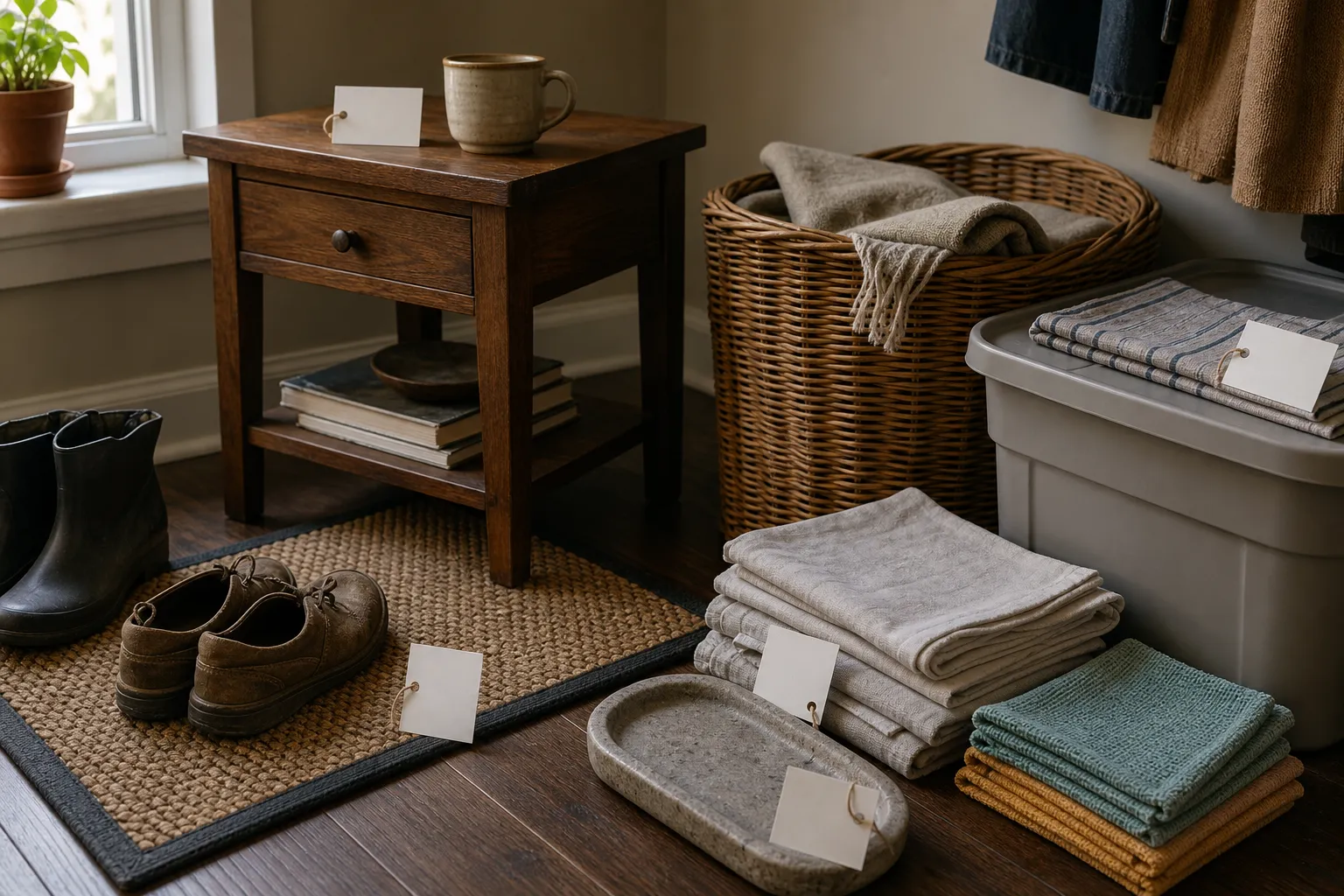
broader context
Parent topic
Use the broader page when you need more context before this narrower page.
Start with the object, not the material category
A dining table, a bathroom storage bin, a washable entry mat, a tea tray, and an outdoor chair are asking different questions.
A solid wood table may suit a dry dining room where scratches can be repaired and water rings are wiped quickly. A plastic storage box may be more practical under a sink, where leaks and cleaning products are part of daily life. A ceramic cup may feel better in the hand for tea at the table, while a lightweight plastic cup may make more sense for a child’s picnic basket.
Before deciding, ask:
- What touches it? Food, skin, hot cups, wet towels, muddy shoes, pet claws, or only dust?
- Where will it sit? Sunny window, damp bathroom, covered porch, dry bedroom, kitchen counter, entryway, or closet?
- How often will it be cleaned? Daily wiping, machine washing, spot cleaning, occasional dusting, or seasonal care?
- How long do you expect to keep it? A long-term focal piece, a rental-home solution, a child-stage item, or a temporary style choice?
- Can it be repaired? Sanded, resealed, reupholstered, rewoven, patched, tightened, glued, or replaced in parts?
- What happens at the end? Reuse, repair, donation, local recycling where accepted, landfill, or difficult mixed-material disposal?
This is close to a life-cycle way of thinking: an object’s impact depends not only on what it is made from, but also on production, transport, use, maintenance, reuse, recycling, and disposal. A natural label does not answer all of that. Neither does a synthetic one.
Where natural materials often work well
Natural materials are strongest when the object is handled often, kept in suitable conditions, and worth maintaining. Their appeal is tactile as much as visual: wood grain under the palm, the cool weight of ceramic, the spring of rattan, the dry texture of linen, the density of wool, the way leather or stone changes with use.
Good candidates include:
- a dining table or writing desk that can be refinished;
- a wooden chair or bench with repairable joints;
- ceramic cups, bowls, vases, and tea objects used with care;
- cotton, linen, or wool textiles when the fiber content is clear and the care routine fits the household;
- rattan, bamboo, or wood storage kept away from prolonged dampness;
- stone or wood surfaces when weight, sealing, staining, and cleaning limits are understood before buying.
The important phrase is when maintained.
Durable natural materials are not maintenance-free. Solid wood can stain, dent, dry, swell, or fade depending on finish and room conditions. Rattan can become brittle or misshapen if it is repeatedly exposed to moisture and strong sun. Wool rugs may need more careful cleaning than some synthetic rugs. Leather can mark, dry, or need conditioning. Natural stone may need sealing and can be heavy, porous, or sensitive to certain cleaners.
Natural materials also are not automatically the better environmental choice. A large, heavy, poorly used object that is shipped far, hard to repair, and discarded early may be less sensible than a lighter alternative that stays useful for longer. The practical question is not whether the material sounds earthy. It is whether the object will stay useful in the life of the room.
Where synthetic or blended materials may make more sense
Synthetic materials are often dismissed as temporary or cheap, but that is too broad. In real homes, synthetic and blended materials solve problems that natural materials may handle poorly or expensively.
They can be useful for:
- outdoor chairs, cushions, or woven pieces exposed to sun and rain;
- washable rugs and mats in entries, kitchens, laundry areas, or children’s rooms;
- lightweight storage that is moved often;
- damp-room organizers;
- short-term furnishing on a limited budget;
- pet or child zones where heavy wear is expected;
- experimental colors or shapes you may not keep for many years.
A synthetic rug may be easier to clean than a wool rug in a muddy entry. Plastic wicker may hold up better than natural rattan on an uncovered balcony, depending on construction and sun exposure. A melamine or plastic plate may be more practical for a picnic or child-heavy gathering than ceramic, even if ceramic feels better for daily tea.
Still, “synthetic” is not one material. Polyester, nylon, acrylic, polyurethane, PVC, melamine, resin, laminate, and composite materials behave differently. Coatings, backings, adhesives, seams, additives, and construction quality can matter as much as the base material.
A synthetic object can be well designed and long used, or flimsy and quickly discarded. The care label and construction details usually tell you more than the style phrase on the shelf tag.
Common home material comparisons
These pairs come up often because they reflect real shopping decisions. None has a permanent winner.
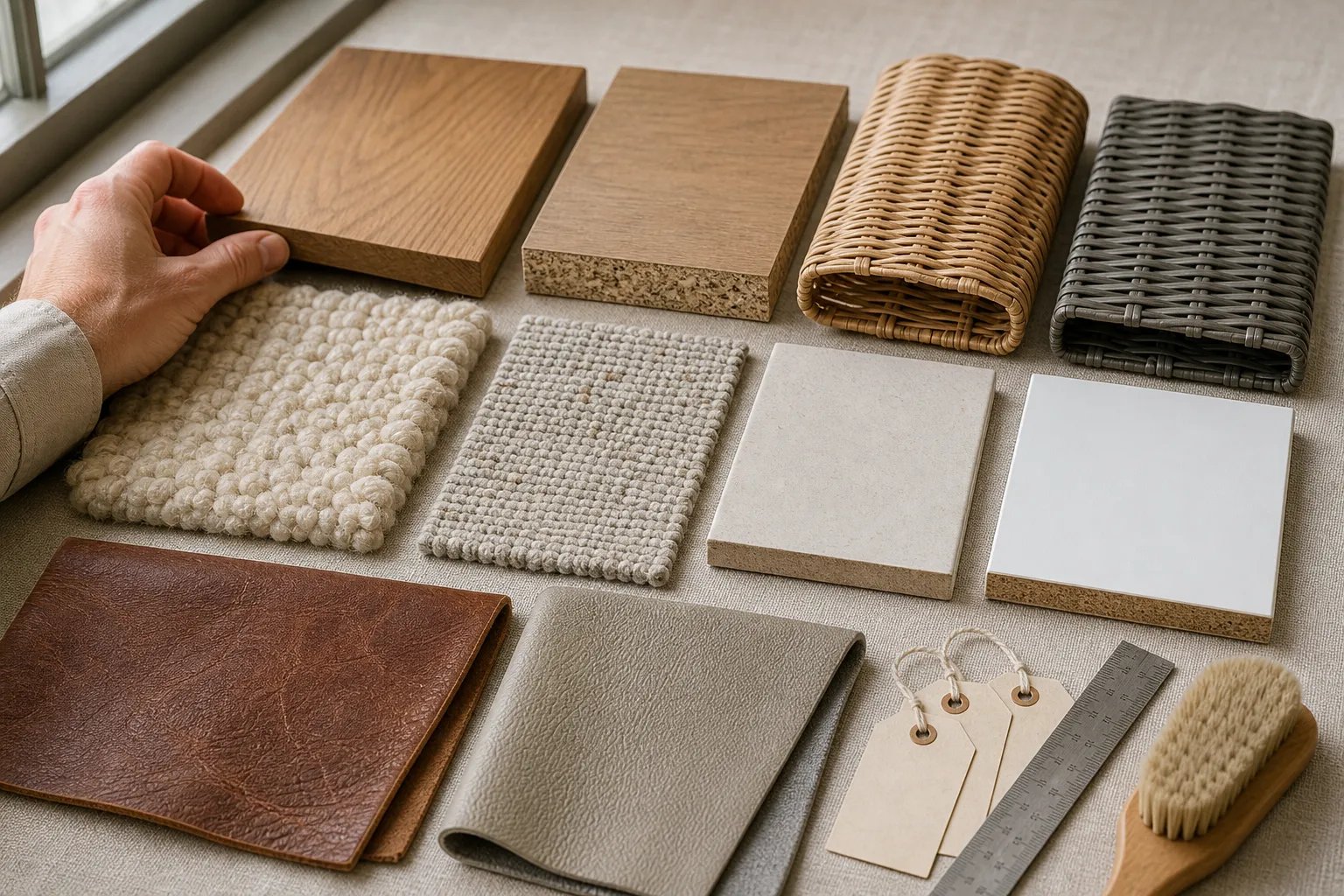
Solid wood vs particle board
Solid wood is often chosen for repairability, visible grain, and long-term furniture use. Depending on construction, it can sometimes be sanded, refinished, tightened, or repaired. It also reacts to moisture, heat, sunlight, and dry air, and it can be heavy and expensive.
Particle board can be affordable and stable enough for shelves, desks, and storage pieces in dry rooms, especially when laminated or veneered. It is less forgiving when edges swell, fasteners tear out, or water enters the board.
For a long-used dining table or repairable cabinet, solid wood may be worth the care. For a temporary bookcase in a dry room, particle board may be reasonable.
Check: thickness, edge sealing, joinery, screw points, veneer quality, weight, and whether damaged parts can be repaired.
Natural stone vs engineered stone
Natural stone offers variation, weight, and visual depth. It may also stain, chip, need sealing, or react to certain cleaners depending on the stone.
Engineered stone or composite stone may offer a more uniform appearance and different maintenance demands, but resins and manufacturing choices are not always obvious from the surface.
For a side table, tray, or decorative surface, the decision often comes down to weight, staining, cleaning, and whether the object will be moved often. Do not buy stone only for the word “natural.” Ask how it is sealed, how it should be cleaned, and whether it suits hot cups, oil, water, or acidic spills.
Rattan vs plastic wicker
Natural rattan has warmth, flexibility, and a handwoven character that suits dry indoor corners, covered spaces, and low-impact storage. It can suffer in prolonged wet conditions or harsh sun.
Plastic wicker can be useful outdoors or in damp-prone areas, but quality varies. Sunlight and heat affect many materials over time, so placement still matters.
For an indoor tea corner, rattan may feel quieter and more tactile. For an uncovered balcony, a synthetic outdoor-rated material may be more practical.
Check: indoor or outdoor rating, frame material, weave tightness, cleaning instructions, sun exposure, and whether loose strands can be repaired.
Wool vs synthetic rug
A wool rug may offer softness, density, and a pleasing natural texture. It can also require more careful cleaning and may not suit every spill-prone room.
A synthetic rug may be lighter, less expensive, and easier to wash or spot-clean, depending on fiber, backing, and construction.
For a calm bedroom or sitting area, wool may be a good long-use choice if care is realistic. For an entryway, kitchen path, playroom, or pet-heavy space, a washable synthetic or blended rug may reduce daily friction.
Check: fiber label, backing, dye stability, cleaning method, pile height, slip resistance, and whether the rug can be cleaned without special effort.
Genuine leather vs synthetic leather
Genuine leather is often chosen for touch, aging, and repair potential, but it can mark, dry, fade, and need care.
Synthetic leather, including PU- or PVC-based materials, may cost less and wipe clean easily at first. Depending on quality, cracking, peeling, and repair difficulty can become concerns.
For a chair used daily for many years, look beyond the word “leather.” Ask about the surface, backing, stitching, cushion structure, and repair options. For a short-term stool, desk chair, or low-budget piece, synthetic leather may be acceptable if you understand its likely wear pattern.
Ceramic vs plastic or melamine
Ceramic is satisfying for mugs, bowls, vases, tea cups, and table objects. It has weight, a pleasant thermal feel, and a settled place in daily use. It can also chip or break.
Plastic and melamine are lighter and more resilient for transport, children, and outdoor meals, but they may scratch, stain, or have manufacturer limits for heat, microwave use, or dishwasher use.
For daily tea, ceramic may be worth the careful hand. For a picnic basket, plastic or melamine may be the easier object.
Read labels as facts, not decoration
Many home objects are sold with style language that sounds like material information but is not. “Linen look,” “cotton feel,” “wood-look,” “natural style,” “stone effect,” and “eco-inspired” may describe appearance rather than composition.
For home textile fiber labels, check the actual fiber content. A curtain that looks like linen may be polyester. A cotton-feel throw may be acrylic or a blend. A wool-like rug may be polypropylene. Fiber content does not automatically tell you quality, but it gives you a factual starting point for cleaning, touch, drying time, heat sensitivity, and wear.
For non-textile objects, look for concrete details:
- solid, veneer, laminate, composite, or coated;
- sealed or unsealed;
- indoor or outdoor use;
- food-contact suitability where relevant;
- heat and dishwasher instructions;
- cleaning limits;
- replacement parts or repair guidance;
- recycling or disposal instructions where available.
Be especially cautious with broad environmental wording. Claims such as “green,” “eco-friendly,” “recyclable,” or “biodegradable” need specifics. A recyclable material is not very useful if your local system does not accept that object, if the item is bonded to other materials, or if the claim applies only to packaging.
Care, heat, and room conditions can change the answer
Home objects are not just surfaces. They sit near heat, hold weight, tip over, collect dust, touch food, and live with children and pets.
That does not mean every purchase has to become complicated. It means a beautiful material can still be wrong for a place.
Avoid placing flammable or heat-sensitive objects near candles, heaters, stovetops, or lamps that run hot. Be cautious with lightweight furniture that may tip. For children’s rooms, check stability and small detachable parts. For pets, consider claws, chewing, shedding, and cleaning. For bathrooms and kitchens, assume moisture will test seams, coatings, glues, and fibers.
Be careful, too, with indoor-air and “chemical-free” style claims. Natural interior materials are not automatically free from emissions, and synthetic materials are not automatically worse. Finishes, adhesives, dyes, coatings, sealants, product age, storage, moisture, and ventilation all matter. If a new object has a strong odor, a practical response is to ventilate, follow the maker’s care instructions, and avoid judging the whole material category by smell alone.
A simple rule before you buy
Picture the object in its real room for one full season.
Will summer sun hit it? Will winter dryness open joints? Will rainy shoes touch it? Will tea, oil, pet hair, or bath steam reach it? Will someone lift it often? Will you clean it gently, or will it need fast wiping at the end of a long day?
Then choose this way:
- Choose natural materials when the object will be kept, touched, maintained, repaired, and allowed to age.
- Choose synthetic or blended materials when moisture, washing, low weight, outdoor use, budget, or short-term use is the stronger need.
- Choose neither by label alone when the object is coated, glued, laminated, blended, heavily finished, or marketed with vague environmental language.
- Choose repairable construction over impressive material wording when the object will work hard.
- Choose clear labeling and care instructions over romantic descriptions.
A calm home is not made by proving one category superior. It is made by matching objects to the way they will be used: wood where hands will care for it, ceramic where weight and touch matter, washable synthetics where life is messy, and plain labels where marketing tries to blur the facts.