How to Choose Natural Home Materials for Daily Use
Choosing natural home materials is not only a style decision. It is a daily-use decision: where the object will sit, how often it will be touched, whether it will get wet, how it will be cleaned, and whether visible aging will bother you.
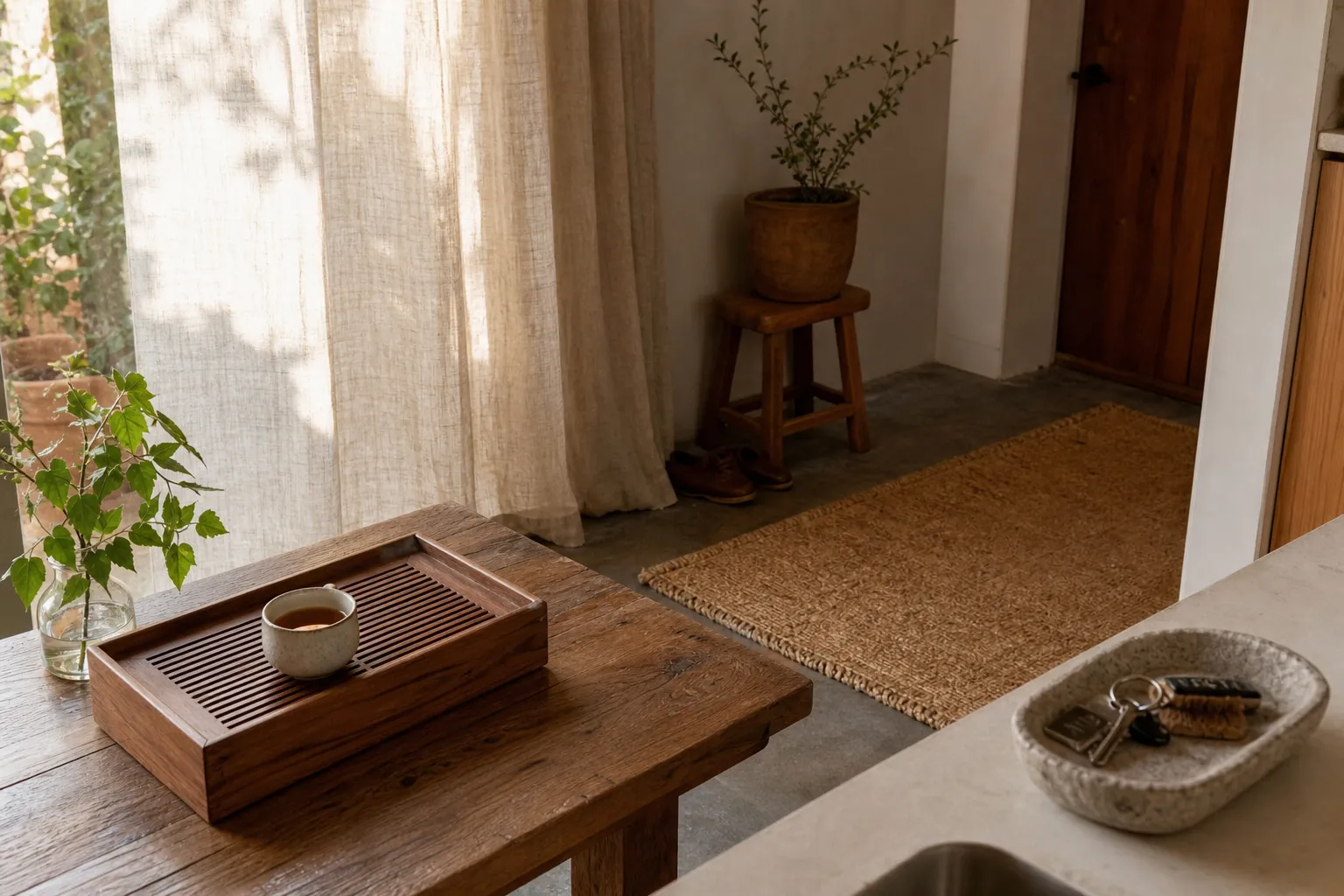
A wooden tray beside tea, a linen curtain in strong sun, a stone catchall near a sink, and a jute rug in an entryway all change once they enter real rooms. The better question is not “Is natural better?” It is: does this material’s behavior fit this room, this object, and this care routine?
Natural materials can bring grain, texture, weight, coolness, softness, and irregularity into a home. They can also stain, swell, fade, scratch, dry out, absorb water, or ask for more careful cleaning than a synthetic alternative. A calm room is easier to maintain when the material choice is honest from the beginning.
broader context
Broader context
Use the broader page when you need more context before this narrower page.
What Counts as a Natural Home Material When You Are Buying for Daily Use
In everyday home shopping, “natural” usually points to materials that come from plant, animal, mineral, or earth-based sources: solid wood, bamboo, rattan, cork, wool, cotton, linen, jute, sisal, leather, stone, clay, ceramic, paper, seagrass, and similar materials.
Some are used in a relatively direct way. Others are processed, woven, fired, laminated, sealed, dyed, glued, or combined with other layers.
That is where confusion begins.
A table may have a real wood veneer over an engineered core. A “stone” object may be sealed, resin-filled, polished, honed, or left more absorbent. A woven basket may use natural fibers but still include metal framing, plastic lining, lacquer, adhesive, or synthetic thread. A ceramic cup may be clay-based, but its glaze and firing quality matter for daily use.
For practical buying, separate three questions
- What is the visible surface? This affects touch, cleaning, staining, and wear.
- What is underneath? This affects strength, weight, movement, and repairability.
- What finish or treatment has been applied? This affects moisture resistance, cleaner compatibility, odor, sheen, and maintenance.
A product can look natural without behaving like an unfinished natural material. It can also contain natural components without being simple, low-maintenance, or clearly disclosed. For daily use, the full product system matters: surface, core, finish, binder, coating, adhesive, and care instructions.
Natural vs Synthetic Materials for Everyday Home Objects
The natural vs synthetic materials question is often framed too simply. Natural materials are not automatically more durable, easier to care for, or better suited to every household. Synthetic and engineered materials are not automatically poor choices. The better comparison is by use.
Natural materials often offer tactile variation. Wood grain, wool texture, stone veining, woven rattan, clay surfaces, and linen slubs create visual depth without much decoration. Many natural surfaces also age in visible ways: darkening, softening, developing small scratches, or forming a patina. For people who like lived-in rooms, that can be part of the appeal.
Synthetic or highly engineered materials may be more consistent. They can be lighter, more water-resistant, easier to wipe, less expensive, or less prone to visible variation. For a splash-heavy bathroom shelf, a child’s craft table, a rental kitchen, or a laundry area, that consistency may be more practical than a beautiful but absorbent surface.
Compare by daily condition
Frequent wiping
Natural material may fit when: the surface is sealed and the cleaner is compatible.
Synthetic or engineered material may fit when: you need quick cleaning with little worry.
Water exposure
Natural material may fit when: the object is designed for moisture and dries easily.
Synthetic or engineered material may fit when: the area is regularly wet or poorly ventilated.
Heavy handling
Natural material may fit when: scratches and patina are acceptable.
Synthetic or engineered material may fit when: you want a uniform look for longer.
Weight matters
Natural material may fit when: the item is small or structurally sound.
Synthetic or engineered material may fit when: you need a light shelf, tray, or movable piece.
Repair matters
Natural material may fit when: the surface can be sanded, refinished, rewoven, or resealed.
Synthetic or engineered material may fit when: replacement is more realistic than repair.
Cost matters
Natural material may fit when: you can buy fewer, better-fitting pieces.
Synthetic or engineered material may fit when: you need budget control or temporary use.
The goal is not to remove synthetic materials from the home. It is to use natural materials where their strengths are useful and their upkeep is realistic.
Start With the Room: Moisture, Sunlight, Heat, and Handling
Before comparing wood, stone, bamboo, rattan, wool, cotton, or clay, look at the room. Material performance changes with placement.
Dry living rooms and bedrooms
Living rooms and bedrooms are usually more forgiving places for natural home materials. Solid wood shelves, veneer cabinets, linen curtains, wool rugs, cotton throws, ceramic lamps, and baskets can work well when they are not exposed to repeated splashes or damp floors.
The main checks are sunlight, dust, handling frequency, and cleaning.
Strong sun can fade textiles, dry some surfaces, and make color change more visible. A windowsill, bright tea corner, or south-facing shelf needs more caution than a shaded wall. Rotate small objects when practical, avoid leaving delicate woven pieces in harsh sun for long periods, and check whether a finish may discolor.
Kitchens, bathrooms, laundry areas, and basements
These rooms ask more of a material. Water, steam, spills, oils, cleaners, and humidity can expose weaknesses in porous or absorbent surfaces. EPA moisture guidance for homes emphasizes moisture control and ventilation; for material selection, that translates into a simple buying rule: damp or poorly ventilated spots need stricter checks.
A natural item near a sink should answer these questions
- Can it tolerate splashes?
- Is it sealed or designed for wet-adjacent use?
- Are edges, seams, and underside surfaces protected?
- Can it dry fully between uses?
- What cleaner is allowed?
- Will stains or darkening be acceptable?
Unsealed wood, rattan, paper, jute, cork, and some natural fiber pieces are often poor fits for constantly damp areas unless the specific product is designed and maintained for that condition. A stone tray or ceramic dish may be a better choice near water, but stone still needs care based on type and finish.
Entryways, dining areas, and tea corners
These are high-touch zones. An entry bench sees bags, shoes, wet umbrellas, and grit. A dining table sees heat, oils, water rings, and repeated wiping. A tea tray may receive hot vessels and occasional spills.
In these places, durability is not just hardness. It is the ability to handle repeated contact, moisture, cleaning, and small accidents without becoming a burden.
How to Check If a Natural Material Is Durable Enough for Daily Use
Durable natural materials are not defined by one label. Durability depends on the material, construction, finish, room conditions, and the way the household uses the object.
Use this buying check before you decide
- Name the wear pattern. Will the surface be walked on, sat on, wiped, carried, stacked, used with hot cups, or touched with wet hands?
- Check the vulnerable parts. Edges, corners, joints, undersides, woven joins, feet, handles, and seams often show weakness before the main surface.
- Ask about the finish. Is it sealed, oiled, waxed, lacquered, glazed, polished, honed, raw, or unfinished?
- Read the cleaning instructions. If the seller cannot say what cleaners to avoid, treat that as a caution.
- Consider repairability. Can scratches be sanded, a finish renewed, a woven part tightened, a cushion cover washed, or a stone surface resealed?
- Decide your patina tolerance. Some people enjoy marks from daily life. Others want a stable, new-looking surface. Both preferences are valid; they lead to different material choices.
A material is not durable in the abstract. It is durable for a particular job.
Solid Wood, Veneer, or Laminate: What to Check Before Buying
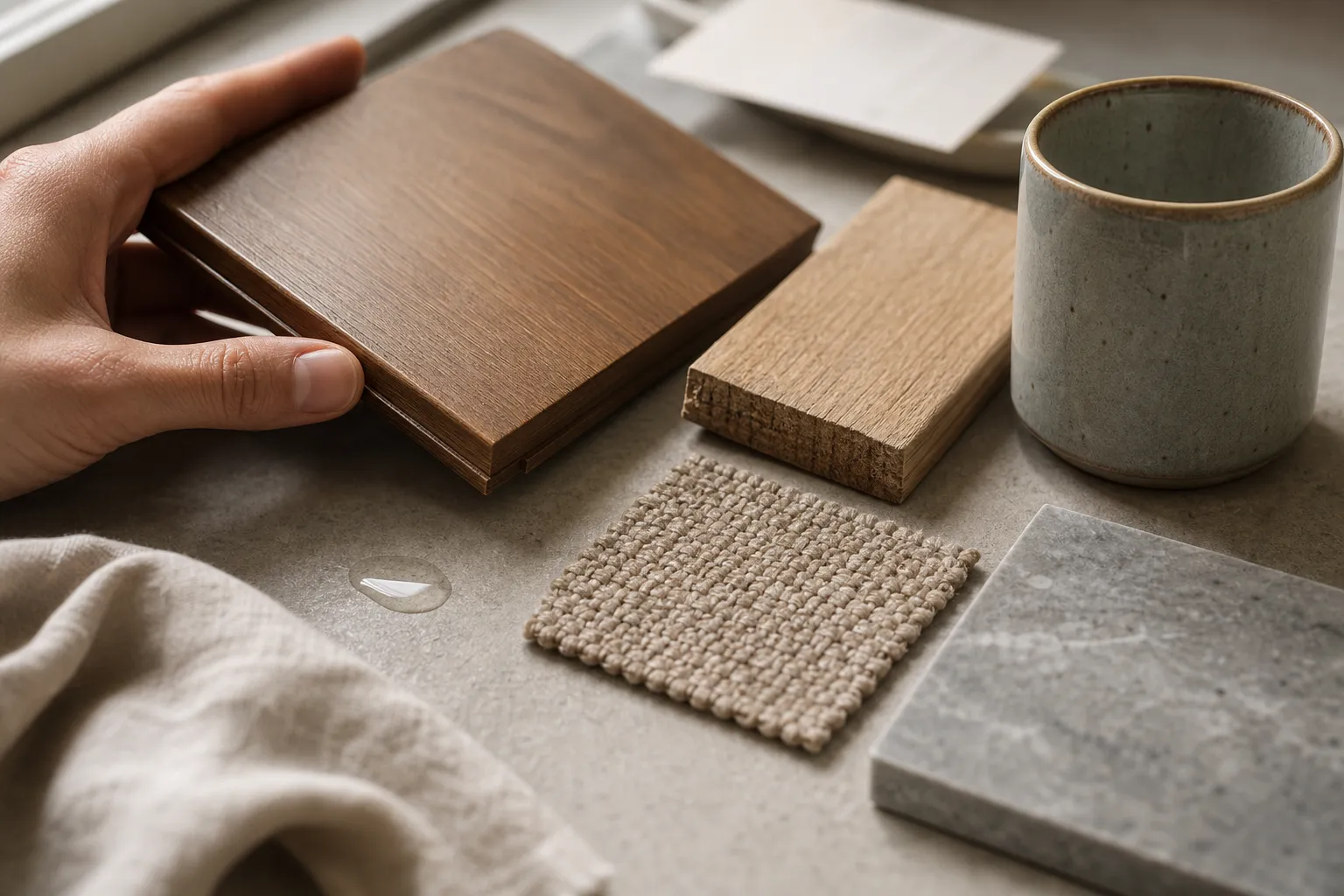
Solid wood has a strong place in natural material home design because it is tactile, visually warm, and often repairable. But wood responds to moisture in the surrounding air. It can absorb and release moisture, and moisture changes can contribute to expansion, contraction, warping, cupping, checking, or gaps, especially when design, drying, finish, or placement are poor.
That does not make solid wood a bad choice. It means solid wood should be chosen with the room in mind.
Choose solid wood when
- You want a surface that may be refinished over time.
- The piece will live in a relatively stable indoor room.
- You accept grain variation and some seasonal movement.
- Weight and cost are acceptable.
- The joinery and finish are appropriate for the use.
Check veneer pieces for
- Edges that are well-banded or protected.
- No lifting, bubbling, or loose corners.
- Clear information about the core material.
- A finish that suits expected cleaning.
- Placement away from repeated standing water or steam unless designed for it.
- Realistic repair expectations, since deep sanding is usually not possible.
Veneer is often misunderstood. A veneer is a thin layer of real wood applied over another core. It can be practical for cabinets, panels, shelves, and tables where weight, stability, cost, and appearance all matter. Veneer is not automatically inferior; poor veneer construction is the problem.
Laminate is not a natural material in the same way, but it may be practical in hard-use areas. If a table will be used for homework, crafts, food spills, and frequent wiping, a laminate surface may fit better than a delicate unfinished wood top. The mistake is not choosing laminate; the mistake is buying a “natural look” and assuming it will age like wood.
Sealed or Unsealed Natural Materials for Tables, Shelves, and Trays
Sealing changes how a natural surface behaves. It can make cleaning easier and reduce absorption, but it also changes touch, sheen, repair method, and sometimes the way scratches appear.
For tables, shelves, and trays, ask whether the surface is
- Unsealed or raw: more tactile and absorbent; more vulnerable to stains, water rings, oils, and uneven darkening.
- Oiled or waxed: often still natural-feeling, but may need renewal and careful cleaning.
- Lacquered, varnished, or coated: usually easier to wipe, but scratches, chips, or clouding may be more visible and harder to spot-repair.
- Glazed or fired: common in ceramic objects; the glaze quality and intended use matter.
- Sealed stone: less absorbent than unsealed stone, but not maintenance-free.
A tea tray needs a different finish than a decorative shelf. A tray sees liquid, heat, lifting, wiping, and sometimes pooled water. A display shelf may only need dusting and occasional handling. The same wood or stone can be appropriate in one object and frustrating in another.
If a seller says a surface is “natural” but cannot describe the finish, ask more questions before buying. Finish transparency is part of material quality.
Porous Natural Materials: What Stains, Absorbs Water, or Needs More Care
Porous natural materials can be beautiful because they are not inert-looking. They take light softly, show texture, and feel less manufactured. But porosity also means the surface may absorb liquid, hold dirt, stain, or dry slowly.
Examples that deserve moisture checks include unfinished wood, rattan, bamboo, cork, paper, jute, sisal, seagrass, some natural fiber rugs, unsealed stone, and certain clay or earthen surfaces. The strongest available sources here support wood, stone, and general moisture boundaries more than every fiber listed, so treat these as practical examples rather than identical materials.
Watch for these placement problems
- A basket sitting directly on a damp bathroom floor.
- A jute or sisal rug in an entry that gets wet shoes.
- A cork mat beside a sink without enough drying time.
- An unsealed wooden shelf under plants.
- A stone tray holding oils, cosmetics, or acidic spills.
- A paper or woven shade in a humid, poorly ventilated room.
Moisture checks for porous materials are simple: look at water exposure, drying time, ventilation, underside contact, and cleaning method. If the item cannot dry and cannot be cleaned in the way the room demands, choose another material or another location.
Bamboo, Rattan, or Solid Wood for Everyday Storage Pieces
Storage pieces carry weight, receive friction, and often sit against walls or floors. Bamboo, rattan, and solid wood can all suit storage, but they serve different roles.
Bamboo is often used in boards, small shelves, organizers, trays, and storage accessories. Rattan is common in baskets, cabinet fronts, and light furniture. Solid wood is common in benches, chests, shelving, and heavier storage. The available sources do not support broad durability rankings among these materials, so the more useful approach is to inspect construction.
For everyday storage, check
- Is the piece load-bearing or decorative?
- Are the feet lifted from the floor?
- Are woven areas tight and supported?
- Are handles reinforced?
- Are corners protected from knocks?
- Will the surface catch dust or be easy to wipe?
- Is it going near shoes, plants, damp towels, or cleaning supplies?
Rattan and woven storage can soften the look of a room, but open weave can collect dust and may not suit wet storage. Solid wood may support more weight, but it still needs protection from damp floors and water spills. Bamboo products vary by construction, coating, and intended use, so rely on product details rather than the material name alone.
Jute, Sisal, Wool, or Cotton Rugs for Everyday Rooms
Natural rugs for everyday rooms should be chosen by foot traffic, moisture, cleaning, softness, and tolerance for visible wear.
Jute and sisal are often chosen for texture and a dry, earthy look. They may be better suited to dry rooms than wet entry points, depending on the product. Wool is widely used for rugs and can feel resilient underfoot, but care instructions vary. Cotton rugs can be washable in some constructions, though they may shift, crease, or wear differently from heavier rugs.
Use the room as the filter
- Entryway: prioritize grit, wet shoes, and easy cleaning.
- Dining area: consider food spills, chair movement, and stain response.
- Bedroom: softness and low moisture exposure may matter more.
- Living room: balance comfort, traffic, furniture pressure, and cleaning.
- Kitchen: be cautious with absorbent rugs near sinks or cooking areas.
A rug can be natural and still be wrong for the room. Look for backing, edge binding, cleaning method, shedding notes, and whether the rug can be lifted to dry if needed.
Marble, Travertine, or Slate for Small Home Objects and Surfaces
Stone feels permanent, but stone surface maintenance is not one-size-fits-all. Natural Stone Institute care guidance notes that stone types and finishes vary, and cleaning compatibility matters. Some stones are more porous. Some are more sensitive to staining or etching. A hard surface can still mark, dull, or respond poorly to the wrong cleaner.
For small home objects, ask
- What stone is it?
- Is it sealed?
- Is the finish polished, honed, tumbled, or rougher?
- Can it be used with water, oils, cosmetics, tea, or food?
- What cleaners should be avoided?
- Will etching or staining bother you?
Marble and travertine are often chosen for veining and softness of appearance, but they may need more care around acidic liquids and staining substances. Slate may have a different surface feel and cleft texture depending on the piece. Granite, limestone, and other stones also differ. The buyer’s mistake is treating “stone” as a single durable category.
A stone tray in a dry entryway may be easy to enjoy. The same tray beside a sink, holding soap and pooled water, may need more attention.
What to Ask Before Buying Handmade Natural Home Objects
Handmade natural home objects can bring irregularity and presence into a room: a clay bowl, woven basket, carved stool, wooden scoop, stone rest, linen cover, or tea accessory. The point is not perfection. The point is knowing what kind of variation is normal and what kind may affect use.
Ask the maker or seller
- Is the object decorative, food-contact, water-contact, or heat-contact?
- What material is used on the surface and underneath?
- Is the finish disclosed?
- Are dyes, glazes, oils, waxes, adhesives, or sealers used?
- How should it be cleaned?
- Can it sit in direct sun?
- Can it be used in a bathroom, kitchen, or near plants?
- What changes should be expected with use?
- Can it be repaired, resealed, rewoven, or refinished?
Avoid treating handmade as automatically more practical. Handmade pieces may be excellent, delicate, unfinished, experimental, or simply intended for display. The more daily the use, the more direct the questions should be.
When Natural Materials Are Not the Most Practical Choice at Home
There are times when natural material tradeoffs do not fit the room. That is not a failure of taste. It is a useful decision.
Consider another material when
- The area is repeatedly wet and poorly ventilated.
- The household needs strong cleaners that the surface cannot tolerate.
- The object will be used roughly and replacement is more realistic than repair.
- You want a very uniform appearance over time.
- The seller cannot explain the finish or care.
- The piece is too heavy for the shelf, wall, or user.
- The cost is high but the maintenance routine is unrealistic.
- Visible scratches, stains, fading, or patina would be frustrating.
A calm home is not made by choosing the most “natural” option every time. It is made by choosing materials that can live well with the actual habits of the household.
A Simple Buying Framework for Natural Home Materials
Before buying, walk through the object’s future life.
1. Place
Where will it live: dry room, sunny window, entryway, kitchen, bath, basement, tea corner, bedside, shelf, or floor?
2. Contact
Will it meet water, heat, oil, food, cosmetics, shoes, pets, plants, children, or frequent hands?
3. Surface
Is it sealed or unsealed? Smooth or textured? Porous or dense? Easy to wipe or likely to hold dust?
4. Construction
Is it solid, veneered, woven, laminated, fired, stitched, glued, or assembled from multiple materials?
5. Care
What cleaner is allowed? Can it dry fully? Does it need oiling, resealing, airing, brushing, or gentle washing?
6. Aging
Will you enjoy darkening, softening, scratches, small dents, and patina? Or do you need a stable, crisp surface?
7. Exit path
If it wears, can it be repaired? If not, is the price and use life still acceptable?
This framework keeps natural materials grounded in daily rooms rather than vague ideals. A solid wood bench, a veneer cabinet, a wool rug, a cotton mat, a rattan basket, a marble tray, and a ceramic tea cup can all be good choices when their behavior matches their use. They can also be wrong when chosen only for appearance.
The most reliable material decision is modest: choose the natural surface you can understand, place it where it can behave well, clean it in a way it can tolerate, and accept the kind of aging it will honestly show.