Material judgment
What Counts as Natural Material Patina in Everyday Home Objects
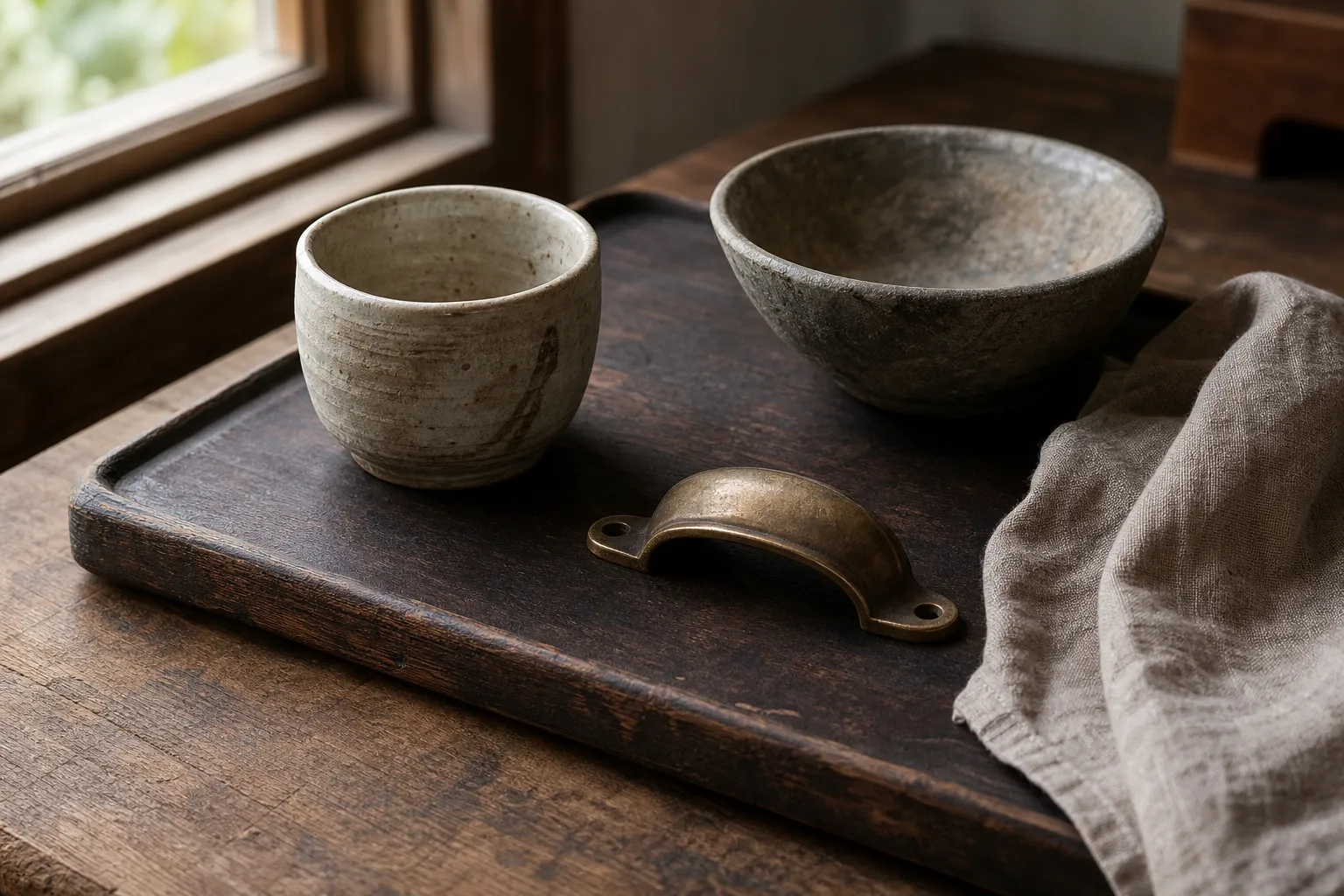
Natural material patina is stable, shallow surface change from age, touch, light, air, and ordinary use. On household objects, it might show up as wood darkening, rubbed wood edges, small dents in wood, softened grain, a mellow brass handle, faint ceramic surface changes, worn stone high points, or linen that has lost its new stiffness.
It counts as patina when the object is clean enough to use or display, dry, mostly intact, and not actively shedding, swelling, smelling musty, flaking, cutting the hand, or weakening.
The simplest test is not “Does it look old?” It is: Is the change stable, adhered, shallow, and compatible with the way the object is used?
broader context
Parent topic
Use the broader page when you need more context before this narrower page.
A quick test for patina in home objects
When you are looking at a wooden tray, ceramic cup, brass pull, stone bowl, linen cloth, leather stool, paper screen, or lacquered box, ask five plain questions.
Is the change stable? A darkened wood tray, softened corner, or dulled brass handle may be stable. Powder, loose flakes, spreading rust, or finish that comes off on your hand points to a condition problem, not just natural object aging.
Does light cleaning leave the character behind? Patina usually remains after gentle dusting because it is part of the used surface. Dirt often lifts, smears, smells, or gathers in neglected seams and corners.
Is it dry? Dry wear can belong to age. Damp softness, water-swollen wood, musty odor, tide marks, or active staining suggest moisture trouble.
Is it shallow? Patina usually sits near the surface: color shift, polish from handling, soft abrasion, light oxidation, small dents, or gentle fiber raising. Deep cracking, loose joints, sharp chips, delamination, and crumbling are different matters.
Can the object still do its job? A worn tea tray can still hold cups. A ceramic cup with a stable exterior rub mark may still feel good in the hand. A chipped drinking rim, unstable interior glaze, loose chair joint, or flaking painted surface changes the decision.
That is why patina versus damage is mostly a material question, not only a style question. A room can welcome age, but the object still has to hold together.
What patina can look like by material
Different materials age in different ways. The same brown mark that feels natural on wood may be dirt on linen, corrosion on metal, or staining on stone. Let the material guide the judgment.
Wood: darkening, rubbed edges, and softened grain
On wood, patina often appears as warmer color, darker touch points, rubbed corners, small dents, and softened grain. A tray, stool, low table, or tea scoop may develop a gentle polish where it has been handled repeatedly.
Wood research on aging and weathering describes color and surface changes from light, moisture, and surface chemistry. In a home, you may notice this near windows, kitchens, tea areas, and entryways: aged wood marks, uneven mellowing, or a surface that no longer has the raw sharpness of new timber.
Not every mark belongs in the patina category. Watch for:
- water-swollen wood
- soft or spongy areas
- damp blackened patches
- lifting veneer
- splinters that catch skin
- wobbling joints
- flaking finish
- sticky buildup from oils, smoke residue, or old polish
A rubbed wooden edge can be part of long use. A swollen table leg or peeling coating needs care before it becomes a design choice.
Ceramics: softened surfaces, crazing, chips, and food-use doubt
Ceramic surface changes can include fine scratches on the foot ring, softened glaze shine on handled areas, faint staining in unglazed clay, or gentle shelf wear underneath a bowl or cup.
Glazed ceramics can also develop networks of fine cracks, often called crazing. Conservation literature connects some ceramic surface problems with moisture, stress between glaze and body, pitting, crack growth, and surface degradation. For everyday use, the distinction is practical: a faint exterior rub on a display bowl is one thing; a cracked drinking rim or unstable interior glaze is another.
Treat these as caution signs rather than decorative patina:
- sharp chips on a cup rim or bowl edge
- cracks that pass through the body
- powdery or pitted glaze in food-contact areas
- staining that returns quickly after cleaning
- unknown old glaze used with acidic food or drink
- pieces that leak, sound dull, or feel weakened
For decorative ceramics, a visible crack may simply change how the piece is displayed. For cups, bowls, and serving pieces, uncertainty around food-contact surfaces calls for restraint.
Brass, bronze-like alloys, copper, and iron: mellow oxidation versus active corrosion
Metal patina is easy to romanticize. Brass handles, bronze-colored trays, copper alloy objects, and old fittings can develop darker, warmer, or greenish surface tones through contact with air, moisture, hands, and nearby materials. Conservation research on copper alloys describes patinas as reaction layers whose structure depends on environment.
In a home, stable metal aging usually feels adhered and quiet: a darker brass pull, softened shine where fingers touch, or a non-flaking color shift.
Be more careful with:
- orange-red rust on iron or steel that keeps spreading
- green powder that transfers easily
- crusty corrosion around joints, screws, or seams
- sharp lifting flakes
- metal that has thinned, cracked, or lost strength
- residue on objects used with food
A mellow brass handle can belong beautifully in a calm room. A corroding hinge that stains the surrounding wood needs attention.
Stone: worn high points, etching, stains, and surface loss
A stone bowl, small indoor garden stone, marble tray, or incense holder may show softened high points, duller touched areas, small scratches, or subtle color variation. Some stone surface layers form through environmental reaction; conservation studies also show that surface color can be stable in some areas and failing in others.
For household use, the key question is whether the surface remains coherent. Gentle wear on a stone bowl’s rim may be patina. Granular loss, flaking, delamination, salt-like crust, or powdery shedding is deterioration.
Also separate patina from staining. Tea, oil, citrus, metal rings, and standing water can mark porous stone. Some marks become part of the object’s visible life, but spreading stains, odor, or surface breakdown should not be excused as age.
Linen, leather, paper, and lacquer: judge more conservatively
The strongest technical sources for this topic tend to cover wood, ceramics, stone, and metal. For everyday textile, leather, paper, and lacquer care, use a more conservative home rule: look for stability, dryness, and continued usefulness.
For linen, patina may mean softened hand feel, gentle fading, and slight thinning from use. It does not mean mildew odor, black spotting, sticky residue, or fibers that tear under normal handling.
For leather, attractive aging may include darkened touch points, softened creases, and deeper tone. It does not include powdery cracking, tackiness, active splitting, or oily transfer onto clothing.
For paper screens, books, shades, and boxes, mild yellowing or softened edges may be age. Brittleness, foxing-like spotting, water distortion, insect damage, and tears that spread with handling are condition concerns.
For lacquered or painted boxes, rubbed corners can be beautiful when the coating remains attached. Flaking finish, lifting layers, or dust from degraded coating should be handled more carefully, especially on older painted objects of uncertain composition.
Patina versus dirt, neglect, and deterioration
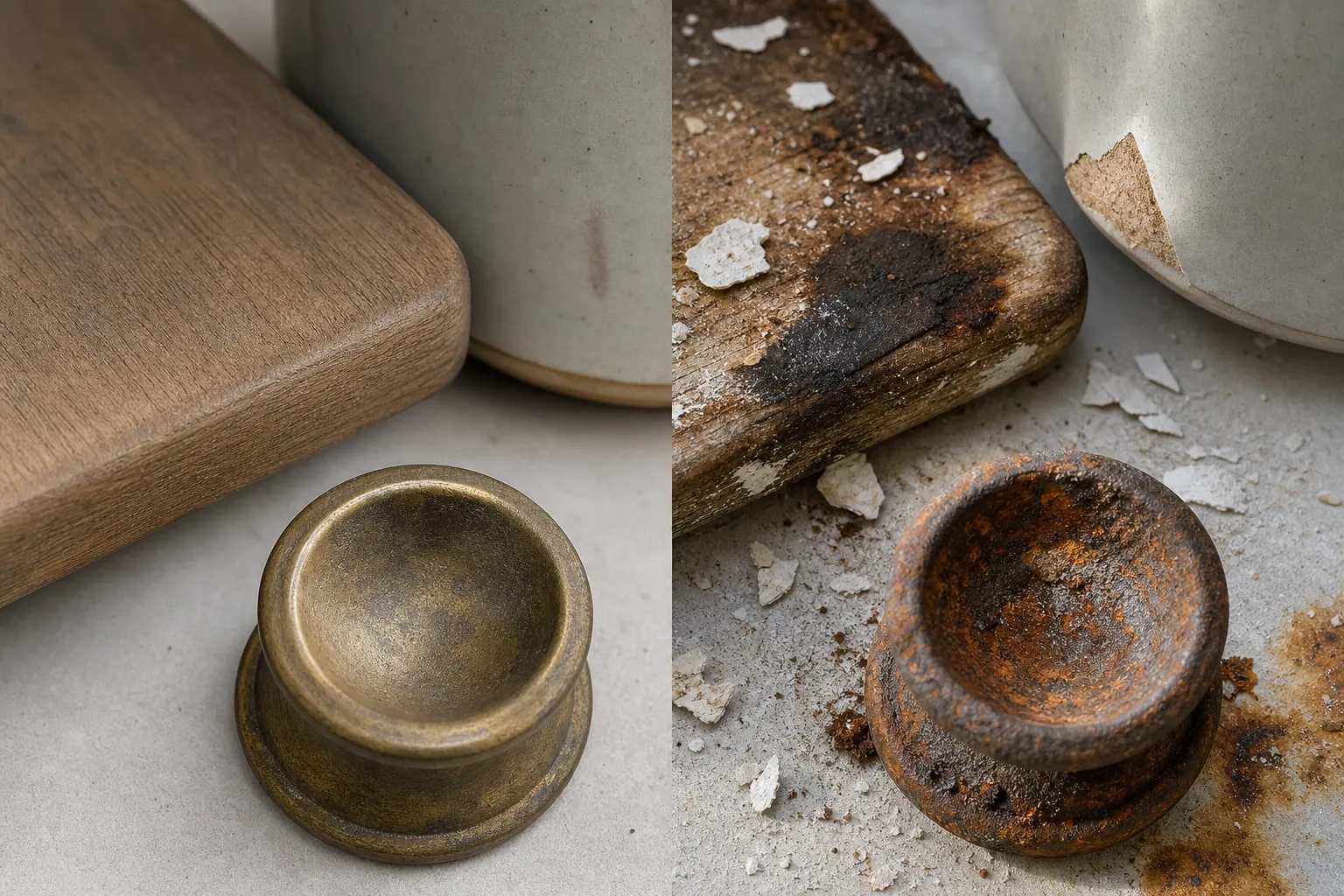
The common misunderstanding is treating “old-looking” as one category. It is not. Patina, dirt, neglect, and deterioration can sit on the same object at the same time.
A wooden tray may have genuine rubbed edges and sticky grime in the corners. A ceramic cup may have a pleasant worn foot ring and a sharp chip. A brass handle may have mellow color and green corrosion at the screw. A linen cloth may have soft fading and a musty storage odor.
Use this quick separation:
Aging is the broader process. Patina is the part of aging that remains stable, coherent, and usable. Deterioration is the part that spreads, sheds, traps moisture, or interferes with use.
When the aged look should not be the priority
There are times when keeping the aged surface is not the first concern. If an object is damp, musty, flaking, structurally weak, or uncertain for food use, understand the material condition before preserving the look.
Be especially careful with:
- old painted pieces with peeling or powdering surfaces
- ceramics of unknown glaze used for food or drink
- objects with mold-like growth or persistent musty odor
- smoke-darkened or sticky surfaces
- metal corrosion that transfers to hands or nearby materials
- lacquer, varnish, or coating layers that are lifting
- wooden objects that have swollen, softened, or split
This does not mean every old object should be restored until it looks new. Often the better decision is gentler: dust carefully, keep the object dry, reduce harsh handling, move it away from direct sun or moisture, and stop using it for food or weight-bearing tasks if its condition is uncertain.
For valuable, inherited, or unusually old objects, avoid aggressive cleaning. A harsh scrub can remove real patina along with dirt, and it may expose weaker material below.
The working rule
Natural material patina is age you can live with: stable color, softened touch, shallow wear, adhered surface change, and continued usefulness. Dirt, neglect, and damage are age you need to respond to: dampness, odor, stickiness, flaking, sharpness, swelling, active corrosion, or weakness.
This rule leaves room for the beauty of age without turning every failing surface into a design feature. Aged objects give a room memory because they show contact with daily life. But the material gets the final say: if the change is dry, clean, shallow, stable, and suited to the object’s use, it can count as patina. If it is spreading, shedding, damp, sharp, soft, sticky, or structurally doubtful, treat it as a care problem first and an aesthetic question second.