Window Reading Nook or Lamp-Lit Reading Corner: What Changes
A window reading nook ties your reading place to daylight, view, weather, season, and privacy. A lamp-lit reading corner gives you more control: you choose where the chair goes, how the light lands on the page, and whether the spot still works after sunset.
So in a window reading nook vs lamp reading corner decision, the real question is not which one looks calmer in a photo. It is which one works at the hour you actually read, with the glare, temperature, outlets, and privacy your room already has.
Choose the window if daytime light and a view matter most. Choose the lamp corner if predictable evening reading and flexible placement matter more.
broader context
Broader context
Use the broader page when you need more context before this narrower page.
What Actually Changes Between the Two
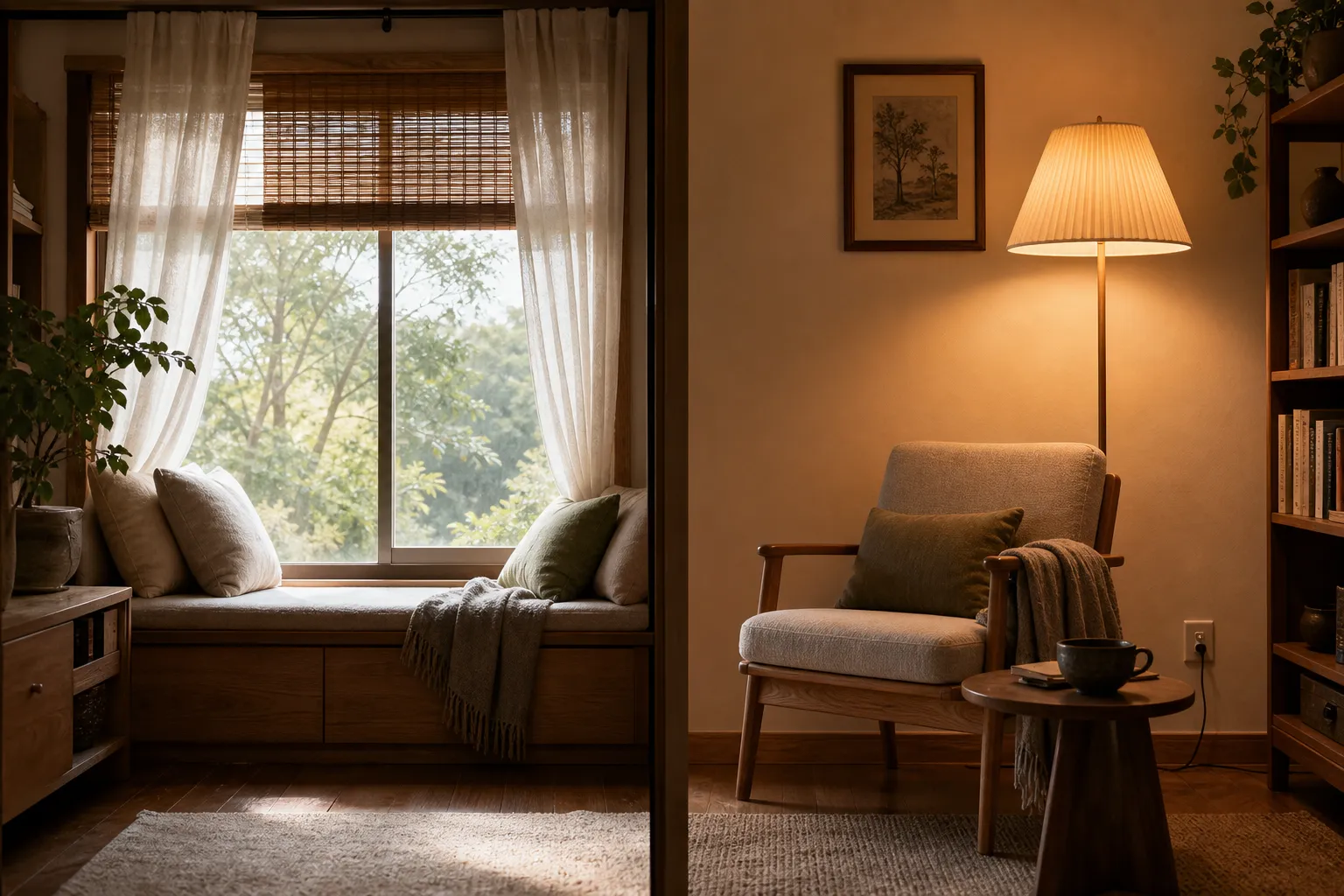
A window nook is built around a changing light source. The page may be bright in the morning, dim by late afternoon, washed by direct sun in one season, and soft on cloudy days. The same seat can feel generous in spring and too hot, too cold, or too exposed at another time of year.
A lamp-lit corner is built around a chosen light source. It does not give you the same view or daylight atmosphere, but it can be made more consistent. The lamp can sit beside or slightly behind the chair, the shade can direct light toward the page, and the seat can move away from awkward windows, traffic paths, or privacy issues.
The softest-looking option is not always the most usable one. A natural light reading nook can become hard to read in when sunlight hits the page directly. A lamp corner can look plain in daylight but become the most reliable seat in the house at night.
Light Behavior: Changing Daylight or Chosen Light
The main advantage of a window reading nook is also its main weakness: daylight changes. This is why the same window seat can feel perfect for morning tea and uncomfortable by midafternoon.
Window direction matters. An east-facing nook may receive bright early light. A west-facing one may catch low, strong sun later in the day. A south-facing window may feel bright for longer in many northern-hemisphere homes, while a north-facing one is often softer but less intense. Nearby buildings, trees, roof overhangs, blinds, and curtains all change the result.
Public guidance from the U.S. Department of Energy notes that window attachments and coverings can affect glare, heat gain, heat loss, insulation, and comfort near windows. For a reading nook, that is not a technical side issue. It may decide whether the seat is pleasant for ten minutes or usable for a whole chapter.
A sheer curtain, woven shade, blind, lined curtain, or other covering can soften direct sun and reduce page glare. It can also improve privacy and make the seat more usable across seasons.
A lamp-lit reading corner has a different problem. It is not waiting for the sun, but it does need deliberate reading corner lighting. A decorative lamp that glows beautifully across the room may not put enough useful light on the page.
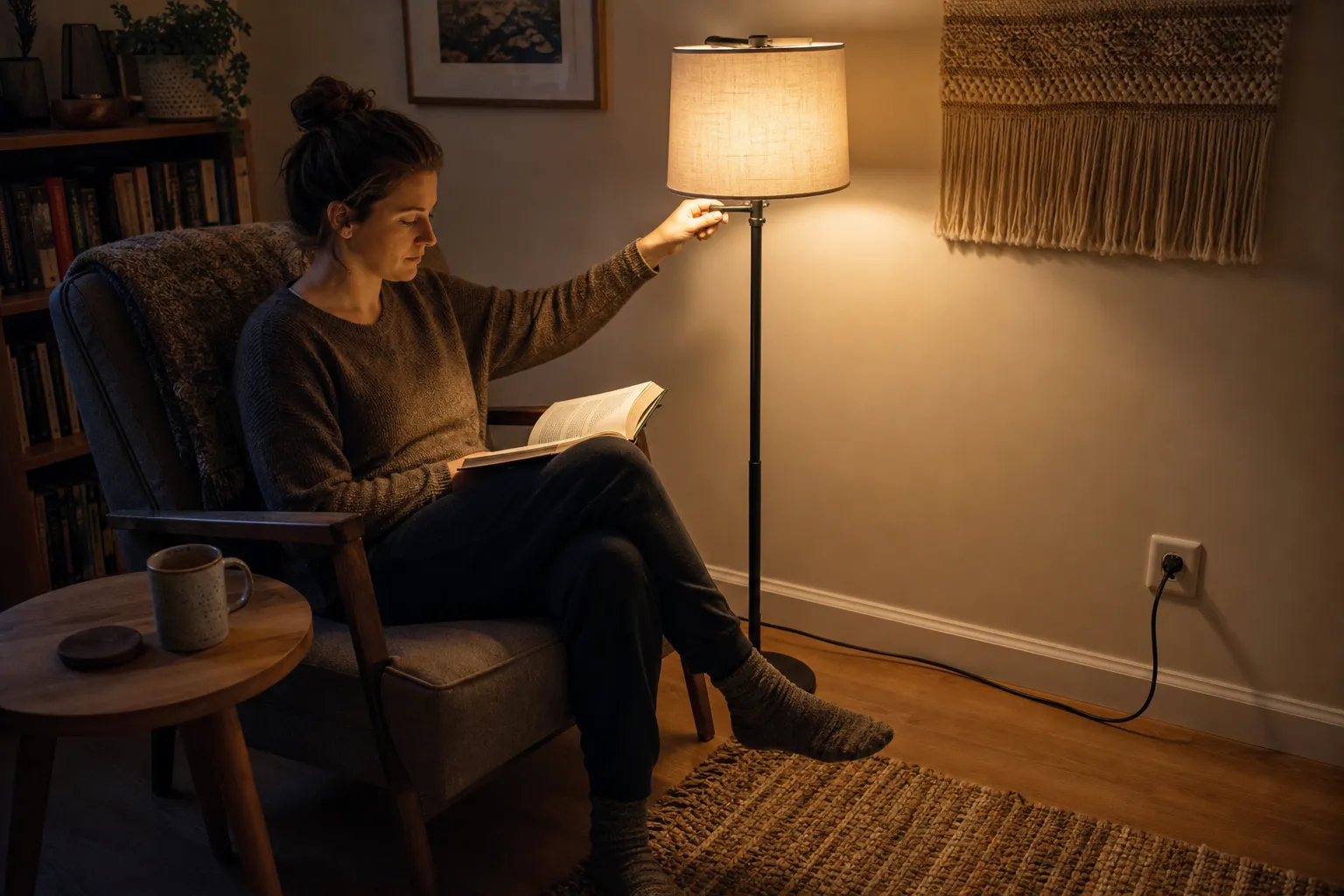
For a reading chair, ask one simple question: does the light reach the book without shining into your eyes or casting your hand and pages into shadow?
Good lamp control usually means:
- the lamp is close enough to the chair to light the book;
- the shade directs light downward or across the page;
- the bulb is bright enough for comfortable reading without harsh contrast;
- the switch is reachable from the seat;
- the lamp does not wobble on a narrow table or unstable shelf.
This is where a lamp corner quietly wins. It can be adjusted. If the chair shifts by a few inches, the lamp can shift too. A window cannot.
Comfort Near the Seat
A window reading nook is often chosen for its atmosphere: the view, the sill, the quiet edge of the room, the feeling of sitting beside seasonal change. In a calm, Eastern-inspired room, that can be beautiful when handled simply: a low cushion, a small side table, a ceramic cup, a linen curtain, a view of rain or leaves.
But atmosphere does not solve the room mechanics.
Glass changes comfort. In warm months, direct sun can make the seat hotter than the rest of the room. In cold months, the area near a window may feel cooler, especially if the window is older or poorly sealed. Even when the room itself feels fine, a reader close to glass may notice a different temperature at the shoulder, back, or feet.
Window coverings for glare are not only decorative. They are part of whether the nook works. A sheer may be enough for a softly bright room. A denser curtain or blind may be needed where direct sun hits the page. If the window faces a street or neighboring building, privacy may matter more than brightness. After dark, indoor light can make the room more visible from outside, so the same nook that feels open during the day may feel exposed in the evening.
A lamp-lit corner moves the comfort problem away from the glass. You can place it against an interior wall, near a bookcase, beside a floor cushion, or in a corner that already feels settled.
The tradeoff is shadow control. If the lamp is too low, too far back, or on the wrong side for the way you hold a book, your body may block the light. If the shade is too open or the bulb is exposed, the lamp may glare in your field of view.
For a lamp, the comfort test is plain: sit in the chair with the book where you normally hold it. Turn the lamp on. If you see the bulb, squint at the shade, or keep moving the page to find light, the corner is not finished yet.
Placement and Room Flow
A window nook uses a fixed architectural feature. That can create a natural visual anchor, especially in a room that needs one quiet destination. A reading bench under a window, a chair angled toward the view, or a cushion beside a low sill can make an otherwise plain wall feel intentional.
But the window decides many things for you. It decides where the chair can go, how much walking space remains, whether the seat blocks a radiator or vent, and whether a side table fits. If the window is in a busy passage, the nook may look charming but feel interrupted. If the sill is too high, too narrow, or too exposed, a built-in window reading nook may require more carpentry and cushion planning than expected.
A lamp-lit reading corner is more forgiving. It can be placed where the room already has a quiet pocket: beside a bookcase, near a tea cabinet, at the end of a sofa, or in a bedroom corner. It can also avoid a view that is too busy or a window that catches harsh afternoon sun.
The lamp corner does, however, need power. Outlet access is not a minor detail. If the only outlet is across a walkway, the cord becomes part of the room’s circulation. If the lamp requires a long extension cord, or the cord must pass under a rug, behind a rocking chair, or beneath heavy furniture, the setup deserves another look.
For small rooms, cord management may decide the answer. A lamp corner that creates a trip path is not calm in practice. It is better to move the chair closer to an outlet, use a stable floor lamp with a short visible cord path, or choose another corner entirely.
Quick Checks Before You Commit
This is not an electrical repair guide, but a lamp-lit corner does involve plug-in equipment. NFPA and CPSC consumer safety guidance warns against damaged cords, overloaded outlets, unsafe extension-cord use, and cord routes that can be pinched, covered, or tripped over. For a reading corner, keep the check simple and visible.
Before choosing a lamp corner, look for:
- a nearby outlet that does not require the cord to cross the main walking path;
- a cord and plug in good condition, with no visible damage;
- a lamp base that stays stable when you reach for a book or cup;
- no cord hidden under a rug or compressed under furniture;
- no crowded outlet arrangement serving too many devices;
- a switch you can reach without standing or leaning awkwardly.
For a window reading nook, ask:
- Does direct sun hit the page at your usual reading hour?
- Does the seat feel too warm or too cold near the glass?
- Can you adjust the shade, curtain, or blind without getting up every few minutes?
- Is privacy acceptable after dark?
- Is the seat stable, deep enough, and clear of window hardware?
- If you read in the evening, is there a nearby lamp or wall light?
If an outlet, plug, or lamp shows heat marks, sparking, recurring power interruptions, or obvious damage, stop using that setup and seek qualified help. The useful home decision is where to place the reading corner, not how to repair wiring.
A window nook without a reachable covering often becomes a fair-weather seat. A lamp corner without sensible cord routing often becomes a nuisance. Both are small problems, but they decide daily use.
Common Confusions
“Natural light is always better for reading”
Not always. Daylight can be beautiful, but uncontrolled daylight can create direct sun glare, sharp contrast, and changing brightness. Lighting guidance often treats glare, evenness, and light direction as important parts of visual comfort. For a home reader, the label “natural” matters less than what the light is doing on the page.
A natural light reading nook works best when daylight is softened and the seat is checked at the actual reading hour. A window that is gentle at 10 a.m. may be glaring at 4 p.m.
“A lamp corner is just a chair plus a lamp”
A lamp-lit reading corner is simple, but not careless. Lamp shade placement, bulb placement, and chair angle all affect whether the page is easy to see. A lamp that is mostly decorative may light the wall while leaving the book dim. A bright exposed bulb may make the corner feel harsh even if the page is technically lit.
Think of the lamp as a useful object with atmosphere, not as decoration alone.
“A window seat is always the calmer option”
A view can settle a room visually, but it can also distract or expose the reader. A street-facing window, a neighboring building, or reflective night glass may make the nook feel less private than expected. In some homes, the calmer choice is an interior lamp corner with a low table, a textile, and a warmer pool of light.
A Simple Way to Decide in Your Own Room
Do not decide from a photo. Sit in both possible places at the time you actually read.
For the window option, test it in daylight and again near sunset. Bring the book, not just your phone. Notice whether the page is evenly lit, whether the sun strikes your eyes, whether the temperature near the glass feels different, and whether you would need a curtain or shade within reach. If the nook is meant for winter afternoons, test it on a darker day if you can.
For the lamp option, test it after dark. Put the lamp where it would actually live, not in a temporary ideal position. Sit in the chair, hold the book normally, and check whether the light lands on the page. Look for cord paths before you fall in love with the corner. A reading spot should not require stepping over a cable or stretching to reach a switch.
The practical decision
Choose a window reading nook if you mostly read during the day, enjoy a view, can control glare with coverings, and the seat feels comfortable across the seasons.
Choose a lamp-lit reading corner if you read in the evening, need predictable light, want more freedom in furniture placement, or have a window that is too bright, cold, exposed, or awkward for daily use.
The best version may combine both: a window nook with a small, well-placed lamp nearby. That gives you daylight when it is kind and a steady reading light when the room changes. For many real homes, that hybrid is less dramatic than a styled window seat and more useful than a lamp placed as an afterthought.