Room setup guide
Reading Corner Setup for Everyday Use
A reading corner often starts as a wish for a quieter place, but the real decision is practical: where can you sit, read the page clearly, reach what you need, and leave the space tidy enough to return to tomorrow?
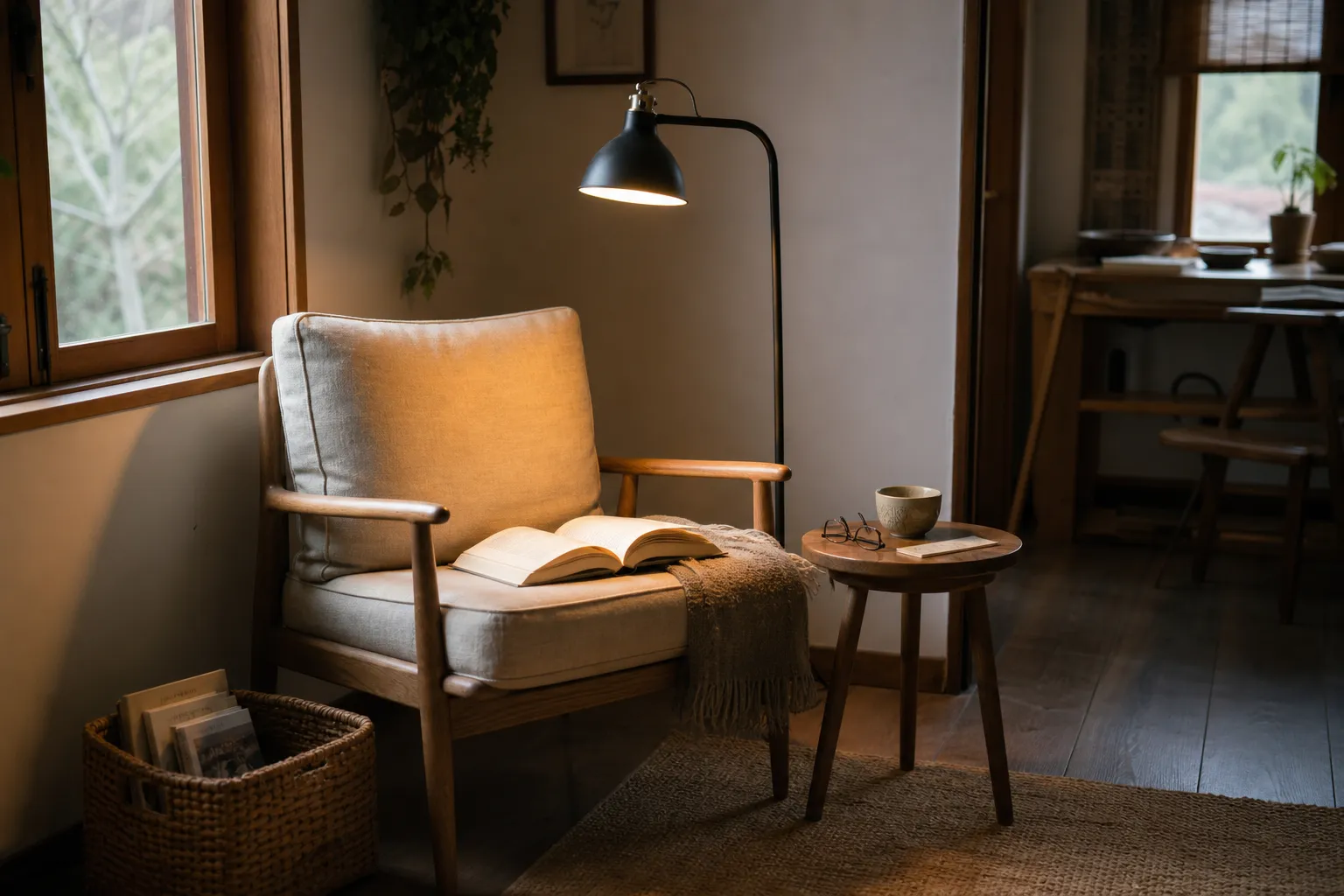
A good reading corner setup is not a staged nook for photographs. It is a small working arrangement inside an ordinary room: a seat, light that lands on the page, a surface for your hand, and storage that does not become a pile. The right version depends on room shape, daylight, outlets, walking paths, and whether the corner must share space with a sofa, bed, desk, or dining table.
broader context
Broader context
Use the broader page when you need more context before this narrower page.
What You Need for a Reading Corner You Will Use Every Day
The useful version is usually simpler than the imagined one. Before buying a chair, lamp, shelf, or floor cushion, look for five conditions.
A seat with a reason
It should face something quiet enough for reading: a window, a wall with art, a plant, a low shelf, or a screen that softens the view of a busy room. It does not have to be hidden, but it should not sit in the main path between doorways.
Light that reaches the page
Ambient light can make a corner pleasant, but reading usually needs a more local source: a floor lamp, table lamp, wall-mounted lamp, or daylight controlled by curtains or blinds. If the lamp glows beautifully but leaves the page dim or throws a hard shadow from your shoulder, the setup is not finished.
A landing place for your hand
A side table for a reading corner does not need to be large, but it should hold the things that interrupt reading when they have nowhere to go: a current book, glasses, bookmark, cup, small dish, lamp switch, or phone placed face down.
Storage that matches real use
A woven basket, low crate, wall shelf, small book stack, or closed box can all work. The point is not to display every book you own. It is to keep the next few books reachable without turning the corner into a sorting station.
Materials you will maintain
Linen, cotton, wool, paper, bamboo, rattan, wood, ceramic, and matte metal can all suit a quiet corner, but each asks for ordinary care. Choose surfaces you are willing to dust, wipe, air, fold, or rotate. A reading nook that is difficult to maintain becomes a temporary installation, not a daily place.
Choose the Spot Before You Choose the Chair
Many reading nook ideas begin with furniture, but the room location changes almost every later decision. Start by standing in the room at different times of day and noticing three things: light, traffic, and edges.
A corner beside a wall often feels easier to settle into than a chair floating in the middle of a room. Research on shared reading and study environments suggests that people often favor corners, wall-adjacent seats, outlet access, and lower-traffic locations. A home is not a library, so treat that as a useful cross-check rather than a rule. In a real living room, the right spot may be the quiet end of the sofa, the space beside a bookcase, the inside edge of a window, or a low cushion near a cabinet.
Small living room
Look for unused edges rather than leftover gaps. A narrow space beside a sofa can work if the chair does not block the walkway. A corner near a media cabinet may work if the lamp does not reflect on a screen. A spot near a window may feel pleasant in the morning and difficult in late afternoon if direct sun falls across the page.
Bedroom
The main challenge is not atmosphere; it is crowding. The chair, lamp, and table should not make it harder to move around the bed, open drawers, or reach the closet. If the room is small, consider a compact armless chair, a floor cushion with back support against a wall, a low stool as a table, or a lamp that shares the bedside surface.
Rental home
A renter-friendly reading corner setup should avoid assuming permanent changes. A folding screen can create a softer edge without drilling. A standing lamp can replace a wired sconce. A freestanding shelf, basket, or low bench can hold books without wall mounting. If you use adhesive hooks or clip-on lights, follow the product instructions and test them in an inconspicuous place where surface damage would matter less.
Reading Chair and Lamp Placement for Comfortable Page Light
Lighting is where many reading corners fail. The room may feel warm and attractive, but the book sits in shadow. Or the lamp is bright, but the shade shines into the eyes. The aim is not maximum brightness everywhere. It is usable page light with limited glare.
Lighting sources often describe reading light through terms such as illuminance, color temperature, glare, general lighting, and local lighting. For home use, you do not need to turn the corner into a technical project. Translate the ideas this way:
- General light is the room’s overall glow.
- Local light is the lamp or daylight that helps you read the page.
- Color temperature is the visual character of the light, often perceived as warmer or cooler.
- Glare is light that feels harsh, reflects off the page, or sits in your line of sight.
For reading chair lighting, place the lamp so light falls over the page from the side or slightly behind the shoulder, not directly into the eyes. If you are right-handed and often write notes, a lamp from the left may reduce hand shadow; if you are left-handed, the reverse may feel better. For reading only, test both sides. Sit down with an actual book, not just an empty chair, and check where the shadow lands.
A floor lamp or table lamp can both work. A floor lamp is useful when you do not have a large side table or when the chair sits alone. An adjustable head or shade gives more flexibility if the corner serves different readers. A table lamp is useful when the side surface is stable, close to the seat, and high enough for the shade to direct light onto the page. If the table is very low, the lamp may create a pool of light below the book instead of on it.
A window reading nook changes the problem. Daylight can be generous, but it shifts. Direct sun may brighten the page too much, create contrast, or make you angle your body awkwardly. Curtains, blinds, sheer panels, or simply turning the chair can soften this. In a lamp-lit reading corner, the issue is more about lamp reach, shade shape, and whether the room behind the page is too dark by comparison. Many homes feel better with a small amount of general room light plus a local lamp, rather than one isolated bright lamp in an otherwise dark room.
Older readers, readers with changing vision, and anyone who switches between paper, e-reader, and notes may need more adjustability. That does not require a complicated lighting scheme. It may mean a lamp with a movable arm, a shade that directs light downward, or a second low-level room light to reduce contrast.
Reading Corner Measurements That Keep the Chair, Lamp, and Walkway Usable
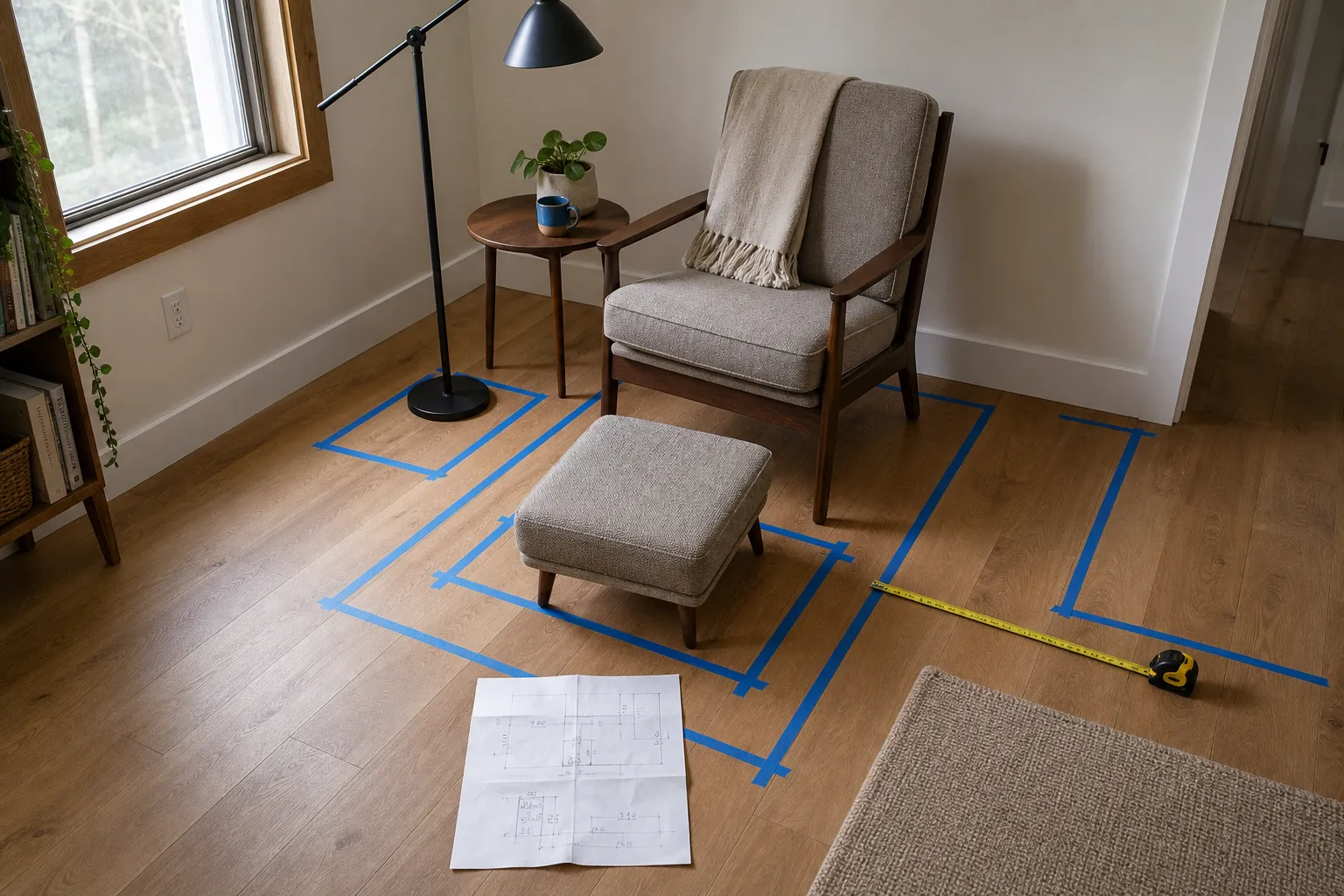
Exact dimensions depend on the furniture, and fixed measurement rules can fail quickly in real homes. A better first test is to mark the setup before you buy or move heavy pieces.
Use painter’s tape, folded newspaper, or a blanket on the floor to show the footprint of the chair and side table. Then walk past it as you normally would. Carry laundry, a tray, a bag, or whatever actually moves through that room. If your hip clips the chair outline or you have to turn sideways every time, the corner will become annoying.
Check four clearances in practice
- Sit-down space: Can you step in front of the seat and sit without moving the table?
- Lamp reach: Does the lamp head or shade reach the reading position, not just the edge of the chair?
- Table reach: Can you set down a cup or book without leaning forward awkwardly?
- Walkway flow: Can others pass without brushing the lamp, footstool, or basket?
If the corner has an ottoman, footstool, or floor cushion, test it in the “used” position, not tucked away. Many reading corners look tidy when the footrest is hidden but fail when someone actually stretches out.
For a one chair reading corner, treat the chair as the anchor and everything else as secondary. Choose one lamp, one small surface, and one storage method. A single chair beside a wall can feel complete with a floor lamp and a basket. A chair beside a window may only need a low table and a small evening lamp. If space is tight, avoid adding a plant stand, extra cushion stack, and large book pile all at once. The corner should read as intentional, not crowded.
Side Table and Book Storage Without Visual Clutter
A side table for a reading corner should answer one question: what needs to fit while you are reading? For many people, that list is short: current book, cup, glasses, bookmark, pencil, small notebook, and perhaps a lamp. If the lamp stands on the floor, the table can be smaller. If the lamp sits on the table, the surface needs enough room that the cup is not crowded against the lamp base.
Low tables can suit an Eastern-inspired room, especially near floor cushions or a low lounge chair. They work best when the reader naturally sits closer to the floor. If you are using a higher armchair, a very low table may look calm but function poorly because you must bend each time you reach for something.
A stool can serve as a table if it is stable for the objects you place on it. A tray on a cushion or fabric ottoman is less dependable for drinks. If tea is part of your reading habit, a small ceramic cup on a solid wood, bamboo, or stoneware-friendly surface is more practical than a soft surface. Use coasters or trays where moisture may mark the material.
Book storage patterns that stay limited
- The current stack: three to five books on a low shelf, stool, or table.
- The basket: soft storage for magazines, paperbacks, or library books.
- The closed box: useful when visual calm matters more than display.
- The narrow shelf: good for a corner that already has a wall or bookcase nearby.
- The rotating tray: a small selection that changes with the season or current interest.
Open storage can become visual noise if every book spine, notebook, cable, receipt, and bookmark remains visible. Closed or semi-closed storage can help, but only if you still know what is inside. A woven basket with one category — current reading only — is often more usable than a beautiful box full of mixed objects.
Materials, Texture, and an Eastern-Inspired Mood Without Overstating It
A calm-looking reading nook does not come from buying everything in one style. It usually comes from restraint: fewer objects, quieter surfaces, and materials that age in a way you can accept.
Natural textures suit this kind of corner because they give the eye enough detail without demanding attention. A wood side table, bamboo tray, linen cushion cover, cotton throw, wool rug, paper shade, ceramic cup, or rattan basket can all support a slower visual rhythm. These choices are practical as much as aesthetic. A basket gathers books. A tray defines a surface. A washable cover makes a chair easier to live with. A screen can soften a view or separate the corner from a busy room.
Avoid turning cultural references into promises. A tea-adjacent corner, floor cushion, low table, screen, or woven basket can make a space feel more considered, but these objects do not guarantee a result. Use them because they fit your room, your habits, and your maintenance capacity.
Texture also changes the light. Matte surfaces tend to feel softer than glossy ones because they reflect light less sharply. Darker walls, shelves, or textiles can make a corner feel enclosed, but they may also require better local light for reading. Pale surfaces can bounce light around, but too many bright reflective surfaces near a window may feel harsh at certain times of day. The answer is not one color rule; it is a seated test with a book in hand.
Window Reading Nook or Lamp-Lit Reading Corner: What Changes
Window reading nook
A window reading nook is strongest when daylight is pleasant and controllable. It often suits morning reading, weekend browsing, plants, and a chair angled slightly away from direct sun. The main tools are curtains, blinds, sheers, chair angle, and a small evening lamp for darker hours.
Lamp-lit corner
A lamp-lit reading corner is stronger when the room has little daylight, when reading happens at night, or when the chair must sit away from windows. The main tools are lamp height, shade direction, bulb character, and enough surrounding light that the page does not feel isolated in a bright spot.
Mixed version
The mixed version is often the most useful. Put the chair near natural light, but do not depend on daylight alone. Add a lamp that reaches the page after sunset or on overcast days. This keeps the corner from being a “good weather” feature.
If the window has a view, angle the chair so the view is available during pauses, not directly competing with the page. If the window faces a busy street, a screen, plant, sheer curtain, or side-facing chair can reduce visual interruption. If the window creates strong glare on glossy book pages or an e-reader screen, turn the chair slightly and test again.
How to Make a Reading Corner Work When You Only Have One Chair
Not every home has space for a dedicated nook. A reading corner can be a mode, not a separate zone.
If one chair must serve conversation, reading, and occasional guests, give it a reading kit rather than a permanent installation. Keep a small basket nearby with the current book, glasses, throw, and bookmark. Use a floor lamp that can turn toward the chair for reading and away for general room light. Let a small stool move between side table, footrest, and extra seat.
In a living room, this may mean the corner is active only in the evening. During the day, the chair belongs to the room. At night, the lamp angle, book basket, and cup tray turn it into a reading spot. This is often more realistic than trying to carve out a separate book corner setup in a small apartment.
In a bedroom, one chair may already collect clothes. If that is the case, do not pretend the reading setup will fix the habit by itself. Add a separate hook, hamper, or shelf for clothing before assigning the chair to reading. The chair needs a clear role, and the room needs another place for the objects that usually land there.
For floor seating, use the same logic. A cushion against a wall, a low table, a basket, and a nearby lamp can be enough. But if getting up from the floor is inconvenient for you or your household, the corner will not be used often. Comfort is personal and practical; choose the seat that matches real use, not the image of use.
A Simple Maintenance Rhythm for a Reading Nook Setup
A reading corner stays usable when reset is built into the design. The routine should be small enough to do without thinking.
After each use, return only three things: the book to its stack or basket, the cup to the kitchen, and the throw to the chair or shelf. Once a week, clear paper scraps, receipts, dead leaves from nearby plants, and books that are no longer current. Dust the lamp shade and table surface when you notice the light looking dull. Rotate cushions or throws by season if the room changes temperature.
Seasonal adjustment matters more than seasonal decoration. In brighter months, you may need a sheer curtain, a different chair angle, or fewer heavy textiles. In colder months, a warmer throw, slightly stronger local lamp, and a more enclosed corner may make the spot easier to use. If your corner depends on a window, observe when the daylight becomes too strong or too weak and adjust the chair before buying more objects.
The most common mistake is adding atmosphere before function. A candle, incense holder, art object, extra cushion, or decorative tray may look appealing, but if it crowds the table or competes with the lamp, it weakens the setup. Keep lamps stable, keep textiles away from heat sources, ventilate if using scent or smoke, and follow product labels or manufacturer instructions. The daily structure is still seat, light, surface, storage, and reset.
A Practical Reading Corner Setup Checklist
Use this as a final pass before you call the corner finished:
- Can you sit down without moving other furniture?
- Does light reach the page from a useful angle?
- Can you reduce window glare with a curtain, blind, sheer, or chair angle?
- Is there a reachable surface for a book, glasses, cup, or lamp switch?
- Is book storage limited to what you are actively reading?
- Are cords, lamp bases, baskets, and footrests out of the main walking path?
- Do the materials match the care you are willing to give them?
- Can the corner be reset in less than a minute?
If the answer is yes to most of these, the setup is probably ready. It does not need to be elaborate. A chair beside a wall, a well-aimed lamp, a small wooden stool, a basket of current books, and one textile you actually use can be more successful than a larger reading nook that is difficult to enter, light, clean, or maintain.