Small bathroom storage decision
Small Bathroom Mirror Cabinet Depth: What Fits Without Feeling Heavy
For a small bathroom, choose the shallowest mirror cabinet that still fits your daily items. Judge it by three separate measurements: exterior projection from the wall, usable internal shelf depth, and, for a recessed cabinet, the rough-in depth the wall must accept.
There is no single small bathroom mirror cabinet depth that works for every sink wall. The useful answer is: let your storage needs set the minimum shelf depth, then let the room set the maximum projection.
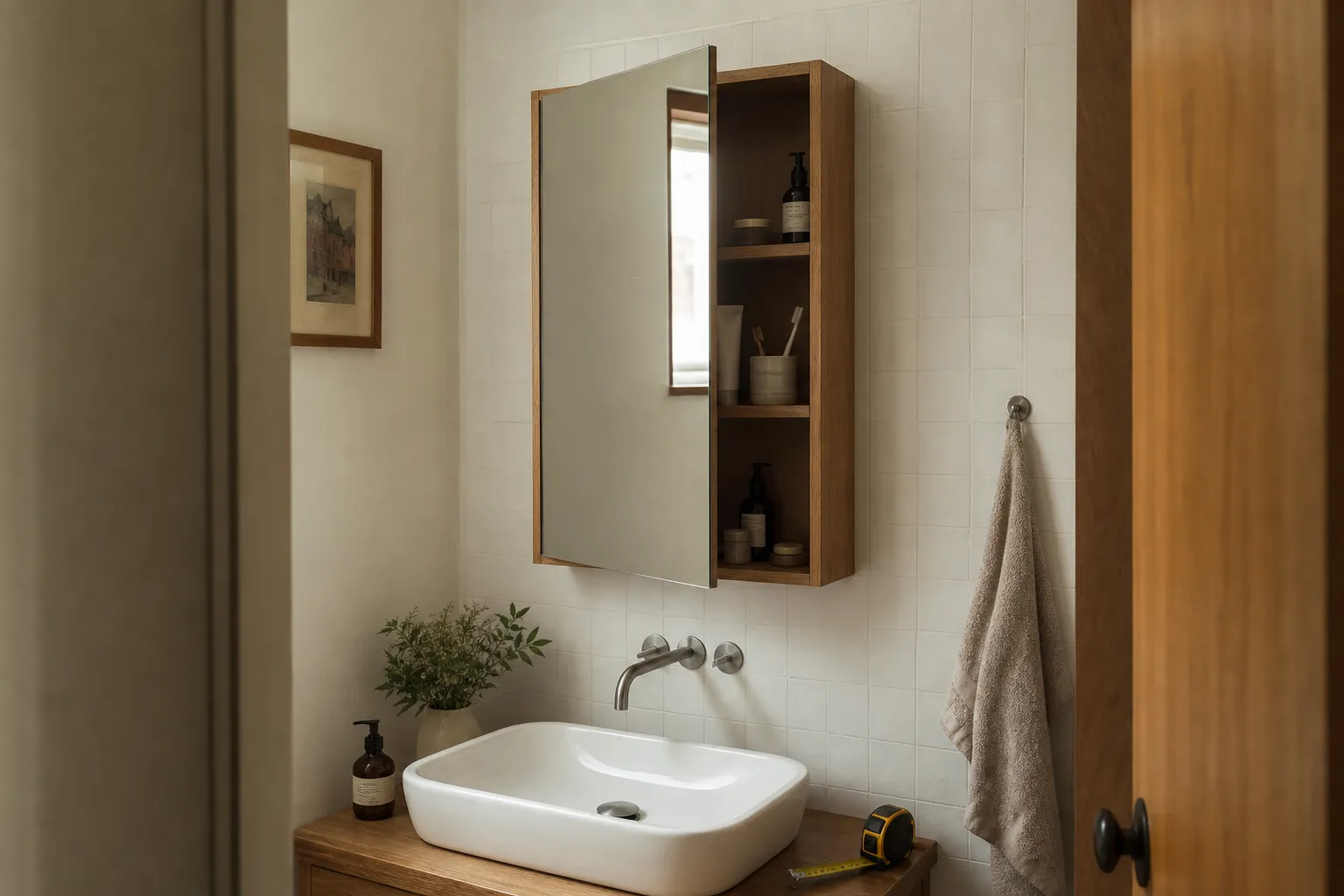
A cabinet feels right when its side profile stays quiet, its shelves hold the things you reach for every day, and its door does not crowd the faucet, lighting, outlet, or your normal movement over the basin.
broader context
Parent topic
Use the broader page when you need more context before this narrower page.
The three depth numbers that matter
Shopping pages often use the word “depth” loosely. Before comparing products, separate these three numbers.
Exterior cabinet depth
This is the full front-to-back size of the cabinet body. For a surface-mounted cabinet, this is the amount that projects into the room. It affects side bulk, shadow, head clearance, and whether the cabinet looks like a box above a small sink.
Internal shelf depth
This is the usable storage space inside the cabinet. It is usually smaller than the exterior depth because the cabinet has a back, door, frame, hinge area, or mirror assembly. This number decides whether a toothbrush cup, small skincare bottle, deodorant, contact lens case, razor, or narrow packet will actually sit on the shelf.
Rough-in depth
This applies to a recessed mirror cabinet. It is the depth needed inside the wall cavity, along with the required wall opening size. A recessed cabinet may look lighter because part of the box sits inside the wall, but only if that wall can accept it.
A compact cabinet listing might show an exterior depth around 3.75 inches, an internal shelf depth around 3.35 inches, and a rough-in depth around 3 inches. Those figures are only an example of how product labels differ, not a universal recommendation. The listed depth, real shelf space, and wall requirement can be three different things.
If you only read the exterior depth, you may buy a cabinet that looks fine online but stores less than expected. If you only read the shelf depth, you may miss how much the cabinet projects into a narrow room. If you only read the recessed rough-in number, you may overlook the wall conditions that decide whether recessing is realistic.
What depth feels right in a small bathroom?
In a small bathroom, depth is not just a storage measurement. It changes how the sink wall reads when you walk in.
A surface mount medicine cabinet depth that seems modest in a product listing can still feel heavy if the side of the cabinet is visible from the doorway, the frame is thick, or the cabinet is wider than the vanity below it. A deep box with dark side panels and strong shadow lines will usually feel more present than a thinner, finer-edged mirror cabinet of the same height.
A recessed mirror cabinet depth works differently. Because part of the cabinet sits inside the wall, the visible projection may be much smaller than the full cabinet body. This can help the mirror wall feel quieter above a small basin. But recessed versus surface mount cabinet choice is not only a design preference; it is also a wall-construction question.
A simple way to sort the decision
- If the cabinet will be surface mounted, be strict about exterior projection.
- If the cabinet will be recessed, be strict about wall cavity depth and rough-in dimensions.
- In both cases, be strict about internal shelf depth, because storage that does not fit your real items will push clutter back onto the counter.
The most balanced small bathroom wall cabinet depth is usually the one that removes daily clutter without making the mirror wall dominate the room. Deeper is not automatically better. Deep shelves can store more, but they can also hide small bottles behind other items, strengthen the side profile, and make the door swing farther into your working space.
Very shallow is not automatically better either. If the shelves cannot hold what you actually use, the cabinet becomes decorative storage while the countertop stays crowded.
Measure the sink wall before trusting product claims
Before comparing cabinets, stand at the sink and measure the conditions the cabinet must live with. This is more useful than searching for one standard medicine cabinet depth.
Vanity width and depth
A mirror cabinet above a small sink usually feels calmer when it relates to the vanity below it. It does not need to match perfectly, but if it is much wider or visually thicker than the sink area, it may make the wall feel top-heavy.
Faucet height and reach
The cabinet should not make faucet use awkward, block your hands while washing, or feel too close when you lean over the basin. If the faucet is tall or set far back, the lower edge and projection of the cabinet matter more.
Light fixture position
A cabinet that projects too far can crowd a bar light, side sconces, or a small ceiling fixture near the mirror. Mirrors also reflect light strongly, so glare and shadow can become more noticeable in a compact room.
Outlets and switches
A bathroom mirror storage unit should not cover access to a wall outlet, switch, or plate that you need to use or service.
Bathroom door and cabinet door
Door swing matters, especially near a side wall. A wide mirrored door on a narrow wall may hit trim, a sconce, a towel hook, or the room door. Double-door cabinets can reduce the swing arc, but they add a center line to the mirror.
Side view from the doorway
Visual weight often comes from the side, not the front. From straight on, most mirror cabinets look fairly flat. From the doorway, the box, side panel, hinge line, and shadow reveal the real depth.
Finally, lean toward the mirror as you normally would. Brushing teeth, shaving, applying skincare, inserting contact lenses, or washing your face all bring your head closer to the cabinet. If the cabinet projects too much over a shallow basin, it can feel intrusive even if it technically fits.
Match shelf depth to the things you actually use
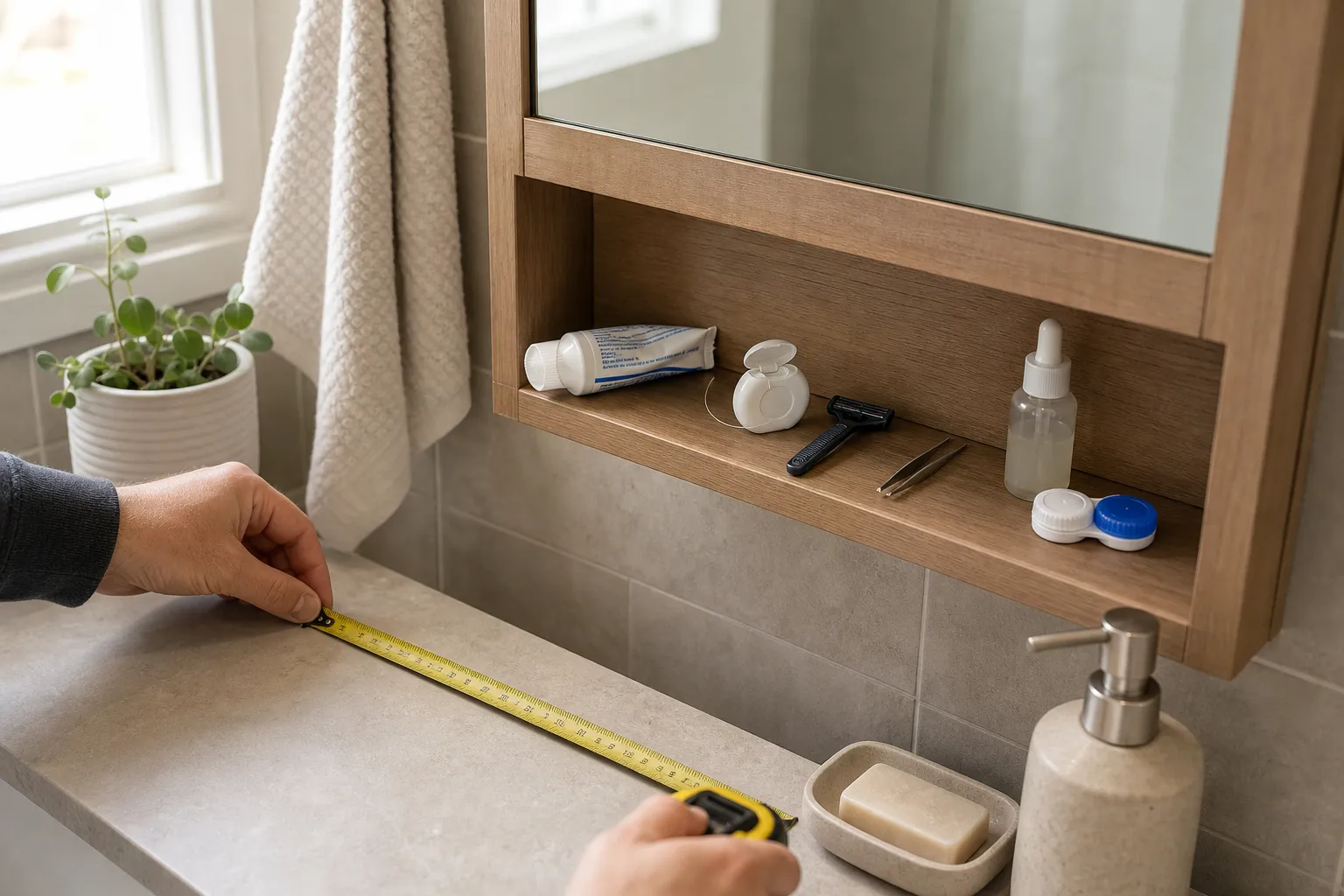
Bathroom mirror storage works best when it holds the small things that create counter clutter. Do not begin with the largest bottle in the room. Begin with the items you touch every day.
Lay them on the counter and group them:
- toothbrush or electric toothbrush heads
- toothpaste
- floss
- razor and spare blades
- small skincare bottles
- deodorant
- contact lens supplies
- cotton swabs or small pads
- nail clippers or tweezers
- a small first-aid packet, if you keep one there
Measure the deepest item in that daily group. That number gives you the minimum internal shelf depth that would be useful. If your items are mostly narrow, shallow shelves for toiletries may be enough. If you rely on wide jars, large pump bottles, or tall containers, a mirror cabinet may not be the right place for all of them.
This is where many buyers confuse bathroom mirror storage depth with total cabinet depth. A cabinet can have an exterior depth that sounds generous while the internal shelf depth is smaller. Adjustable shelves help with height, not depth. They can make room for taller bottles, but they cannot make a shelf deeper from front to back.
For a calm small bathroom, let the mirror cabinet hold the light daily layer and place bulky supplies elsewhere: under the sink, in a linen closet, on a narrow side shelf, or in a separate small bathroom wall cabinet away from the face-level mirror zone. The goal is not to hide every bathroom object inside one mirrored box. It is to keep the sink surface clear enough to clean easily and use without shuffling items around.
Recessed versus surface mount depth
A surface-mounted cabinet is straightforward: the whole cabinet sits on the finished wall. Its exterior depth becomes the full projection into the room. This can be practical where recessing is not realistic, such as tiled walls, masonry, thin partitions, rental situations, or walls that may contain wiring or plumbing. Surface mounting is not a lesser choice. It simply asks for more care with proportion and side appearance.
A recessed cabinet places part of the cabinet body inside the wall. This can reduce visible boxiness and help the mirror sit more quietly above a small sink. But recessed installation depends on the wall cavity depth, wall opening size, framing, tile thickness, wiring, plumbing, vent lines, fasteners, and the manufacturer’s instructions for that exact model.
Do not treat a rough-in depth for medicine cabinet installation as a universal number. Read the installation sheet before buying, not after the box arrives. If the wall may contain wiring, plumbing, or structural framing, confirm what is inside the wall before cutting. For tile, older walls, or uncertain wall cavities, a qualified installer is often the more practical route.
A cabinet advertised as both surface and recessed mount should still be checked both ways. The same cabinet will feel different depending on how it is installed. On the wall surface, its full side depth is visible. In the wall, its projection may be quieter, but the wall has to be suitable for it.
What makes a mirror cabinet feel heavy?
Depth is only one part of bathroom cabinet visual weight. A shallow cabinet can still look heavy if its proportions and details are loud.
Watch these features:
Side color and finish
A white or wall-toned side panel often recedes more than a dark or high-contrast side panel. If the cabinet side is visible from the doorway, this matters.
Frame thickness
A thick mirror frame can make a shallow cabinet feel heavier. A frameless or fine-edged mirror may feel lighter, while still needing suitable hardware and construction.
Height
A tall cabinet can store more, but in a small bathroom it may compress the wall above the sink. If the cabinet rises close to a light fixture or ceiling line, it can feel crowded.
Width relative to the sink
A cabinet wider than the vanity may be useful, but it can also make the sink area feel top-heavy. A slightly narrower or aligned cabinet often looks calmer.
Shadow lines
Surface-mounted cabinets cast side and bottom shadows. The deeper the box and the stronger the bathroom lighting, the more noticeable those shadows can be.
Door swing
Even if a cabinet looks slim when closed, the open door can make the space feel awkward. Check how far the mirror door moves into the room and whether you can stand naturally while using it.
The quietest choice is not always the thinnest product. It is the cabinet whose projection, shelf use, mirror size, and side view all make sense for the sink wall.
A short buying check
Use this before choosing a shallow bathroom mirror cabinet, a recessed option, or a surface-mounted medicine cabinet.
- Read the product dimensions carefully. Identify exterior depth, internal shelf depth, and rough-in depth if provided.
- Measure your daily items. Make sure the internal shelf depth fits what you actually plan to store.
- Tape the cabinet outline on the wall. Mark width, height, and side projection if possible.
- Check faucet and basin movement. Lean in and use the sink as you normally would.
- Check lighting and outlet conflicts. Do not assume a mirror cabinet can replace a flat mirror without affecting nearby fixtures.
- Open nearby doors. Include the room door, shower door, cabinet door, and any vanity door.
- Look from the doorway. If the side box is the first thing you notice, consider a shallower projection, a recessed model if feasible, or a quieter side finish.
- For recessed cabinets, confirm the wall. Compare the rough-in size and depth with the actual wall cavity and hidden conditions before committing.
This keeps the decision grounded: useful storage first, quiet proportion second, installation reality always.
Common misunderstanding: “depth” does not mean one thing
The most common mistake is reading one depth number and assuming it answers everything.
For a small bathroom mirror cabinet depth decision, you need to know what that number describes. Is it the full cabinet body? The shelf space inside? The amount required inside the wall? Those are not interchangeable.
If a listing does not clearly show internal shelf depth or rough-in requirements, look for the installation document or a dimension diagram. If those details are missing, be cautious about treating the cabinet as a good fit for a tight sink wall.
The bottom line
The right small bathroom mirror cabinet depth is not a single number. It is the shallowest cabinet that fits your daily items internally, projects modestly enough for your sink wall, and, if recessed, matches the wall cavity and rough-in requirements for that specific cabinet.
If you want the least visual weight, compare recessed options first, but do not assume the wall can accept one. If surface mounting is the realistic route, choose a cabinet with restrained exterior depth, a side finish that does not shout from the doorway, and shelves deep enough for the few objects that truly belong at face level.
A small bathroom feels better when the mirror wall does one honest job: reflect clearly, store the daily layer, and leave the sink area easy to use and easy to wipe down.