Shower Niche or Shower Caddy for a Small Bathroom
For most small bathrooms, the practical answer is simple: choose a built-in shower niche if the shower is already being remodeled, you own the space, and recessed storage can be planned before tile work is finished. Choose a shower caddy if you rent, cannot alter the wall, need a lower-cost fix, or expect your bottle habits to change.
The shower niche vs shower caddy decision is less about which one looks nicer in a photo and more about what your wall, lease, budget, and daily routine can realistically support.
A niche usually gives the quieter visual result because bottles sit inside the wall plane. A caddy is easier to add, move, and remove, but it can make a tight shower feel busier and narrower. Neither is automatically better for every small bathroom.
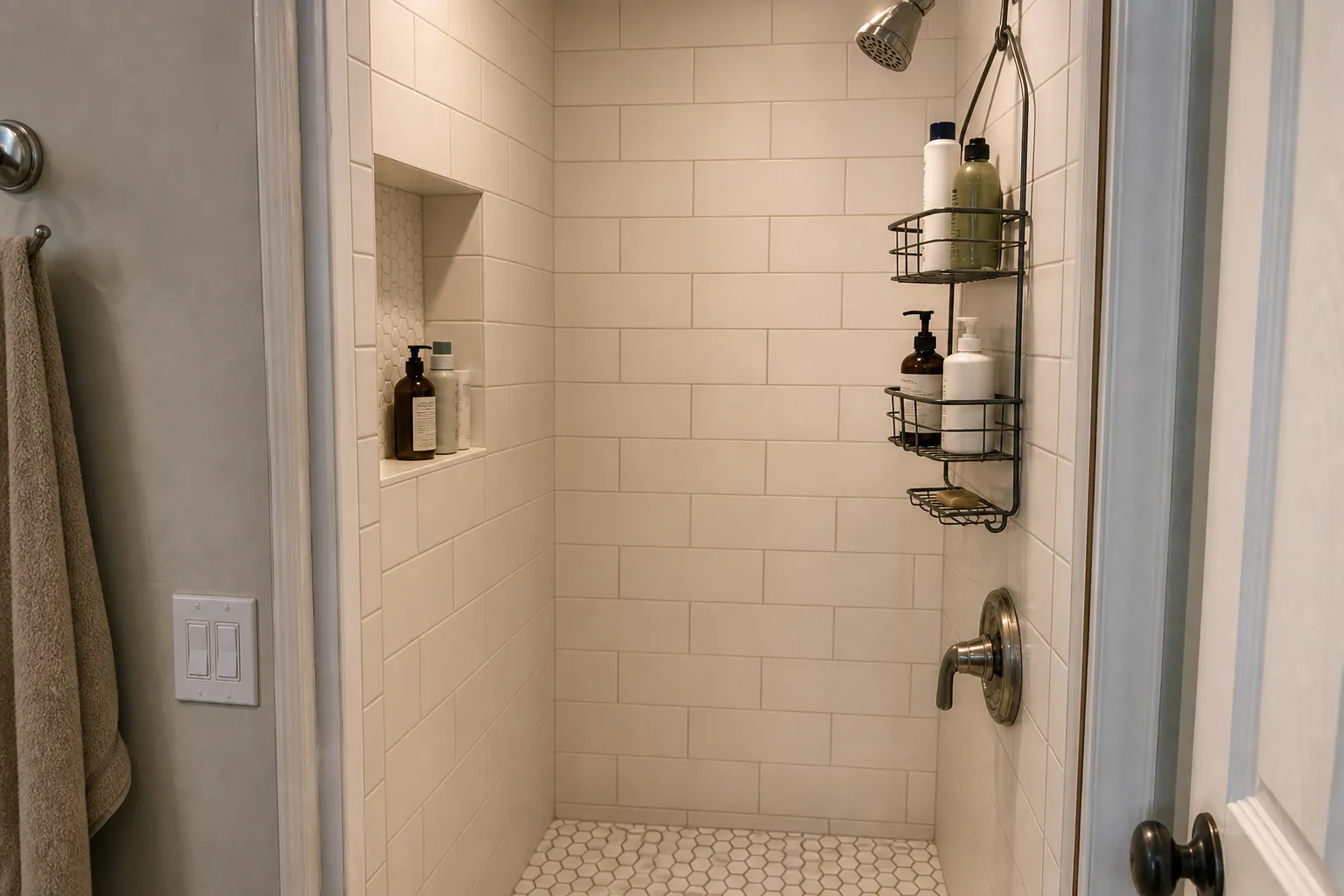
broader context
Broader context
Use the broader page when you need more context before this narrower page.
Quick answer: when each option makes more sense
A small shower often has three problems at once: not enough ledge space, bottles sitting on the floor, and very little elbow room. The right bathroom shower organizer should solve those problems without creating a new one.
You are already remodeling or retiling the shower
Built-in shower niche
You rent or cannot change the wall
Removable shower caddy
The shower is very narrow and every inch of shoulder room matters
Shower niche, if wall work is already possible
You need storage this week
Shower caddy
You use only a few bottles and want a quieter wall
Small niche
You use many tall bottles, razors, soap, children’s items, or shared products
Larger caddy or more than one storage point
You dislike cleaning around wires, baskets, hooks, and suction cups
Niche may be simpler day to day
You do not want a permanent decision
Caddy
The main dividing line is permanence. A built-in shower niche is part of the wall assembly. It has to be planned, cut, waterproofed, tiled, and finished as part of the shower. A removable shower caddy is an object added after the room is complete.
If you are not already opening the wall, a niche may be more project than the storage problem deserves. If the wall is already open during a remodel, a caddy may feel like a temporary compromise unless flexibility matters more to you.
What changes the answer in a small shower
1. Wall work matters more than style
A shower niche for small bathroom storage can look clean because it does not hang from the showerhead, sit on the floor, or project from the corner. But it depends on the wall being suitable for that work.
If a niche requires cutting into finished tile, changing waterproofing, or altering a wall you do not control, treat it as a construction decision, not a simple organizer purchase. It may still be the right choice during a planned remodel, but it is not the same kind of decision as hanging a basket in ten minutes.
This page is not an installation guide for waterproofing, tile cutting, or wall modification. For built-in work, check the tile system requirements and use a qualified installer or contractor where the wall assembly is involved.
A caddy avoids wall reconstruction. That makes it the more natural choice for renter friendly shower storage, temporary homes, dorm-style bathrooms, and bathrooms where you are still learning how the room is used.
2. Projection is the hidden cost of a caddy
In a generous shower, a caddy is just storage. In a narrow stall, it becomes part of the space your body moves through. A hanging caddy can bump the shoulder. A corner basket can catch an elbow. A tension-pole caddy can make one corner feel crowded. A floor-standing organizer can take away the exact space where your foot wants to land.
That is why small shower storage is not only about capacity. It is also about depth.
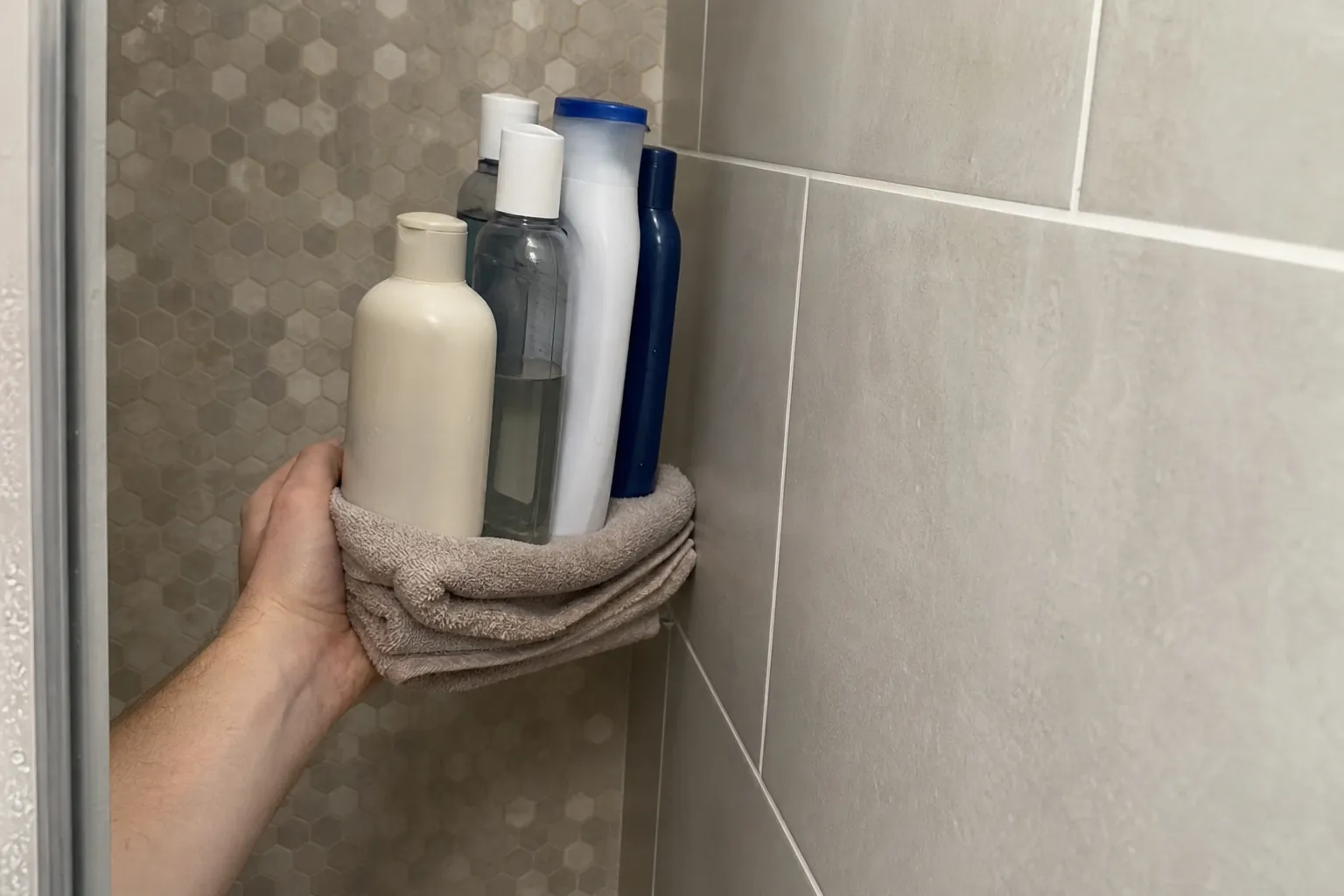
Before buying a shower caddy for a small shower, hold a folded towel, box, or cluster of bottles where the caddy would sit. Turn as you normally do. Reach for shampoo. Rinse your hair. If the mock-up feels irritating, a full organizer may feel worse.
A niche does not project in the same way. Its storage depth sits inside the wall cavity, which is the main reason it can feel calmer in a compact shower. But it only helps if the niche is reachable and sized for the bottles you actually use.
3. Bottle count is not a small detail
A useful reminder from research on showering routines is that real showers often involve more than one soap and one shampoo bottle. Shared bathrooms, hair care routines, children’s products, and occasional items can quickly turn a small ledge into a crowded one. The research is not a storage-product comparison, but it supports a practical point: count your actual items before choosing the storage form.
Do not design for an imaginary minimalist version of yourself unless you are also changing what stays in the shower.
Count:
- shampoo and conditioner bottles
- body wash or bar soap
- face cleanser
- razor and shaving product
- children’s products
- shared household items
- occasional items that still need a place
- tall pump bottles
- refill pouches or backup bottles that should probably live elsewhere
A small niche can fail if it is beautiful but too short for pump bottles. A caddy can fail if it has enough shelves but makes the shower feel visually crowded. The better choice is the one that fits the real number, height, and reach pattern of your items.
4. Cleaning access should be part of the decision
Wet household surfaces need regular cleaning access. Research on periodically wet household surfaces is not a shower-storage comparison, but it reinforces a plain maintenance point: design should not make wet areas hard to reach.
For a niche, look at corners, grout lines, and the lower shelf where water may sit if the design is not well executed. For a caddy, look at wires, suction pads, hooks, baskets, and the wall behind it. The easiest-to-clean shower organizer is often the one with fewer hidden contact points and enough clearance to wipe around it.
A caddy that can be lifted off and cleaned in the sink may suit one person. Another person may find the wires, hooks, and product rings annoying. A niche may be simpler visually, but its corners are fixed; if they are awkward, you live with them.
5. Attachment type is not just a buying detail
A shower organizer without drilling can mean suction, adhesive, over-showerhead hanging, over-door hanging, or a tension pole. These are not interchangeable.
The available source set for this page includes research on temporary bathroom attachments, not caddy performance. The useful takeaway is modest: removable bathroom products should be placed and used within their intended limits. For a caddy, that means checking the specific product’s instructions, load guidance, suitable surfaces, and installation conditions.
Avoid using a storage caddy as a grab point or body support. It is storage, not a support fixture.
Visual clutter versus flexibility
A built-in niche usually wins on visual quiet. The wall stays flatter. Bottles have a defined home. Nothing hangs from the showerhead. In a small bathroom, that can matter because every exposed object reads louder: the towel, the bath mat, the mirror edge, the shampoo label.
But calm is not the same as emptiness. A niche that is too small can create a new clutter line, with bottles on the floor below it. A niche placed too far from reach may be tidy but inconvenient. A niche with no room for household changes may suit the first year and frustrate the third.
A caddy is more visible, but it is forgiving. You can move it. You can replace it. You can choose a narrower one after learning that the first version was too deep. For a shared rental, that flexibility may be more useful than a perfectly quiet wall.
There is also a budget rhythm to consider. A caddy is usually a purchase. A niche is usually part of a larger wet-area project. Without reliable price data for this page, it is better not to quote numbers. The practical distinction is enough: one is an add-on object; the other is built into the shower.
A practical check before you choose
Stand in the shower with the water off and go through the routine slowly. This is more useful than choosing from a photo.
Ask:
- Am I allowed to change the shower wall?
If not, the answer usually moves toward a removable shower caddy. - Is tile or wall work already planned?
If yes, a built-in shower niche becomes worth considering before the wall is finished. - How narrow is the usable standing space?
If a basket would sit where your elbow or shoulder moves, recessed storage may be better if construction allows. - How many bottles must stay in the shower?
If the true number is high, a small niche may not be enough. - Are the bottles tall?
Pump bottles and family-size bottles can defeat shallow or short shelves. - Who shares the shower?
More users usually mean more categories, more duplicates, and more need for adjustable storage. - Will I actually clean around this?
Be honest. A beautiful organizer that is annoying to clean will not stay beautiful. - Do I want a permanent answer?
If your routine, household, or rental status may change, flexibility has value.
For many readers, this check gives a clear direction. If you are renting, have a narrow stall, and need storage now, choose a slim removable caddy and keep only daily-use bottles inside the shower. If you are remodeling a bathroom you own, and the shower is tight, plan a niche before tile work begins and size it around real bottles.
Common misunderstanding: built-in does not always mean better
A niche can look more intentional, but it is not automatically the better small bathroom shower storage choice. The common mistake is comparing a finished niche in a design photo with a cheap, overloaded caddy in real life. That is not a fair comparison.
A fair comparison is:
- a correctly planned niche that fits the wall, tile layout, waterproofing system, and bottle sizes
- versus
- a well-sized caddy that fits the shower width, carries the actual load, can be cleaned, and can be removed without damage
Under that comparison, the answer depends on the room.
Another confusion is thinking that “no drilling” means “no attention needed.” A removable caddy still needs the right surface, correct installation, realistic load, and occasional cleaning. Adhesive, suction, hanging, and tension designs each behave differently. Since this page is not based on product testing, it should not rank them or promise long-term performance.
The most workable answer for common small-bathroom scenarios
If the shower is already being rebuilt, a built-in niche is often the cleaner long-term choice for a small bathroom because it saves protruding space and reduces the number of hanging objects. Plan it around actual bottle height, reach, and cleaning access.
If the bathroom is finished, rented, or uncertain, a removable shower caddy is usually the more sensible first move. Choose the slimmest form that holds your daily items, avoid overloading it, and keep backup products outside the shower.
If you are undecided, start by reducing the number of bottles in the shower. That one step can make either option work better. A small bathroom does not need the most elaborate storage; it needs storage that respects the room’s limits.