Room fit check
Is Low Living Room Furniture Comfortable for Everyday Use
A low sofa can make a living room feel open and close to the floor, with the coffee table, rug, and cushions held in one quiet line. But the useful answer to “is low living room furniture comfortable” is not yes or no. It can be comfortable for everyday use when the seat fits the people using it, the cushion gives enough support, and the room works for sitting down, standing up, reaching, talking, reading, and watching.
It is often better for lounging than for upright sitting. It can be less practical for older guests, laptop work, frequent getting up, or households where everyone needs an easier seat height. The look may suit an Eastern-inspired room, but comfort comes from fit and use, not from the low profile alone.

broader context
Broader context
Use the broader page when you need more context before this narrower page.
What actually makes low living room furniture comfortable
Start with the body, not the style label.
A low-profile sofa usually means the seat is closer to the floor than a conventional sofa. Two measurements matter most: seat height, from the floor to the top of the cushion, and seat depth, from the front edge of the cushion to the back cushion. They shape how your knees, feet, hips, and back meet the furniture.
General seating guidance from Cornell’s ergonomics materials describes sitting comfort as a matter of support through the seat, feet, back, and sometimes the arms. It also makes a useful everyday point: no single sitting position works for everyone. That is especially true in a living room, where one person may curl sideways with tea, another may sit upright for conversation, and someone else may stretch out for a movie.
Low living room furniture tends to work best when:
- Your feet can rest on the floor, a rug, or a stable foot support.
- The seat feels low and relaxed, but not so low that standing takes a strong push.
- The cushion supports you instead of letting you sink too far.
- The seat depth lets you use the backrest without sliding forward.
- The back cushion meets your usual sitting angle.
- An arm, side table, or nearby stable surface helps with movement.
- The coffee table is low and close enough for cups, books, and remotes.
The cushion is often the hidden issue. A soft low sofa can feel pleasant for the first few minutes, then become awkward if your hips drop far below your knees or the backrest becomes hard to use. A firmer cushion may look less cloud-like, but it can make daily sitting and rising easier. For everyday furniture, “soft” and “comfortable” are not the same thing.
The surrounding pieces matter too. A low couch beside a high coffee table can make a calm-looking room feel physically wrong. Knees hit the edge, tea is awkward to serve, and everyone leans forward too often. The quiet corner still has to work for hands, knees, cups, and walking paths.
Lounging comfort is different from upright sitting
Low seating often feels most natural when the activity is loose: movie nights, reading with cushions, napping, listening to music, or sitting near a low table. This is where floor seating comfort and low sofa comfort overlap. The eye line drops, the furniture does not dominate the wall, and the room feels more grounded.
That does not make the same sofa good for every daily task.
For lounging
A deeper low sofa can be comfortable because it gives room to fold one leg, add a throw, or lean into pillows.
For upright sitting
The same depth may become a problem. A shorter person may not reach the back cushion without extra pillows. A taller person may like the depth but dislike the low rise if the cushion compresses too much.
Body size changes the answer. Research on chair sizing and user height supports the broad point that seating fit varies by person. That should not be turned into a fixed low-sofa rule, but it does support a plain buying check: do not judge a low sofa by the showroom photo alone.
Before buying or rearranging, try these ordinary tests:
- Sit upright for five minutes, not only reclined.
- Stand up twice without using momentum.
- Place both feet down, or notice if you need a footrest.
- Lean back and check whether the back cushion actually meets your back.
- Pretend to hold a cup, book, or small plate.
- Turn toward another person as if in conversation.
- Reach for the coffee table and notice if it feels too high, too far, or in the way.
A low couch can be excellent in a room centered on resting, watching, and informal sitting. It can be less comfortable as the only seat in a room used for hosting, work calls, attentive reading, or repeated sit-stand movement. Lounging versus upright sitting is the main split.
When low furniture becomes hard to live with
The most common problem is not simply that the furniture is low. It is that the rest of the room assumes a different seat height.
A tall coffee table can trap a low sofa. A thick rug can make a low chair harder to move around. A narrow walkway can force people around cushions, ottomans, and table legs. A low sectional may look calm in a staged photo and still interrupt the room flow from the doorway to the window.
There is also the question of who uses the room. Universal design thinking is useful here because it asks whether a space works for different people, not only for the person choosing the furniture. A living room may need to welcome children, taller adults, shorter adults, older relatives, overnight guests, and people who simply prefer a firmer, higher seat.
Very low seating may be harder to rise from for older adults, guests with limited mobility, or anyone who needs more stable support when standing. CDC STEADI materials focus on older-adult fall-risk awareness more broadly; for this living room question, the modest takeaway is this: do not make every seat in the room low if some regular users may need easier standing support.
This does not mean low seating is a poor choice. It means a mixed room often works better than a single-height room. One low sofa can sit with one higher accent chair. A low lounge area can be paired with a firmer armchair. Floor cushions can be used occasionally without becoming the only seating option.
Low profile furniture limitations show up most often when:
- The sofa is used for daily laptop work.
- Guests sit for long conversations.
- Someone stands up and sits down many times in an evening.
- The seat is both low and very deep.
- The cushion compresses heavily under body weight.
- The backrest is too far away for shorter users.
- There are no arms or stable nearby surfaces.
- The coffee table belongs with a higher sofa.
- Older or less mobile guests use the room often.
If several of these are true, a fully low living room may be less practical. A single low piece may still work well.
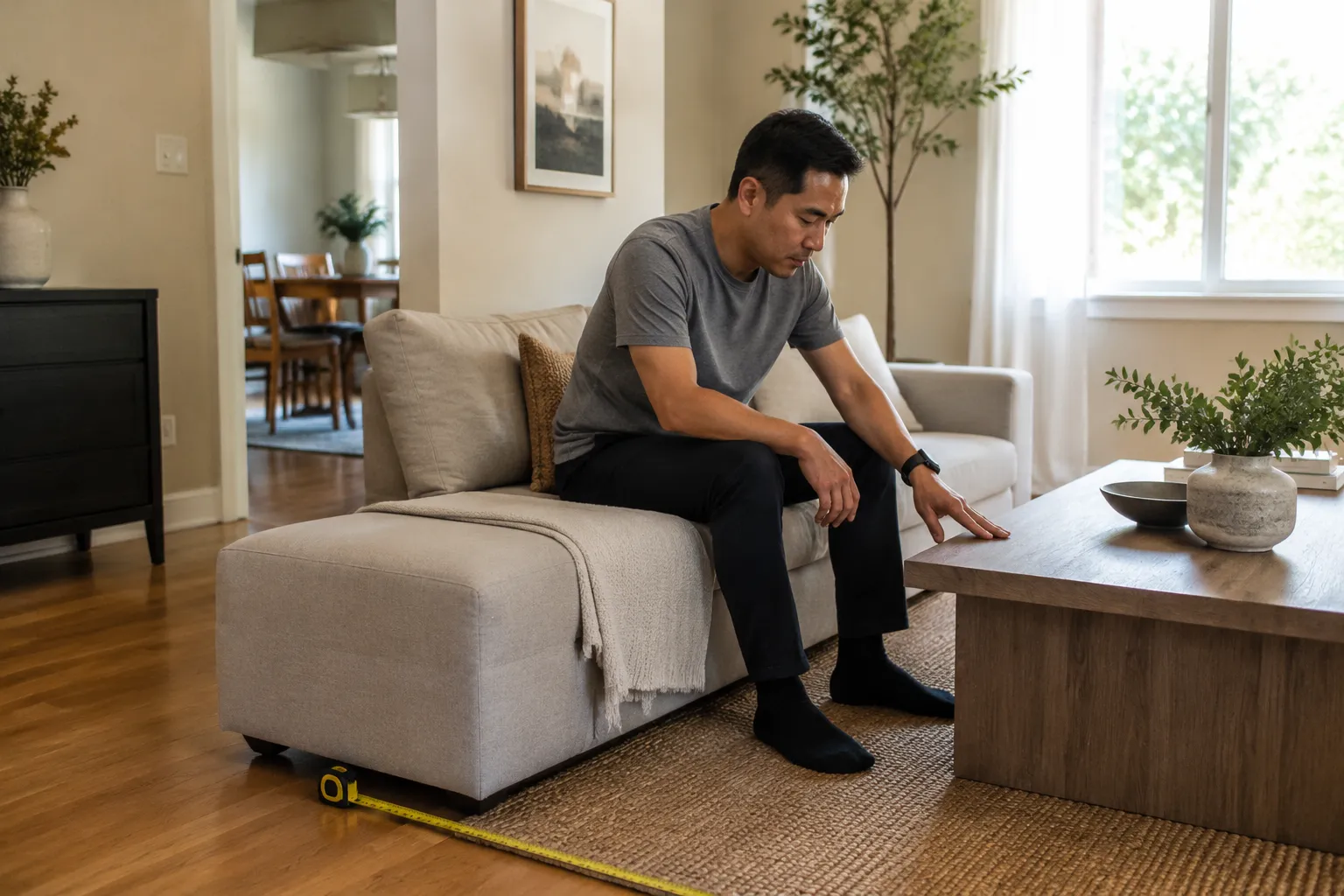
How to check fit in a real room
A living room test should be physical and ordinary. Do not rely on the product name, the staged image, or the idea that low-profile furniture is automatically more relaxed.
Start with the sitting edge. When you sit down, notice whether your knees rise sharply above your hips, whether your feet settle naturally, and whether you feel stuck in the cushion. Then check the return movement. If standing requires a strong forward rock, a hand on the coffee table, or help from the wall, the seat may be too low or too soft for daily use.
Next, check the backrest. A generous low sofa seat depth can feel fine if the back cushion is reachable. If the depth leaves you perched at the front edge, loose pillows may help. But if pillows are required every time, the sofa may be better for occasional lounging than for everyday sitting.
Then look at the table relationship. A low sofa often needs a lower coffee table or a softer arrangement: a tray on an ottoman, a small side table, or a low wooden table that does not block knees. Tea, books, and remotes should be easy to reach without a repeated forward bend.
Finally, walk the room. Zen Spaces begin with the path through the room. Low furniture can visually open a compact space because the back line sits lower, but it still occupies real floor area. A deep low sofa may make a small room look wider in one photo and feel tighter in daily passage.
A useful home trial is simple: stack folded blankets, firm cushions, or temporary blocks at the expected seat height, then use them with your current coffee table for one evening. It will not reproduce the real cushion feel, but it can reveal whether the height, reach, and path make sense.
Common misunderstandings about low sofa comfort
The lowest sofa is not automatically the most serene choice
A low line can support a calm room proportion, but extreme low seating can become tiring if the room is used often. A room does not become more usable because the furniture sits closer to the floor.
Deep seats are not always more comfortable
Deep cushions are often pleasant for stretching out, movie nights, and relaxed conversation. They are less reliable for upright sitting, especially for shorter users who cannot reach the backrest. If a deep low sofa needs loose back pillows, those pillows are part of its real comfort system.
Office-chair expectations do not fully apply
Office seating and lounge seating serve different activities. A living room sofa does not need to behave like a desk chair, but it still needs workable support for the way the room is used.
Market language does not answer fit
Low-profile furniture is often described as airy, modern, relaxed, or space-saving. Those words may describe the look, but they do not answer whether the piece works for your body, your table, your guests, or your daily routine.
The better question is narrower: can this low seat support the people and activities that happen here most days?
A practical decision rule
Choose low living room furniture for everyday use when the room is mainly for lounging, quiet conversation, tea, reading, and movie nights, and when the people who use it can sit and stand without strain. It works best when the cushion is supportive, the backrest is reachable, the coffee table is proportioned to the seat, and the circulation path stays clear.
Be cautious when the room is the main hosting space, the only seating area, or a place where older guests regularly sit. Be cautious, too, when the sofa is low, deep, armless, and very soft at the same time. That combination may look generous but feel difficult in daily movement.
The available public sources are stronger for general seating fit, body-size variation, inclusive usability, and older-adult household caution than for precise low-sofa comfort rules. So the best answer is not a universal dimension. It is a room test.
Sit, rise, reach the table, use the backrest, and notice who else can do the same. If those checks pass, low furniture can be comfortable every day. If they do not, keep the low piece as a lounge seat and add one firmer, higher chair nearby. That small adjustment preserves the quiet room line while making the space easier to live in.