Low-clutter seasonal rhythm
Holiday Decor vs Seasonal Decor: What Changes in a Low-Clutter Home
In a low-clutter home, the difference is practical: seasonal decor is the longer background layer that reflects the time of year, while holiday decor is the shorter layer tied to a specific celebration, date, symbol, or family observance. Seasonal pieces may stay for weeks or months. Holiday pieces usually come out for a narrower window and leave sooner.
Low clutter does not mean no decor. It means fewer objects, clearer surfaces, and a more deliberate swap between the base layer and the special-occasion layer. The room can still notice autumn, winter, spring, summer, New Year, harvest meals, end-of-year gatherings, or a family festival. The useful question is which objects carry the season, which objects announce the holiday, and how much the room can hold before it feels visually crowded.
broader context
Broader context
Use the broader page when you need more context before this narrower page.
Seasonal Decor Is the Background Layer
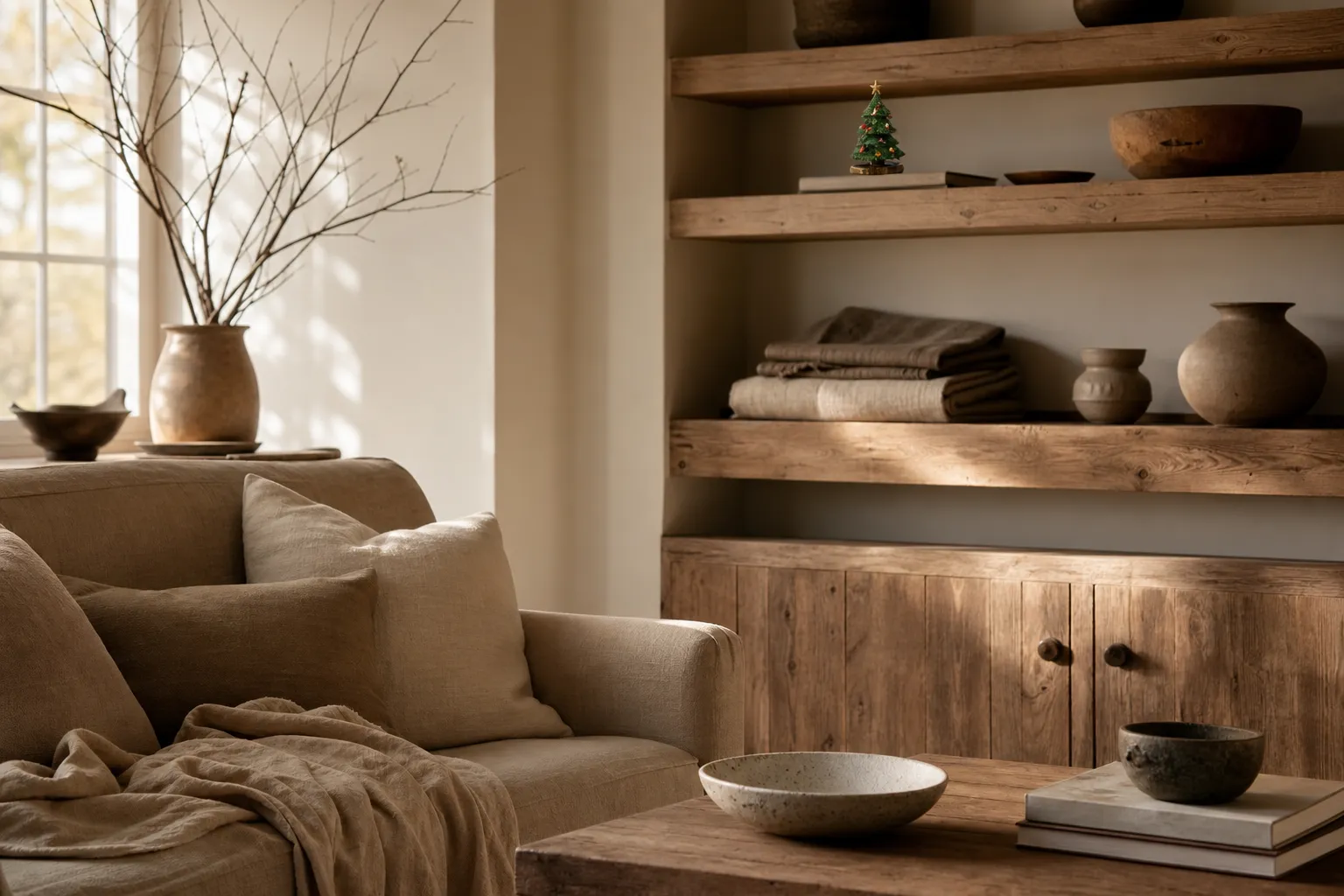
A useful seasonal decor definition is simple: it supports the broader feeling of a time of year without depending on one exact date. It may show up through texture, color, light, material, or a small room edit.
These pieces can be expressive, but they usually do not announce one named occasion. They help the room shift gently with the season.
- A heavier throw in a cool season
- A woven tray near the entry
- A bowl of pinecones, fruit, or branches
- A darker table runner in autumn
- Pale flowers or lighter cotton cushions in spring
- Bare branches, ceramic bowls, natural fiber, or folded cloth
Holiday Decor Is the Specific Signal
Holiday decor is narrower. It points to a named moment, observance, gathering, or tradition. Ornaments, stockings, greeting cards, gift wrap, a wreath, a menorah, a New Year tabletop piece, a harvest centerpiece, or specific holiday colors are not just “winter” or “autumn” in a general sense. They carry a more specific meaning.
In a low-clutter room, that specificity makes holiday decor useful. One strong object can mark the moment clearly. It also makes holiday pieces easier to overdo, because they often bring sharper color, shine, symbol, pattern, or shape.
The easiest way to separate seasonal vs holiday decorating is to ask how long the object still makes sense. A warm linen runner may work through much of autumn. A pumpkin-shaped sign feels more time-bound. A simple evergreen branch may suit winter broadly. A group of gift-tagged miniature trees reads as holiday specific decor. None of these are wrong; they simply belong to different time frames.
What Changes in a Low-Clutter Room
The main change is not style. It is editing.
Quantity changes
A low clutter holiday decor plan usually needs fewer objects than a general seasonal display because holiday pieces carry stronger visual signals. A red ribbon, metallic ornament, stack of wrapped gifts, card line, or themed tabletop object can draw attention quickly. In a quiet room, one or two may be enough.
Duration changes
Seasonal decor can sit in the background for a longer period because it is less tied to a single day. Holiday decor usually works better when it has a beginning and an end. That does not require a strict calendar. It simply means the room should not have to hold every seasonal object and every holiday object at once for too long.
Placement changes
Seasonal pieces often belong where the room already has a natural landing place: a sofa, entry bench, tea table, dining surface, windowsill, or open shelf. Holiday pieces need more care because they can interrupt daily use. A dining table cleared three times a day may not be the best place for a dense arrangement. A small tray on a sideboard may carry the same feeling with less friction.
Contrast changes
Seasonal base decor can be quiet: muted color, simple shape, soft light, natural fiber, bare branches, or folded textiles. Holiday pieces often bring stronger detail. In a low-clutter home, choose that contrast instead of scattering it. If the wreath is the main signal, the tabletop can stay plain. If the mantel holds cards and candles, the entry may need only one small branch or bowl.
Storage is part of the decision
If the holiday box is too large for the home, the room may be asked to absorb too many objects each year. A practical limit might be one small container for a minor holiday, one shelf for winter pieces, or one labeled box for the most meaningful items. The exact size depends on the home, but the principle stays the same: stored decor still affects the room.
What Can Stay When Holiday Decor Comes Out
The calmest rooms do not restart from zero for every occasion. They keep a seasonal base layer, then add a small holiday layer. The base can stay when it supports the room rather than announcing the event.
Good base pieces are flexible. A plain basket can hold gloves in winter, flowers in spring, or folded cloth in summer. A ceramic bowl can hold fruit, branches, wrapped sweets, or nothing at all. A tray can gather tea things, a small vase, cards, or one ornament. A neutral throw can stay through a cool season while a holiday cushion comes and goes.
Three Checks for What Stays
- It should still serve the room. A textile that is used, a bowl that gathers daily objects, a lamp that improves evening light, or a tray that organizes a surface has a reason to remain. Decorative objects do not have to be functional, but in a low-clutter home, the most stable pieces are often both quiet and useful.
- It should not compete with the holiday focal point. If a shelf already has branches, framed cards, figurines, candles, ribbon, and garland, the eye has no place to rest. Remove the background pieces that repeat the same visual job. Keep the one that gives shape or texture. Let the holiday item carry the meaning.
- It should be easy to live with. A low surface crowded with small objects can make wiping, meals, tea, reading, and keys more annoying. The room should feel dressed, not blocked. If an object makes ordinary movement harder, move it to a tray, shelf, or storage box until the holiday layer comes down.
This is the common misunderstanding around low clutter seasonal decor: the goal is not a bare room. A bare room can still feel unresolved if it lacks warmth, texture, or signs of the season. The goal is to avoid visual overload by choosing a few objects that speak clearly and leaving enough space around them.
A Room-by-Room Way to Decide
Not every room needs the same level of seasonal or holiday detail. Give each room a small role.
Entryway
Seasonal decor can stay practical: a tray for keys, a basket for scarves, a narrow vase, or a small mat change. Holiday decor here should be brief and clear because the entry is already a transition zone. One wreath, card display, or small object near the door may be enough.
Living room
Choose one main focus: a shelf, low table, mantel, window, or corner with a floor lamp. Seasonal pieces can soften the room through textiles and natural materials. Holiday pieces can then appear in one concentrated place. The low-clutter mistake is spreading small holiday items across every surface.
Dining area
Think about use first. If the table is used daily, a large centerpiece may become an obstacle. A low bowl, folded cloth, single branch, or small tray may work better than a broad arrangement. For a holiday meal, the table can become more specific for the day or weekend, then return to the quieter seasonal setting.
Bedroom
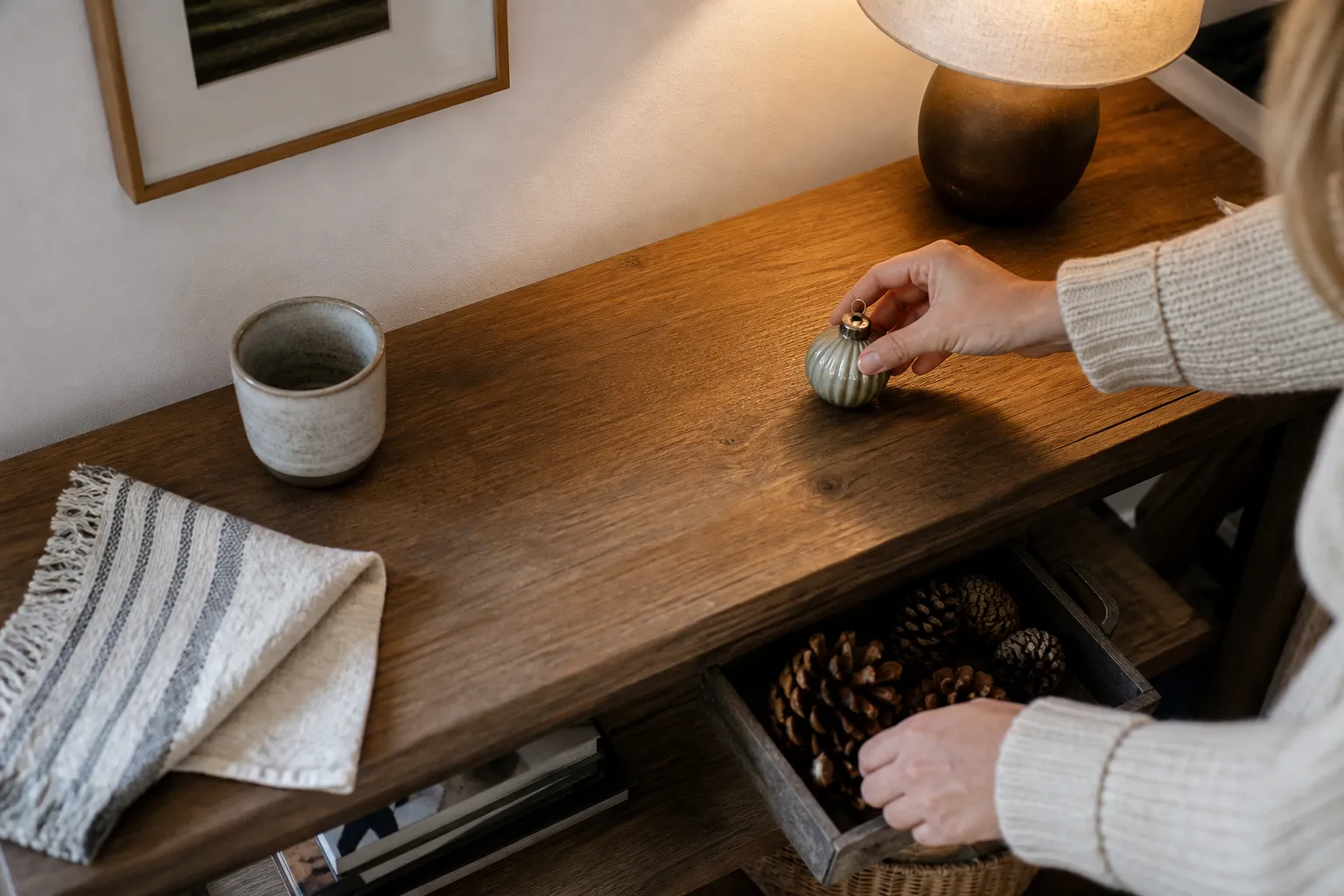
Keep the shift restrained. Bedding weight, one textile color, a bedside branch, or a warmer lamp tone may be enough. If you want a holiday note, keep it small: a card, a single ornament in a dish, or a ribbon on an existing object.
Tea corner, reading nook, or quiet shelf
The distinction can be especially clear. The seasonal layer might be a small textile, ceramic cup, tray, or branch. The holiday layer might be one symbolic object or temporary card. When the holiday passes, remove that specific signal and let the base continue to carry the season.
The Low-Clutter Rule: Swap Before You Add
The most useful holiday decorating limit is not a fixed number. It is a sequence: remove, then add.
Before bringing out holiday pieces, take away a few seasonal objects that fill the same visual space. If a winter branch is already tall and sculptural, do not place a second tall holiday object beside it unless the room has enough emptiness around both. If the sofa already has three cushions, swap one for a holiday cushion rather than adding a fourth.
This keeps the holiday decor differences visible. The room changes because the signal changes, not because every surface gains another layer.
Quick Test
- If the item works for most of the season, it belongs to the seasonal layer.
- If the item only makes sense for a specific observance or gathering, it belongs to the holiday layer.
- If it repeats the same color, shape, height, or message as something nearby, choose one.
- If the surface becomes harder to use, remove something before adding more.
- If the room still has clear surfaces and one main focal point, the edit is probably working.
Here, “calm” is a design description. It means visible breathing space, clear surfaces, and a manageable number of focal points.
Seasonal Is Not Less Festive
Seasonal decor is not automatically plain, and holiday decor is not automatically better. Seasonal decor can be rich, warm, colorful, and expressive. It simply works on a broader time scale. A deep indigo textile, persimmon-colored bowl, cluster of winter branches, or spring floral arrangement can feel generous without being tied to one holiday.
Low-clutter holiday decor also does not have to be minimal in personality. A single meaningful object can carry more presence than ten scattered ones. A family ornament bowl, handmade card line, small tabletop arrangement, or carefully placed wreath can feel complete when the surrounding room is edited.
The reverse problem is treating seasonal decor as a reason to keep adding. If autumn pieces are still out when winter pieces arrive, and then holiday pieces are added, the room may lose its structure. Seasonal decorating is a rotation, not a pileup.
It also helps to separate decoration from storage guilt. If a box contains items that no longer fit the home, the answer is not to display them all out of obligation. Some objects may be kept for memory, passed on, used only in certain years, or retired. The room should not have to carry every stored item at once.
Scope Note
This article stays with practical room logic: what changes, what stays, and how to keep a low-clutter home from feeling overloaded. No usable public sources were supplied for specific claims about electrical lighting, candles, dried greenery, ventilation, plant care, product durability, storage materials, or named cultural practices, so those topics are not treated as detailed guidance here.
If a decoration involves heat, flame, electricity, fragile materials, fresh or dried plant matter, children, pets, or a named cultural object with specific handling expectations, check reliable guidance for that exact item before treating it as casual styling. The core point here is narrower: seasonal decor is the longer background layer, holiday decor is the shorter specific layer, and a low-clutter home usually works better when one layer partly replaces the other instead of stacking endlessly.
A Simple Final Check
Stand at the doorway and look for three things: one seasonal base, one holiday signal, and enough open space around both. If you can name the main focal point quickly, the room is probably clear. If your eye jumps between many small objects, remove the weakest ones first.
For low clutter holiday decor, the strongest change is often not adding more. It is making the seasonal layer quieter so the holiday piece can be seen. Let the season set the room’s tone, let the holiday mark the moment, and let empty space remain part of the design.