Seasonal Home Decor Without Adding Clutter
Seasonal decorating gets frustrating when a room looks “finished” but becomes harder to live in. The entry table no longer holds keys. The dining table loses eating space. Shelves collect tiny objects. Storage bins multiply after every holiday.
Seasonal home decor without clutter is not about making a room bare. It is about choosing fewer seasonal cues, placing them where they do not interrupt daily use, and storing the rest so the next season feels easier, not heavier.
A calm seasonal room usually changes by editing first, then adding. One branch in a vase, a warmer textile, a small bowl of gathered objects, or a repeated color can mark the season more clearly than a dozen pieces spread across every surface.
broader context
Parent topic
Use the broader page when you need more context before this narrower page.
What Counts as Seasonal Decor Without Clutter
Low-clutter seasonal decor has three qualities: it is visible, contained, and easy to remove.
A seasonal object can be beautiful and still become clutter if it blocks a task. A garland that makes a shelf hard to dust, a candle group too close to paper, a bowl that takes over the entry drop zone, or a fragile keepsake placed where children or pets pass through may create more friction than atmosphere.
Use a practical test before anything stays out:
- Can the surface still do its normal job? A dining table should still allow plates, elbows, and serving dishes. An entry table should still receive keys, mail, glasses, and a bag.
- Can the room be cleaned without dismantling the display? Decor that traps dust behind many small pieces usually becomes neglected.
- Can the display be removed in five minutes? If undoing it requires a long session, it may be too complicated for ordinary seasonal rotation.
- Does every item have an off-season home? If not, the display is borrowing space from the future.
- Are heat, flame, cords, exits, and walkways clear? Seasonal objects often involve candles, lights, dry greenery, paper, fabric, and temporary wiring, so placement matters.
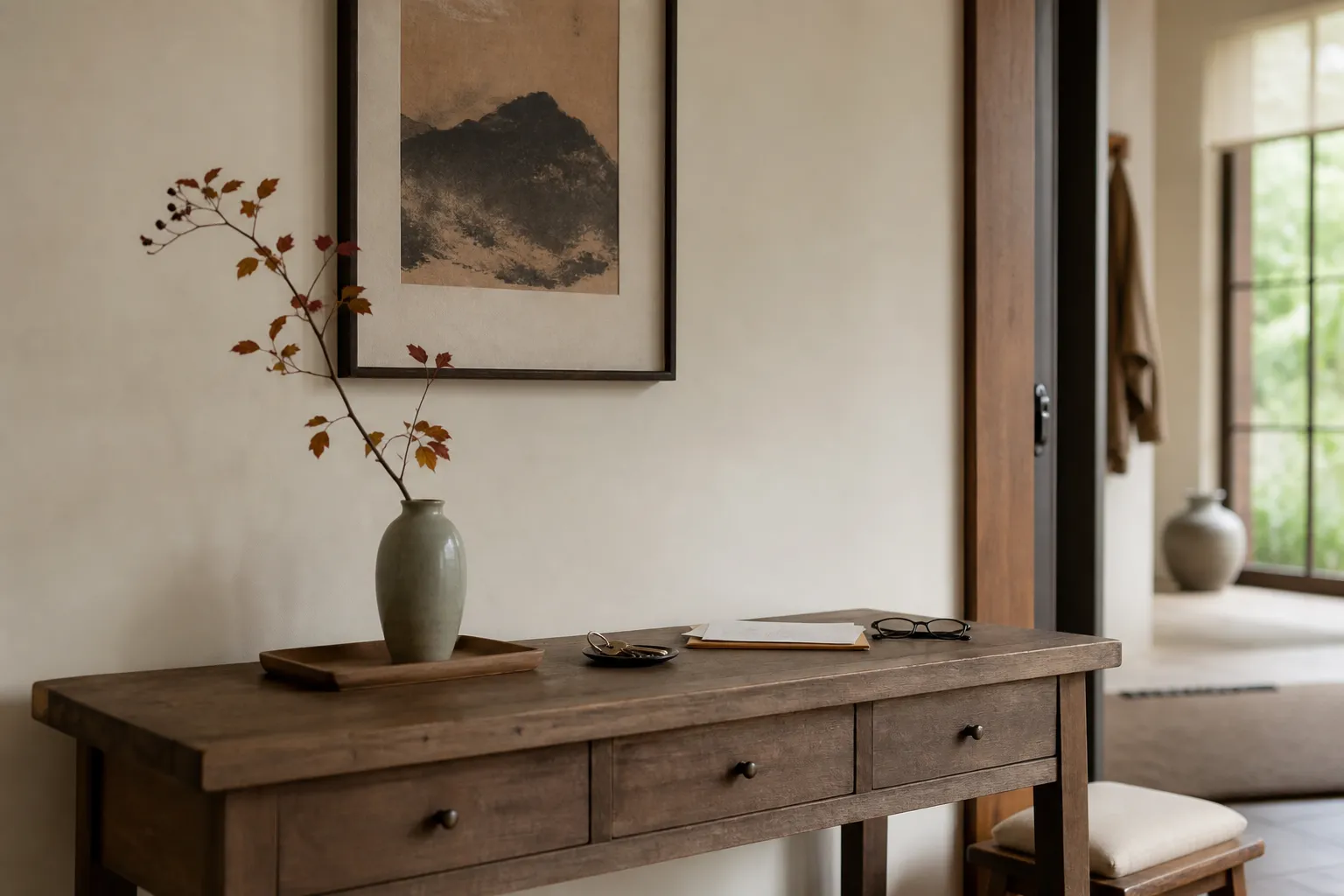
The Eastern-inspired part is not a costume or a strict rulebook. In practical room terms, it means letting empty space participate. A single vase on a sideboard can feel seasonal if the branch, flower, or textile nearby is chosen carefully. A tray with three objects can read more clearly than a shelf filled edge to edge. Restraint gives the eye somewhere to rest and gives the room back its normal use.
How Many Seasonal Decor Items Should Stay Out at Once
There is no universal number. A studio apartment, a family dining room, and a large entry hall do not carry objects the same way. A more useful limit is the number of seasonal focal zones.
For most rooms, one focal zone is enough. In a larger open-plan area, two may work if they do not compete.
A focal zone might be:
- an entry table;
- a mantel or open shelf;
- a dining table centerpiece;
- a tea tray or serving tray;
- a window ledge;
- a low bowl on a sideboard;
- a single wall hook with a wreath or textile.
Within one focal zone, group objects instead of scattering them. Three pinecones in a ceramic bowl are usually calmer than three pinecones placed separately across a shelf. One vase with branches is clearer than five small seasonal figurines lined across a console. A folded textile on a chair may carry the season without adding another object to a crowded surface.
| Room condition | Better seasonal choice |
|---|---|
| Small living room with limited surfaces | One contained tray, one textile swap, or one vase |
| Busy family entry | Wall-hung piece or narrow bowl that leaves the drop zone clear |
| Dining table used daily | Low centerpiece that can move as one unit |
| Open shelving | Replace one existing object instead of adding another layer |
| Room with pets or young children | Heavier, stable, non-fragile pieces placed above reach |
The count matters less than the interruption. Two large pieces can feel cluttered if they block movement. Ten small leaves in one shallow bowl may feel quiet if they are contained, dry, and easy to remove.
Seasonal Decorating by Swapping Instead of Adding
The simplest way to keep seasonal home styling from becoming accumulation is to swap categories instead of piling new items on top of old ones.
Start with a year-round base:
- a ceramic bowl;
- a wooden tray;
- a plain vase;
- a neutral textile;
- a lamp with warm light;
- a small basket;
- a tea tray;
- a simple hook or wall rail.
Then rotate what these base pieces hold or support.
In spring, a vase may hold fresh stems. In summer, the same tray may hold a linen cloth and a small bowl. In autumn, a ceramic bowl may hold leaves, nuts, or seed pods collected from outside, if they are clean, dry, and not prone to shedding. In winter, the same area may shift toward heavier cloth, darker wood, or a small arrangement of evergreen cuttings used with care.
This keeps storage lighter because the base objects stay useful all year. Only the accent layer changes.
Swapping also prevents the common mistake of decorating around decor that is already there. If a shelf already has books, a framed piece, a vase, and a lamp, do not add seasonal items to every gap. Remove one item first. Let the seasonal object take that place for a few weeks. When the season passes, return the original object or leave the space open.
A low-clutter seasonal swap can be as small as:
- replacing a bright cushion cover with a woven or deeper-toned one;
- changing the cloth under a tea set;
- placing one branch in an existing vase;
- moving a favorite ceramic bowl to a more visible surface;
- replacing a framed print with a seasonal card or textile;
- changing the contents of a tray from summer shells to autumn leaves.
The room changes because attention changes, not because every surface receives new inventory.
Simple Seasonal Decor for a Small Living Room
A small living room has little tolerance for decorative overflow. Seating, circulation, lighting, and working surfaces come first. Seasonal decor should attach to those priorities rather than compete with them.
A good small-room sequence:
- Clear the working surfaces first. Coffee tables, side tables, and media units often collect remotes, cups, books, chargers, and mail. Seasonal objects should not hide the fact that the surface is already full.
- Choose one vertical or contained area. A wall hook, narrow shelf, tray, or vase gives the season a boundary.
- Use scale instead of quantity. One taller branch arrangement may create more seasonal presence than many small objects.
- Repeat one cue. A warm rust cloth, a pale spring stem, a dark winter bowl, or a summer woven mat can repeat gently in one other place.
- Leave at least one visible pause. An empty section of shelf, a clear side table edge, or open floor around a chair keeps the room usable.
Avoid spreading seasonal miniatures across every ledge. Small objects multiply visual edges, make dusting harder, and are easier to knock over. If you like small found items, gather them in one bowl, tray, or lidded box rather than placing them one by one through the room.
Cords also need attention in small spaces. String lights, plug-in decor, and temporary lamps can quickly create tangles around seating and walking paths. Consumer product safety guidance commonly emphasizes checking decorative electrical products and using them as intended. In a decorating plan, that means not forcing cords under rugs, across walkways, behind unstable furniture, or into crowded outlets.
A small room often benefits from seasonal color more than seasonal objects. A single textile, pillow cover, tray cloth, or vase of flowers can carry the shift without adding another storage bin.
Seasonal Table Decor That Still Leaves Room to Eat
A dining table is not a display platform first. It is a working surface for meals, tea, homework, sorting, conversation, and sometimes food preparation. Functional seasonal table decor should move easily and stay low enough that people can see across the table.
A good table arrangement is:
- contained on one tray, runner, or shallow bowl;
- low enough for conversation;
- narrow enough to leave place settings clear;
- stable enough not to tip when the table is bumped;
- easy to lift away before a larger meal.
For a daily table, one tray is often better than a full tablescape. The tray might hold a small vase, a folded cloth, and a bowl of seasonal objects. When dinner needs space, the whole arrangement moves to a sideboard.
Candles need a stricter placement test. Fire-safety organizations such as the NFPA repeatedly point to candles, dry greenery, paper, fabric, and heat sources as materials that require care during seasonal decorating. In ordinary home terms: keep open flame away from anything that can catch, do not tuck candles into dried arrangements, and do not use a candle display where it will be forgotten, brushed by sleeves, reached by children, or disturbed by pets.
If you want the look of candlelight without managing a flame, choose the simplest option that suits the room. Battery-operated or plug-in alternatives still bring their own checks: batteries, cords, switches, timers, and storage.
A table should never become so styled that eating feels like an intrusion. If the display must be dismantled every time someone wants a bowl of soup, it is too elaborate for a daily table.
Natural Seasonal Decor From Branches, Leaves, and Small Found Objects
Natural seasonal decor works well in restrained rooms because it changes with place and weather. A branch, seed pod, stone, shell, persimmon, pinecone, or fallen leaf can show the season without introducing a themed object.
But natural does not automatically mean low maintenance.
Branches may shed. Leaves can crumble. Dried flowers collect dust. Pinecones and seed pods may carry dirt or small insects. Fresh stems need water and can mark wood if vases sweat or spill. Heavy branches can tip a narrow vase. Dried greenery belongs away from flame, hot lamps, vents, and cooking areas.
Before bringing found objects indoors, ask:
- Is it dry, clean, and stable?
- Will it shed onto a food surface, rug, or heater?
- Does it need a liner, bowl, or tray?
- Can it be composted, returned outdoors where appropriate, or discarded at the end of the season?
- Is it placed away from candles, hot lamps, vents, and cooking zones?
- Will children or pets treat it as a toy or snack?
A calm arrangement does not need many materials. One branch in a heavy vase, one bowl of leaves, or one stone and one flower on a tray may be enough. The more fragile or dusty the material, the shorter its display life should be.
This is where seasonal observation matters. A room does not have to announce a holiday to feel current. It can register a rainy month, a dry garden, the first cold evening, the color of fallen leaves, or the lighter cloths of summer.
Seasonal Shelf Styling Without Crowding Open Shelves
Open shelves become cluttered quickly because everything is visible at once. Seasonal shelf styling works best when it replaces, groups, and edits.
Before adding anything seasonal, remove one object from the shelf. This creates a real place for the seasonal piece. If the shelf still looks full after one removal, remove two.
Then choose one shelf level as the seasonal line. Avoid placing seasonal objects on every level unless the shelf is very large and sparsely arranged. A single repeated cue is enough: one color, one material, one shape, or one natural element.
Good shelf methods include:
- placing a small seasonal object inside an existing bowl;
- leaning one seasonal card or paper piece behind a ceramic object;
- replacing a vase’s contents rather than adding another vase;
- using one textile strip under a few objects;
- grouping small items on a tray so they read as one unit;
- leaving visible space around fragile pieces.
The Smithsonian Museum Conservation Institute’s public care guidance is designed for collection care rather than ordinary decorating, but its basic concerns translate well to reusable seasonal objects: dust, light exposure, pests, rough handling, and poor storage can damage materials over time. For a home shelf, that means avoiding sunny spots for light-sensitive paper or fabric, not stacking fragile ornaments loosely, and not letting seasonal items sit dusty for months after the season has passed.
A shelf should not become a place where seasonal objects go to be forgotten. If an object is too delicate to clean around, too meaningful to risk, or too awkward to store, display it briefly and intentionally.
Seasonal Entry Table Decor Without Blocking Daily Drop Zones
The entry is one of the hardest places to decorate because it already has a job. It handles keys, shoes, bags, mail, umbrellas, dog leashes, sunglasses, and last-minute objects leaving the house.
Entry table seasonal decor should be narrow, stable, and clearly separated from the drop zone.
A useful layout is:
- one small tray or bowl for daily items;
- one vertical seasonal element, such as a branch in a heavy vase or a wall-hung wreath;
- one low accent, such as a cloth, stone, ceramic piece, or small seasonal object;
- clear space at the front edge for hands and bags.
Avoid fragile or tippy displays at hip height. People move quickly through entries. Sleeves, backpacks, and grocery bags can catch on branches or garlands. If the entry is narrow, wall space may be better than tabletop decor.
This is also where holiday and seasonal decorating often get mixed up. A holiday display may be more symbolic, more colorful, and more temporary. Seasonal decor can be quieter and last longer: a winter branch, spring blossom, summer basket, or autumn bowl. In a low-clutter home, holiday items should still pass the same test: do they block the path, overload storage, tangle cords, or make the daily routine harder?
How to Use Seasonal Color Without Buying More Decor
Color is one of the lightest seasonal tools because it can come from objects you already use: textiles, flowers, food, books, ceramics, paper, or natural materials.
A longitudinal study of fall color preference found that people’s liking for leaf-related colors shifted during autumn in relation to seasonal environmental colors and associations. That does not create a decorating rule, and it does not mean everyone responds to color the same way. It simply supports a modest idea: seasonal colors are noticed in context.
At home, use this gently. You do not need a new palette each season. Choose one small color movement:
- Spring: clearer greens, pale blossoms, lighter cloth.
- Summer: straw, linen, water tones, bright fruit.
- Autumn: rust, ochre, brown, muted red, dried grasses.
- Winter: deeper wood, white paper, dark ceramics, evergreen accents.
The low-clutter method is to repeat one color in two places, not ten. An autumn rust cloth on a tea tray and a few similar leaves in a bowl can connect the room. A spring branch and a pale green cushion cover may be enough. If you already own ceramics, books, or textiles in seasonal colors, move them forward temporarily instead of buying new objects.
Color can also reduce the need for themed decor. A room does not need pumpkins on every shelf to suggest autumn. It may only need a warmer cloth, a brown ceramic bowl, and one branch.
What to Check Before Buying Seasonal Decor
Buying seasonal decor is easiest before you ask where it will live. That is how hidden seasonal clutter begins.
Before buying, ask:
- What will this replace? If the answer is “nothing,” it is an addition, not a rotation.
- Where will it be displayed? Name the exact surface, hook, shelf, or tray.
- Where will it be stored? If there is no off-season space, do not buy it yet.
- Is it easy to clean? Flocked, glittered, deeply textured, or very small items can be difficult to dust.
- Is it fragile in a useful way or a stressful way? Fragile pieces can be meaningful, but they need stable display and careful storage.
- Does it require flame, batteries, cords, hooks, water, or special handling? These are not reasons to reject it, but they change the decision.
- Will it still suit the room when the novelty fades? A quieter object often lasts through more seasons.
This buying check favors repeated use, natural materials, and good storage over novelty. It also avoids turning low-clutter home decor into a strict minimalist performance. Some objects carry family meaning, travel memory, craft, or seasonal tradition. The point is not to remove all sentiment. The point is to give important objects enough space to be seen, handled, and stored properly.
How to Store Seasonal Decor So It Does Not Become Hidden Clutter
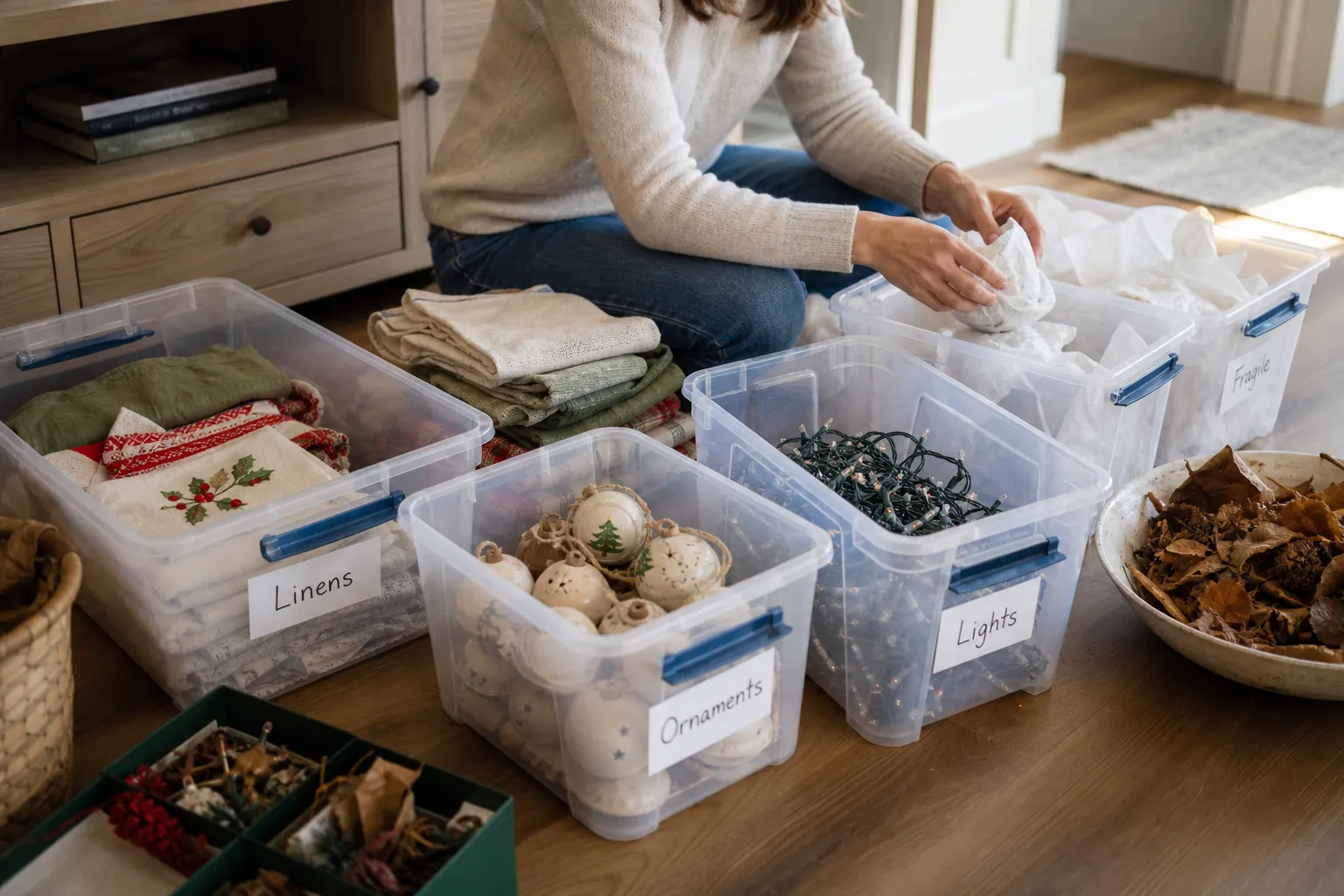
Seasonal decor becomes hidden clutter when it is stored without limits: mixed holidays in one bin, crushed garlands, tangled lights, loose fragile pieces, dusty textiles, unlabeled boxes, and objects kept only because they once cost money.
Storage is part of the decorating system, not an afterthought.
Use a simple end-of-season routine:
- Discard or compost natural materials that are no longer useful.
- Wipe dust from reusable objects before packing.
- Separate fragile items from heavy ones.
- Coil lights and cords without tight knots.
- Remove batteries from items that will sit unused for a long time, when appropriate for the product.
- Keep paper and fabric away from damp or pest-prone storage.
- Label bins by season, not just by holiday.
- Leave some empty space in each container so items are not crushed.
Museum-level care guidance is more exacting than most homes need, but the household lesson is useful: light, dust, pests, moisture, and repeated rough handling can shorten the life of objects. A low-clutter seasonal system protects what you already own so you do not keep rebuying replacements.
A helpful storage limit is one container per season, or one shelf per season, depending on home size. If autumn needs three bins but only one small table is decorated, the storage is out of proportion to the display. Edit before packing: keep the pieces you actually use, the ones that store well, and the ones that carry real meaning.
The cleanest seasonal rooms are often not the rooms with the fewest objects. They are the rooms where every seasonal object has a reason to be out, a place to rest, and a way to return.