Cleaning Around Low Living Room Furniture: What to Check Before Buying
A low sofa can sit quietly in a room yet leave dust beyond the reach of your usual tools. Before buying, compare the furniture with the cleaning method you already use.
For effective cleaning around low living room furniture, check three things: the gap below the lowest obstruction, the passage between legs or panels, and whether your tool can reach the center and back.
Do not rely on seat height, visible leg height, or the phrase “low-profile.” Inspect the complete underside, including rails, braces, fabric, supports, and hardware. If your tools cannot cover the floor beneath it, decide whether the piece can be separated or repositioned occasionally according to its handling instructions and your flooring requirements.
broader context
Broader context
Use the broader page when you need more context before this narrower page.
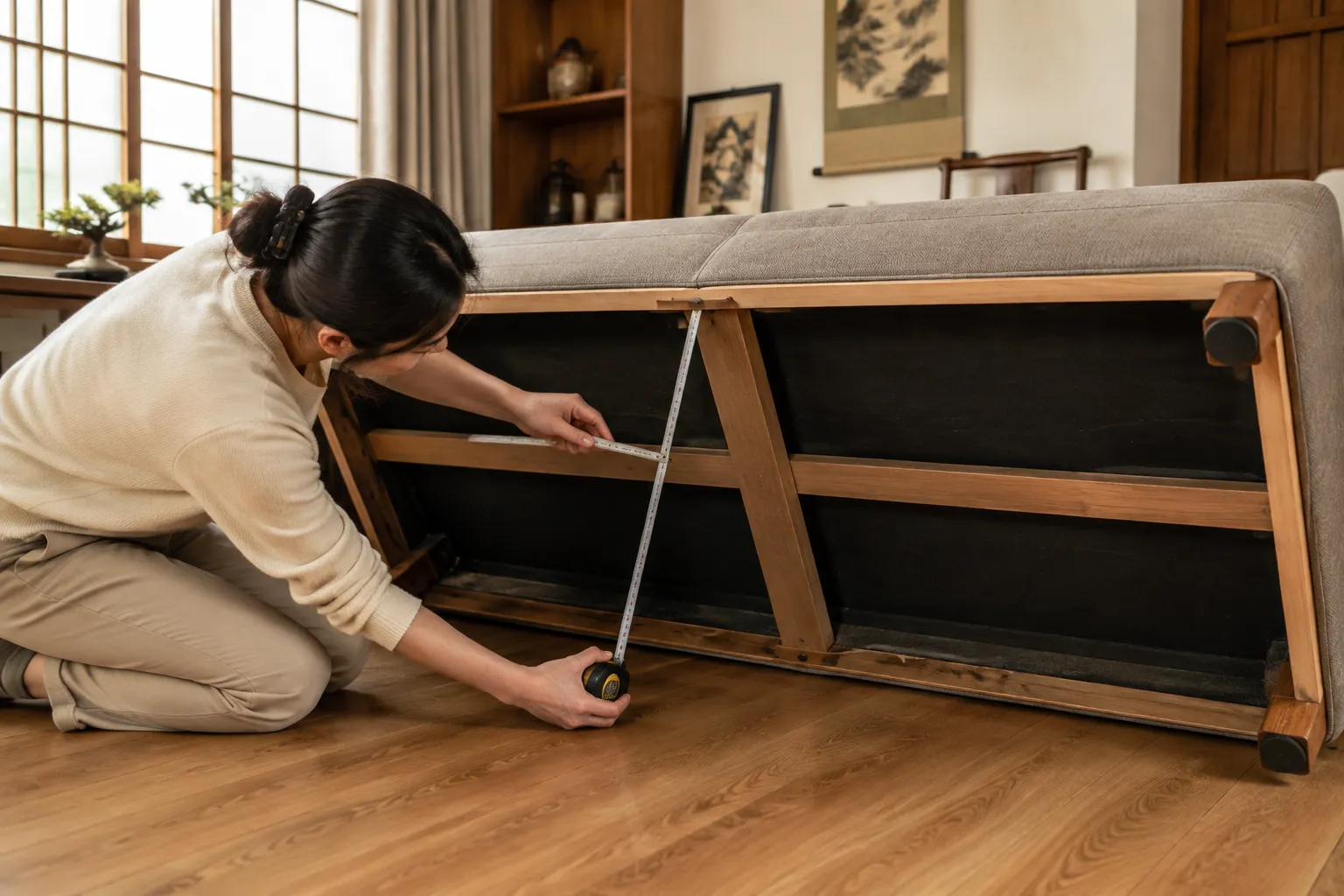
Measure the whole route beneath the furniture
Useful clearance is the distance from the floor to the lowest obstruction anywhere under the piece. The front rail may look high enough while a center support, cross-brace, reclining mechanism, skirt, motor, or section of loose fabric hangs lower.
Check the full footprint, from front to back and side to side:
| Check | What to measure | What can block access |
|---|---|---|
| Vertical entry | Floor to the lowest obstruction | Rails, braces, hardware, skirts, loose fabric |
| Horizontal passage | Clear width between legs, panels, and supports | Closely spaced legs, center supports, narrow side openings |
| Full-depth reach | Entry edge to the center or back | Deep frames, short handles, rigid hose angles, nearby walls |
A tool can pass one check and fail the next. A vacuum head may slip under the front rail but be unable to turn between the legs. A flat duster may reach halfway under a deep sofa while leaving dust around center supports.
Measure the cleaning tool itself before evaluating the furniture. Note the working head’s highest point, width, handle angle, reach, and ability to lie flat. A thin head can still stop at the frame if its joint or handle rises sharply as it moves forward.
For an online purchase, request
- The floor-to-lowest-obstruction measurement
- A clear photograph of the underside
- A drawing that shows rails, braces, and center supports
- The spacing between legs or base panels
- The overall front-to-back depth
- The assembled weight and whether sections detach
- Instructions covering movement, floor contact, and powered mechanisms
If these details are unavailable, treat access beneath the furniture as unknown. “Low-profile” describes appearance or seating height; it does not confirm a clear cleaning route.
Test the method you normally use
The useful question is not whether a specialized tool might fit. It is whether your usual method can cover the area without repeated awkward lifting or repositioning.
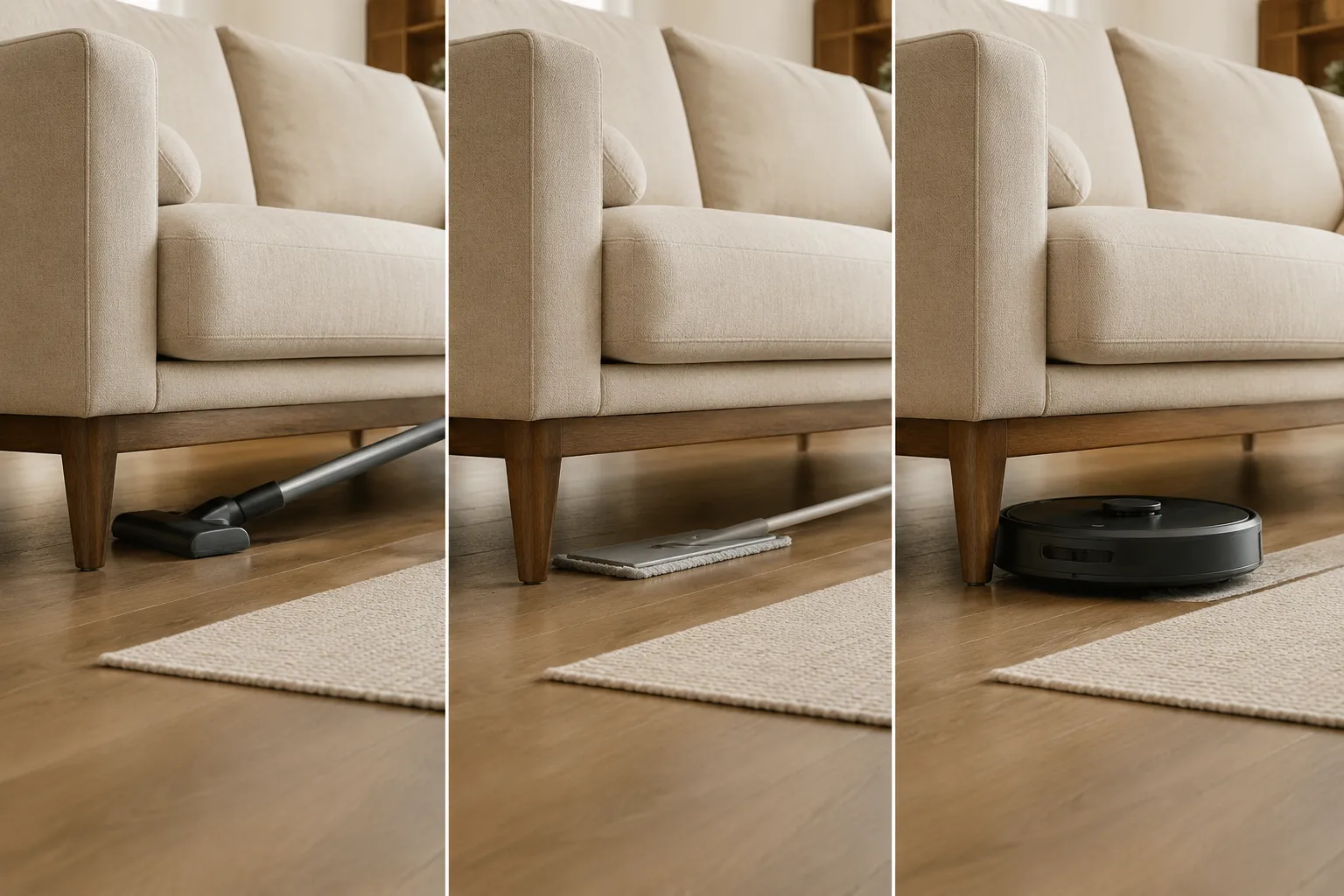
Low-profile vacuum head
Measure the entire head, including raised joints and hose connections. Place it flat on your floor and move the handle through its normal working angle. Check whether it can enter, turn, and travel the full depth beneath a surface with similar clearance.
A long hose can extend your reach, but the attachment still needs a workable angle. A nearby wall, side table, or rug edge may stop the handle before the head reaches the back.
Flat duster
Measure the duster’s rigid frame, not only its compressible fibers. The frame must pass under the lowest obstruction, and the handle must reach across the complete footprint.
A flat duster can collect routine dust from an open underside, but spills and debris caught around feet, seams, or mechanisms may require fuller access. Dusting and complete floor cleaning are separate tasks.
Robot vacuum
Compare the opening with the exact robot’s total height, including any raised sensor housing. Then consult that model’s manual for required operating space and setup conditions. There is no supported universal sofa-clearance figure, so a general rule should not replace direct measurements.
Robzone’s setup material demonstrates the basic process: measure the machine at its highest point, compare that measurement with the opening, and inspect the surrounding route. Its numerical guidance belongs to its own product context and should not be applied to every robot.
Height alone does not establish coverage. Consumer Reports notes that furniture legs, cables, rug details, clutter, low objects, and tight layouts can interfere with navigation or require intervention. Edges and inaccessible sections may still need another tool.
Before relying on a robot, inspect the route
- 01Can it enter from more than one side?
- 02Is the passage wide enough between legs and center supports?
- 03Are cables, tassels, or loose objects in its path?
- 04Does a rug edge interrupt the approach?
- 05Could the machine become confined behind a rail or narrow opening?
- 06Can its brushes reach the floor beside the legs?
“Slim” and “obstacle avoidance” are shopping terms, not measurements. Use the exact dimensions and instructions for the model under consideration.
Separate routine cleaning from occasional full access
Routine cleaning under a sofa may not require moving it. A suitable vacuum attachment, flat duster, or robot can collect ordinary debris when the underside is open. Spills, seams, edges, and material caught around supports may still require more complete access.
Decide how that access would work before purchase. Look for separable modules, removable skirts, open sides, or enough surrounding room for a different long-reach attachment. If a heavy piece needs repositioning, use assistance appropriate to its weight and follow the furniture instructions.
Repeated lifting should not be the default plan
- Total weight and the weight of detachable sections
- Whether modules separate as described by the manufacturer
- Approved handling points
- Leg shape and load distribution
- Flooring instructions for movement and surface protection
- Compatibility of any proposed slider with the floor, load, and leg
- Cables, motors, reclining parts, or other powered components
- The clear path available for repositioning
Do not assume that dragging, tipping, or placing generic sliders beneath a sofa suits every furniture-and-floor combination. Powered or reclining pieces need particular attention because hardware and cables may be concealed below the frame. Follow the instructions for the exact model before moving it or reaching near those components.
Clean and inspect the floor before delivery as well. This will not solve future access, but it provides a clear starting surface and shows how the feet or base contact the floor.
Floor seating presents a related task. Removable mats, cushions, or textiles may expose much of the floor when lifted individually, while their undersides and perimeter seams still need care according to the material labels. Before buying, check whether each component is realistically removable and where it can be placed during cleaning.
Turn shopping language into measurements
Several common phrases sound useful without answering the maintenance question.
“Easy to clean” requires two separate checks: how the upholstery is maintained and how the floor beneath the piece is reached. Use the care label for the exact covering; an upholstery claim does not establish access underneath.
“Low-profile” should be translated into seat height, floor-to-frame clearance, underside construction, and an open or flush base. A flush base can block access beneath the main footprint while still allowing debris to gather along its edges.
“Raised on legs” does not necessarily mean easy access. Rails, center feet, narrow spacing, and a deep frame may still interrupt the route.
“No-move cleaning” should mean that a named tool can enter, turn, and cover the intended floor area in your actual room. Fitting beneath the first few inches of the front edge is not enough.
Evidence boundary
The available public sources are limited and weighted toward robot vacuums. Consumer Reports offers independent observations about navigation obstacles, while Robzone provides a manufacturer-specific measurement example. They do not establish a universal clearance, a preferred manual-tool shape, or one furniture-moving method for every floor. For the buying decision, direct measurements and exact instructions carry more weight than broad product language.
Before ordering, compare your tool’s complete dimensions and reach with the furniture’s lowest underside point, narrowest passage, and full depth. Then identify how you will reach edges and trapped debris occasionally. The object earns its place by use and care; the final check is whether your own tool can complete the route.