Small Teapot or Large Teapot for Everyday Loose-Leaf Tea
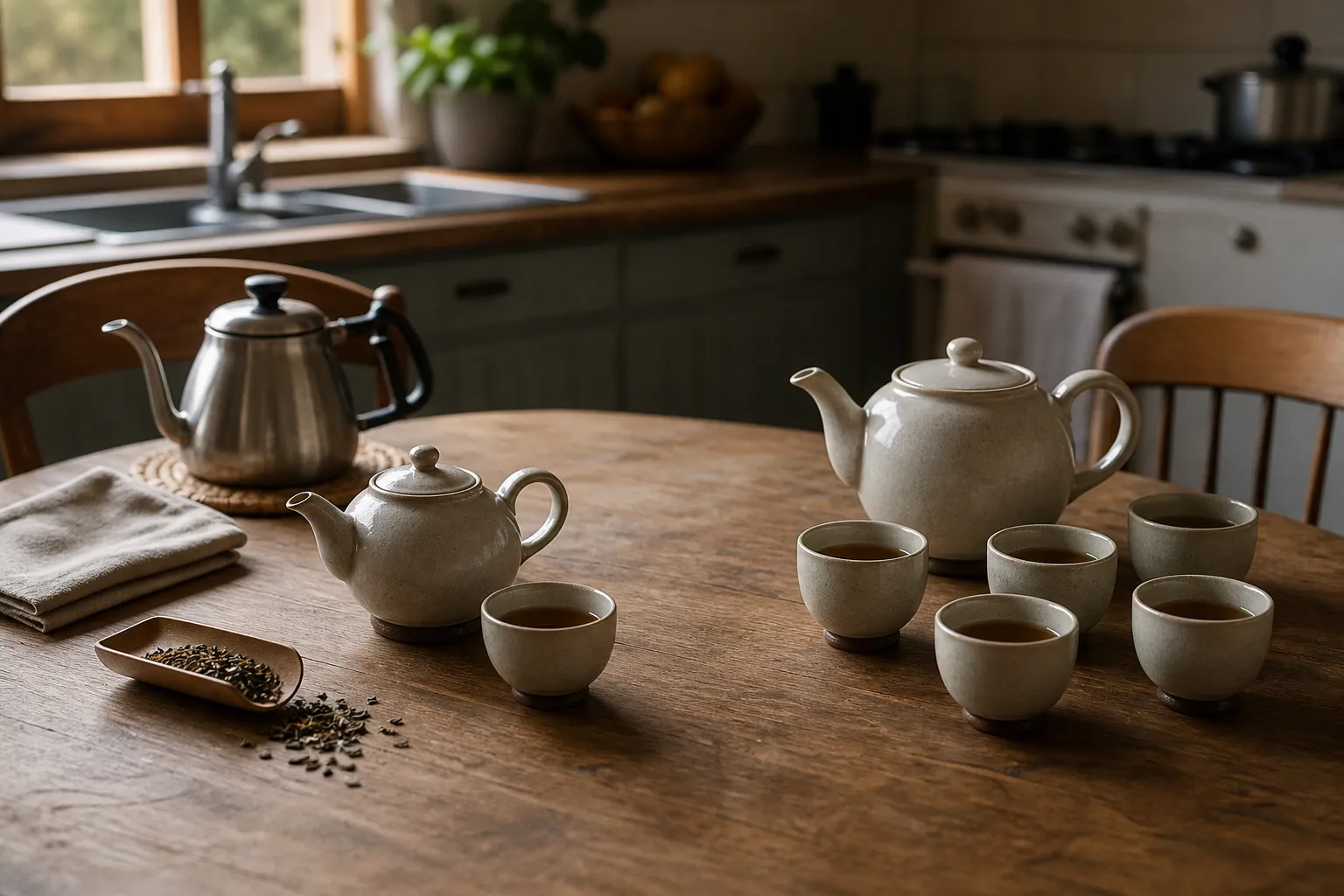
For most everyday loose-leaf tea, a small teapot is the better daily choice if you usually drink alone or with one other person, finish tea slowly, or like making repeated fresh steeps. A large teapot makes more sense if you often serve guests, want one shared pot at the table, or drink several cups before the tea cools.
The practical answer to small vs large teapot is not “which size is better.” It is: choose the pot that matches the number of cups you actually pour and finish.
If you are unsure, start with the smallest teapot that comfortably serves your normal session while still giving the leaves and strainer enough room. A pot that is easy to empty, rinse, and store will usually be used more often than a beautiful larger pot that sits half full.
broader context
Parent topic
Use the broader page when you need more context before this narrower page.
Match the teapot to the session, not the shelf
A loose-leaf teapot does more than hold water. It affects how much tea you make, how much room the leaves have, how quickly the tea is poured, and whether the infusion keeps sitting between cups.
Brewing research usually treats tea strength and sensory quality as the result of several variables working together: tea type, leaf amount, water volume, temperature, steeping time, vessel, and number of infusions. That does not give us one universal household teapot size. It does explain why capacity changes the daily experience.
How many cups do you usually pour before the tea is no longer at its best for you?
If the honest answer is “one cup, maybe two,” a large teapot often makes more tea than the session needs. The tea may cool, deepen, or become stronger than you intended, especially if the leaves remain in contact with the water.
If the answer is “three or four cups, and they disappear quickly,” a small teapot may feel fussy. You may spend the session refilling and waiting instead of simply serving.
For daily use, the right teapot is the one that empties naturally.
When a small teapot works better
A small teapot is usually the better fit when the tea session is quiet, short, and controlled. It suits people who care less about having a full pot on the table and more about keeping each pour fresh.
Choose a small teapot for daily tea if most of these are true:
- You usually drink alone or with one other person.
- You prefer one or two cups at a time.
- You like repeated fresh steeps.
- You drink teas where you often adjust each round, such as green tea, oolong, white tea, or Pu-erh.
- You want closer control over leaf amount, water volume, and steeping time.
- You dislike finding half a pot of cooled tea later.
- You have limited counter or cabinet space.
- You want a pot that is quick to empty and clean.
When a large teapot is more practical
A large teapot earns its place when tea is shared, poured quickly, or treated as a table drink rather than a close brewing session.
Choose a large teapot if most of these are true:
- You regularly serve three or more people.
- Your household drinks tea quickly once it is made.
- You want one pot on the table instead of repeated trips to the kettle.
- You use larger cups or mugs rather than small tasting cups.
- You often serve tea with breakfast, snacks, or dessert.
- You prefer one steady brew rather than many short rounds.
- You have space to wash and store a bigger vessel comfortably.
Small vessels are common in repeated-infusion tea practice, including many Chinese tea contexts. Some brewing studies also use small-volume vessels when looking at multiple rounds of tea. That does not mean every household needs to brew this way. It simply shows why a smaller pot can be practical: less water per steep, more chances to adjust, and less leftover tea.
The main advantage is control. If the first steep tastes too light, the next can be longer. If it is too strong, the next can be shorter or use slightly less leaf. A small pot makes that adjustment easy because each round is modest.
The drawback is serving rhythm. If two or three people want full mugs at once, a small teapot may feel too busy. It can also be a poor match for a large infuser basket that takes up most of the vessel and leaves little room for water to move around the tea.
The strength of a large teapot is ease. It gathers the session into one object: leaves, hot water, lid, handle, and cups around the table. For guests, this can feel calmer than preparing many tiny steeps while people wait.
A larger pot can also make sense for black tea, blended tea, or everyday teas brewed in a more familiar Western-style pattern: one measured amount of leaf, one pot of water, one shared serving. In that setting, the goal is not to study each infusion. It is to make enough tea for the people present.
The main caution is overcapacity. A large pot filled just because it is large can create tea you do not finish. Some teas become heavier, flatter, or more bitter if leaves remain in the water too long. Even when the leaves are removed, a big pot may cool before the last cup is poured.
So the better question is not “Can this teapot hold enough?” but “Will we drink this amount while it still tastes good to us?”
Practical size examples
There is no single official household chart for daily teapot capacity. Cup sizes vary too much. A small porcelain cup, a yunomi, a Western teacup, and a large mug all change the answer.
Still, these practical directions can help:
One person, small cups, repeated steeps
Better direction: small teapot. It works because there is less leftover tea and more control.
One person, large mug
Better direction: small to medium teapot. It gives enough for the mug without excess.
Two people, slow drinking
Better direction: small to medium teapot. It is easier to finish before cooling.
Two to four people at the table
Better direction: medium to large teapot. It means fewer refills and smoother serving.
Guests, breakfast, or dessert
Better direction: large teapot. It serves several cups at once.
Treat these as rules of thumb, not fixed standards.
A useful home test is to measure your real habit for a few days. Fill the cup you normally use with water, pour it into a measuring jug, and note how much you actually drink in one sitting. Then choose a teapot that matches that amount with a little working space above the liquid line.
Do not judge by maximum listed capacity alone. A teapot filled to the rim is awkward to carry, pour, and manage. For everyday use, comfortable brewing capacity matters more than the largest number on a product page.
Check the leaves and strainer before choosing
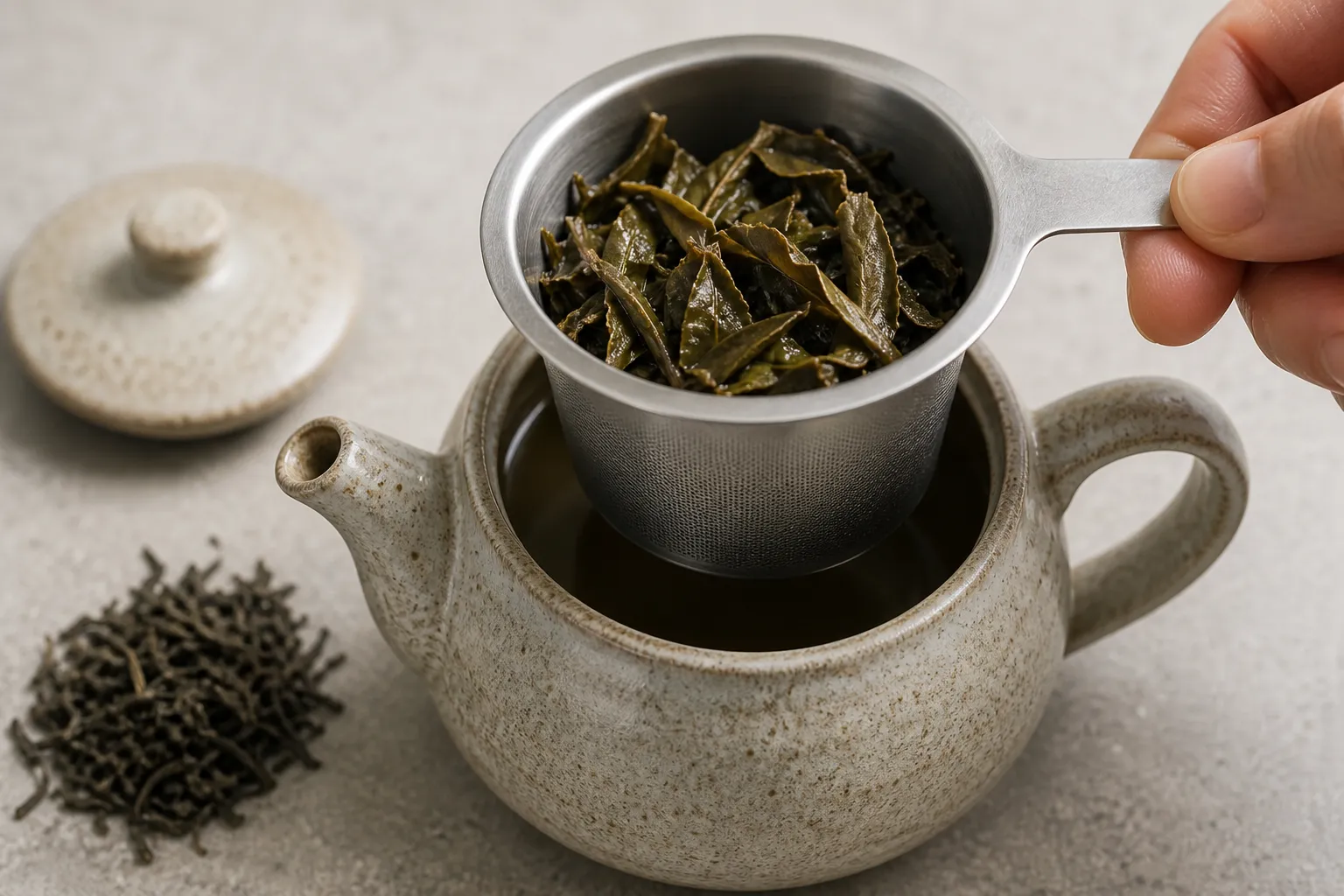
Teapot size is not only about how many people are drinking. It is also about whether the leaves can brew properly in the space provided.
Loose leaves need room to wet, loosen, and release flavor into the water. The amount of expansion depends on the tea. Rolled oolongs may open dramatically. Broken leaves need less room. Long white tea leaves can sit awkwardly in a small basket.
Before choosing a small or large teapot, check three things:
-
Does the strainer fit the tea you drink?
A tiny basket may work for small leaves but feel cramped for large, twisted, or rolled leaves.
-
Can water move through the leaves?
If leaves are packed tightly in a small metal insert, the teapot’s stated capacity is less useful. The tea may brew unevenly.
-
Can you remove or separate the leaves easily?
If leaves keep steeping in a large pot while you drink slowly, later cups may taste stronger than the first. A removable infuser, internal strainer, or separate serving vessel can change that experience.
This is why a slightly smaller teapot with a generous brewing area can be more useful than a larger pot with a cramped basket.
Heat, timing, and tea sitting too long
A larger teapot does not automatically keep tea better. A smaller teapot does not automatically make better tea. What matters is how quickly the tea is served and whether the leaves remain in the water.
Some studies comparing brewing vessels look at how vessel material and heat behavior can affect aroma or sensory qualities. For a home decision, the takeaway can stay simple: vessel choice and brewing conditions can change the drinking experience, but you do not need to turn daily tea into a technical project.
Observe your own table.
A large teapot is helpful when the tea is poured soon after brewing. It is less helpful when half the pot remains after everyone has moved on.
A small teapot is helpful when you want a fresh round. It is less helpful when it interrupts the table every few minutes.
If you often forget the pot after the first cup, choose smaller. If people keep asking for more before you sit down, choose larger.
Cleaning and storage count too
A daily teapot has to live in an ordinary kitchen: sink, dish rack, shelf, towel, cabinet door, and morning hurry. A pot that is beautiful but annoying to clean can quietly leave the routine.
For a small pot, check
- Can your hand, brush, or cloth reach inside?
- Is the spout easy to rinse?
- Does the lid feel stable when wet?
- Does the infuser lift out without scattering leaves?
- Is it too delicate for your normal sink habits?
For a large pot, check
- Does it fit under the tap?
- Does it fit on the dish rack?
- Is it heavy when full?
- Does it need a wide storage space?
- Will you hesitate to use it on an ordinary weekday?
Also handle hot water plainly and carefully: use a stable surface, avoid filling the pot to the rim, and follow the maker’s care instructions when they are available.
The best daily teapot is not always the most formal one. It is the one you can empty and clean without making tea feel like a chore.
Quick decision
Choose a small teapot if your normal tea life is one person, quiet cups, repeated fresh steeps, limited space, or a wish for closer brewing control.
Choose a large teapot if your normal tea life is shared cups, guests, breakfast table service, or several people drinking before the tea cools.
Choose a medium teapot if your routine changes often: alone on weekdays, two people in the evening, occasional guests. A medium pot is rarely the most precise choice, but it can be the most forgiving one.
If you already own both, do not assign them by status. Assign them by moment. Small for attentive daily loose-leaf tea. Large for company and quick shared serving.
The quiet test is this: after tea, is the pot empty, easy to rinse, and ready to return to its place? If yes, the size is probably right.
FAQ
Is a small teapot only for formal tea sessions?
No. A small teapot can be very practical for ordinary daily tea, especially if you drink alone, prefer fresh rounds, or do not want leftover tea sitting in the pot.
Is a large teapot better for loose-leaf tea?
Only when the amount matches the session. A large teapot is useful for guests or quick shared serving, but it can be too much for one slow drinker.
What if I use mugs instead of small cups?
Use your real mug size as the guide. One large mug may need a small-to-medium pot, while several mugs at a table may call for a larger one.
Should I buy one teapot or two?
If you are starting with one, choose for your normal day, not the rare occasion. If you often host, a second larger pot can be useful, but it does not need to replace the smaller daily one.