Tea Ceramic Types and How They Change Everyday Use
Choosing teaware often starts with a small irritation: one cup makes tea feel easy, while another makes the same drink feel too hot, too thin, too formal, or awkward to pour. The reason is rarely one feature. Tea ceramic types matter, but so do shape, rim thickness, glaze, volume, handle position, storage space, and how often you actually make tea on an ordinary day.
This guide treats teaware as a home object. The useful question is not “Which ceramic is best?” but “What changes when I use this piece every morning, rinse it after dinner, store it on a small shelf, and pour from it while half-awake?”
broader context
Broader context
Use the broader page when you need more context before this narrower page.
The main tea ceramic types and what you notice at home
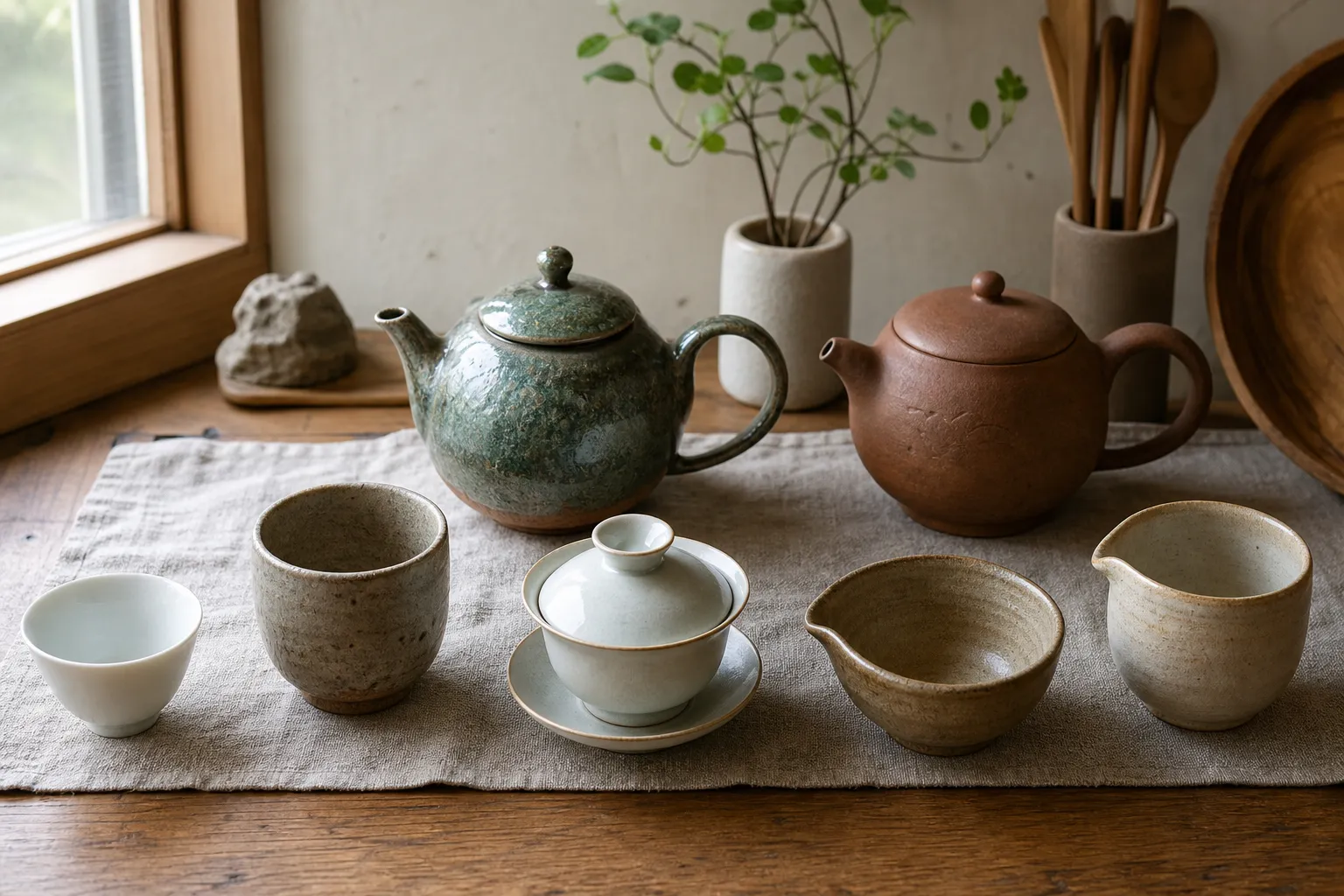
Most everyday ceramic teaware falls into a few practical families: porcelain, stoneware or pottery, glazed ceramic, and unglazed or semi-porous clay traditions. Market labels are not always consistent, so it helps to judge the object in your hand rather than rely only on the product name.
Porcelain is commonly described in ceramic research as a dense, vitrified material made with ingredients such as kaolin, feldspar, and quartz, fired at high temperatures. In teaware, that often translates into a hard, smooth surface and low water absorption when properly made and finished. For everyday use, porcelain cups often make tea color easy to read, suit a clean shelf, and rinse without much fuss.
Stoneware and pottery are broader terms. Some bodies are fired at lower temperatures than porcelain and may feel more substantial or textured. A glazed stoneware tea cup can be excellent for daily use, but it will not behave like a thin white porcelain cup. It may feel heavier, warmer visually, and more relaxed beside wood, linen, and soft kitchen light.
So “porcelain vs stoneware tea cups” is not a contest. It is a handling question. Porcelain may suit you if you value visual clarity, a smooth lip, and a lighter table setting. Stoneware may suit you if you prefer a grounded feel, a thicker wall, and a cup that looks natural outside a formal tea setup.
Glazed vs unglazed teaware: the surface is what you live with
The most useful ceramic distinction for daily tea is often not the clay name. It is the surface that touches the tea.
A glazed interior creates a smoother barrier between the liquid and the ceramic body. In ordinary use, this usually means easier rinsing, less visible staining, and more flexibility if you drink different teas from the same cup or pot. If you rotate between green tea, roasted oolong, black tea, and herbal infusions, glazed porcelain or glazed stoneware is usually the simpler choice.
Unglazed teaware is different. It is often valued for touch, surface character, and its place in particular tea practices, especially when a small vessel is used repeatedly with attention. The tradeoff is practical: unglazed surfaces can show use, hold scent, or ask to be used more selectively. Available research supports material and surface differences, but it does not support a blanket claim that unglazed clay always makes tea better.
A practical home rule
- Choose glazed teaware if you want one flexible set, easy rinsing, and lower-maintenance daily use.
- Choose unglazed teaware if you enjoy slower preparation, can dedicate pieces more narrowly, and accept visible aging.
- Be careful with old, unknown, cracked, or decorative-only ceramics. If a piece was not made or sold for drinking use, do not assume it belongs in regular tea service.
Market language can blur this decision. Words such as “mineral,” “ancient,” “handmade,” or “traditional” may describe style, origin, or craft context. They do not tell you whether the piece fits your sink, shelf, grip, cleaning routine, or daily tea habit.
Tea cup shape changes what you notice
Research on teacup perception suggests that cup width, height, rim thickness, surface smoothness, and visual presentation can influence how people rate or expect tea. That does not mean a cup objectively transforms the liquid. It means the vessel changes the drinking situation: what you see, how close your nose is to the surface, how the rim meets the lip, and how the cup sits in the hand.
For home use, that is enough to matter.
Wide tea cup vs tall tea cup
A wide tea cup exposes more surface area. You may notice aroma sooner because your face is closer to the open surface, and the color is easier to observe. A wide, shallow cup also lets tea cool more quickly, which can be helpful if you sip while working or serving guests.
A tall cup feels more contained. It may hold heat longer depending on wall thickness and shape, but the stronger everyday difference is visual and tactile: the tea surface is less open, the grip may feel more mug-like, and the cup takes up less table width.
Choose a wide tea cup when you want openness, aroma access, and quick tasting.
Choose a tall tea cup when you want a compact footprint, contained sipping, or a familiar mug-like habit without using a full mug.
Thin rim or thick rim tea cups
Rim thickness is one of the easiest features to feel immediately. A thin rim can make tea feel more delicate and precise. It often suits smaller cups, porcelain, and teas you drink in short sips.
A thick rim feels steadier and more substantial. Some cup-perception studies connect rim thickness with sensory ratings, but for daily home choice the more reliable observation is tactile: thick rims slow the gesture down and make the cup feel less fragile.
If you are buying online, rim thickness is hard to judge from a front-facing photo. Look for side images, weight, capacity, and close-up shots. If buying in person, hold the cup at drinking angle. A beautiful cup that feels wrong at the rim rarely becomes a favorite.
Smooth surface or textured surface
A smooth cup feels clean, quiet, and easy to rinse. A textured or carved surface changes grip and visual presence. Some perception research connects surface texture with how people interpret taste qualities, but at home the immediate checks are simpler: does the texture feel pleasant when wet, and will it be annoying to clean?
Textured exteriors can be useful if your hands are often damp during tea preparation. Textured interiors need more caution because residue can be harder to rinse from uneven surfaces than from a smooth glazed interior.
Teapot shapes: body, handle, spout, lid, and pour
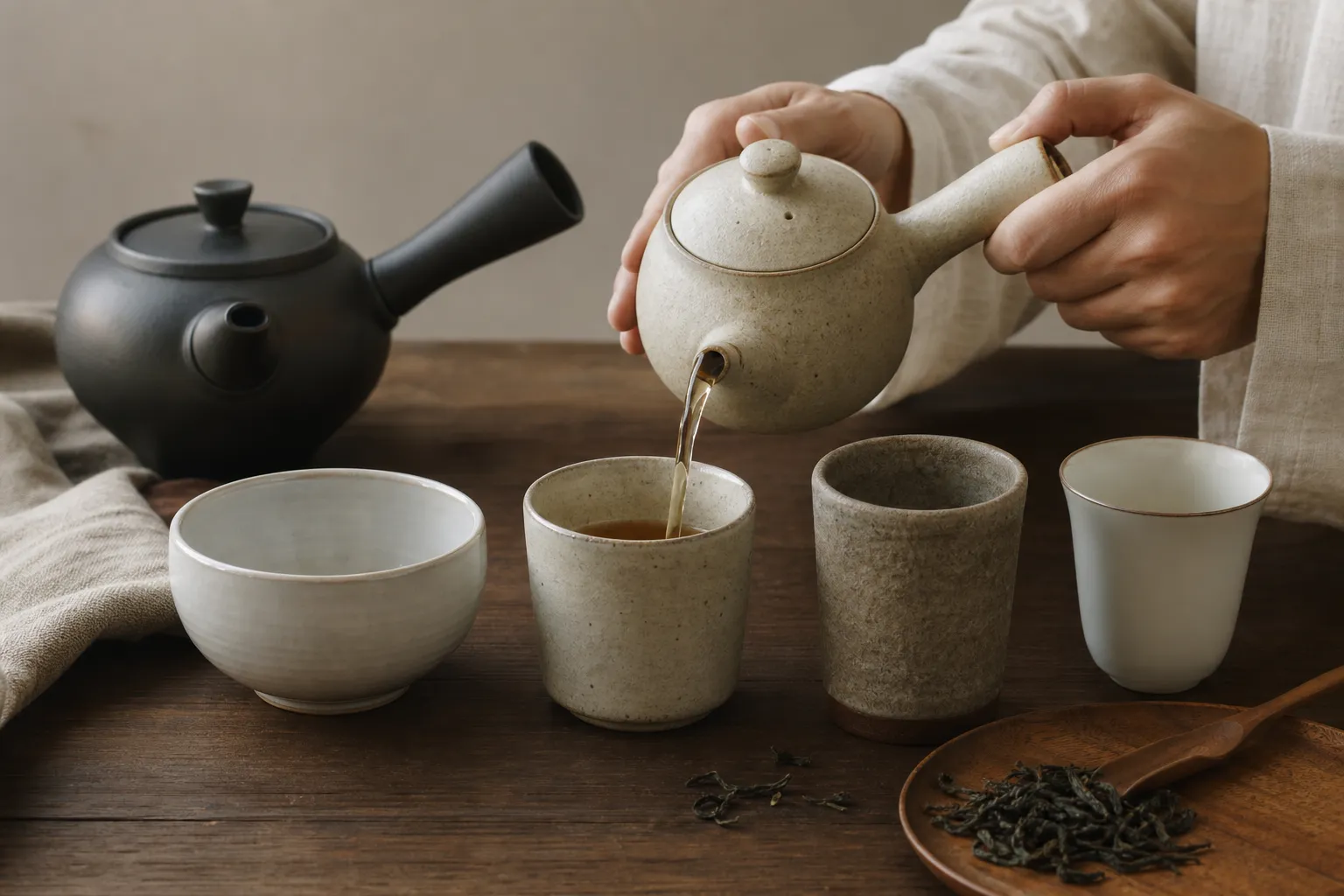
Teapot shapes are often described with poetic language, but daily use depends on a few observable parts: body, spout, handle, lid, opening, and volume. Design research on ceramic teapot forms often discusses roundness, proportion, classic styling, and visual harmony. Those qualities may influence preference, but they do not prove that one shape pours better in every kitchen.
The best teapot is the one that fits your tea amount, grip, sink, shelf, and pouring habit.
Flat teapot vs round teapot
A round teapot usually feels familiar and stable. It often gives a sense of fullness and visual softness. In a quiet room setting, round forms pair easily with wood trays, low cups, and warm lighting.
A flatter teapot has a lower profile. It may look more restrained on a tray and can feel deliberate for small-volume loose-leaf tea. But flatness also changes cleaning access, lid handling, and storage. If the opening is narrow, rinsing leaves out may be more annoying.
When comparing a flat teapot vs round teapot, check:
- Can you reach the inside easily enough to rinse leaves?
- Does the lid stay seated when you pour?
- Does the spout clear the body cleanly, or does tea run down the side?
- Does the shape fit the shelf where it will actually live?
- Does the pot feel balanced when half full?
The research base is stronger for shape vocabulary and preference cues than for confident claims about pour quality. Let the hand test decide.
Small teapot or large teapot for everyday loose-leaf tea
For everyday loose-leaf tea, volume is often more important than ceramic type. A small teapot encourages short steeps, less waste, and repeated infusions. It suits one or two people and a slower table rhythm.
A large teapot is easier when you want tea available without repeated pouring. It suits family breakfast, guests, or a desk pot. The tradeoff is that leaves may sit longer in water unless you decant fully, and a large pot can feel clumsy to rinse.
Kyusu teapot shape and the side handle
A kyusu is commonly recognized by its side handle, especially in Japanese tea contexts. The side handle changes the pouring gesture: instead of lifting from behind like a Western-style teapot, you rotate the wrist from the side. This can feel efficient when pouring small cups in sequence.
The side handle is not automatically easier for everyone. It depends on wrist comfort, dominant hand, pot weight, and where you sit in relation to the cups. If possible, mimic the pour before buying. Hold the empty pot with the lid on, angle it as if pouring, and notice whether your wrist or shoulder has to compensate.
For daily use, the kyusu teapot shape is most appealing when you prepare tea in smaller amounts and pour directly into one or more cups. It is less ideal if you want one large pot to sit in the center of a table for mixed users.
Gaiwan, teapot, shiboridashi, and fairness pitcher
Not every tea vessel solves the same problem. A gaiwan, teapot, shiboridashi, and fairness pitcher can all belong in a tea cabinet, but most homes do not need all of them at once.
What is a gaiwan used for in everyday tea?
A gaiwan is a lidded bowl used for steeping and pouring tea. In everyday use, it gives direct control: you can watch leaves open, adjust steeping time quickly, and pour out small infusions. It is especially useful when you enjoy loose-leaf tea as a short, repeated process rather than one long brew.
The tradeoff is handling. A gaiwan requires coordination between bowl, lid, and saucer or base. Very hot water, a thin wall, or an overfilled bowl can make it uncomfortable. For a beginner, a modestly sized gaiwan with a well-fitting lid and a rim that is easy to grip is more practical than an elegant but slippery one.
Gaiwan vs teapot
The gaiwan vs teapot choice is mostly about attention.
Gaiwan
A gaiwan suits tea sessions where you stand or sit close to the tray, pour often, and enjoy seeing the leaves. It is compact and versatile, but it asks for your hands.
Teapot
A teapot suits a more relaxed rhythm. You load leaves, add water, pour, and set it down. It is easier for guests and often easier for a household where different people use the same object.
If you want simple daily tea while reading, cooking, or answering messages, a small glazed teapot may be easier. If tea itself is the pause, a gaiwan may feel more satisfying.
Shiboridashi vs gaiwan
A shiboridashi is a small, usually handleless vessel often associated with careful brewing of smaller amounts of tea. Compared with a gaiwan, it tends to feel lower, quieter, and more specialized. It may have a simple lid and a pouring edge or grooves rather than a pronounced spout.
The shiboridashi vs gaiwan difference is not about status. It is about gesture. A gaiwan is more general and often easier to adapt across teas. A shiboridashi can feel intimate and precise, but may be less forgiving for fast household use.
If you are buying your first small brewing vessel, a gaiwan is usually the more flexible learning object. If you already enjoy small pours and want a lower, more tactile form, a shiboridashi can make sense.
Fairness pitcher in tea
A fairness pitcher, sometimes called a sharing pitcher, receives tea after brewing and before serving. Its main everyday purpose is consistency: tea from the first second of a pour and the last second of a pour can differ in strength, so decanting into one pitcher helps make each cup more even.
You do not always need one. If you brew directly into one cup, skip it. If you use a teapot for two or more people, or if you make short infusions from a gaiwan, a fairness pitcher can make serving cleaner. It also keeps leaves from continuing to steep in the brewing vessel while people are still drinking.
A practical buying frame: judge the piece before the story
Many teaware descriptions lead with origin, craft language, or tradition. Those can be meaningful, but they should not replace basic checks. A tea object must first work in your room and your hands.
Before buying, ask:
- How many people will use it most days?
One person does not need a large teapot unless they like keeping tea on the table. Two or three people may benefit from a pot and fairness pitcher. - Do I want one flexible set or dedicated pieces?
Glazed porcelain or glazed stoneware is easier for mixed tea habits. Unglazed clay makes more sense when you are willing to use it selectively. - Can I clean it without special effort?
Look at the opening, spout, lid seat, foot ring, and interior surface. If leaves get trapped, daily use becomes less likely. - Does the rim feel right?
Thin rim or thick rim tea cups change the drinking gesture. This is personal, and it matters more than the product description. - Will it fit where tea actually happens?
A beautiful pot that needs a special tray, high shelf, or careful packing may remain unused. Measure cabinet height and tray width if space is tight. - Is the piece clearly intended for beverage use?
Decorative ceramics, vintage pieces of uncertain origin, or cracked glazes should be treated cautiously. For regular drinking, choose pieces sold for that purpose and follow the maker’s care instructions. - Does the object match your pace?
A gaiwan rewards attention. A teapot supports ease. A shiboridashi invites a small, focused session. A wide cup opens aroma quickly. A tall cup keeps the gesture contained.
The strongest everyday teaware choice is rarely the most specialized one. It is the piece that makes tea easier to prepare, pleasant to hold, simple to rinse, and natural to leave out.
Where people mix concepts up
A few common confusions make tea ceramics harder to choose than they need to be.
Material is not the same as shape.
Porcelain, stoneware, and clay describe body and surface tendencies. Round, flat, tall, wide, side-handled, and lidded describe form. A porcelain teapot can be awkward; a stoneware cup can be elegant.
Tradition is not a universal instruction.
Gaiwan, kyusu, shiboridashi, and purple sand-style vessels come from real tea cultures and should be treated with respect. But cultural context does not mean every home needs the same setup.
Perception is not the same as objective tea quality.
Cup shape, rim, surface, and presentation can influence how tea is noticed or rated. That is useful for choosing objects, but it should not be stretched into guaranteed results.
Small cups are not only decorative.
Small tea cups help with short infusions, shared rounds, and drinking tea while it is still at a pleasant temperature. They also slow the serving rhythm. If you want one large drink beside a laptop, they may feel impractical.
Expensive does not automatically mean easier.
A high-priced piece can still be too hot to hold, hard to rinse, too small for your habit, or too precious for daily use.
Simple starting combinations for a useful tea shelf
If you want a practical path without collecting too much, start with one of these combinations.
For flexible daily tea
- Glazed porcelain or glazed stoneware teapot
- Two medium cups with comfortable rims
- Optional fairness pitcher if serving more than one person
For small loose-leaf sessions
- Gaiwan or small teapot
- Two to four small cups
- Fairness pitcher
- Small tray or cloth for drips
For tactile, slower tea
- Unglazed or textured vessel used selectively
- Simple cups that do not compete visually
- Clear storage space so the piece can dry fully and be handled carefully
For the smallest kitchen
- One well-made glazed cup
- One small lidded brewing vessel or compact teapot
- No extra accessories until your habit proves you need them
The best tea ceramic types are the ones that stay in use after the first week. Let material guide expectations, let shape guide handling, and let your daily rhythm decide how much ceremony your home can comfortably hold.