Tea ceramics decision guide
Handmade Tea Ceramics: Texture, Grip, Heat, and Care
A handmade cup can look right on a tea tray and still feel wrong in the hand. The rim may be sharper than it appears, the glaze may turn slick when wet, the foot may rock, or the cup may hold heat in a way your fingers do not enjoy.
Handmade Tea Ceramics are better judged through contact than romance: lip, fingers, table, hot liquid, washing water, and storage shelf. That applies whether you are choosing tea cups, a clay teapot, a small pitcher, or deciding whether a crackled bowl belongs in daily use or on display.
Handmade means a human process and visible variation. It does not automatically mean better function, confirmed food use, or easier care.
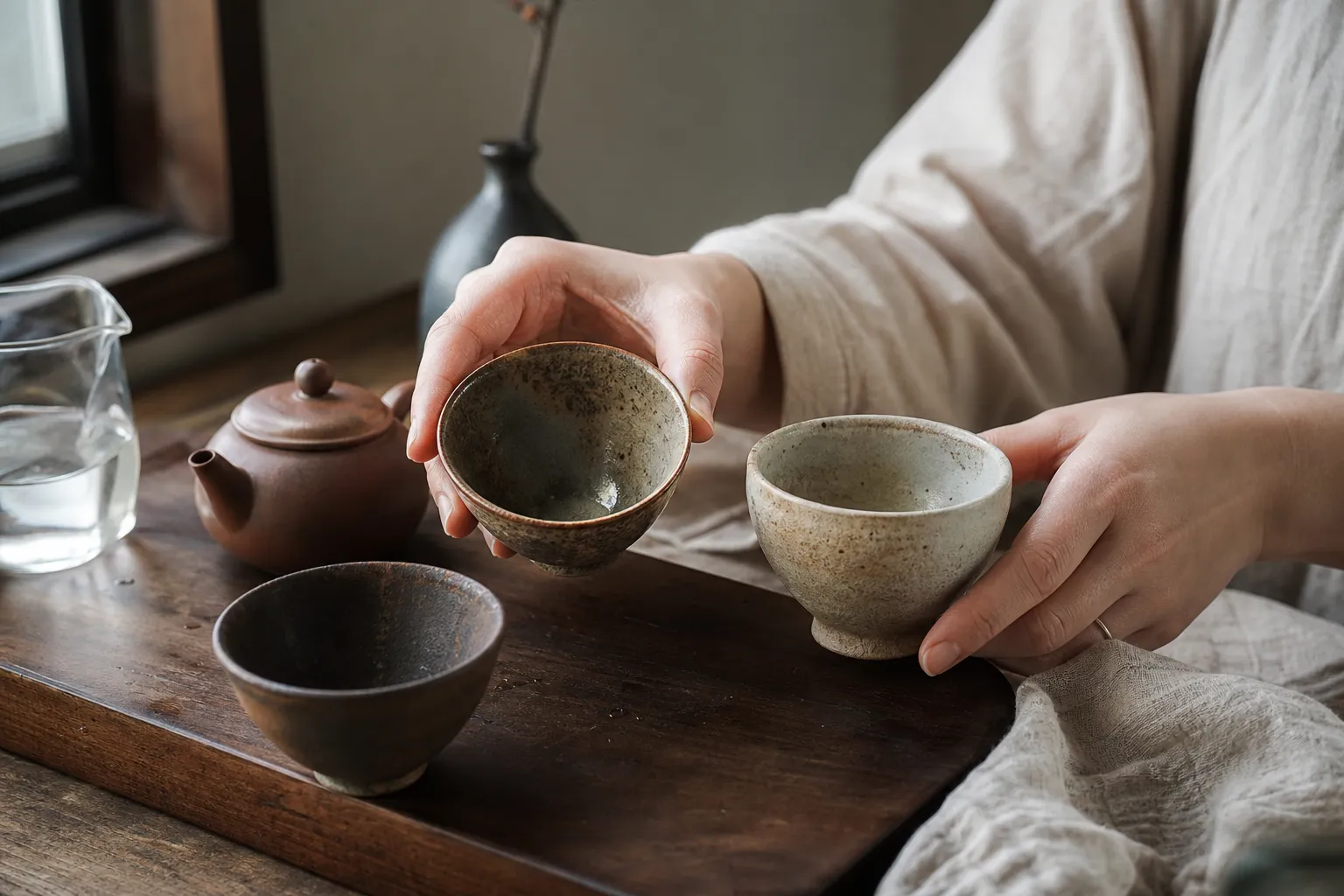
broader context
Broader context
Use the broader page when you need more context before this narrower page.
Judge handmade tea ceramics by use, not irregularity alone
The appeal of handmade ceramics often begins with small differences: a thumb mark near the foot, a softened rim, glaze pooling on one side, or a body that does not look machine-perfect. Those details can give a tea object warmth. They can also distract from practical problems if every irregularity is read as craft value.
A useful tea piece has to answer ordinary questions:
Does the rim feel comfortable against the lip?
Can the cup be held securely when warm?
Does the glaze feel good when dry and when wet?
Does the foot sit flat on a tray or low table?
Can tea residue be cleaned without forceful scrubbing?
Is the piece described as suitable for food contact and hot drinks?
Are chips, deep cracks, or worn glaze present where tea or the mouth will touch?
For tea cups and bowls, the rim is often the first real test. A thin rim can feel refined without feeling sharp. A thick rim can feel rustic without feeling clumsy. What matters is whether the lip lands comfortably, whether tea leaves the edge cleanly, and whether there are glaze beads, rough spots, chips, or exposed clay where drinking happens.
Wall thickness is another common source of confusion. A thick handmade tea cup may feel grounded and may slow cooling in some situations, but it can also feel heavy, blunt at the lip, or too warm around the fingers if there is no handle. A thin cup may feel elegant and responsive, but it may cool faster and feel more delicate in the sink. Neither choice is automatically better. The right answer depends on tea temperature, cup size, how quickly you drink, and whether you hold the vessel continuously or set it down between sips.
For a clay teapot, the same thinking shifts from lip contact to handling. A good-looking pot still needs a handle that suits your grip, a lid that sits reliably, a spout that is not easily knocked, and a body that can be cleaned according to the maker’s care notes. Small pitchers need similar checks: balance when full, comfortable pour angle, stable foot, and a rim that does not dribble more than you are willing to live with.
Texture: when glaze and clay help, and when they become a nuisance
Glaze texture is both visual and practical. A glossy glaze can feel smooth and easy to rinse, but it may become slippery on a small handleless cup. A matte glaze may feel quiet and tactile, but some matte surfaces hold tea film more readily or show staining sooner. A rough unglazed or partly glazed surface can improve grip, yet feel unpleasant at the lip or prove harder to clean with darker teas.
When evaluating handmade tea cup texture, separate the surface from the story around it.
Surface feature
What to notice in real use
Why it matters
Matte glaze
Drag under the fingers, tea staining, ease of rinsing
Tactile appeal should not make cleaning difficult
Glossy glaze
Slipperiness when wet, glare, pooled glaze
Smoothness may help cleaning but reduce grip
Crackled glaze
Fine visible lines, staining inside the lines, maker guidance
Crackle changes the cleanability judgment
Exposed clay
Roughness, absorption, contact with lips or tea
Texture can help grip but may not suit every contact area
Pooled or uneven glaze
Thick glassy areas, sharp drips, pinholes, rough edges
Variation is acceptable only if the object remains usable
Crazing is especially easy to misread. In ceramics language, crazing refers to fine cracks or a network of cracks in the glaze. Technical glaze references connect this to glaze fit: the glaze and clay body respond differently as they cool and as conditions change. That does not make every crackled piece unsuitable for use. It does mean crackle is not just a decorative word.
In a daily tea object, crackled glaze should prompt a closer look at staining, cleaning, maker instructions, and whether the piece is sold for food and hot-liquid use. Location matters too. A crackled exterior on a cup raises different practical questions from a heavily crackled interior that repeatedly holds tea. A decorative crackle pattern under a mature surface may be part of the maker’s design; a deep crack, a chip crossing the rim, or a line you can feel with a fingernail is a stronger reason to stop using the piece for drinking.
Texture should not be treated as proof of authenticity. Rougher does not mean more honest. Irregular does not mean better made. A quiet tea object can be handmade, tactile, and still cleanly finished where the hand, mouth, and tea meet.
Grip when warm: the hand test buyers often skip
Tea ceramics are not handled like display objects. They are picked up wet, warm, and sometimes with one hand while the other hand holds a kettle, tray, or cloth. Grip when warm is one of the most practical checks before buying or putting a piece into daily rotation.
For handleless tea cups, look at the whole hand path. Can your fingers find a natural resting place? Is the cup narrow enough to hold securely? Does the foot ring give your lower fingers control? If the wall is thick and the tea is hot, will you need to wait before lifting it? If the glaze is glossy, does it become slick when rinse water or condensation is present?
For handled cups, do not judge the handle by silhouette alone. Check finger space, angle, and balance. A handle that looks elegant may pinch the knuckle or force the wrist into an awkward tilt. A heavy cup with a small handle can feel unstable when full.
For a clay teapot, grip becomes more layered:
- The handle should feel secure when the pot is full.
- The lid should not shift easily during a normal pour.
- The knob should be usable without forcing fingers near steam.
- The spout should pour at a controllable angle.
- The body should not become so hot that the handle design feels misleading.
- The foot should sit flat enough that the pot does not rock while filled.
Clay teapot lid fit deserves special attention because handmade variation is normal, but looseness has limits. A lid can have slight movement and still be usable. If it rattles heavily, lifts during pouring, or requires one finger to hold it down in a way that brings the hand too close to heat, the pot may be better for careful occasional use than daily service.
Spouts are another weak point. A finely pulled spout may pour beautifully, but it is exposed during washing and storage. If you wash quickly, stack objects tightly, or keep teaware in a crowded cupboard, a delicate spout may not match your routine.
Heat retention is a tradeoff, not a single ceramic advantage
Ceramics are often described as heat-tolerant and durable, but the way a tea vessel feels with hot liquid depends on more than the word “ceramic.” Material, wall thickness, vessel size, shape, glaze, lid, handle design, and drinking pace all affect the experience.
Research comparing tea utensils has treated material composition, capacity, porosity, permeability, and heat behavior as variables that can influence brewing conditions and sensory impressions. That supports cautious comparison, not broad promises that handmade ceramics automatically improve tea.
For daily choice, think in situations.
Small, thin porcelain-like cup
A small, thin porcelain-like cup can suit tea poured in modest amounts and drunk promptly. It may let the hand sense temperature quickly and feel light at the lip. The tradeoff is that the tea may cool faster, and the cup may feel more fragile in a busy sink.
Thicker stoneware cup or tea bowl
A thicker stoneware cup or tea bowl may feel stable and hold warmth longer in some use patterns. It can suit slower drinking, especially when the cup is set down between sips. The tradeoff is weight, a heavier rim, and possible heat transfer to the hand if the form is handleless.
Lidded clay teapot
A lidded clay teapot behaves differently from an open cup. The lid, body volume, clay body, and wall thickness all shape how heat is held and released. A pot that keeps tea warm may also become uncomfortable to handle if the handle, knob, or pour angle has not been well considered.
Small pitcher
A small pitcher cools and pours differently again. If it is used as a fairness pitcher or serving vessel, the practical questions are balance when full, heat at the fingers, and whether the rim pours cleanly enough for your tray and cloth routine.
Because exact heat behavior varies by piece, avoid buying from vague promises alone. Ask concrete questions instead: Is the vessel meant for boiling water, near-boiling tea, or lower-temperature infusions? Does the maker recommend preheating? Are there warnings about thermal shock? Is it dishwasher or microwave suitable, or hand-wash only? If guidance is absent, avoid sudden temperature changes and use the piece conservatively.
Food-contact suitability: handmade is not the same as drink-ready
A ceramic object that looks like a cup is not automatically appropriate for drinking tea. Food-contact suitability depends on intended use, glaze materials and firing, decoration, condition, and information from the maker or seller.
Public food guidance from the U.S. Food and Drug Administration treats lead in some ceramicware as a real concern, especially with improperly made, imported, antique, damaged, or decorative pieces. This does not mean all handmade ceramics are suspect. It means beauty, age, and handmade status should not be used as proof that an object belongs in contact with hot tea.
A limited pilot study on ceramic mugs known to contain lead found measurable leaching into coffee and tea in some cases. The study was narrow and does not show how common that issue is across handmade teaware. Its practical lesson is modest: when a piece has uncertain materials, decorative status, damage, or no clear food-use information, make the decision at the object level rather than by appearance.
Before using handmade ceramics for tea, check:
- Is it sold as functional ware, not decorative-only?
- Does the maker or seller describe it as suitable for food contact?
- Is it intended for hot beverages?
- Are metallic overglazes, bright decorations, or painted surfaces placed where tea or lips contact?
- Is the piece antique, secondhand, imported without clear information, or from an unknown source?
- Are there chips, deep cracks, exposed decoration, or worn glaze inside the cup or on the rim?
- Are care notes provided, and do they match your intended use?
Decorative shape is not drinking permission
Decorative ceramicware is often misunderstood because many decorative objects borrow the shape of bowls, cups, and jars. If an item is marked decorative, ornamental, not for food use, or unclear, do not turn it into a tea cup because it “feels fine.” Use it for display, dry objects, or another non-drinking role.
Home “curing” or folk treatment should not be treated as a reliable way to make uncertain ceramicware suitable for tea. If the intended use is unclear, verify it or choose another piece.
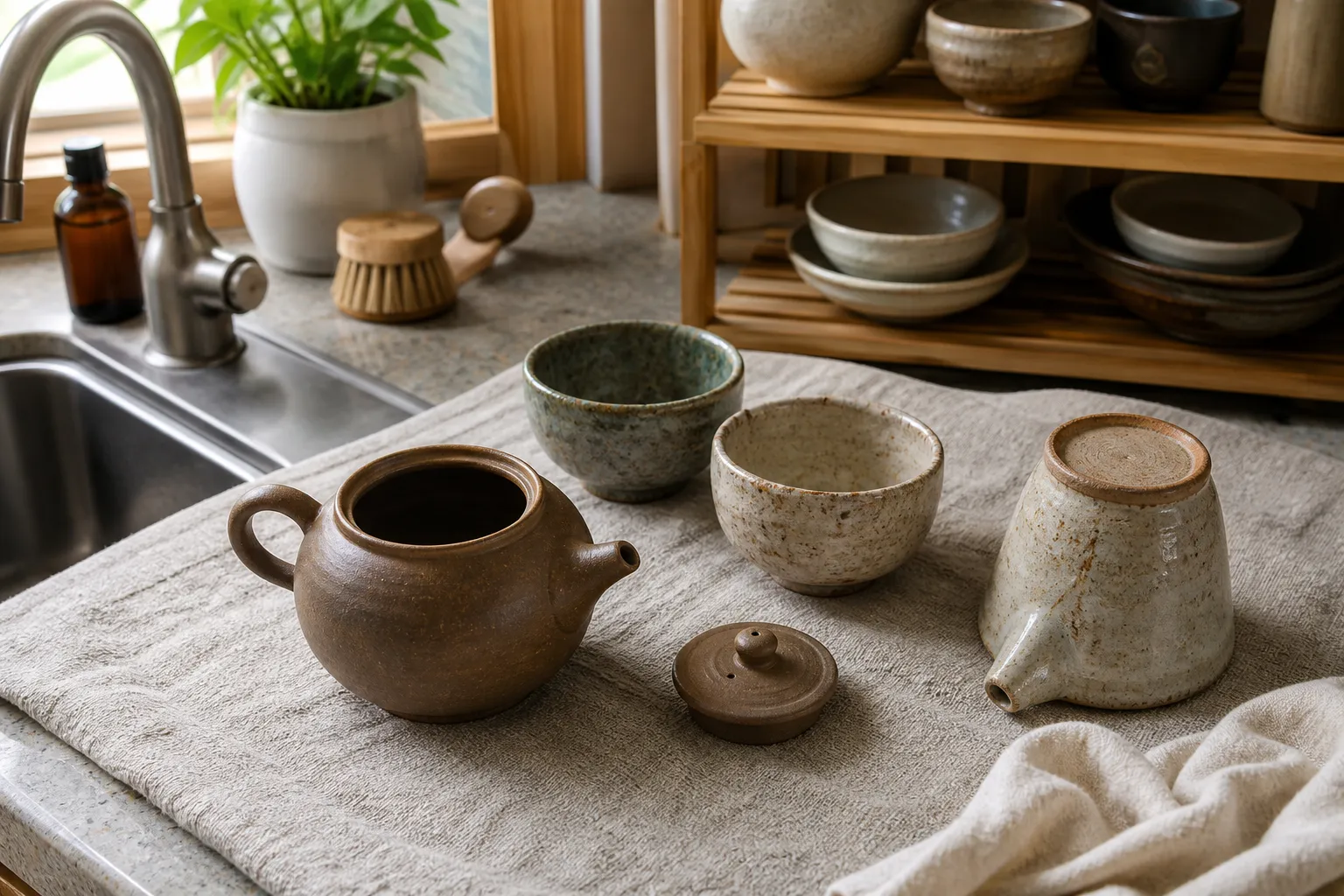
Handmade teaware cleaning and storage care
Good teaware care is usually quiet and consistent. Conservation guidance for ceramics and glass is more conservative than normal household use, but it supports a useful household principle: handle carefully, clean gently, dry fully, and store pieces so they do not knock against one another.
For everyday handmade teaware cleaning, start with the maker’s instructions. If none are available, hand-washing is the gentler default for delicate handmade pieces, especially those with lids, spouts, matte surfaces, unglazed areas, or applied decoration. Use warm water, a soft cloth or sponge, and mild dish soap when appropriate for the piece. Avoid harsh abrasives unless the maker specifically says the surface can take them.
Do not let fragile pieces collide in the sink. A chip often begins not during drinking but during washing: a lid against a faucet, a spout against another cup, a foot ring dropped onto a hard basin. Wash one delicate item at a time if needed. Set lids and strainers where they cannot roll.
Drying matters. A cup stored damp can develop odor or staining, especially if it has unglazed clay areas, a foot ring that traps water, or a fine surface texture. Let pieces air-dry fully before closing a cabinet. For a clay teapot, remove the lid while drying so moisture is not trapped inside. If the maker advises against soap for a particular unglazed teapot, follow that guidance, but still prioritize thorough rinsing and drying.
Storage should match the object’s weak points:
- Store lids with their pots, but not where they can rattle.
- Give spouts room so they are not the first point of contact.
- Avoid stacking handmade tea cups unless the foot and interior shape clearly support it.
- Place a soft divider between delicate pieces if they must be nested.
- Keep frequently used cups within easy reach rather than behind heavy dishes.
- Inspect rims, handles, spouts, and feet periodically.
Staining is a judgment call. Light tea color on an unglazed or textured surface may be acceptable to some owners, depending on the object and maker guidance. Dark residue in cracks, rough glaze pockets, or chipped areas is different. If you cannot clean a drinking surface without force, or if the surface continues to hold odor or residue, retire that piece from tea use.
A practical buying and use frame
When comparing handmade tea ceramics, do not begin with “best.” Begin with the role the piece must play.
Daily tea cups
For daily tea cups, prioritize rim comfort, stable foot, easy grip, cleanable glaze, and clear hot-drink suitability. A daily cup should not require careful negotiation every time you wash it.
Occasional tea bowl
For an occasional tea bowl, you may accept more weight, a more expressive glaze texture, or a larger form, as long as the lip, surface, and food-contact status still make sense.
Clay teapot
For a clay teapot, prioritize lid fit, handle comfort, pour control, spout durability, drying access, and maker care notes. A beautiful pot that is awkward to pour will stay on the shelf.
Display pieces
For display pieces, be honest about the role. Some ceramics are worth keeping because they are visually strong, culturally meaningful to the owner, inherited, or simply pleasing in a room. They do not need to be forced into tea service. Display is a valid use when food-contact suitability, condition, or cleanability is uncertain.
One slow pass before buying or using
- Look at glaze condition, cracks, chips, decoration, foot stability, and overall form.
- Touch the rim, handle, exterior texture, foot, lid, and spout.
- Imagine heat in the actual grip points, not just in the vessel body.
- Check use status through maker notes, food-contact statements, and hot-liquid guidance.
- Plan care before buying: washing, drying, storage, and how often the piece will be used.
- Assign the role: daily tea, careful occasional use, serving, or display.
The most useful handmade tea ceramics for a home are not necessarily the rarest, roughest, thinnest, or most dramatic. They are the pieces whose texture, grip, heat feel, glaze condition, and care needs match the way tea is actually made, held, poured, washed, and put away.