How to Create Return Places for Objects You Use Every Day
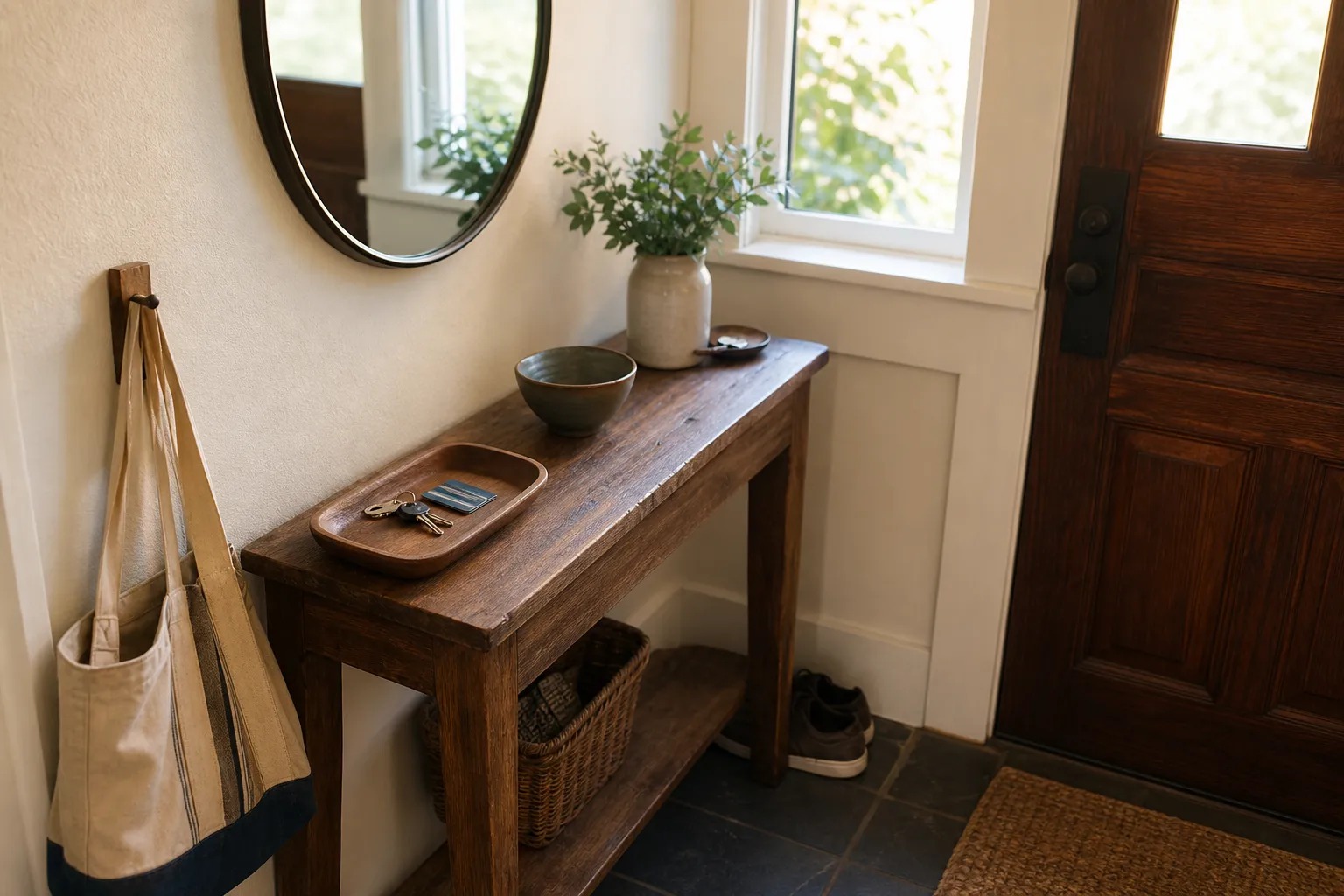
Create return places for everyday objects by choosing the spot where each item is actually used, set down, and remembered. Start with one thing that keeps drifting: keys, glasses, remote controls, chargers, tea tools, mail, cleaning cloths, or a daily bag. Give it a small, easy-to-reach place near its real path: a tray by the door, a bowl on a console, a hook beside the chair, a drawer near the kettle, or a basket where the clutter already gathers.
The best return place is not always the most elegant one. It is the place that makes putting the object back feel easier than leaving it loose.
A return place usually works when four things line up:
- the item sits near the task it belongs to;
- the spot is simple to reach;
- the tray, hook, drawer, or basket fits the category;
- the household can remember it without a complicated system.
If clutter comes back, treat that as information. The spot may be too far away, too hidden, too crowded, or assigned to too many kinds of objects.
broader context
Broader context
Use the broader page when you need more context before this narrower page.
Start with the object’s real path
Most misplaced everyday objects have a route. They move from door to hand, sofa to side table, kitchen counter to drawer, bathroom sink to bedroom, or desk to bag. Before buying new baskets or clearing a whole cabinet, follow the object for one ordinary day.
Ask:
- Where do I pick this up?
- Where do I use it?
- Where do I set it down when I am tired, carrying something else, or in a hurry?
- Where would another person in the household naturally look for it?
- Does it need to be visible, hidden, hanging, charging, drying, or protected?
Reading glasses may not belong in a bedroom drawer if reading usually happens in one chair. A small tray on the side table may work better. Keys may not need a polished box in a hallway cabinet if everyone enters through the back door and drops them on the kitchen counter. The return place should respect the actual entrance, not the formal one.
This is where a room often begins to feel more settled: not because every surface is empty, but because each surface has a clearer job. A narrow tray can hold three pocket items. A hook can receive one daily bag. A drawer divider can keep tea tools together near the kettle.
The available research for this page is indirect, but it supports a modest household observation: object placement depends on reach, task context, expected location, and personal preference. One human-robot interaction paper on household arrangement preferences describes factors such as practical fit, convenience for frequent use, grouping related items, and placing things where people expect to find them. That does not prove a home-organizing method, but it does explain why one universal storage rule rarely works for every room or family.
Choose a return form: tray, hook, drawer, basket, shelf, or station
“Put it away” is too vague for daily life. “Put the remote in the wooden tray” is easier. The form should match how the object is handled.
Keys, wallet, transit card
Better return form: small tray or bowl near the real entry point.
Why it works: visible, quick, and limited to pocket items.
Reading glasses
Better return form: side-table tray, small case, or shelf near the reading seat.
Why it works: close to use and less likely to be buried.
Remote controls
Better return form: low tray on the coffee table or side table.
Why it works: keeps one visible category together.
Phone charger
Better return form: charging point or cable clip near use.
Why it works: reduces cable wandering.
Tea scoop, strainer, lighter, cloth
Better return form: drawer, tray, or small box near the kettle or tea area.
Why it works: groups tools by task.
Cleaning cloths
Better return form: basket or caddy near the surface they serve.
Why it works: makes return part of the same task.
Mail or papers
Better return form: one shallow inbox near the entry or desk.
Why it works: keeps paper from spreading across surfaces.
Daily bag
Better return form: hook, bench, or open shelf near the leaving route.
Why it works: easier than a closed closet for frequent use.
The container should be just large enough. Oversized baskets invite mixed storage. Deep bowls hide small things. A tray with a clear edge can hold pocket objects without becoming a general dump. A shallow drawer works if the item does not need to be seen. A hook works for objects with a handle, strap, or loop. A shelf works when the object has a stable shape and needs air or visibility.
Keep categories small. “Keys, wallet, sunglasses” is a category. “Everything I bring in from outside” is usually too broad. “Tea tools” is a category. “Kitchen things I may need later” is not.
A return place can be beautiful, but beauty should not make it fussy. A lidded box may look quiet but fail if the item is used ten times a day. An open tray may be more visible but succeed because the hand can drop the object in one movement. For daily objects, ease usually matters more than concealment.
Put the spot near use, but not in the way
A landing place near use is not the same as clutter on the work surface. The return spot should sit beside the task, not on top of it.
In a kitchen, cooking oil may belong near the stove if it is used constantly, but not so close that it crowds the burner area or gets coated with splatter. Tea tools can live near the kettle, while a small tray or drawer keeps the counter from becoming open storage. Dish towels may need a hook where they can dry, while spare towels can live in a drawer.
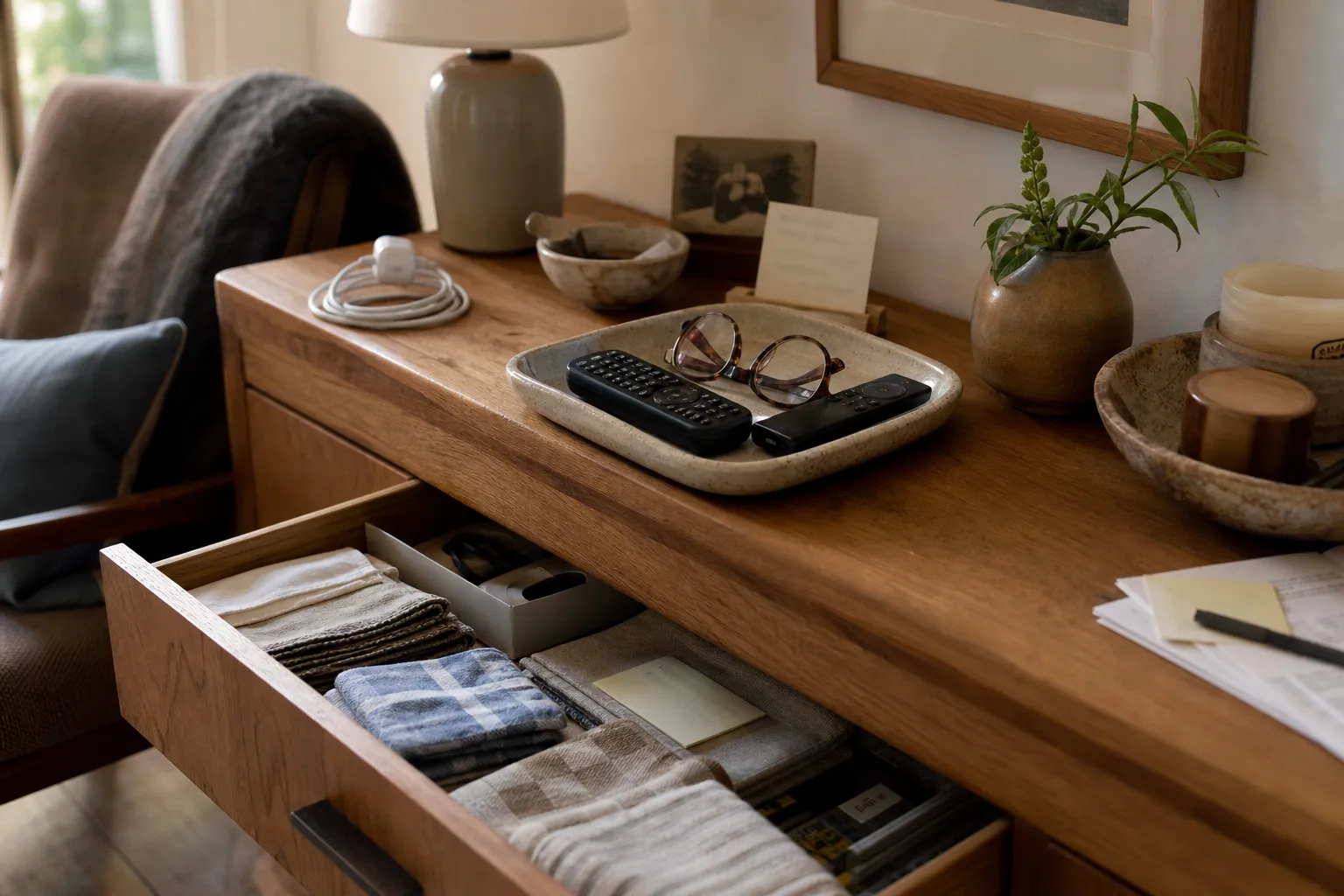
In a living room, remotes may return to a tray on the table, but the tray should not take over the whole surface. Glasses can sit beside the reading chair, but not under books or candles. A blanket basket can sit near the sofa, but if it blocks the walking path, people may start leaving blankets elsewhere.
In an entry area, keys and wallets need a reliable landing place, but the entry should not become the home for every receipt, tool, letter, and shopping bag. If the return place is for pocket items, keep it to pocket items. If mail needs its own place, give it a separate shallow tray or vertical sorter.
A useful test: can the object be returned with one hand, in two seconds, while standing where the task ends? If not, the spot may be too hidden, too high, too full, or too far from the actual route.
Use visible spots for daily objects and quieter storage for slower ones
Not every object needs to be visible. The right amount of visibility depends on how often the object moves.
Daily objects often need visible or semi-visible return places: trays, hooks, open shelves, charging stands, and shallow baskets. These are not signs of failure. They are active storage. A room can look calmer when visible items are gathered into intentional places rather than scattered across unrelated surfaces.
Weekly or occasional objects can live behind a door: cabinet shelves, drawers, boxes, or closets. They do not need prime reach space. If a slow-use object occupies the easiest place, a daily object will probably be left out. This is one reason “clearing clutter” does not always last: the best locations are sometimes given to things that rarely move.
Try sorting by movement:
- Moves many times a day: visible tray, hook, small open shelf, charging point.
- Moves once a day: drawer, basket, open cubby, dedicated shelf.
- Moves weekly: cabinet, closet, higher shelf, closed box.
- Moves seasonally: storage bin, upper shelf, deeper closet, labeled container.
This is not a strict system. It is a way to stop asking one drawer to hold every kind of object. Frequent objects need fast return. Occasional objects need stable storage. Decorative objects need room to be seen, not used as landing pads for everything else.
Research on personalized household cleanup also shows that people differ in where they believe objects belong. One person may see a shelf as the right place for folded clothing; another may expect a drawer. In a real household, the return place should be agreed on by the people who use the object most, not chosen only because it looks tidy in isolation.
Test the place for one week
A return place is only reliable after it survives ordinary behavior. Set it up lightly first. Use a tray you already own, an empty bowl, a spare basket, a hook, or a temporary drawer section. Then watch what happens for a week.
The place is working if
- the object returns there without repeated reminders;
- the spot is easy to see or remember;
- nearby surfaces stay clearer;
- the category does not expand too quickly;
- other household members can find the object there;
- the container is not annoying to open, move, or clean around.
The place needs adjustment if
- the object lands one surface away from the assigned spot;
- the container fills with unrelated items;
- people keep searching in the old location;
- the spot is too hidden for a daily item;
- the object needs charging, drying, or protection that the place does not provide;
- the return place blocks a normal movement path.
When clutter returns, read the pile. If keys keep landing on the counter instead of the entry tray, the real entry path may end at the counter. If mail spreads across the dining table, the first mail stop may be too far from where envelopes are opened. If chargers migrate to the sofa, the charging point may not match where devices are actually used.
Small changes often solve more than large reorganizations. Move the tray a little closer. Put the hook at shoulder height. Change a deep basket to a shallow one. Split one mixed drawer into two categories. Bring the return place closer to the last point of use.
Common confusion: storage is not the same as a return place
A storage place is where something can live. A return place is where it can realistically go back after use.
A cabinet may be good storage for mugs, but the mug used for morning tea may need a small drying or holding place before it returns to the cabinet. A closet may be the official place for a daily bag, but a hook near the door may be the true return place if the bag leaves again every morning. A desk drawer may hold stationery, while the pen used for daily notes may need a cup on the writing surface.
This distinction helps because it accepts that objects move. The goal is not to hide every useful thing. The goal is to give useful things a clear pause point between uses.
There is also a difference between a display and a return place. A ceramic tray can hold keys beautifully, but if it is too delicate, too small, or placed where hands do not naturally pass, it becomes decoration rather than storage. A return place can be visually quiet, but it must still do work.
What this advice can and cannot cover
The sources available for this article are adjacent academic and technical materials, not direct home-organization manuals, accessibility standards, child-safety guidance, or product tests. They are useful for cautious background: object placement often depends on practical fit, frequency of use, task grouping, expected location, and household preference. They should not be read as proof that a specific tray, drawer, hook, or routine will work in every home.
For this narrow task, the most dependable method is observable and simple: place the object where its use already points, make returning it easier than abandoning it, keep the category small, and adjust the spot when the room shows you it is not being used.
A short setup sequence
- Pick one drifting object, not the whole room.
- Notice where it is used and where it is usually dropped.
- Choose a nearby tray, hook, basket, drawer, shelf, or station.
- Limit the spot to one small category.
- Keep it easy to reach with one hand.
- Test it for one week.
- Move, shrink, split, or relabel the spot if clutter returns.
A good return place feels almost uneventful. The object leaves, does its work, and comes back to a place the hand remembers. That small reliability is often enough to make a room easier to reset at the end of the day.