Room routines
Everyday Home Routines That Keep Rooms Settled
A lived-in home rarely becomes scattered all at once. It happens through small transfers: shoes pause near the door, a cup follows someone from the kitchen to a desk, laundry waits on a chair, mail drifts onto the dining table. The purpose of everyday home routines is not to make a home look unused. It is to give ordinary objects a reliable way back, so rooms stay visually settled, usable, and easier to pick up without turning every evening into a cleaning project.
The better question is not “How do I keep everything perfect?” It is: Where does this room usually come undone, and what small return habit would make tomorrow easier?
broader context
Parent topic
Use the broader page when you need more context before this narrower page.
What Is a Daily Home Reset?
A daily home reset is a short return of a room to a usable state. It is not deep cleaning, seasonal decluttering, or styling for a photograph. It deals with the objects, surfaces, and pathways that changed during ordinary use.
A practical reset usually includes five actions:
- Return objects that have wandered from their usual places.
- Clear active surfaces such as counters, dining tables, desks, low tables, and bedside surfaces.
- Remove small blockers such as dishes, packaging, shoes in a walkway, or laundry occupying a chair.
- Reset textiles such as cushions, throws, towels, bedding edges, or entry mats.
- Prepare the next transition: keys near the door, bags where they leave from, a breakfast counter ready to use, or a living room ready for the next evening.
Research on domestic routines often looks at how household actions repeat across space, time, sequence, and frequency. That is a useful lens for rooms because scattered surfaces are rarely just an object problem. They are also a route problem. The cup is not only “out of place”; it traveled through several rooms and never met a return point.
A settled room, then, is not a room with nothing visible. It is a room where visible things have a reason to be there, useful surfaces still work, and the next ordinary activity can begin without moving yesterday’s leftovers first.
Daily Reset vs Cleaning Routine: What Is the Difference?
People often mix up a daily reset and a cleaning routine because both may involve wiping, folding, or putting things away. The distinction matters because confusing them makes the habit too large.
A daily home reset restores order after use. A cleaning routine addresses dirt, residue, dust, stains, or buildup. They can overlap, but they are not the same task.
| Home task | Daily reset role | Cleaning routine role |
|---|---|---|
| Kitchen counter | Remove dishes, packaging, mail, and tools so the counter can be used again | Wash or wipe according to the surface, food use, and product guidance |
| Entryway | Put shoes, bags, keys, and mail in return places | Clean floor marks, shake mats, or wash surfaces when needed |
| Living room seating | Fold throws, return cups, align cushions, clear low tables | Vacuum upholstery, handle marks, or clean under furniture |
| Bathroom towel area | Hang towels so they can dry and keep the floor clear | Launder towels and clean surfaces on a separate cadence |
| Bedroom chair | Remove clothing so the chair is usable | Wash clothing, dust furniture, clean floors |
If a 10 minute home reset turns into mopping, drawer sorting, window washing, and pantry reorganization, it has become a larger home-care session. That may be useful, but it belongs in a different time slot.
Reset asks
Can this room do its next job?
Cleaning asks
Does this surface, textile, or object need care beyond placement?
Both matter. They simply solve different problems.
The Variables That Change an Everyday Home Routine
No single routine fits every household. Homes develop their own patterns: where people enter, where objects pause, which surfaces carry too many roles, and which return places people actually use.
Before copying someone else’s evening routine, look at the variables that change the answer.
Room transitions
Most visible disorder appears where people shift from one activity to another:
- outside to inside
- cooking to eating
- work to rest
- bathing to dressing
- laundry to storage
- school or errands to evening seating
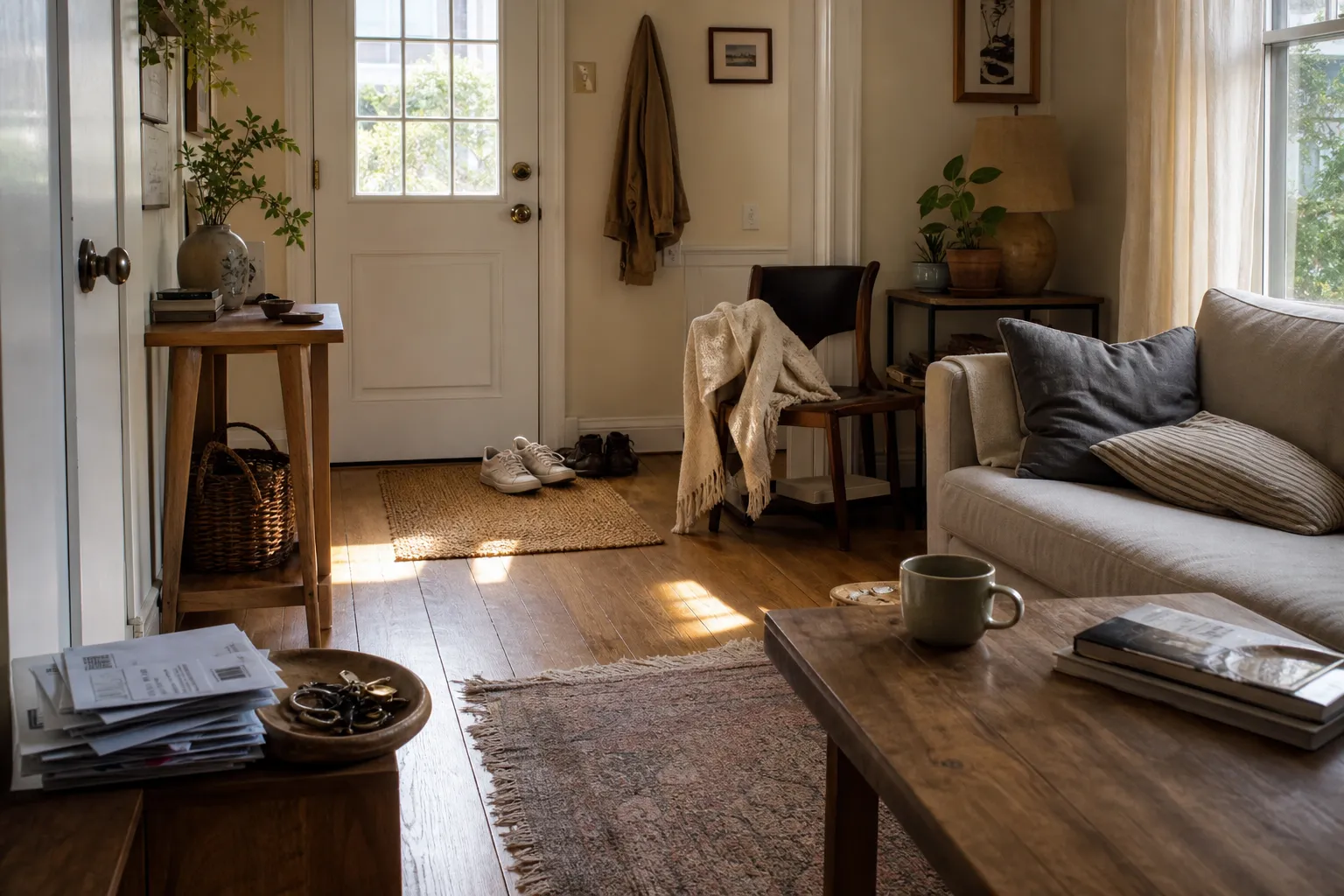
An entryway reset routine, for example, is not only about shoes. It is about the transition from public movement to home use. If bags, keys, umbrellas, mail, headphones, and reusable bottles all enter together, their return places need to sit near that route. A beautiful basket in another room may not help if no one naturally walks there.
Surface pressure
Some surfaces collect everything because they are horizontal, visible, and close to movement. Kitchen counters, dining tables, low tables, hallway consoles, bedside shelves, and desk corners often become temporary holding areas.
A surface reset works better when each surface has a narrow job:
- The dining table is for eating, work, tea, or conversation, not long-term paper storage.
- The kitchen counter is for food preparation and daily tools, not mail.
- The low table can hold a tray, cup, book, or remote, but not every object that passed through the room.
- The bedside surface should hold only what belongs to the end and start of the day.
This is not strict minimalism. It is protection for the working role of a surface.
Number of users
A one-person small apartment reset can be direct: one person chooses the object homes and follows them. Shared rooms need more negotiation. A “proper place” that makes sense to one person may feel inconvenient to another.
Shared routines work better when they name zones instead of blaming habits:
- “Work papers return to the right shelf before dinner.”
- “School bags go on the bench or hook, not the floor.”
- “Tea cups return to the kitchen before lights are lowered.”
- “Charging cables stay in the tray unless in use.”
The goal is not identical behavior. It is enough agreement that the room can recover after use.
Object frequency
Daily objects deserve easier homes than occasional objects. If keys are used every day, their return place should be more accessible than holiday table linens. If a throw is used every evening, it needs a basket, bench, or folded place close to the seating area.
A common mistake is hiding frequently used objects so thoroughly that the household resists returning them. The more often an item is used, the simpler its return path should be.
Material and care limits
A reset may involve wood, stone, ceramics, textiles, paper, or metal, but placement advice is not the same as material-care guidance. Unless you are following product instructions or reliable care information for that material, keep the daily reset plain: return, fold, hang where appropriate, and avoid treating every surface with the same product.
For this page, the focus is room usability and object return, not detailed cleaning chemistry or specialist care.
How to Make a 10 Minute Home Reset That Fits Real Rooms
A 10 minute home reset should follow the room’s movement, not an abstract checklist. Start where objects enter, move through the room in the same path people use, and end at the surface that most affects the next day.
Minute 1–2: collect visible wanderers
Pick up objects that clearly belong elsewhere: cups, plates, clothing, mail, books, chargers, toys, tools, receipts, or towels. Do not sort deeply. Make one pass.
Use a small tray, basket, or your hands. The point is to avoid turning this into a drawer-cleaning session.
Minute 3–4: return daily objects
Return the objects that already have homes:
- keys to a hook, bowl, or tray
- bags to a hook, shelf, or bench
- shoes to a rack or mat
- cups and dishes to the kitchen area
- remotes to a tray
- books to a shelf or reading stack
- laundry to a hamper or folding place
If an object has no return place, put it in a temporary decision area and note the need for one. Do not redesign the whole room during the reset.
Minute 5–6: clear the main surface
Choose the surface that changes the room most. In a kitchen, this may be the counter. In a living room, it may be the low table. In a bedroom, it may be the chair or bedside surface. In an entry, it may be the floor path.
A clear surface changes how the room functions. It makes the next activity easier to start.
Minute 7–8: reset textiles and seating
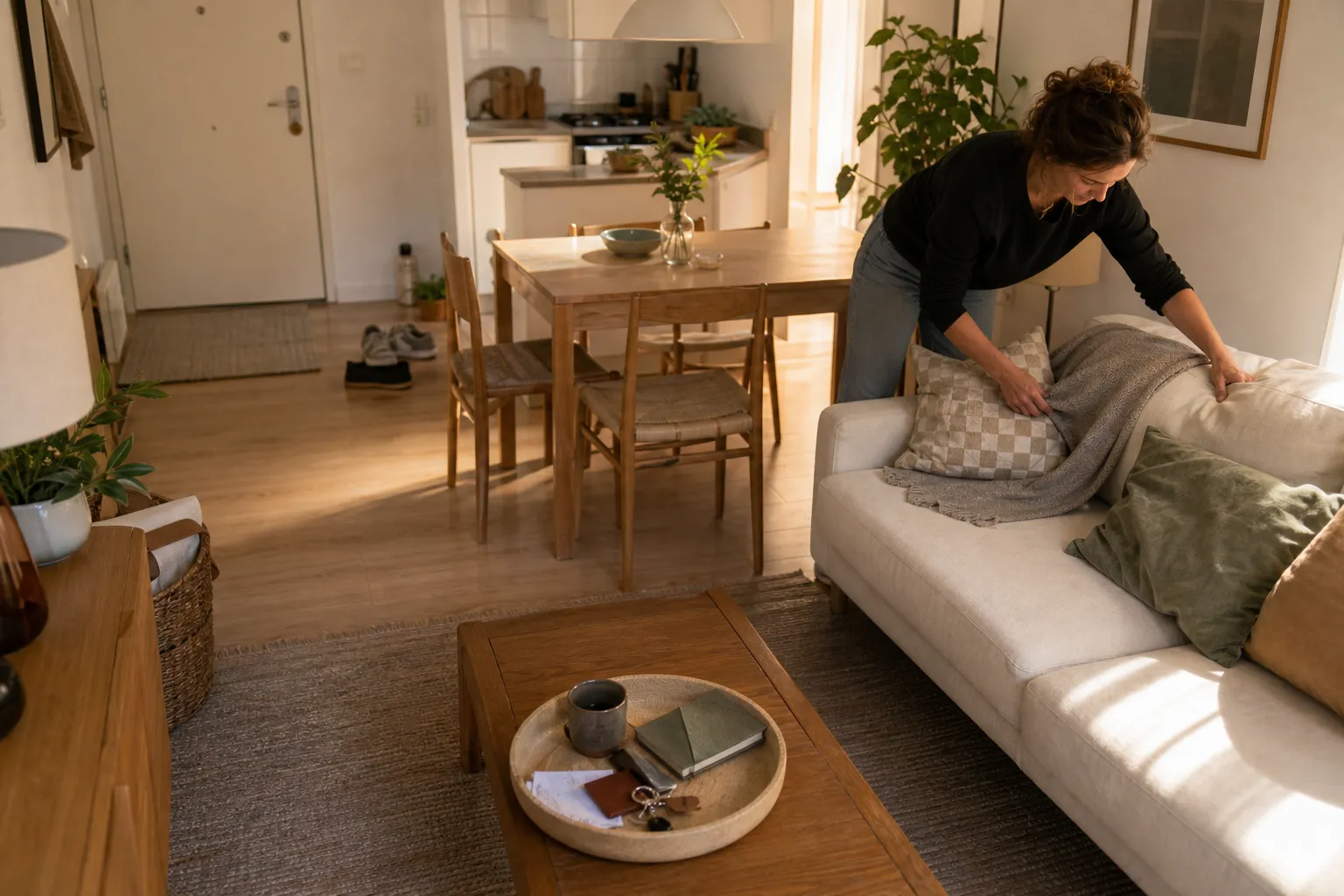
This is the visual part, but it is also practical. Cushions return to seats. Throws fold or drop into a basket. Towels hang. Bedding edges are pulled into place. Entry mats are straightened if they have shifted.
A daily textile reset should not become laundry management unless laundry is blocking the room. It is mainly about returning fabric items to a usable position.
Minute 9–10: prepare the next transition
End by asking what the room needs next:
- Morning: is the counter ready for breakfast?
- Evening: is the living room ready to sit in?
- Workday: are bags, keys, and shoes easy to leave with?
- Cooking: are tools back where they are used?
- Shared room: can the next person use the space without moving your things first?
The room is not reset for display. It is reset for use.
Evening Home Reset Routine for Counters, Floors, and Seating Areas
An evening reset works well for households where daytime use spreads objects across shared rooms. It does not need to be long. It should focus on the areas that affect morning and the next evening.
Kitchen closing routine for clear counters
A kitchen closing routine may include returning tools, grouping dishes for washing or loading, removing food packaging, placing cloths or towels where they belong, and clearing the counter that will be needed first in the morning.
Keep the aim narrow: clear usable counter space. Detailed appliance care, product use, and surface treatment depend on material and manufacturer guidance, so they should not be improvised as part of a general reset.
A helpful kitchen test is simple: Could someone prepare a drink or breakfast here without moving unrelated objects first?
Living room reset at the end of the day
To reset a living room, start with the objects that do not belong there: dishes, clothing, mail, work items, and stray packaging. Then return the room’s own objects: remotes, books, blankets, cushions, coasters, floor pillows, or children’s items.
Seating areas look unsettled when they cannot be sat in. A living room does not need formal arrangement, but seats should be open, low tables should have space, and walkways should be clear enough for ordinary movement.
For a home with tea, reading, or quiet evening use, a small tray can help. It gives cups, a small cloth, a book, or a remote a visible boundary. The tray is not decoration first; it is a return place.
Floors and pathways
Floors are not just another surface. They are movement routes. Shoes, bags, cords, laundry, and stacked objects can make a room feel unfinished because they interrupt walking.
An evening floor reset can be limited to the main paths: entry to kitchen, sofa to doorway, bed to bathroom, desk to door. If the path is clear, the room often feels more settled even before deeper cleaning happens.
Morning Home Reset Routine Without Starting a Cleaning Project
Morning is not the best reset time for every household. Some homes are rushed; others are quiet. A morning routine should be small enough that it does not derail the day.
Use it to remove friction:
- Open the entry path.
- Put sleep-related items back where they belong.
- Move cups or water glasses to the kitchen.
- Hang towels.
- Place laundry in the hamper.
- Clear one counter or table zone.
- Check keys, bag, glasses, or transit items.
The morning version should not ask for perfection. Its value is in preventing yesterday’s objects from becoming today’s obstacle.
A good morning question is: What will bother us if it is still here tonight? Handle only those things.
How to Create Return Places for Objects You Use Every Day
Return places are the backbone of simple household routines. Without them, every reset becomes a new decision. With them, the movement becomes easier: pick up, return, clear, continue.
A return place should be:
- Near the point of use or transition. Keys near the door, not in a distant drawer.
- Visible enough for frequent objects. If something is used daily, hiding it too well may make return less likely.
- Limited in size. A tray, hook, shelf, basket, or shallow bowl works because it creates a boundary.
- Named by function. “Mail to review,” “daily bags,” “tea cloths,” “reading stack,” or “charging tray” is clearer than a vague catch-all basket.
- Easy for regular users. If children, guests, elders, or housemates use the zone, the return place should be obvious from the room’s layout.
Some objects need more than one acceptable home. A blanket may live on a sofa arm in winter and in a basket in summer. A laptop may belong on a desk during the week and on a shelf during meals. Household-specific placement is not a failure of order; it is how real rooms work.
The danger is the unbounded drop zone. One basket for “miscellaneous” can help for a day, but if it never gets reviewed, it becomes a hidden surface. Use temporary holding areas sparingly, and clear them on a separate cadence.
Small Apartment Reset Routine: Fewer Rooms, More Overlap
Small homes often become visually scattered faster because one surface may serve several roles. A table may be used for meals, work, folding laundry, and tea. A bedroom may also hold a desk. An entry may open directly into the kitchen or living space.
A small apartment reset routine should focus on role changes:
- Work table back to eating table.
- Sofa back to seating, not laundry storage.
- Bedside area back to sleep and morning use.
- Kitchen counter back to food preparation.
- Entry floor back to movement.
In a compact home, storage does not have to be abundant, but return places must be precise. Hooks, trays, shallow baskets, wall shelves, under-bench space, and lidded boxes can all help if they match actual use. The key is not adding containers; it is deciding what transition each container serves.
For small spaces, a useful rule is: reset the surface before the next role begins. Clear the table before eating. Clear the chair before dressing. Clear the counter before cooking. This prevents one activity from spreading into every other one.
Shared Home Reset Routine When People Use the Same Rooms Differently
Shared homes need routines that respect different habits while still protecting common rooms. A person who reads on the sofa, someone who works at the dining table, and a child who plays on the floor may all be using the room properly. The problem begins when one use blocks the next use.
Instead of making one person’s preference the universal rule, define room thresholds:
- The table must be clear enough for meals at a set time.
- The entry path must remain open.
- Shared seating should be available by evening.
- Personal projects return to a tray, shelf, or bin when not active.
- Mail has one review place, not every surface.
- Shoes stop at the entry zone.
This approach judges the room by function. A shared routine does not require every object to vanish. It requires the next person to be able to use the room without negotiating every item.
When disagreement appears, look for the missing return place. Many household conflicts over clutter are really conflicts over undefined storage, inconvenient routes, or surfaces doing too many jobs.
Common Misunderstandings About Daily Resets
Language around calm home habits can become inflated. For a practical home, it helps to separate useful routine design from promises that ask too much of a room.
A settled room does not have to be minimal
A room can be settled and still hold books, tea ceramics, textiles, baskets, plants, tools, and family objects. The question is whether the objects have a visible relationship to use and place. A bare room is not automatically easier to live in.
The same routine will not work for every home
Domestic routines are shaped by rooms, timing, household members, and transitions. A person who cooks nightly needs a different kitchen reset from someone who mostly prepares tea and simple breakfasts. A family entryway needs different return places from a single-person apartment.
Resetting is not the same as deep cleaning
A reset restores usability. Cleaning addresses dirt, residue, dust, and care needs. Mixing them makes the daily habit too large and often delays both.
More storage does not always solve scattered rooms
Storage helps only when it matches behavior. If the return place is far from the route, too hidden, too full, or unnamed, objects will keep landing on the nearest surface.
A routine should not remove all signs of life
A home that is used will show use. The aim is not to erase living, but to keep daily objects from blocking the room’s next purpose.
A Practical Decision Frame for Everyday Home Routines
If you want to build a routine that lasts, begin with one room and answer these questions.
- What is the room’s next job?
Cooking, eating, sleeping, leaving the house, reading, working, bathing, hosting, or resting? - Which surface most often prevents that job?
Counter, table, floor, chair, shelf, bed, entry bench, or low table? - Which objects keep landing there?
Name them specifically: keys, mail, cups, chargers, towels, bags, books, laundry, shoes. - Where should each object return?
Choose a close, clear, repeated place. - When is the lightest reset moment?
Morning, after dinner, before bed, after work, after school, or before leaving? - What is outside the daily reset?
Deep cleaning, laundry loads, repairs, material care, donation sorting, paperwork decisions, and seasonal storage may need their own time.
A settled room is built through these small decisions. Return the object. Clear the surface. Restore the seat. Open the path. Prepare the next transition. Then stop before the reset becomes a larger project.
That restraint is what makes the routine repeatable.