Materials, wear, and buying checks
Mala Beads and Symbolic Jewelry: Materials, Wear, and Buying Checks
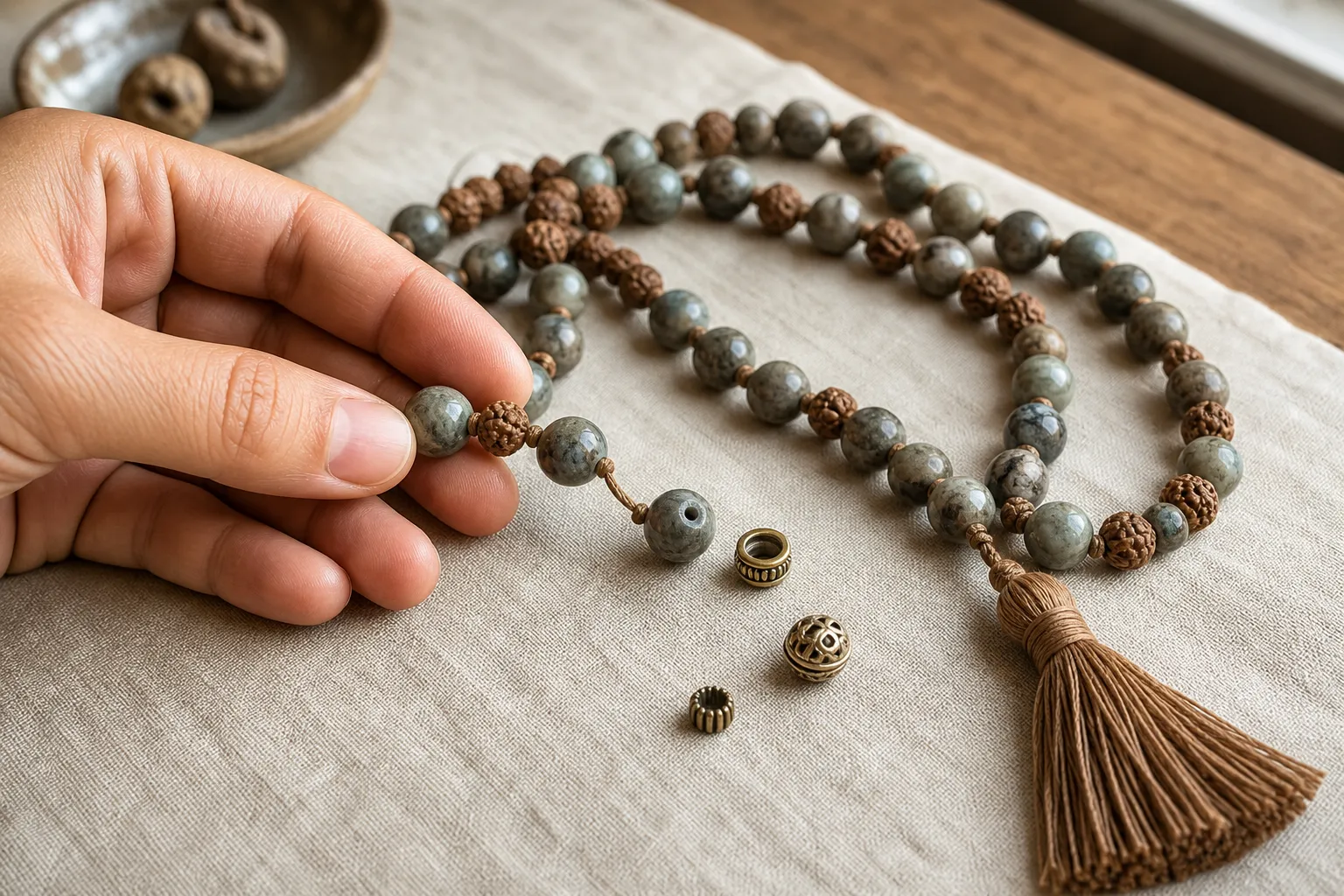
A bead strand can look simple in a photo and become complicated the moment you try to buy one: stone or seed, elastic or knotted cord, daily bracelet or occasional necklace, traditional form or modern keepsake. Mala Beads and Symbolic Jewelry sit in that overlap. They may carry cultural references, personal meaning, tactile appeal, and ordinary jewelry concerns at the same time.
The useful question is not whether a listing has the “right” mood. It is whether the materials, construction, seller description, and care needs match how you plan to wear the piece.
This guide treats mala beads and symbolic jewelry as wearable keepsakes. It acknowledges prayer-bead histories without turning tradition into a product promise, then returns to what a buyer can actually check: bead material, cord, metal parts, durability, cleaning, storage, and seller clarity.
broader context
Parent topic
Use the broader page when you need more context before this narrower page.
Why mala beads and symbolic jewelry get mixed up
“Mala beads” can point to several overlapping things:
- a traditional strand used for counting in Buddhist or Hindu contexts;
- a mala-inspired necklace or bracelet sold as symbolic jewelry;
- a seed, wood, stone, or glass bead strand worn as a personal reminder;
- a fashion piece using prayer-bead language in a loose marketplace way.
Museum and material-culture sources support the broad point that prayer beads have long histories in Buddhist and Hindu settings, and that bead forms and counts may carry specific meanings in those contexts. That does not make every modern bracelet with 18, 27, 54, or 108 beads the same kind of object. It also does not make a poetic seller description proof of authenticity, value, or outcome.
For a practical buyer, the distinction changes the questions. A traditional-use strand may deserve more attention to cultural context, naming, and handling. A modern symbolic bracelet can be judged more like jewelry: comfort, materials, durability, and whether the seller describes it honestly. A family keepsake or inherited strand may need gentler care than a new item bought for daily wear.
A useful rule: do not flatten every bead strand into decoration, and do not let symbolic language replace material facts.
Start with use: daily wear, occasional wear, or display
Before comparing mala bead materials, decide how the piece will live.
A daily bracelet has a harder job than a necklace worn occasionally. It rubs against desks, sleeves, soap, hand cream, sweat, bags, and door frames. It may be stretched repeatedly if it is elastic. A long strand worn over clothing has different pressure points: it can catch on buttons, swing against hard surfaces, or strain at the tassel and knot. A strand kept on a shelf or in a quiet display corner has fewer abrasion issues, but more dust, light, and storage concerns.
Use changes the answer more than symbolism does.
For daily wear, look for
- smooth bead holes with no sharp interior edges;
- tight but flexible stringing;
- knots that are even and not already loosening;
- metal components that are identified, not just called “premium” or “vintage”;
- bead surfaces without obvious flaking, chalkiness, sticky coating, or dye transfer;
- a seller description that explains what the beads are, not only what they represent.
For occasional wear, you may accept more delicate materials, a tassel, larger beads, or a softer finish, as long as you store the piece well and avoid unnecessary water exposure.
For display or memory-keeping, comfort matters less, but material stability matters more. Old glass, antique components, inherited metal charms, and deteriorated coatings should be handled carefully. Heritage-conservation research on damaged historical glass beads shows that old, unstable glass can be a special case. That does not make ordinary modern glass beads a concern, but visibly crumbling, crusted, or flaking antique beads should not be treated like new craft beads.
Bead material changes weight, feel, care, and durability
“Bead material” sounds plain, but it is the center of the buying decision. Stone, seed, wood, glass, ceramic, resin, bone-like substitutes, and metal all behave differently. Even within one category, there is variation.
Gem and jewelry care sources such as GIA emphasize that gemstones are not all equally durable and should not all be cleaned the same way. Hardness, toughness, porosity, coatings, dye, and setting method can affect how a bead tolerates water, abrasion, heat, and cleaners. That matters for mala beads because beads touch skin and clothing repeatedly, and many strands are not protected by metal settings.
Stone and gemstone beads
Stone beads feel cool, weighty, and visually steady. They can make a strand feel substantial, especially in larger sizes. But “stone” is not a single durability rating.
Seed, wood, and plant-based beads
Seed and wood beads often appeal to readers who like warmth, lightness, and natural texture. Names can be culturally meaningful without being botanically exact.
Glass, ceramic, resin, and composite beads
These materials can be beautiful, stable, precise, light, or affordable, but they should be named accurately so expectations match the object.
Stone and gemstone beads
Stone beads feel cool, weighty, and visually steady. They can make a strand feel substantial, especially in larger sizes. But “stone” is not a single durability rating.
Some stones tolerate ordinary wear better than others. Some are porous, coated, dyed, stabilized, or assembled from fragments. Turquoise is a useful example because research on turquoise treatments and imitations shows how many categories can sit behind one familiar name: natural material, treated material, reconstructed or pressed material, dyed look-alikes, synthetic products, or plastic imitations. A casual listing that says “turquoise gemstone” may not tell you which category you are buying.
For gemstone bead care, avoid assuming that water, ultrasonic cleaning, steam, alcohol, or household cleaners are suitable. A soft dry cloth is usually the least aggressive first step, but stone-specific rules should come from the seller or a reliable gem-care source. If a listing does not identify the material clearly enough for care, that is itself a buying signal.
Ask
- Is the bead natural stone, treated stone, reconstructed material, synthetic material, or imitation?
- Is it dyed, waxed, coated, stabilized, or filled?
- Will water, skin oils, or sunlight affect the color or surface?
- Are the beads individually knotted, strung on thread, wire, or elastic?
- If one bead chips, can the strand be repaired?
Seed, wood, and plant-based beads
Seed and wood beads often appeal to readers who like warmth, lightness, and natural texture. Ethnobotanical research on Bodhi beads in China is useful here because it shows that names can be culturally meaningful without being botanically exact. “Bodhi seed” does not always identify one plant species. In modern use, similar names may refer to seeds or fruits from various plants used for prayer beads or ornaments.
That matters in two ways. First, a name is not always a complete material description. Second, plant-based beads may respond to moisture, heat, skin oils, and dry storage differently from stone or glass.
Plant materials may darken, polish, dry out, absorb oils, or crack depending on the material and environment. Some wearers like the patina that comes from handling; others want the beads to remain visually unchanged. Neither preference is wrong, but it should be matched to the material.
Ask
- What plant or seed is named, if any?
- Is the seller using “Bodhi” as a broad style term or a specific material claim?
- Are the beads sealed, oiled, dyed, carved, or natural-surfaced?
- Should the strand be kept away from water, high heat, or very dry air?
- Are there cracks around the drill holes?
Glass, ceramic, resin, and composite beads
Glass and ceramic beads can be beautiful, stable, and visually precise, but they may chip if dropped or struck. Resin and composite beads can be light and affordable, yet they may scratch, cloud, or show seam lines depending on quality.
The buyer issue is not that these materials are inferior. It is that they should be named accurately. A glass bead sold as stone, or a resin imitation sold with vague gem language, creates a different expectation for weight, temperature, value, and care.
For symbolic jewelry, “looks like” is acceptable when clearly stated. “Dyed howlite in a turquoise color” gives you more useful information than “genuine turquoise bracelet” because it tells you what the bead actually is and how to judge the price and care.
Stringing, knots, tassels, and metal parts decide how long the piece works
Beads get attention; construction often decides whether the strand survives ordinary use.
A well-chosen bead on weak elastic may fail quickly. A durable stone with rough drill holes may cut through cord. A beautiful tassel may fray if it is worn under a coat every day. Metal spacers may discolor or irritate skin if their composition is unclear.
The available source set does not include long-term wear testing or repair-professional interviews, so it would be too strong to rank one stringing method as universally best. Instead, inspect the construction against the use you expect.
Cord and elastic
Elastic bracelets are easy to wear, but stretching is part of their daily life. Look for elastic that returns to shape and is not already gapping between beads. If you can see the cord thinning, fraying, or turning cloudy, treat that as a warning sign.
Knotted cord can give a strand flexibility and may keep beads separated, but knots should be even and snug. Loose knots near the guru bead, tassel, clasp, or charm can become failure points. Thread or cord should not be visibly cut by the bead holes.
Wire can be strong in some jewelry formats, but it changes the feel of mala-style strands and may kink if poorly finished. Check the ends, crimps, and clasp area carefully.
Drill holes and bead finish
A bead can look smooth on the outside and still have a rough drill hole. Look closely where the cord enters each bead. Uneven holes, sharp chips, powdery edges, or cracks radiating from the hole may shorten the life of the strand.
For coated, dyed, or painted beads, inspect edges and high-contact spots. Wear often appears first around holes, corners, raised carvings, and spacer contact points.
Metal jewelry components
Symbolic jewelry often includes charms, spacers, caps, clasps, pendants, bells, or small metal beads. These parts should not be afterthoughts. Seller descriptions should identify whether metal is solid, plated, filled, stainless steel, sterling silver, brass, alloy, vermeil, or another material. “Gold tone” and “silver tone” describe appearance, not metal content.
Plated and filled jewelry are not the same. Plating is a surface layer and may wear through, especially on high-friction areas. Filled material generally describes a thicker bonded layer than ordinary plating, though exact meaning and quality still depend on the product and jurisdiction. For a practical buyer, the question is simple: what is the base metal, what is the surface layer, and how should it be cleaned?
Seller description checks: translate feeling words into material questions
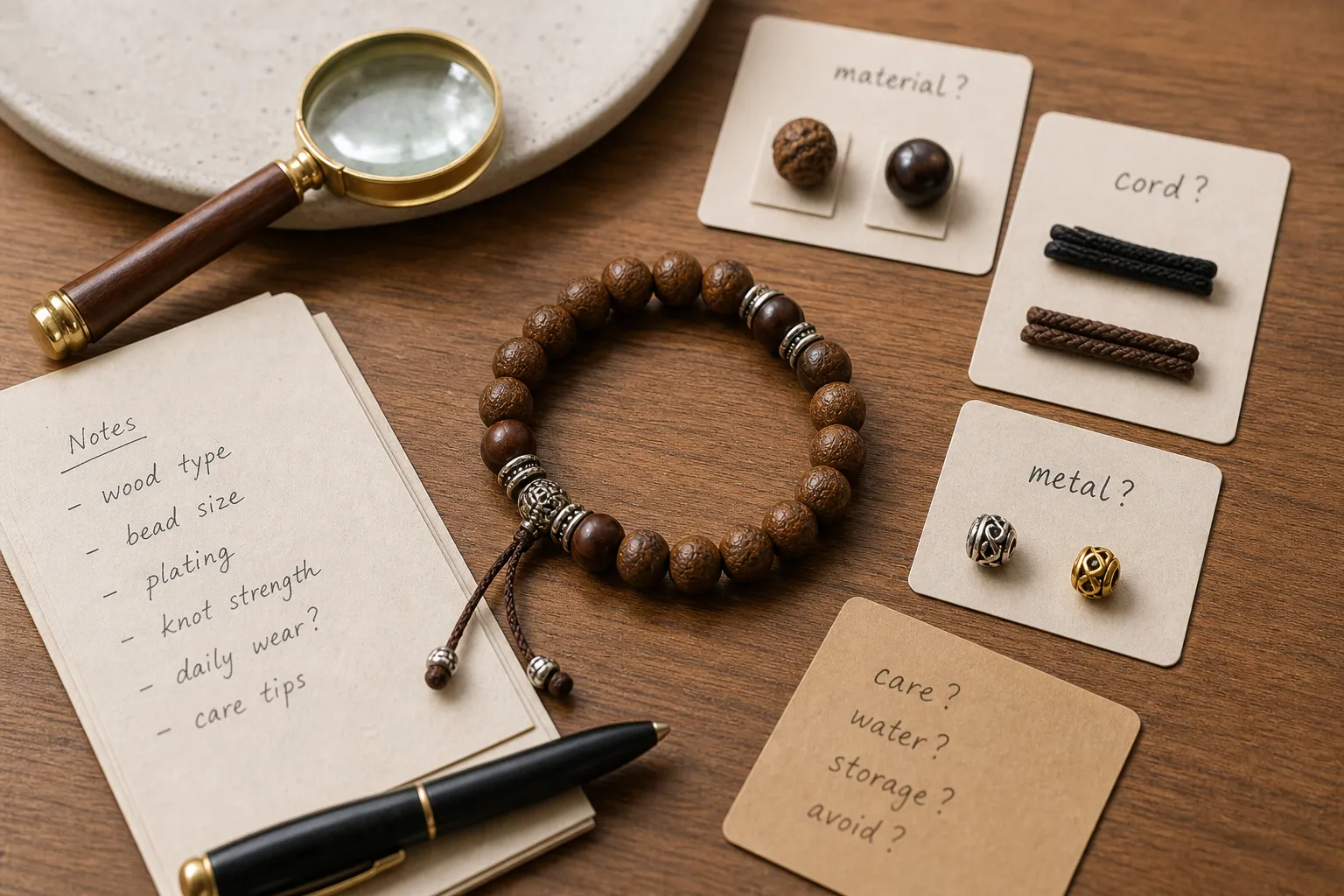
Marketplace language around mala beads and symbolic jewelry can be warm but imprecise. Some words describe appearance. Some describe tradition. Some describe a seller’s story. Some are material claims that should be verifiable.
FTC jewelry guidance in the United States is useful as a buyer-check framework because it emphasizes truthful, clear representations around jewelry materials, treatments, and imitations. This is not a legal compliance article; the practical lesson is that vague material language should lead to follow-up questions.
Use this table when reading a listing.
A clear seller does not need to answer every question poetically. They should be able to tell you what the beads are, what the metal parts are, how the strand is strung, whether the material has been treated, and how to care for it.
If the item is expensive, antique, or sold as a specific rare material, appearance alone is not enough. Scientific studies of gemstone treatments and cultural-heritage beads show that precise identification can require specialist methods. For ordinary buying, that does not mean every bracelet needs laboratory testing. It means seller certainty should match the evidence offered. A high-value claim deserves more than a flattering photo.
Cultural context without turning meaning into a product claim
Mala beads and prayer beads are not just bead strands with a nice rhythm. In Buddhist and Hindu contexts, bead counts, forms, materials, and handling may connect to specific practices and communities. That background deserves care, especially when a product borrows traditional language.
For a modern reader choosing symbolic jewelry, respectful handling can be plain:
- Do not assume all Buddhist and Hindu mala beads mean the same thing.
- Do not use a religious term only as decoration if the object is being marketed without context.
- If a strand is sold for traditional practice, look for a seller who explains the form soberly.
- If you are buying a mala-inspired keepsake, name it that way rather than overstating its role.
- Treat inherited or culturally specific objects with more care than trend jewelry.
Bead counts are a common source of confusion. Many readers search for bead counts meaning, especially around 108 beads. The available research supports the general idea that counts can carry traditional meaning, but exact explanations vary by tradition and context. If bead count matters to you for cultural reasons, verify it through tradition-specific sources rather than relying on a retail caption.
Symbolic jewelry meaning can still be personal. A bracelet may remind you of a trip, a family member, a season, a promise to slow down before tea, or a room corner where you keep meaningful objects. Those uses do not need exaggerated language. Personal meaning is enough.
Child-access cautions for metal parts and small components
Most adult mala beads and symbolic jewelry can be discussed through ordinary material and construction checks. Child access is a narrower issue and should not be inflated into alarm about all jewelry.
Consumer product safety sources, including CPSC materials, have highlighted cadmium concerns in children’s metal jewelry. The practical takeaway for this page is limited: if a piece has metal charms, spacers, beads, clasps, or pendants and a child may wear, handle, mouth, or pull at it, be more demanding about material identification and age suitability.
Also consider non-metal issues: small beads can detach, elastic can snap, clasps can break, and tassels can shed threads. A mala-style bracelet sized for an adult is not automatically suitable for a child because it is meaningful or handmade.
For homes with young children, store bead strands where they cannot be casually pulled down, chewed, or taken apart. If buying jewelry specifically for a child, use products intended for that use and check the maker’s material disclosures carefully.
Cleaning mala beads and storing symbolic jewelry
Cleaning mala beads should be gentle because mixed materials are common. A single strand may include stone beads, seed beads, thread, elastic, a tassel, metal spacers, and a charm. The most delicate component should set the cleaning method.
A cautious routine
- Dry wipe first. Use a soft dry cloth to remove surface dust and skin oils.
- Avoid soaking unless the material is known to tolerate it. Water can affect cord, tassels, wood, seeds, porous stones, coatings, and some metal finishes.
- Skip harsh cleaners. Household cleaners, alcohol, abrasives, steam, and ultrasonic methods are not universal jewelry care.
- Store pieces separately. Keep the strand in a soft pouch or small tray so harder beads and metal parts do not scratch softer surfaces.
- Let dampness clear before storage. If a piece has been worn against skin, let it air briefly before putting it in a closed box.
- Inspect high-stress points. Check knots, elastic gaps, tassel attachment, clasp loops, and bead holes.
For gemstone bead care, material-specific guidance matters. For seed or wood beads, avoid sudden moisture and heat changes unless the seller gives different care instructions. For plated or filled components, minimize rubbing and chemical exposure. For antique or visibly deteriorated glass beads, reduce handling and avoid aggressive cleaning; if the object has family or cultural importance, consider conservation-minded advice rather than ordinary jewelry cleaning.
Storage can be simple. A shallow tray near a dressing area works for pieces worn often. A cloth pouch suits travel. A box with separate compartments helps prevent harder stones or metal charms from abrading softer beads. Avoid leaving strands in direct sun, damp bathrooms, or tangled piles where tassels and cords are strained.
A practical buying frame
When a piece looks meaningful, slow the decision down with five checks.
1. Name the intended use.
Daily bracelet, occasional necklace, display object, practice strand, travel keepsake, or gift?
2. Identify the main material.
Stone, seed, wood, glass, ceramic, resin, metal, or mixed? If a gemstone name is used, is the treatment status clear?
3. Inspect construction.
Cord, elastic, knots, tassel, drill holes, clasp, spacers, and charm attachment all matter.
4. Read seller language literally.
“Tone,” “style,” “inspired,” “natural,” “authentic,” and “handmade” need specifics before they become useful.
5. Match care to the weakest component.
A durable bead does not make a delicate tassel waterproof. A strong charm does not protect weak elastic. A meaningful symbol does not replace clear material information.
A good wearable keepsake does not have to be rare or expensive. It should be understandable. You should know what it is made from, how it is put together, how to wear it without quickly damaging it, and how to clean and store it without guessing.
Mala beads and symbolic jewelry are easiest to choose when meaning and material are allowed to sit side by side. Let the symbolism make the object worth noticing. Let the bead material, construction, seller checks, and care needs decide whether it belongs in daily wear, occasional use, or a quiet place where it can last.