Lamp Placement Ideas for Softer Rooms
A room can have good furniture and still feel sharp at night. One corner goes black. The ceiling light feels too strong. A table lamp shines into your eyes. The TV catches a bright reflection. Useful lamp placement ideas start with those ordinary problems, not with a perfect design plan.
The main question is practical: where can a floor lamp or table lamp sit so the room has gentler background light, enough visibility for reading or tea, fewer reflections, and a cord route that does not fight the furniture?
The answer changes with the seat, shade, bulb, wall surface, outlet, and walking path. Softer light is rarely made by adding lamps at random. It usually comes from placing light where it can land well.
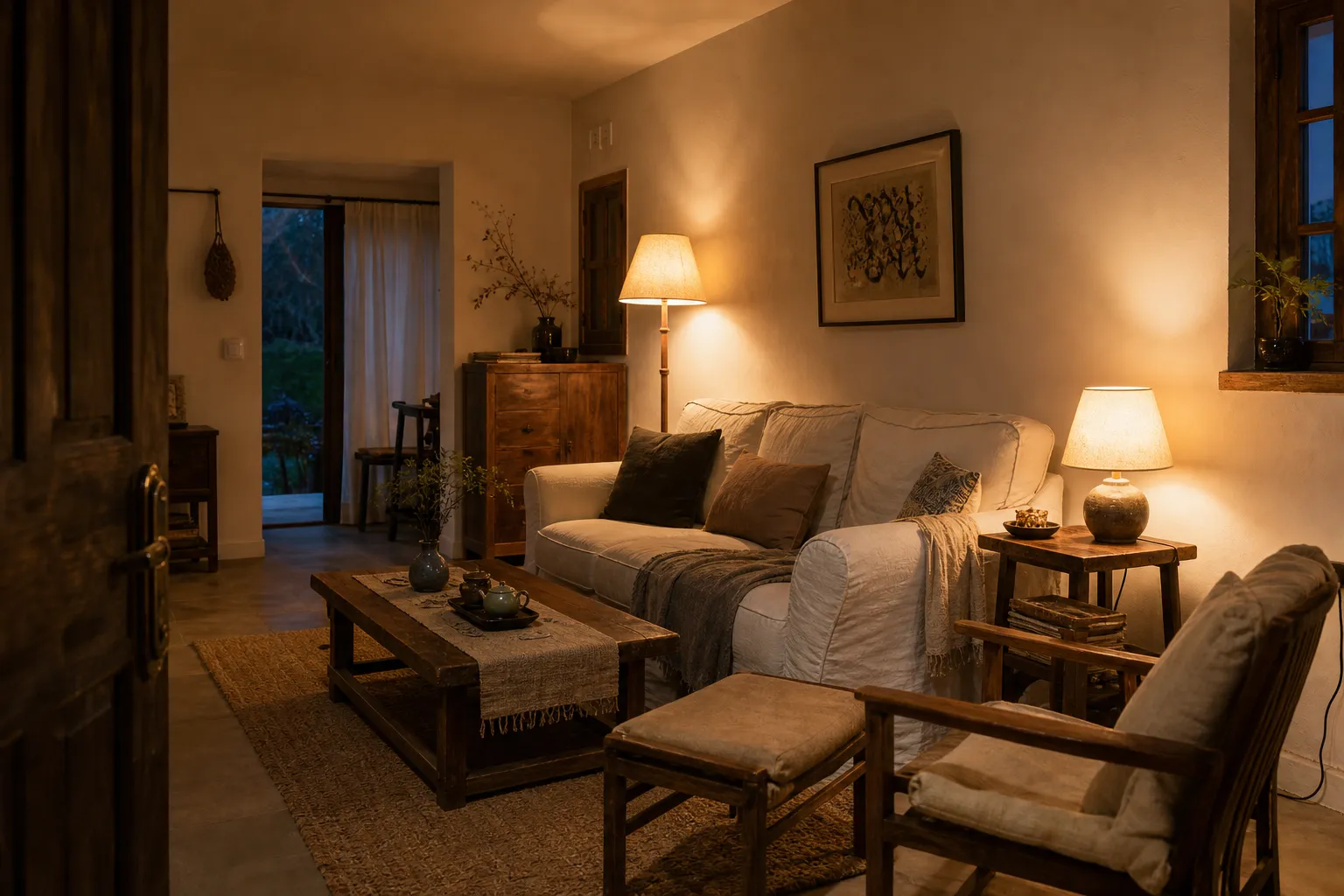
broader context
Broader context
Use the broader page when you need more context before this narrower page.
Start With the Lamp’s Real Job
Before moving a lamp, name what it needs to do. Lighting language often separates general room light, task light, and accent light. At home, those categories are easier to read this way:
Background glow
Light that makes the room visible without relying on a bright ceiling fixture.
Task light
Light for reading, writing, sewing, serving tea, sorting objects, or finding something on a side table.
Object or corner light
Light that lifts a shelf, plant, wall texture, ceramic piece, or quiet corner without trying to light the whole room.
Many poor arrangements happen because one lamp is asked to do all three jobs. A floor lamp behind a sofa may give a pleasant wall glow but fail as a reading light. A small table lamp beside a chair may help with a book but leave the opposite side of the room heavy and dark. A decorative lamp on a shelf may look beautiful while adding little useful light.
A good first pass is to stand in the doorway at night and ask:
- Where do people sit?
- Where do hands need light?
- Where is the bulb or bright shade visible at seated eye level?
- Where can the cord reach without crossing a walking path?
Domestic lighting research on exact plug-in lamp placement is limited, but observed-home studies do show lamps commonly placed around activity zones: beside sofas and armchairs, on shelves, near dining or work surfaces, and in corners. That matches what most real rooms ask for. Local lamps usually work best when they answer a real use first, then add atmosphere as a second benefit.
Floor Lamp Placement in a Living Room Without Glare
Floor lamps are useful because they bring light to a seat without rewiring the room. They also create problems when the bulb is too exposed, the shade sits at eye height, or the cord has to run across open floor.
For floor lamp placement in a living room, begin near the main seating, not in the empty center of the room. Useful positions include:
- beside a reading chair;
- just behind the front third of a sofa arm;
- between two seats that share a side table;
- near a dark corner where the shade can throw light onto two walls;
- behind a sofa when the lamp head, base, and cord all have enough clearance.
A floor lamp beside a chair is usually more useful than one far away in a corner if someone needs focused light. The lamp should light the page or object, not shine into the person’s eyes. If the shade is open at the bottom, check that the bulb is shielded from the seated line of sight. If the shade throws light upward, place the lamp near a pale wall or ceiling area so the room receives reflected light rather than a visible bright point.
A corner floor lamp can soften a room when the light lands on wall surfaces. Studies on light distribution and perceived spaciousness are not plug-in lamp formulas, but they support a useful home observation: light on walls, ceilings, and vertical surfaces changes how a room feels. In practice, a lamp that gently lights a wall often feels less harsh than a lamp aimed straight across the room.
When a Floor Lamp Behind a Sofa Works
Lamp placement behind a sofa can be calm and useful, but it has more conditions than it seems. Check:
- Sofa clearance: the lamp should not be crushed between the sofa and wall.
- Shade height: the bulb should not be visible over the sofa back from common seats.
- Reach: switches should be accessible without awkward leaning.
- Cord path: the cord should reach an outlet without being pinched or stretched across a walkway.
- Wall reflection: if the wall behind the sofa is glossy or mirror-like, test for glare before settling the lamp there.
Behind-sofa placement is strongest when the lamp creates a wall glow or supports reading at the sofa end. It is weaker when the lamp becomes only a tall object trapped in a narrow gap.
Table Lamp Arrangement: Side Tables, Low Tables, and Uneven Rooms
Table lamps sit close to hands, cups, books, and the edges of daily life. Because of that, table lamp arrangement is less about matching pairs and more about height, shade, surface, and balance.
On a side table, the shade should feel connected to the seat. If the lamp is too short, it may light only the tabletop. If it is too tall or has a bright exposed opening, it may shine into the face of someone seated nearby. Sit where you normally sit and look toward the lamp. If your eye catches the bulb or a very bright inner shade, adjust the lamp, shade, bulb, or position.
For table lamps on side tables, consider:
- keeping the shade near a height that lights the lap, book, or cup area;
- leaving room for a mug, book, glasses, or small tray;
- avoiding a base so large that the table becomes unusable;
- checking whether a glossy tabletop reflects the bulb;
- using one table lamp as task light and another as background glow instead of forcing both to match.
A room can feel uneven when all lamps sit on one side. Symmetry is not the only solution. Two lamps in one room can differ if they share something: similar shade softness, related height, compatible bulb appearance, or a visual relationship to the furniture. One lamp may sit on a side table by the sofa while another stands near a corner or low cabinet. The room often feels calmer when the pools of light relate to how the room is used, not when every object is mirrored.
Low Tables and Tea Areas
A low table or tea area asks for restraint. A lamp placed too close to a low reflective surface can make cups, glazed ceramics, lacquered trays, or polished wood throw small bright reflections. Instead of placing the lamp directly beside the table, try moving it slightly to the side, behind the seating line, or near a wall where the shade can soften the light before it reaches the surface.
For tea, reading, or quiet conversation, the lamp does not need to flood the whole room. It needs to make hands and objects visible while keeping the bright source out of the direct view of seated people.
Should Lamps Go in Corners or Beside Seating?
Corners and seating areas solve different problems.
A lamp in a dark corner is useful when one side of the room disappears at night. It can lift the wall, show texture, and reduce the contrast between a bright seating area and a black edge. A corner lamp works especially well when the shade sends light sideways or upward, and when nearby surfaces are matte enough not to glare.
A lamp beside seating is useful when someone needs light for a clear activity. If you read in one chair every night, the lamp belongs near that chair before it belongs in the most photogenic corner. Observed domestic lighting patterns support this practical habit: local light tends to gather where local seeing happens.
A good compromise is to place a floor lamp just off the seating area but close enough to catch a wall. For example:
- beside a chair angled toward the corner;
- behind the sofa end, with light aimed upward or onto the wall;
- between a chair and a shelf, so the lamp supports both reading and background glow;
- near a plant or textured wall, as long as leaves and surfaces do not block the useful light.
The weak compromise is a lamp too far from the seat for reading and too exposed for softness. If the lamp does neither job well, move it closer to one purpose.
Lamps Without Ceiling Light: How Many Does a Small Living Room Need?
When you do not want to use the ceiling light, a small living room usually needs more than one source, but not necessarily many. The better question is: how many separate light zones does the room need?
A compact room may work with:
- one floor lamp near the main seat for reading or handwork;
- one table lamp on a side table, shelf, or low cabinet for background glow;
- one small accent or shaded lamp only if there is still a dark corner, entry point, or tea area that feels cut off.
For soft lighting in small living rooms, two well-placed lamps often do more than three poorly placed ones. If both lamps sit at the same height on the same side of the room, the opposite side may still feel flat. Try varying height and direction: one lamp near seating, one lamp catching a wall or shelf, and one lower lamp only if it has a clear reason.
Bulb choice changes the result. ENERGY STAR consumer guidance treats brightness and color appearance as important bulb characteristics, and that matters for placement. A lamp that feels gentle with one bulb may feel glaring with a brighter or cooler-looking bulb. Before buying another lamp, test whether the existing lamp needs lower output, a different shade, or a position that hides the bright source.
More lamps are not always the answer. More visible bulbs can create more glare, more cords, and more clutter. Softer light comes from controlled placement, shaded sources, and useful reflection.
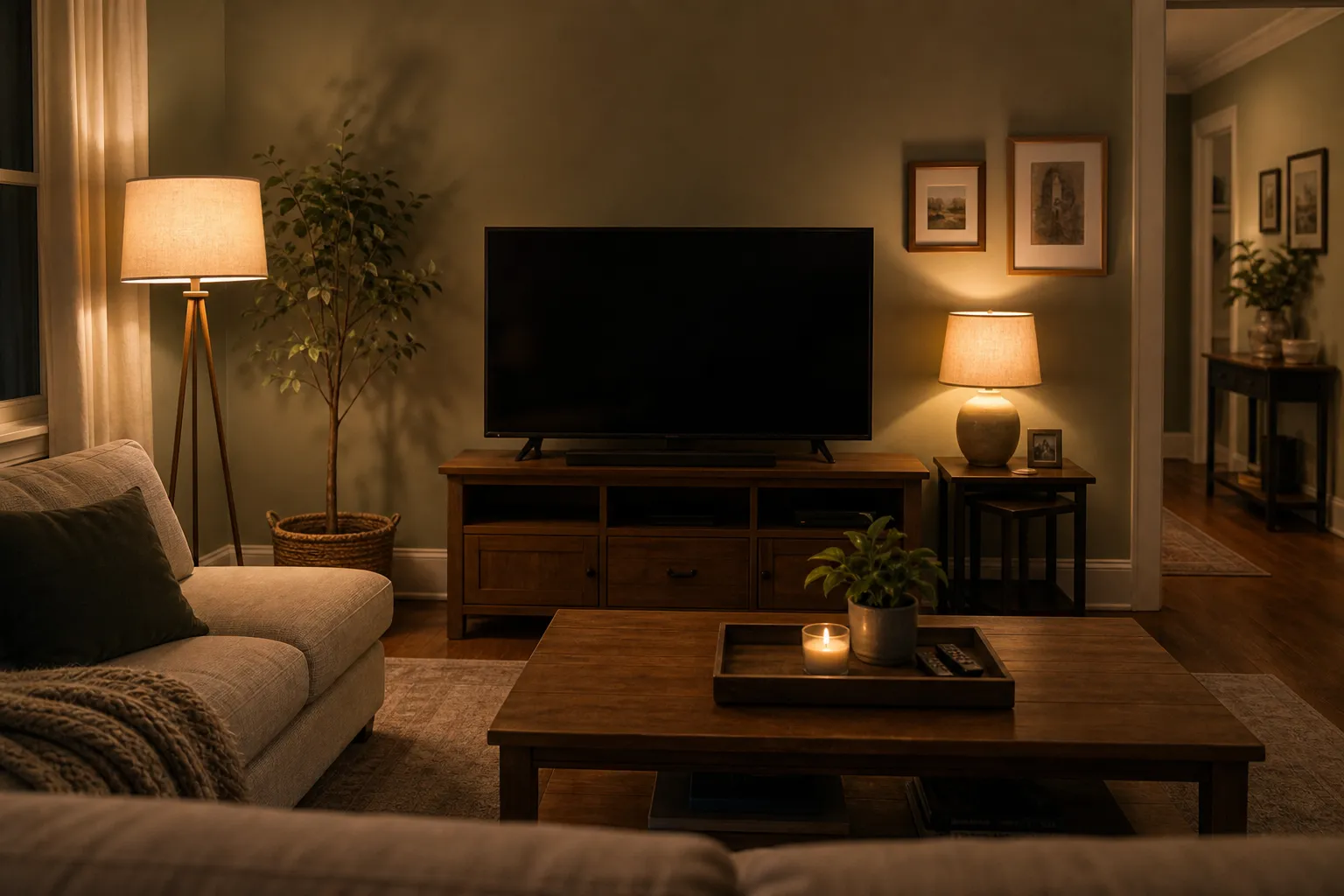
How to Place Lamps Around a TV Without Screen Glare
Lamps around a TV need special attention because screens reveal placement mistakes quickly. A lamp may look fine from the doorway but appear as a bright shape on the screen from the sofa.
Test the lamp from the actual viewing seat. Turn the TV off or show a dark scene, then look for reflected bulbs, pale shades, shiny bases, or bright wall patches. The problem may not be the lamp itself; it may be the angle between the lamp, the screen, and the viewer.
Better positions for lamps around a TV often include:
- a shaded table lamp to the side of the seating area, not directly opposite the screen;
- a floor lamp behind or beside the sofa with the bulb hidden from the screen angle;
- a lamp near a side wall that gives background glow without reflecting in the display;
- a low-output shaded lamp on a console only if it does not reflect as a bright spot.
Be careful with lamps placed directly beside or behind the TV. A small glow near the wall can reduce the contrast between a bright screen and a dark room, but a visible bulb or shiny shade can be distracting. Keep the source shielded, check the screen from all common seats, and avoid polished objects that bounce light back toward the viewer.
Bedroom Lamp Placement Without Crowding the Nightstand
Bedroom lamps need to support ordinary actions: reading, setting down a cup, finding glasses, moving around the bed, and keeping the nightstand usable. The best bedside lamp placement is often less about style and more about reach.
A bedside table lamp should be easy to switch on and off from bed. It should leave room for the objects that actually live on the nightstand. If the table is small, a narrow lamp base, wall-adjacent placement, or a floor lamp beside the nightstand may work better than a broad decorative lamp.
Check these points:
- Can you reach the switch without sitting fully up?
- Does the shade shine into the eyes of the person lying down?
- Is there enough space for a book, cup, phone, or glasses?
- Does the cord fall behind the table without being pinched?
- If there are two lamps, do both people need the same height and brightness?
Matching bedside lamps can look settled, but they are not required. If one person reads and the other does not, two different lamps may make more sense. Keep the arrangement visually related through shade material, bulb appearance, or scale rather than forcing identical lamps where they do not serve the room.
Cord Placement Ideas That Keep the Room Quiet
Cord planning is not the decorative part of lamp placement, but it often decides whether an arrangement is workable. ESFI guidance on extension cords is a useful guardrail here: outlets, overloading, damaged cords, and poorly routed cords should not be treated casually. For a practical home arrangement, choose the lamp location with the outlet in mind before you settle on the visual effect.
Good lamp cord placement ideas are quiet because they are simple:
- place lamps near existing outlets when possible;
- run cords along wall edges rather than across open walking paths;
- avoid routing cords under rugs or through doorways;
- do not pinch cords tightly behind heavy furniture;
- keep cords away from chair legs, bed frames, and sofa mechanisms that may press or rub;
- use cord covers or furniture placement only when they do not hide a problem.
Extension cords should not become a permanent design strategy for a lamp that really belongs near another outlet. If a lamp only works by stretching a cord across a room, the placement is probably wrong. Choose a nearer lamp position, a different lamp type, or a simpler arrangement. For persistent outlet or wiring problems, bring in qualified electrical help rather than designing around the problem with longer cords.
A calm room is not only a room with warm light. It is also a room where the path from seat to table to doorway remains clear.
A Simple Walkthrough for Softer Light
If the room feels harsh, dim, or uneven, work through the lamps in this order.
1. Turn off the ceiling light and read the room
Look for the darkest corner, the brightest glare point, the least useful seat, and the surface that reflects the most light. This shows whether the room needs background glow, task light, or glare control.
2. Place the first lamp by the main activity
If the activity is reading, put the lamp beside the chair or sofa end. If the activity is tea, place the lamp so it lights hands and objects without bouncing off the tabletop. If the activity is conversation, avoid putting the bright source behind someone’s head or directly in another person’s eyes.
3. Use a wall or corner for the second layer
Let the next lamp catch a wall, shelf, or corner. This helps the room feel less divided between one bright pool and one dark edge.
4. Sit down and check eye level
Many lamps look good while standing and fail while seated. Sit in the real positions: sofa, chair, bed, floor cushion, or low table. If the bulb is visible, the shade interior is too bright, or the lamp reflects in a screen, adjust.
5. Check the bulb before adding another lamp
A different bulb output or color appearance can change the placement. If the lamp is too sharp, a softer shade or lower brightness may solve the issue. If the room is too dim for a task, moving the lamp closer may work better than increasing brightness across the whole room.
6. Approve the cord route last
A lamp that needs an awkward cord path is not a settled placement. The final test is not only “Does it look soft?” but also “Can people walk, sit, clean, and use the furniture without working around the cord?”
Common Misreads About Softer Lamp Placement
Soft light does not always mean dim light. A room can be dim and still uncomfortable if one exposed bulb sits in the line of sight. Another room can be brighter but gentler because the light is shaded, reflected, and spread across walls or surfaces.
Table lamps do not always need to match. Matching can help a formal room, but in a lived-in room, usefulness matters more. Two lamps can belong together through proportion, shade texture, or similar bulb appearance.
Corners are not automatically better than seating areas. Corners are good for background glow. Seating areas are better for reading and object handling. The softer arrangement often uses both, while giving each lamp one clear job.
A new purchase is not always the first fix. Often, the first improvements are free: rotate the shade, move the lamp a few inches behind the seated line of sight, shift it away from a TV reflection, pull it closer to the chair, or stop using a cord path that makes the room feel unsettled.
FAQ
Where should a lamp be placed in a living room?
Start near the main activity: beside a sofa, next to a reading chair, on a side table, or near a dark corner that needs wall glow. Then check seated eye level, screen reflections, and the cord route.
Is a floor lamp better beside a chair or in a corner?
Beside a chair is usually better for reading or handwork. A corner is better for soft background light. If possible, place the lamp near seating but close enough to a wall or corner to catch some reflected light.
How do I use two lamps in one room without matching everything?
Let the lamps share one visual link, such as similar shade softness, related height, compatible bulb appearance, or similar scale. They do not need to be identical if each lamp supports a different part of the room.
What is the easiest way to reduce glare from a lamp?
Sit in the normal seat and look for the visible bulb, bright shade interior, TV reflection, or glossy tabletop reflection. Then move the lamp, turn the shade, lower the bulb output, or place the lamp where a wall softens the light before it reaches your eyes.