home / zen spaces / The Engawa Effect: Blurring Lines with Nature

The Engawa Effect:
Blurring Lines with Nature

Modern homes are brilliant at keeping us safe, but they often insulate us from the gentle sensory inputs our bodies need to thrive.

By 2026, we have perfected indoor comfort. Our spaces feature stable temperatures, filtered air, and perfectly flat floors. While this protects us from the elements, it also puts our proprioceptive systems and circadian rhythms into a state of sensory hibernation. We evolved to interact with the natural world, and a completely static environment can lead to invisible cognitive fatigue. Fulfilling the biological need for nature through "Engawa" architecture is about strategically reintroducing this vital "sensory friction" back into our daily lives.

When we explore Indoor Outdoor Living Design, the goal isn't necessarily to tear down your walls or undertake a million-dollar renovation. True Nature Connection in a Biophilic Home is about intention. The traditional Japanese Engawa—a liminal wooden porch sheltered by eaves—serves as our master blueprint. It acts as a buffer zone, blending the safety of the interior with the dynamic stimuli of the exterior. By understanding *why* the Engawa works on our nervous system, we can extract its principles and apply them to any space, from a sprawling architectural build to a modest urban apartment.

01 — Spatial Dynamics

The Anatomy of the Threshold

"The Engawa provides the safety of a shelter while granting the nervous system the rich data of the wild."

To understand how to recreate the Engawa effect, we first must understand the three distinct zones of human habitation. Moving from the core to the exterior changes the thermal, acoustic, and tactile data our brains receive. Click the zones below to see how our bodies respond to each layer.

🛋️

Core

Stable Zone

🚪

Engawa

Transition

🌿

Exterior

Wild Zone

Sensation: Consistent & Predictable

The Protective Core

This is where we retreat to focus, sleep, and feel secure. The flooring is smooth, the temperature is controlled by thermostats, and the lighting is even. This environment is highly efficient for productivity and baseline survival.

However, because there is no variance, the body goes into "autopilot." The feet don't have to navigate textures, the skin doesn't have to react to breezes, and the eyes maintain a static focal length. While essential for comfort, spending 95% of our lives in this zone can lead to a feeling of disconnection and lethargy. The core keeps us safe, but it doesn't stimulate recovery.

Sensation: Gentle Friction

The Liminal Buffer

This is the magic of the threshold. Historically a wooden strip of flooring facing the garden, the Engawa acts as a literal and psychological bridge. You are sheltered by a roof, but exposed to the air.

When you step onto an Engawa, you experience "gentle friction." The floor might be slightly cooler, forcing blood circulation. You hear the rustle of leaves (Biophilic sound), which naturally masks the hum of appliances inside. The light is dynamic, shifting with the clouds. This zone softly asks your nervous system to wake up and adapt, providing the restorative benefits of nature without the harshness of full exposure.

Sensation: High Intensity

The Uncurated Wild

Past the eaves lies complete exposure. The ground is uneven, the sun can be glaring, and the temperature is entirely out of your control. This zone provides the richest sensory data possible—vital for our circadian rhythms and immune systems.

Yet, it can be too intense for sustained modern life. We cannot comfortably read a book in a downpour or work in direct midday sun. The genius of the Engawa is that it allows us to "borrow" the visual and auditory beauty of this wild zone, safely framing it for our enjoyment while protecting us from its extremes.

Reality Check: Why "Hacking" is Often Smarter

"The multi-million dollar architectural Engawa is breathtaking, but it comes with a physical tax. You don't need to rebuild your home to capture its essence."

1. The Hidden Costs of the Architectural Ideal

When browsing architectural magazines, we often see breathtaking, zero-threshold sliding glass walls that open an entire living room to a pristine forest. It looks perfect, but as evidence-based designers, we must share the reality: this level of architectural integration is a structural and logistical heavy lift.

Real, unsealed timber—the kind that smells wonderful and feels textured underfoot—requires significant maintenance. It must be oiled regularly, or it will grey and splinter. Massive sliding glass doors have floor tracks that inevitably collect leaves, dust, and insects, requiring constant cleaning. Furthermore, opening a 20-foot wall to the outdoors introduces thermal bridging, meaning your heating and cooling bills will noticeably increase.

2. The Empowering Pivot: Principles over Floorplans

We share these risks not to discourage you, but to empower you. **You are not failing if you cannot afford a massive structural renovation.** The physiological benefits of the Engawa do not come from the expensive glass doors; they come from the *sensory variance* the space provides.

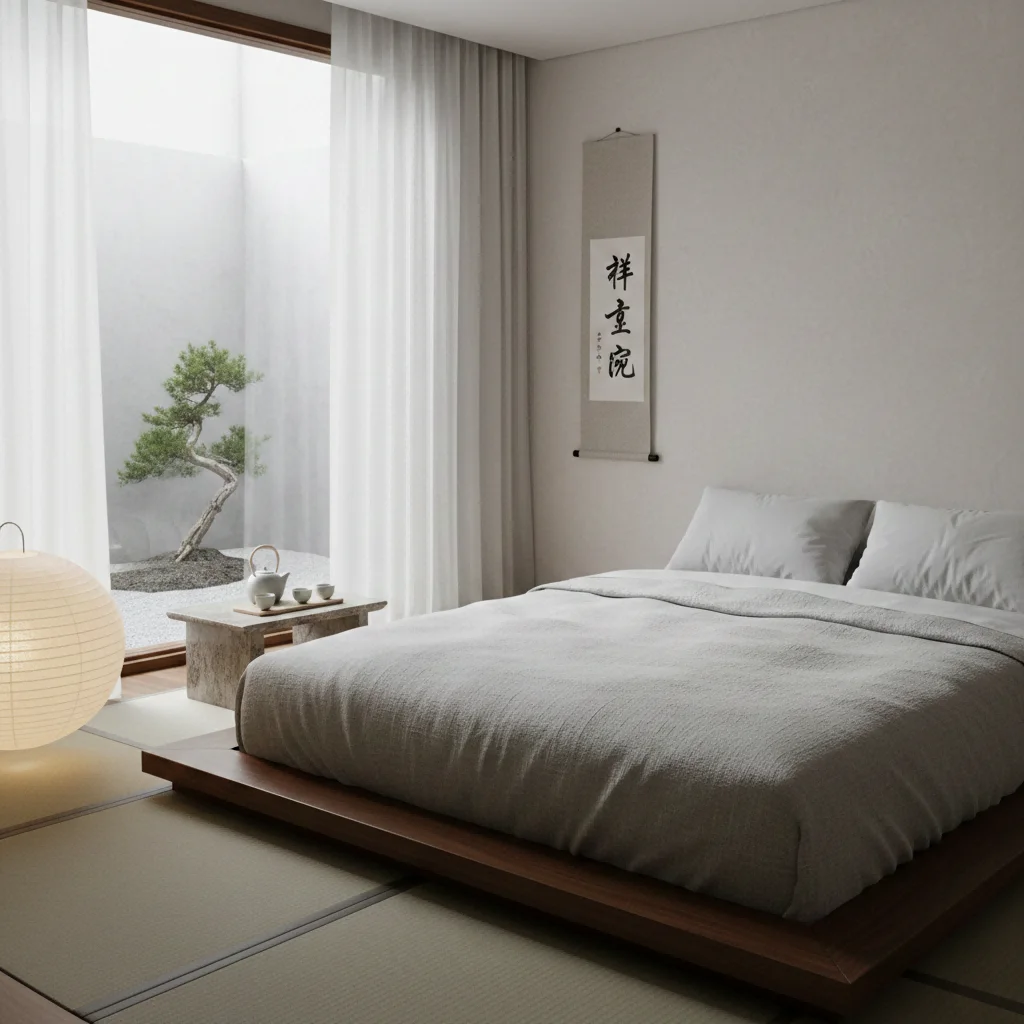
If you understand that your body simply needs a slight drop in temperature, a change in texture underfoot, and the visual complexity of a plant to feel "connected," you can engineer this experience in a 600-square-foot apartment. The Engawa is a mindset of transition. A well-placed tactile rug, an open window, and a clustered group of plants can simulate the exact same neurological down-regulation as a high-end architectural build.
02 — Visual Bandwidth

The Comfort of Fractals

"Looking at nature is like a massage for the optic nerve."

Our modern environments are filled with Euclidean geometry: straight lines, flat screens, and sharp corners. Processing these shapes requires active cognitive effort. In contrast, nature is built on Fractal Patterns—repeating, self-similar shapes like the branching of a fern, the veins of a leaf, or the edge of a cloud.

Because the human vascular and neural systems are also fractal, our brains process these natural shapes with almost zero effort. This creates a state of "Soft Fascination," giving our overworked executive function a much-needed rest.

The Science of Borrowed Scenery

The Engawa utilizes Borrowed Scenery (Shakkei). Whether framing a majestic mountain or simply the canopy of a balcony potted plant, placing nature in our peripheral vision actively lowers stress. The chart demonstrates how exposure to these transition zones aids in the natural down-regulation of physiological stress markers (like cortisol) compared to remaining in a static, windowless room.

Physiological Support Trajectory

Observed Cortisol Down-Regulation (nmol/L)

Static Interior
Threshold Exposure

*Data indicates environmental support for relaxation, not a medical cure.

03 — Actionable Solutions

The Accessible Sanctuary Builder

You don't need to rebuild your house to blur the lines with nature. Here are scalable, low-cost "Micro-Interventions" that hack the sensory principles of the Engawa. Toggle the habits and additions below to see how easily you can increase your daily nature connection.

Connection Achieved

0 Engagement %
Currently: Baseline Environment. You have the opportunity to introduce gentle sensory variety.